Best ASVAB Scores for Army Intelligence MOS Jobs
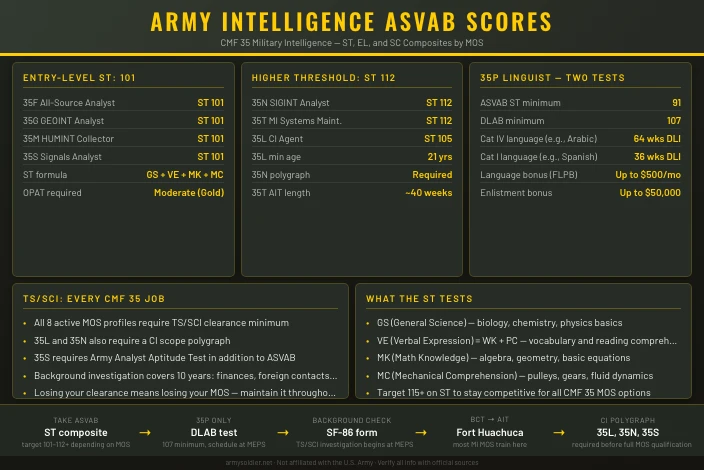
No other Army career field uses as many different ASVAB composites, secondary tests, and additional screening requirements as CMF 35 Military Intelligence. One MOS demands only a 91 on the Skilled Technical composite. Another demands 112. A third skips the composite entirely and adds a foreign language aptitude test on top of the ASVAB. If you want a job that literally requires you to be smart before they let you in the door, intelligence is it.
Why CMF 35 Has the Most Varied Requirements in the Army
Most Army career fields lean on one composite. Infantry needs CO. Maintenance jobs need MM. The intelligence field is different because it covers completely different kinds of work under one career management field.
Recommended study resource: An ASVAB study guide with full-length practice tests and section-specific tutorials helps you target the ST composite specifically, which is what every CMF 35 MOS uses.
When you purchase through links on our site, we may receive compensation at no extra cost to you.
Analyzing satellite imagery, interrogating detainees, intercepting radio signals, translating Arabic phone calls, and repairing classified servers are all CMF 35 jobs. The analytical work requires verbal and quantitative aptitude. The technical jobs need electronics and mechanical reasoning. The linguist job adds a separate exam entirely. That range is why the ASVAB floor varies by 21 points across the field and why some jobs stack three or four screening requirements on top of the basic ASVAB.
The composite used across every single CMF 35 MOS is the Skilled Technical (ST), which adds together your General Science, Verbal Expression, Math Knowledge, and Mechanical Comprehension subtest scores. The Army designed this composite to measure the kind of analytical thinking that intelligence work demands. But what you need on that composite depends on the job.
ASVAB Line Scores by MOS
The table below lists every active CMF 35 enlisted MOS, its required ST score, and any additional tests or entry requirements beyond the standard ASVAB.
| MOS | Title | ST Score | Additional Requirements |
|---|---|---|---|
| 35F | All-Source Intelligence Analyst | 101 | TS/SCI clearance |
| 35G | Geospatial Intelligence Imagery Analyst | 101 | TS/SCI clearance; normal color vision |
| 35L | Counterintelligence Agent | 105 | TS clearance; CI polygraph; minimum age 21 |
| 35M | Human Intelligence Collector | 101 | TS/SCI clearance; DLAB 100+ recommended |
| 35N | Signals Intelligence Analyst | 112 | TS/SCI clearance; CI scope polygraph |
| 35P | Cryptologic Linguist | 91 | TS/SCI clearance; DLAB 107 minimum; CI scope polygraph |
| 35S | Signals Acquisition/Exploitation Analyst | 101 | TS/SCI clearance; Army Analyst Aptitude Test; CI scope polygraph |
| 35T | MI Systems Maintainer/Integrator | 112 | TS/SCI clearance; Moderate OPAT |
A few things stand out in this table. 35N and 35T both require ST 112, which is among the highest enlisted ASVAB thresholds in the entire Army. 35P requires the lowest ST score in the field, but it compensates with a 107 minimum on the Defense Language Aptitude Battery, a separate test that many candidates fail. 35L adds a minimum age of 21 – rare for enlisted jobs. And 35S is the only MOS that requires a separate aptitude exam beyond the ASVAB and the clearance polygraph.
The ST composite formula is: GS + VE + MK + MC
- GS (General Science): biology, chemistry, Earth science, physics principles
- VE (Verbal Expression): a computed score from Word Knowledge and Paragraph Comprehension
- MK (Math Knowledge): algebra, geometry, basic equation-solving
- MC (Mechanical Comprehension): pulleys, gears, hydraulic systems, simple machines
A 101 puts you roughly in the top 30 percent of ASVAB takers on this composite. A 112 is closer to the top 15 percent. Neither is impossible, but both reward deliberate preparation.
The Clearance Reality
Every CMF 35 MOS on the list above requires a Top Secret security clearance. Most require full TS/SCI – the highest clearance level in the enlisted force. This is not a technicality. It is the actual gating factor for most applicants who have the ASVAB score but still don’t qualify.
The background investigation reviews roughly the past 10 years of your life: finances, criminal history, drug and alcohol use, foreign contacts, and personal conduct. It interviews your references, neighbors, and coworkers. It checks court records and credit reports.
What commonly derails clearances:
- Unpaid debt or a history of financial irresponsibility
- Undisclosed foreign contacts or family members in certain countries
- Drug use (even marijuana, even in legal states, even disclosed upfront)
- A criminal record that includes any conviction beyond minor traffic violations
- Inconsistencies between what you self-report on the SF-86 form and what investigators find
Certain MOSs add a Counterintelligence Scope Polygraph on top of the investigation. The 35L, 35N, 35P, and 35S all require one. The polygraph takes 3 to 4 hours and asks questions about foreign contacts, criminal activity, espionage, and other topics. It extends the overall clearance timeline by several months.
The clearance is not something you apply for separately. The process starts at MEPS when you fill out the SF-86 form. Most CMF 35 soldiers begin training on an interim clearance while the full investigation continues. Full adjudication must be completed within about 12 months of MOS award.
35P Linguist: The Test Nobody Expects
The 35P Cryptologic Linguist sits at the bottom of the ST table at 91, but that number is misleading about how hard this MOS is to qualify for.
The Defense Language Aptitude Battery (DLAB) is a separate, 2-hour test that measures your capacity to learn a new language – not whether you already speak one. It uses an invented language structure that you must decode under time pressure. A score of 107 is the minimum for 35P qualification. The test is not something you can cram for. Either your brain processes unfamiliar language patterns quickly or it doesn’t.
If you pass, the Army assigns you a target language based on its needs. Your language determines your training timeline.
| Language Category | Examples | DLI Duration |
|---|---|---|
| Category I | Spanish, French, Portuguese | 36 weeks |
| Category II | German | 26 weeks |
| Category III | Russian, Persian-Farsi | 48 weeks |
| Category IV | Arabic, Chinese, Korean, Japanese | 64 weeks |
Category IV linguists spend more than a year at the Defense Language Institute in Monterey, California before they ever attend signals intelligence training. The total pipeline – BCT, DLI, then AIT at Goodfellow Air Force Base – can exceed two years.
The pay reflects that difficulty. Qualified linguists receive the Foreign Language Proficiency Bonus (FLPB) of up to $500 per month per language based on Defense Language Proficiency Test (DLPT) scores. Soldiers fluent in two languages can earn up to $1,000 per month in FLPB on top of base pay. Signing bonuses for 35P have reached $50,000 for high-demand languages on longer contracts.
Studying for the SC and ST Composites
Most CMF 35 jobs use the ST composite, but a few signals-related jobs also reference the SC (Surveillance and Communications) composite in older publications. The Army shifted most SIGINT MOS to ST in recent years, so the ST is your primary target.
The four subtests that build the ST composite are all teachable, but some respond better to targeted prep than others.
General Science (GS) rewards broad review. No single topic dominates. Study basic biology (cell structure, genetics), chemistry (periodic table, states of matter, reactions), Earth science (weather, geology), and physics (forces, energy, motion). You don’t need deep knowledge – you need breadth.
Verbal Expression (VE) is actually two subtests averaged together: Word Knowledge and Paragraph Comprehension. Word Knowledge is pure vocabulary. Build a daily flashcard habit 30 to 60 days out. Paragraph Comprehension tests your ability to pull the main idea and supporting details from short passages. Read actively and practice inference questions.
Math Knowledge (MK) covers algebra and geometry. Solve for variables, work with polynomials, apply the Pythagorean theorem, calculate area and volume. This subtest rewards practice more than any other.
Mechanical Comprehension (MC) tests your intuition about physical systems: how levers work, what happens when you add a pulley, how pressure distributes in a hydraulic system. Review each machine type with diagrams, not just text.
An ASVAB prep course with section-specific drills and timed practice tests gives you the most direct preparation for the ST composite subtests.
When you purchase through links on our site, we may receive compensation at no extra cost to you.
If you’re targeting 35N or 35T – the ST 112 jobs – score well above 112 on every practice test before you sit for the real exam. Many recruiters say that borderline scores on a composite that’s already at the higher end of the Army’s scale create problems when you hit the clearance process and training pipeline.
What Each MOS Type Is Worth After Service
CMF 35 MOSs are not equally valuable when you leave the Army. The intelligence community and defense contracting sector hire for specific skill sets, and some translate better than others.
35F, 35G, 35N, 35S (analysts): These MOS train you to use classified analytical systems that have direct civilian equivalents. Former 35F soldiers apply directly to analyst roles at DIA, CIA, and NSA. Geospatial analysts move into NGA or commercial satellite companies. SIGINT analysts are heavily recruited by NSA and defense contractors like Booz Allen Hamilton, Leidos, and Northrop Grumman. Starting salaries for cleared analysts in the Washington, D.C. area typically run $65,000 to $95,000 at entry level, with higher ranges for mid-career veterans.
35L (Counterintelligence Agent): This MOS maps most directly to FBI Special Agent, DHS Homeland Security Investigations, and defense contractor CI positions. The investigative experience and CI polygraph training are credentials most civilian employers cannot find anywhere else. Federal law enforcement agencies actively recruit 35L veterans.
35M (HUMINT Collector): Source operations, interrogation, and reporting skills translate to federal intelligence agencies, law enforcement, corporate security, and any career involving eliciting information from people. The language training many 35M soldiers receive at DLI adds another layer of value.
35P (Cryptologic Linguist): Three credentials stack here: a foreign language at professional proficiency, a TS/SCI clearance, and SIGINT experience. NSA, CIA, DIA, and the FBI all hire cleared linguists. Federal government language positions frequently include a foreign language pay differential on top of base salary.
35T (MI Systems Maintainer): The IT skills combined with a TS/SCI clearance open doors in cleared IT, cybersecurity, and systems engineering. Information Security Analyst is one of the fastest-growing BLS occupations at +33% over 10 years, and cleared candidates command a consistent $20,000 to $40,000 salary premium over uncleared equivalents.
The clearance itself – regardless of which CMF 35 MOS you hold – adds substantial civilian market value. Government contractors pay $15,000 to $50,000 to sponsor a new clearance investigation for an employee. A soldier who arrives with an active TS/SCI already adjudicated skips that cost and timeline entirely.
Which MOS Should You Target?
If your ST score is 101 to 111, your options are 35F, 35G, 35M, and 35S. All four are solid careers with strong post-service value.
If your score is 112 or above, 35N and 35T open up. Both are technically demanding and pay off well afterward.
If your verbal scores are stronger than your math and science scores, the ST composite will feel harder to move. Prioritize GS and MK in your prep – those two subtests have the most room for improvement through targeted study.
If language aptitude is your strength, score enough on ST to qualify for 35P and then take the DLAB seriously. The FLPB and signing bonus make 35P one of the best-compensated enlisted jobs during service, and the post-service value of a TS/SCI clearance combined with a Category IV language is genuinely exceptional.
Once you know which scores you need, 35F vs 35G vs 35L: Which Intel MOS Is Right for You breaks down how the three most common CMF 35 jobs actually differ day to day. You may also find Army jobs that require a security clearance, ASVAB scores for every Army MOS, and Army ASVAB test prep helpful as you compare CMF 35 with other career fields and build your study plan.