Best ASVAB Scores for Army Maintenance MOS Jobs
Maintenance MOS jobs span two very different skill sets. CMF 91 covers mechanical work: engines, tracks, weapons systems, and heavy equipment. CMF 94 covers electronics, radar, and missile systems. The ASVAB scores reflect that split. Most 91-series jobs use MM (Mechanical Maintenance) or GM (General Maintenance) composites. Every 94-series job uses EL (Electronics), and several sit at the highest EL thresholds in the entire enlisted Army.
If you’re deciding between maintenance specialties, your ASVAB scores will determine which doors are open before you talk to a recruiter.
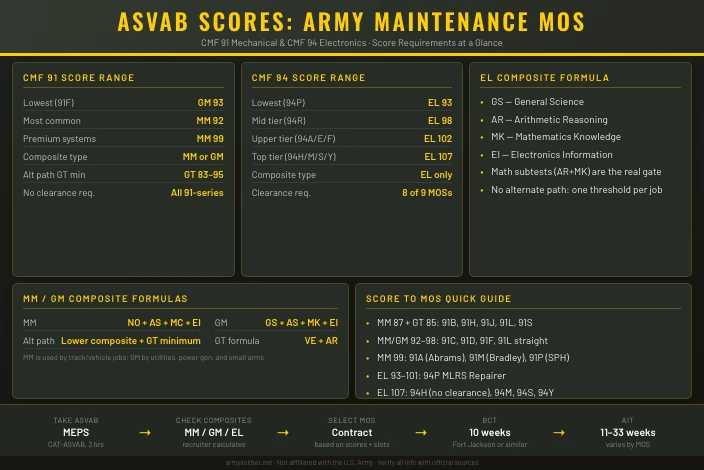
How the Maintenance Composites Work
The Army uses composite scores (weighted combinations of ASVAB subtests) to screen for specific aptitudes. Maintenance jobs use three composites.
MM (Mechanical Maintenance): NO + AS + MC + EI. This tests mechanical comprehension, electronics basics, auto/shop knowledge, and numerical operations. Most CMF 91 track and wheeled vehicle jobs use this composite.
GM (General Maintenance): GS + AS + MK + EI. Similar to MM but substitutes General Science and Math Knowledge for the NO and MC subtests. Utilities, power generator, and small arms jobs use this one.
EL (Electronics): GS + AR + MK + EI. Replaces auto/shop knowledge with Arithmetic Reasoning. Every CMF 94 job uses EL, which is why these roles are more math-heavy than mechanical at baseline.
Some 91-series jobs offer an alternate qualification path. You can meet either a higher composite by itself, or a lower composite combined with a minimum GT (General Technical) score. The GT composite is VE + AR, which measures reading and reasoning. Soldiers who are strong in verbal reasoning but not mechanical subtests may qualify via the combined route.
CMF 91: Mechanical Maintenance ASVAB Scores
The 91-series covers ground vehicle maintenance, weapons systems, and field equipment. Requirements cluster around MM 92 and GM 98 for most jobs, with premium systems like the M1 Abrams, Bradley, and self-propelled artillery pushing to MM 99.
Ground Vehicle and Track Maintenance
| MOS | Title | Composite | Alternate Path |
|---|---|---|---|
| 91A | M1 Abrams Tank System Maintainer | MM 99 | MM 88 + GT 85 |
| 91B | Wheeled Vehicle Mechanic | MM 92 | MM 87 + GT 85 |
| 91H | Track Vehicle Repairer | MM 92 | MM 87 + GT 85 |
| 91M | Bradley Fighting Vehicle Systems Maintainer | MM 99 | MM 88 + GT 92 |
| 91S | Stryker Systems Maintainer | MM 92 | MM 87 + GT 85 |
The M1 Abrams (91A) and Bradley (91M) both require MM 99, the highest mechanical composite in the field. The Bradley alternate path also demands GT 92, which is tougher than the GT 85 required for most other 91-series jobs. If your GT score is below 92, you’ll need to hit MM 99 straight for the Bradley.
Field Equipment and Weapons
| MOS | Title | Composite | Alternate Path |
|---|---|---|---|
| 91C | Utilities Equipment Repairer | GM 98 | GM 88 + GT 83 |
| 91D | Tactical Power Generator Specialist | GM 98 | GM 88 + GT 88 |
| 91E | Allied Trade Specialist | GM 98 | GM 88 + GT 95 |
| 91F | Small Arms / Artillery Repairer | GM 93 | GM 88 + GT 85 |
| 91J | Quartermaster/Chemical Equipment Repairer | MM 92 | MM 87 + GT 85 |
| 91L | Construction Equipment Repairer | MM 92 | MM 87 + GT 85 |
| 91P | Self-Propelled Artillery Systems Maintainer | MM 99 | MM 88 + GT 88 |
The Allied Trade Specialist (91E) has the most demanding alternate path in CMF 91: GM 88 plus GT 95. If you want the flexibility of the lower GM score, your GT needs to be near the top of the enlisted range. 91E covers welding, metal fabrication, and machining work, so the reasoning threshold makes sense.
91F (Small Arms/Artillery Repairer) has the lowest direct score requirement in CMF 91 at GM 93. If you’re mechanical but not hitting the higher composites, this is the most accessible path into the maintenance field.
CMF 94: Electronics Maintenance ASVAB Scores
Every 94-series job uses the EL composite. These are some of the highest ASVAB requirements in the enlisted Army, and most jobs also require a Secret clearance. If your ASVAB scores and background check both pass, you’ll earn technical skills that translate directly to defense electronics, aerospace, and federal contractor work after service.
EL Score Requirements by MOS
| MOS | Title | EL Minimum | Clearance |
|---|---|---|---|
| 94P | MLRS Repairer | 93 | Secret |
| 94A | Land Combat Electronic Missile System Repairer | 102 | Secret |
| 94E | Radio/Communications Security Repairer | 102 | Secret |
| 94F | Computer Detection Systems Repairer | 102 | Secret |
| 94R | Avenger System Repairer | 98 | Secret |
| 94H | TMDE Support Specialist | 107 | None |
| 94M | Radar Repairer | 107 | Secret |
| 94S | Patriot System Repairer | 107 | Secret |
| 94Y | Automatic Test Systems Operator/Maintainer | 107 | Secret |
The range runs from EL 93 (94P MLRS Repairer) to EL 107 (94H, 94M, 94S, 94Y). That spread matters. A score that qualifies you for the MLRS repairer role won’t get you into the Patriot or radar specialties, even though all of them are in the same career field.
What Separates EL 93 from EL 107
The EL formula is GS + AR + MK + EI. At EL 93, you need solid performance across the four subtests but no single subtest needs to be exceptional. At EL 107, you need real depth in mathematics and electronics. Arithmetic Reasoning and Math Knowledge carry heavy weight in the formula, and you can’t compensate for a weak math performance by doing well on Electronics Information alone.
94H stands out from the rest of CMF 94 in one important way: it does not require a Secret clearance. TMDE (Test, Measurement, and Diagnostic Equipment) Support Specialists calibrate and repair test equipment used across the Army, but the work doesn’t involve classified system documentation. If your background has issues that might complicate a clearance investigation, 94H is the one EL 107 job where that’s not a barrier.
The other three EL 107 jobs (94M Radar Repairer, 94S Patriot System Repairer, and 94Y Automatic Test Systems Operator/Maintainer) all require a Secret clearance and work with classified weapons system data. Start your clearance process early. It runs concurrently with BCT and AIT but can take three to six months or longer.
Training Length and Career Value for CMF 94
AIT for 94-series jobs runs significantly longer than most career fields. The 94P trains at Redstone Arsenal, Alabama for approximately 15 weeks. The 94E and 94F programs at Fort Gordon run 29 to 34 weeks. The 94S Patriot System Repairer course at Fort Sill is one of the longest enlisted AIT programs in the Army, running approximately 52 weeks. That length reflects the complexity of the systems involved – you are not learning how to turn a wrench but how to diagnose and repair classified weapons systems that cost tens of millions of dollars per unit.
The civilian credential value for 94-series soldiers is substantial. Electronics repair, radar systems, and communications security skills map directly to federal contractor positions supporting the same platforms soldiers maintain on active duty. Cleared technicians with four or more years of hands-on experience on Patriot, Avenger, or radar systems routinely transition into defense contractor roles paying $80,000 to $130,000 or more. The clearance you build while on active duty remains valid as long as you maintain continuous employment in cleared positions after separation.
Most 94-series duty stations cluster around Army installations with active air defense or signal missions: Fort Sill (Oklahoma), Fort Bliss (Texas), Fort Drum (New York), Fort Cavazos (Texas), and OCONUS assignments in Germany, South Korea, and the Pacific.
Which Maintenance MOS Matches Your Score?
Your composite scores determine your realistic options before anything else. Here’s a quick guide.
If you score MM 87-91 or GM 87-97: You qualify for most 91-series jobs via the alternate GT path, provided your GT score meets the secondary threshold. The most common path is MM 87 + GT 85, which opens wheeled vehicles (91B), track vehicles (91H), Stryker (91S), and quartermaster/chemical equipment (91J).
If you score MM 92-98 or GM 93-97: You qualify straight for wheeled vehicles, track vehicles, Stryker, small arms (91F), construction equipment (91L), and the utilities equipment jobs (91C at GM 98). No GT score needed to qualify.
If you score MM 99: The M1 Abrams (91A), Bradley (91M), and self-propelled artillery (91P) are available to you. These are the most technically complex armored systems in the Army’s ground fleet. Soldiers who complete AIT on the Abrams or Bradley are positioned for the Army’s most sought-after armored maintenance billets, and the technical depth translates well to civilian heavy equipment and defense contractor roles after service.
If you score EL 93-101: 94P (MLRS Repairer) is your entry into the CMF 94 electronics world. You’ll need a Secret clearance and you’ll meet the Very Heavy OPAT physical standard at MEPS. This band gets you started in electronics maintenance, and many 94P soldiers use their first enlistment to build a clearance record and hands-on technical experience before reclassifying to a higher-EL specialty like 94M or 94S.
If you score EL 102-106: 94A, 94E, and 94F open up. All three require a Secret clearance. 94R (Avenger System Repairer) opens at EL 98.
If you score EL 107: You can compete for 94H, 94M, 94S, and 94Y. 94H is the only one without a clearance requirement. The other three work on some of the most advanced weapons systems in the Army’s air defense and intelligence arsenal.
ASVAB Prep for Mechanical and Electronics Composites
CMF 91 and CMF 94 test different aptitudes, and your prep plan should reflect that.
For MM and GM composites, focus on Mechanical Comprehension (MC), Auto and Shop Information (AS), and Electronics Information (EI). These three subtests do most of the work in both formulas. Mechanical Comprehension covers gears, pulleys, levers, and fluid systems; these concepts show up in every vehicle maintenance AIT. Auto and Shop tests knowledge of hand tools, vehicle systems, and basic shop practices. You can improve these scores quickly with targeted review if you’ve done any hands-on work with vehicles or machinery.
For EL, the math-heavy subtests are the real gate. Arithmetic Reasoning (AR) and Mathematics Knowledge (MK) together account for two of the four EL subtest inputs. If your math is weak, no amount of electronics knowledge will get you to EL 107. Work through arithmetic operations, fractions, percentages, algebra, and geometry before moving to electronics theory.
The General Science (GS) subtest feeds both GM and EL composites. Physics concepts like force, energy, electricity, and waves show up in both maintenance contexts. A solid GS review pays dividends across multiple composites.
Study Timelines and Retake Rules
If you are targeting CMF 91 jobs, a four-to-six-week prep cycle is realistic for most candidates. Spend the first two weeks on Mechanical Comprehension using practice sets focused on gear ratios, lever systems, and hydraulics. Week three covers Auto and Shop Information: vehicle systems, hand tools, and basic shop math. Week four targets Electronics Information – circuits, Ohm’s law, and component identification. After a full practice test measuring your MM or GM composite, add a fifth week drilling the weakest subtest if you are still short of your target.
If you are targeting CMF 94 at EL 107, plan eight to ten weeks. Math is the primary gate. Spend the first three weeks exclusively on arithmetic and algebra: order of operations, fractions, percentages, ratios, and basic equations. Week four adds geometry. Weeks five and six cover General Science with a focus on electricity, magnetism, and waves. Weeks seven and eight add Electronics Information on top of the math foundation. Week nine consists of full composite-score practice tests. Week ten is targeted review of whichever subtest came in lowest.
The Army allows one ASVAB retake after a 30-day waiting period. A second retake requires a six-month wait. If you are within four to five points of an EL threshold, the 30-day window is enough time to close the gap with focused drilling on your weakest subtest. A gap of ten or more points typically requires the full six-month cycle.
You can find section-specific practice at Army ASVAB test prep, including composite-by-composite breakdowns and score calculators.
For more detail on all ASVAB line scores across every Army career field, see the full breakdown in ASVAB scores for every Army MOS.
You may also find Best ASVAB Scores for Army Engineer MOS Jobs and Best ASVAB Scores for Army Aviation MOS Jobs helpful.