Best ASVAB Scores for Military Police Army MOS
Military police ASVAB requirements work differently from most Army jobs. Every CMF 31 MOS uses the Skilled Technical (ST) composite as its primary line score, not the Combat (CO) or General Technical (GT) composites that infantry and armor use. But the ST floor varies by 16 points across the four MOSs, and the CID Special Agent track piles a mandatory GT requirement on top of the ST. Knowing which subtests to target before test day changes how you study.
Every score in this post is pulled directly from the MOS profile pages on this site, verified against the source page for each job.
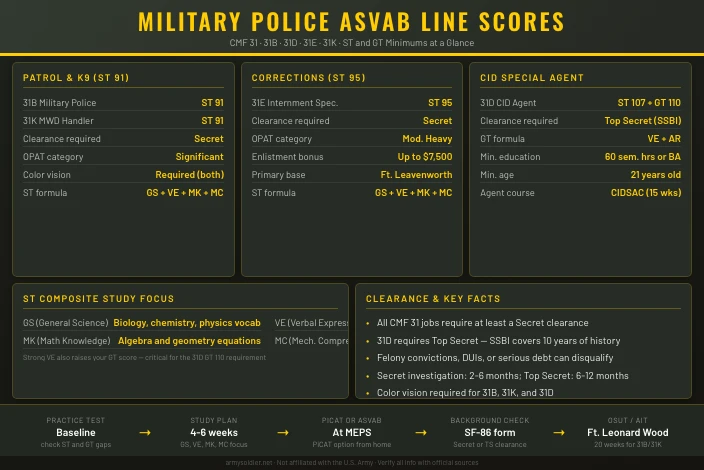
What the ST Composite Measures
The Army’s Skilled Technical composite is built from four ASVAB subtests: General Science (GS), Verbal Expression (VE), Mathematics Knowledge (MK), and Mechanical Comprehension (MC). Verbal Expression itself combines Word Knowledge and Paragraph Comprehension.
| Composite | Subtests | What It Tests |
|---|---|---|
| ST (Skilled Technical) | GS + VE + MK + MC | Science literacy, reading, algebra, mechanical reasoning |
| GT (General Technical) | VE + AR | Reading comprehension, arithmetic reasoning |
The ST composite rewards well-rounded students more than specialists. You need solid science vocabulary, strong reading, algebraic math, and mechanical intuition at the same time. That is different from the FA (Field Artillery) composite, which weights math and coding speed, or CO (Combat), which leans on mechanical and verbal.
Know your weak subtest before you walk into MEPS. An ASVAB study guide with section-specific practice tests lets you drill GS, VE, MK, and MC independently so you see exactly where your ST score is leaking points.
When you purchase through links on our site, we may receive compensation at no extra cost to you.
Military Police ASVAB Scores at a Glance
| MOS | Title | Primary Composite | Minimum | Secondary | Clearance |
|---|---|---|---|---|---|
| 31B | Military Police | ST | 91 | None | Secret |
| 31K | Military Working Dog Handler | ST | 91 | None | Secret |
| 31E | Internment/Resettlement Specialist | ST | 95 | None | Secret |
| 31D | CID Special Agent | ST | 107 | GT 110 | Top Secret |
The gap between the patrol-oriented MOSs and CID is significant. A GT of 110 is among the highest enlisted requirements in the Army, sitting alongside intelligence and cyber MOSs. Every CMF 31 job requires at least a Secret clearance, and the 31D requires a Top Secret backed by a Single Scope Background Investigation.
31B and 31K: The ST 91 Floor
Two jobs share the same ASVAB floor: the 31B Military Police and the 31K Military Working Dog Handler.
An ST of 91 is the lowest bar in CMF 31, and it’s a moderate score for the Army overall. Most candidates who put in four to six weeks of focused study can reach it. The real differentiators for these jobs are the Secret clearance and, in the 31B’s case, the driver’s license requirement and 18-year age minimum.
31B Military Police
The 31B patrols Army installations, responds to crimes, runs detainee operations, and shifts to convoy escort and checkpoint operations when deployed. You work like a civilian cop in garrison and like a combat support soldier in the field.
The OPAT requirement sits at the Significant (Gray) level, which is more demanding than most support MOSs but less than the Heavy (Black) category required for infantry. Patrol work involves foot pursuits, physical restraints, and wearing body armor for full shifts.
Additional requirements that go beyond the ASVAB:
- Must be at least 18 years old (split training available at 17)
- Valid state driver’s license before training
- Red/green color vision required
- Physical profile of 222221
31K Military Working Dog Handler
The 31K trains and employs military working dogs for explosive detection, building searches, and installation patrol. The same ST 91 threshold applies, but the training pipeline is longer than 31B.
Training runs through three distinct phases:
- Basic Combat Training at Fort Leonard Wood (10 weeks)
- AIT Phase 1 at Fort Leonard Wood covering MP fundamentals (7 weeks)
- AIT Phase 2 at Joint Base San Antonio-Lackland covering dog handling, detection, and canine first aid (11 weeks)
The Lackland phase is where you get your first dog. Belgian Malinois and German Shepherds are the standard breeds. The OPAT category for 31K is also Significant. Normal color vision is required.
The 31K is more competitive than 31B because the Army has far fewer dog handler billets. An ST score above the 91 floor helps your application, but the limiting factor is slot availability.
31E Internment/Resettlement Specialist: ST 95
The 31E runs military confinement and detention facilities. The ST minimum rises four points to 95 compared to patrol MOSs. That gap seems small but represents a meaningful score difference on the ASVAB’s 200-point composite scale.
The job is corrections-focused rather than law enforcement-focused. You process prisoners, conduct cell searches, manage inmate records, and handle emergency response inside a facility. When deployed, the mission shifts to detainee operations under Geneva Convention rules rather than UCMJ corrections procedures.
| Requirement | 31E Detail |
|---|---|
| ST Score | 95 minimum |
| Security Clearance | Secret |
| OPAT Category | Moderately Heavy |
| Vision | Correctable to 20/20 |
| Age | 17-39 years old |
The Moderately Heavy OPAT rating for 31E is one level below the Significant requirement for 31B and 31K. Physical demands are real because you restrain non-compliant inmates and respond to facility emergencies, but the daily work is less strenuous than foot patrol.
Fort Leavenworth, Kansas is the primary duty station for 31E soldiers, home to the United States Disciplinary Barracks. The 31E currently carries an enlistment bonus of up to $7,500 depending on contract length.
31D CID Special Agent: ST 107 and GT 110
The 31D Criminal Investigation Special Agent is a different category entirely. You investigate Army felonies, from homicides and sexual assaults to fraud and cyber crimes, carrying the same 1811 federal agent credential as FBI and DEA agents.
The score requirements reflect that responsibility:
- ST: 107 minimum (16 points above the 31B floor)
- GT: 110 minimum (both scores must be met simultaneously)
- Clearance: Top Secret with Single Scope Background Investigation (SSBI)
A GT of 110 is one of the highest enlisted requirements in the Army. Because the GT composite is VE + AR, you need strong reading comprehension and solid arithmetic reasoning at the same time as the broader ST score. Candidates who score well on the verbal subtests tend to see both composite scores rise together.
The 31D is not an entry-level MOS. Two paths in exist:
- In-service reclassification for active soldiers with 2-10 years of service, E-4 through SGT(P), 60+ college semester hours
- Direct Accessions Pilot Program for civilians with a bachelor’s degree in an approved field (Criminal Justice, Forensic Science, Computer Science, and others), entering at E-4
Direct accession soldiers complete 31B OSUT first (20 weeks), then attend the 15-week CID Special Agent Course (CIDSAC) at Fort Leonard Wood. Total pipeline from enlistment to first assignment runs roughly 9 to 10 months.
The ST Composite: What to Study
All four CMF 31 MOSs live or die on the ST score, so targeting the right subtests matters. The four components and their study focus:
General Science (GS) covers biology, chemistry, physics, and earth science at a high school level. The questions test scientific vocabulary and basic concepts. Study common terminology, the periodic table basics, Newton’s laws, and cell biology fundamentals. Most study guides cover GS in one chapter.
Verbal Expression (VE) is Word Knowledge plus Paragraph Comprehension. Strong VE scores also pull up the GT composite, which matters directly for the 31D. Vocabulary study is the highest-return activity for VE. Twenty to thirty new words per day using flashcards produces measurable score gains in three to four weeks.
Mathematics Knowledge (MK) tests algebra and geometry, not word problems. Practice solving for variables, working with fractions and percentages, and applying basic geometry formulas. MK questions are predictable; the concepts repeat across practice tests. If you have not touched algebra since high school, four weeks of dedicated practice is usually enough to get competitive.
Mechanical Comprehension (MC) covers simple machines, gears, pulleys, and basic physics. It rewards people with hands-on mechanical experience, but the concepts can be learned from scratch. Drawing diagrams when studying gears and levers is more effective than memorizing rules.
If you are targeting the 31D GT requirement, you also need to focus on Arithmetic Reasoning (AR), which tests word problems rather than equations. AR is the most time-pressured subtest on the ASVAB. Practice translating sentences into math setups and work under timed conditions from day one.
Security Clearances and What Slows the Process
Every CMF 31 MOS requires at least a Secret clearance. The 31D requires Top Secret. Neither clearance level is guaranteed, and the process can delay or derail your enlistment timeline regardless of your ASVAB scores.
The Secret clearance investigation covers seven years of personal history. Common disqualifiers:
- Felony convictions or serious misdemeanors
- Drug use (type, frequency, and recency all matter)
- Significant debt or unresolved financial judgments
- Foreign national contacts in sensitive countries
- Prior dishonest statements on government forms
The Top Secret investigation for 31D goes deeper, typically covering 10 years and including interviews with neighbors, former employers, and references. Credit problems that might get a waiver for Secret clearance are much harder to work around at the TS level.
Processing time runs 2 to 6 months for Secret and 6 to 12 months for Top Secret. If your clearance investigation drags, your ship date and training slot can shift.
Color vision requirements add one more filter. The 31B and 31K both require normal red/green color discrimination. The 31D requires no color blindness. Check with your optometrist before your MEPS date if you have any uncertainty.
Taking the PiCAT Before MEPS
First-time testers can take the PiCAT from home before their MEPS appointment. The PiCAT is an unproctored version of the ASVAB. If you pass a short verification test at MEPS, your PiCAT score stands in for the full ASVAB.
This is significant for military police applicants. You can take the PiCAT, see your ST and GT scores, identify weak subtests, study, and take it again before committing to a MEPS date. Knowing where you stand before you’re sitting in a room with a recruiter gives you more control over which MOS you can actually qualify for.
This site is not affiliated with the U.S. Army or any government agency. Verify all information with official Army sources before making enlistment or career decisions.
You may also find ASVAB scores for every Army MOS and Army ASVAB test prep helpful as you plan your score targets.