Best ASVAB Scores for Special Operations MOS
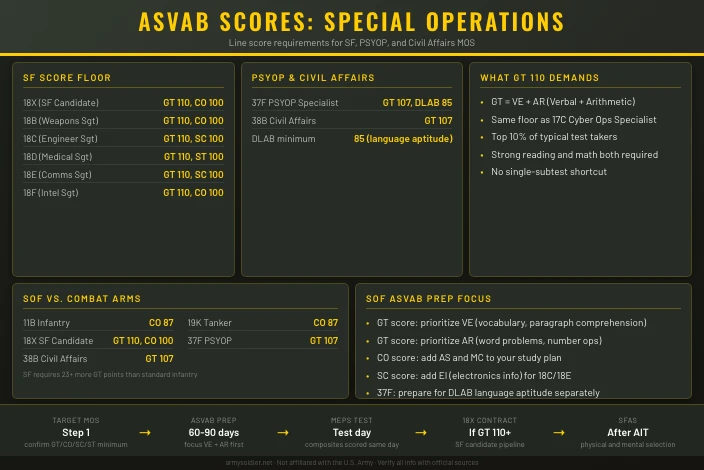
Special operations MOS jobs have some of the highest ASVAB requirements in the Army. Every Special Forces specialty starts with a GT score of 110 – the same ceiling that blocks most people from 17C Cyber jobs. PSYOP and Civil Affairs land three points lower but add a language aptitude test that most standard combat arms jobs never ask for. If you’re aiming at any of these MOS, you need to know exactly which composites matter before you walk into a testing center.
This post pulls ASVAB line scores directly from each MOS profile on this site. Every number is verified against the source page for that job.
How Special Operations ASVAB Scores Work
Army MOS don’t use your AFQT percentile to assign jobs. They use composite line scores: combinations of specific ASVAB subtests that target different skill sets. Every composite in the table below pulls from a different mix.
| Composite | Subtests | What It Tests |
|---|---|---|
| GT (General Technical) | VE + AR | Verbal reasoning, math reasoning |
| CO (Combat) | AR + CS + AS + MC | Math, coding speed, auto/shop, mechanical |
| SC (Surveillance/Communications) | VE + AR + AS + MC | Verbal, math, auto/shop, mechanical |
| ST (Skilled Technical) | GS + VE + MK + MC | Science, verbal, math, mechanical |
The GT composite shows up in every special operations MOS. It combines Verbal Expression (VE) and Arithmetic Reasoning (AR). A GT of 110 puts you above roughly 75% of all ASVAB test-takers, which is why it filters so many candidates before selection even begins.
The second required composite varies by specialty. The 18C engineer and 18E communications sergeant need SC 100, which adds auto/shop knowledge on top of the verbal and math. The 18D medical sergeant needs ST 100, which swaps in General Science and Mathematics Knowledge. Each variation reflects what that specialty actually does on an ODA.
Special Forces Candidate (18X)
The 18X isn’t a permanent MOS. It’s an enlistment contract that puts you in the pipeline for Special Forces Assessment and Selection (SFAS). If you pass SFAS and the SF Qualification Course (SFQC), you get assigned to one of the four Green Beret specialties: 18B, 18C, 18D, or 18E.
| Requirement | Minimum |
|---|---|
| GT | 110 |
| CO | 100 |
Both scores must be met. You can’t qualify on GT alone. The CO composite (Arithmetic Reasoning + Coding Speed + Auto/Shop + Mechanical Comprehension) at 100 is more approachable than the GT for some test-takers, but it still requires solid mechanical and math aptitude. Candidates who score well above both minimums tend to have more options during specialty assignment after selection.
The 18X contract also requires U.S. citizenship, a 50-meter swim test in uniform, and eligibility for a Secret clearance. ASVAB scores are the first gate but not the only one.
Green Beret MOS Line Scores
All four Green Beret specialties build on the same GT 110 baseline from the 18X contract. The second required composite shifts based on the technical demands of each role.
| MOS | Title | GT | Second Composite |
|---|---|---|---|
| 18B | Special Forces Weapons Sergeant | 110 | CO: 100 |
| 18C | Special Forces Engineer Sergeant | 110 | SC: 100 |
| 18D | Special Forces Medical Sergeant | 110 | ST: 100 |
| 18E | Special Forces Communications Sergeant | 110 | SC: 100 |
These specialties are not available as direct enlistments. You enter as 18X and receive your specialty MOS after completing the Qualification Course. Specialty assignment happens during SFQC based on class needs and your performance.
18B (Weapons Sergeant) and 18F (Intelligence Sergeant) share the CO 100 requirement. The CO composite weights Arithmetic Reasoning, Coding Speed, Auto/Shop, and Mechanical Comprehension, reflecting the mechanical and analytical demands of operating and teaching a wide range of weapons systems.
18C (Engineer Sergeant) and 18E (Communications Sergeant) both require SC 100 instead. The SC composite swaps Coding Speed for Verbal Expression, giving more weight to communication and reading comprehension alongside the mechanical components. Both specialties require soldiers who can write plans, teach techniques, and maintain complex technical equipment simultaneously.
18D (Medical Sergeant) is the outlier. The ST 100 requirement adds General Science and Mathematics Knowledge, which directly reflects what the SFQC medical phase covers: pharmacology, anatomy, and clinical medicine at a pace that most nursing programs don’t match. Candidates who want to be assigned 18D should score as high as possible on both GT and ST.
18F: Special Forces Intelligence Sergeant
The 18F is not an entry-level MOS. You cannot enlist as 18F. This role requires first completing SFAS and SFQC in a primary SF MOS (18B, 18C, 18D, or 18E), then serving at least two years on an ODA before receiving a chain-of-command nomination for the SF Intelligence Sergeant Course (SFISC).
| Requirement | Minimum |
|---|---|
| GT | 110 |
| CO | 100 |
| Security Clearance | TS/SCI required |
| Prior Service | 2+ years on ODA, rank E-6 to E-7 |
The ASVAB requirements match the 18X baseline. The real filter for 18F is time, performance, and the clearance investigation.
PSYOP Specialist (37F)
The 37F Psychological Operations Specialist sits three GT points below the SF floor, but that’s only part of the picture.
| Requirement | Minimum |
|---|---|
| GT | 107 |
| DLAB | 85 |
The Defense Language Aptitude Battery (DLAB) is the additional filter that most combat arms jobs don’t require. It measures how quickly you can learn a foreign language. Not every applicant takes it at MEPS automatically, so ask your recruiter to schedule it when you go in.
A GT of 107 still puts you above most test-takers. And the DLAB at 85 is not a trivial score – it requires genuine language learning ability, not just a passing familiarity with foreign words. Candidates who do well on the verbal and reading sections of the ASVAB tend to score better on the DLAB too, since both measure how your brain processes language rules and patterns.
When you purchase through links on our site, we may receive compensation at no extra cost to you.
If you’re targeting 37F or 38B, the GT composite is your main study target. Both VE and AR feed into GT, and VE improvement also correlates with stronger DLAB performance. An ASVAB study guide with section-specific drills lets you target these subtests without wasting time on composites that don’t affect your MOS options.
Civil Affairs Specialist (38B)
The 38B Civil Affairs Specialist has the same ASVAB floor as PSYOP.
| Requirement | Minimum |
|---|---|
| GT | 107 |
No DLAB is required for 38B, which distinguishes it from 37F. The job focuses on assessing civilian infrastructure, meeting with local government officials, and advising commanders on civil-military relationships in deployed environments. The GT 107 requirement reflects the analytical and writing demands of producing civil affairs assessments that feed into operational intelligence.
U.S. citizenship is mandatory for 38B. The Secret clearance investigation will look at foreign contacts and travel history, which can be a factor for candidates with international ties.
What Makes SOF ASVAB Requirements Different
Most standard combat arms MOS – infantry, armor, cannon crew – need a single composite in the 80s or 90s. Special operations flip that logic.
Every SF specialty requires two composites to be met simultaneously. A GT of 110 with a CO of 95 doesn’t qualify you for 18B. A CO of 100 with a GT of 108 doesn’t qualify you either. Both numbers have to clear at the same time, and both are above what the majority of other Army jobs require.
The practical implication: if you’re targeting SF, you can’t afford to focus prep on just one composite. Arithmetic Reasoning feeds into both GT and CO. Verbal Expression feeds into both GT and SC. These overlapping subtests are where prep time pays off across multiple composites at once.
The DLAB requirement for 37F adds a layer that purely score-focused prep doesn’t address. If you can read, absorb patterns quickly, and handle abstract language rules under time pressure, your DLAB score will reflect that. If you struggle with that kind of material on the ASVAB verbal sections, expect the DLAB to feel harder than you anticipated.
Score Comparison Across SOF MOS
| MOS | GT | Second Score | DLAB | Notes |
|---|---|---|---|---|
| 18X / 18B / 18F | 110 | CO: 100 | No | SF entry and weapons/intel tracks |
| 18C / 18E | 110 | SC: 100 | No | Engineer and communications tracks |
| 18D | 110 | ST: 100 | No | Medical track; hardest composite to hit |
| 37F | 107 | None | Yes (85+) | PSYOP; language aptitude required |
| 38B | 107 | None | No | Civil Affairs; citizenship required |
The 18D ST requirement is arguably the most demanding in the group because the ST composite draws on General Science, which doesn’t appear in any other special operations composite. If science was never your strong subject, the 18D path requires the most targeted prep.
PSYOP at GT 107 looks slightly easier on paper, but the DLAB is a real filter that no amount of ASVAB prep directly addresses. Take a language aptitude practice test before assuming the DLAB will be straightforward.
Study Plan: Hitting GT 110
When you purchase through links on our site, we may receive compensation at no extra cost to you.
Focused prep matters more here than anywhere else. SOF ASVAB minimums are strict, and retesting at MEPS takes time you may not have. An ASVAB prep course or ASVAB study guide that targets GT composites specifically – Verbal Expression and Arithmetic Reasoning – will move your score faster than general studying.
The GT composite is VE + AR. That’s it. Every point you gain in Verbal Expression or Arithmetic Reasoning moves your GT score.
Verbal Expression (VE) combines Word Knowledge (WK) and Paragraph Comprehension (PC) from the ASVAB. Read actively, build vocabulary from context, and practice answering reading questions under time pressure. This feeds both GT and SC.
Arithmetic Reasoning (AR) is word problems. The math itself isn’t advanced, but the framing trips up test-takers who haven’t practiced reading math problems carefully. AR feeds GT, CO, and EL simultaneously, making it the highest-value subtest for anyone targeting multiple composite scores.
For the second composite (CO, SC, or ST), the subtests shift:
- CO and SC: Add Auto/Shop Information (AS) and Mechanical Comprehension (MC) to your prep. These subtests have dedicated sections in every major ASVAB guide.
- ST: Add General Science (GS) and Mathematics Knowledge (MK). GS covers basic biology, chemistry, and physics. MK covers algebra and geometry.
Study the specific subtests for your target MOS. Don’t spend prep time on Electronics Information if your MOS doesn’t require an EL score.
The full ASVAB line score breakdown for every Army MOS covers every career family if you want to see how SOF requirements compare to the rest of the Army’s job list.
You may also find best ASVAB scores for Army combat arms MOS, Special Operations ASVAB and fitness requirements, and the Army Special Operations careers overview helpful if you’re weighing SF, PSYOP, and Civil Affairs against each other.
This site is not affiliated with the U.S. Army or any government agency. Verify all information with official Army sources before making enlistment or career decisions.