Best ASVAB Scores for Transportation & Logistics Army MOS Jobs
The Army’s transportation and logistics career fields cover a wider range of ASVAB composites than almost any other branch of the service. At the low end, driving a truck requires OF 85. At the high end, maintaining Army watercraft engines demands MM 99. Between those two points, you’ll find cargo specialists, supply clerks, petroleum handlers, lab technicians, parachute riggers, and more – each screened by a different composite designed to test a different kind of aptitude.
The career family splits into two groups: CMF 88 covers motor transport, cargo, and watercraft. CMF 92 covers supply, fuel, food service, and quartermaster specialties. If you know which composite your target MOS uses, you can build your prep plan before you ever walk into a recruiter’s office.
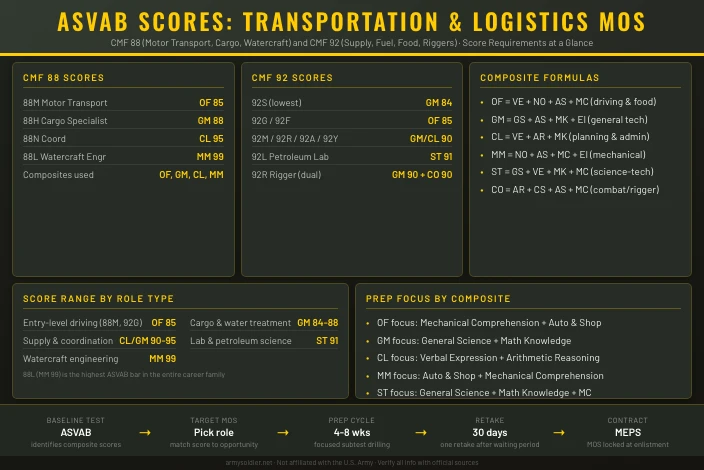
How Transportation and Logistics Composites Work
The Army doesn’t test you on one score. It uses weighted combinations of ASVAB subtests called composites, each designed to screen for the aptitudes a specific job requires.
Five composites cover the transportation and logistics career family:
- OF (Operators and Food): VE + NO + AS + MC. Tests verbal reasoning, basic math, and mechanical/shop knowledge. Used for driving and food service jobs.
- GM (General Maintenance): GS + AS + MK + EI. Tests general science, shop knowledge, math, and electronics basics. Used for cargo, water treatment, mortuary affairs, and rigger roles.
- CL (Clerical): VE + AR + MK. Tests verbal expression, arithmetic reasoning, and math knowledge. Used for supply coordination and planning roles.
- MM (Mechanical Maintenance): NO + AS + MC + EI. Emphasizes mechanical comprehension and shop knowledge. Used exclusively for watercraft engineering.
- ST (Skilled Technical): GS + VE + MK + MC. Combines general science with mechanical comprehension and math. Used for petroleum laboratory work.
One thing to know before you pick a target: some MOSs use two composites simultaneously, and you must meet both. The 92R Parachute Rigger requires GM 90 and CO 90 at the same time. No exceptions.
CMF 88: Motor Transport, Cargo, and Watercraft
CMF 88 uses three different composites across four jobs. The spread is wide: OF 85 for the truck driver and MM 99 for the watercraft engineer, with GM 88 and CL 95 filling the middle.
CMF 88 ASVAB Score Requirements
| MOS | Title | Composite | Score |
|---|---|---|---|
| 88M | Motor Transport Operator | OF | 85 |
| 88H | Cargo Specialist | GM | 88 |
| 88N | Transportation Management Coordinator | CL | 95 |
| 88L | Watercraft Engineer | MM | 99 |
The 88M Motor Transport Operator has the lowest bar in the family at OF 85. The OF composite tests verbal reasoning, numerical operations, auto/shop knowledge, and mechanical comprehension – a balanced combination that screens broadly for the practical aptitude needed to operate tactical wheeled vehicles in convoy.
The 88H Cargo Specialist steps up to GM 88. That composite shifts the emphasis toward general science and electronics information, which reflects the cargo accountability systems and industrial equipment operation that make up most of the job. An 88H loads, secures, and documents cargo at ports and aerial terminals, so the slightly higher technical aptitude threshold makes sense.
The 88N Transportation Management Coordinator requires CL 95, the highest verbal-math composite in the career family. This job coordinates movement by air, rail, road, and water using Army logistics software like TC-AIMS II. Strong verbal and math reasoning are the core skills, which is exactly what CL measures.
The 88L Watercraft Engineer sits alone at MM 99. That is among the highest mechanical composites in the enlisted Army. Marine diesel propulsion systems are technically demanding, and AIT for this MOS covers everything from engine overhauls to shipboard damage control. If you’re targeting 88L, mechanical comprehension and auto/shop knowledge are the subtests you need to own.
What the MM 99 Requirement Actually Means
The MM formula is NO + AS + MC + EI. At MM 99, you don’t need to be exceptional in every subtest, but you can’t have a major weakness either. Numerical Operations and Electronics Information need to be solid. Auto and Shop Information and Mechanical Comprehension need to be strong.
Most candidates who fall short of MM 99 are weak in one specific area rather than broadly unprepared. If you have hands-on experience with engines, boats, or heavy equipment, your MC and AS scores will likely reflect that. If your gap is in EI or NO, targeted drilling on those subtests alone can close several points.
CMF 92: Supply, Petroleum, Food, and Quartermaster Specialties
CMF 92 is the largest and most varied sub-family in the transportation cluster. Nine MOS use three different composites – GM, CL, ST – and one requires two composites simultaneously. The scores cluster in a tighter band than CMF 88, mostly between 84 and 95, with the petroleum lab specialist sitting at ST 91 as the outlier.
CMF 92 ASVAB Score Requirements
| MOS | Title | Composite | Score |
|---|---|---|---|
| 92S | Shower/Laundry/Clothing Repair Specialist | GM | 84 |
| 92G | Culinary Specialist | OF | 85 |
| 92F | Petroleum Supply Specialist | CL 86 or OF 85 | Either |
| 92W | Water Treatment Specialist | GM | 88 |
| 92M | Mortuary Affairs Specialist | GM | 90 |
| 92R | Parachute Rigger | GM 90 and CO 90 | Both required |
| 92A | Automated Logistical Specialist | CL | 90 |
| 92Y | Unit Supply Specialist | CL | 90 |
| 92L | Petroleum Laboratory Specialist | ST | 91 |
The Entry-Level Jobs: GM 84 and OF 85
The 92S Shower/Laundry/Clothing Repair Specialist has the lowest ASVAB requirement in CMF 92 at GM 84. The job covers field hygiene support, laundry operations, and clothing repair – essential for troop welfare but less technically demanding than fuel handling or rigger work.
The 92G Culinary Specialist sits at OF 85, matching the 88M truck driver. The OF composite’s emphasis on verbal and mechanical reasoning reflects the production management side of the role: menu planning, kitchen equipment operation, food safety compliance, and inventory control for a dining facility serving hundreds of soldiers.
Petroleum Roles: 92F and 92L
The 92F Petroleum Supply Specialist is unusual because it accepts either a CL 86 or OF 85 – whichever composite the applicant scores higher on. This dual-composite qualification path widens access to the MOS. Whether your strength is in verbal-math reasoning or mechanical-verbal aptitude, one of the two paths may work for you. Color vision is a hard disqualifier for 92F regardless of scores.
The 92L Petroleum Laboratory Specialist uses ST 91, a composite that does not appear in many MOS fields. The ST formula is GS + VE + MK + MC: general science, verbal expression, math knowledge, and mechanical comprehension. This combination reflects the scientific nature of petroleum testing – running ASTM-standard lab tests on fuel samples requires actual science background, not just mechanical aptitude. It’s the most science-demanding score threshold in the entire career family.
Supply and Coordination: CL 90 Cluster
Three MOS cluster at CL 90: the 92A Automated Logistical Specialist, the 92Y Unit Supply Specialist, and – with GM 90 instead of CL – the 92M Mortuary Affairs Specialist. The CL composite (VE + AR + MK) screens for the verbal and arithmetic skills needed to manage supply records, property accountability systems, and cargo documentation.
The 92A and 92Y roles are functionally related but distinct. The 92A is the broader logistics role managing the Army’s GCSS-Army supply platform, inventory operations, and equipment readiness data. The 92Y focuses on unit-level supply: property books, individual equipment issue, and hand receipt accountability. Both require the same CL 90 baseline.
The 92R Dual-Composite Requirement
The 92R Parachute Rigger is the hardest MOS to qualify for in CMF 92. It requires GM 90 and CO 90 simultaneously. The CO (Combat) composite uses AR + CS + AS + MC, which combines arithmetic reasoning, coding speed, auto/shop knowledge, and mechanical comprehension. Meeting GM 90 does not help if CO falls short. You must hit both thresholds on the same test.
This dual requirement reflects the technical precision of parachute rigging. A mistake in rigging a personnel parachute has obvious consequences. The Army uses two different composite screens to verify that candidates have both the general maintenance aptitude and the coding-speed/mechanical aptitude needed for the exacting standards of the MOS. You must also be airborne-qualified to enter the MOS, so the physical commitment matches the intellectual bar.
Water Treatment: GM 88
The 92W Water Treatment Specialist sits at GM 88, one step above the 92S (GM 84) floor but below the GM 90 cluster. The GM composite tests general science, auto/shop knowledge, math, and electronics – all relevant to operating and maintaining reverse osmosis water purification units in the field.
When you purchase through links on our site, we may receive compensation at no extra cost to you.
Scoring GM 90 or above unlocks most of the CMF 92 supply and technical roles. An ASVAB prep course with targeted General Science and Math Knowledge practice sets is the most direct path to that composite threshold.
Which Transportation or Logistics MOS Matches Your Score?
Your composite scores determine your realistic options before a recruiter can help you. Here’s a straightforward guide.
OF 85 or higher: You qualify for 88M (truck driver) and 92G (culinary) straight. These are high-volume MOS with frequent training seat availability. Strong candidates with OF scores at 90 or above have negotiating room for preferred duty station options.
GM 84-88: You qualify for 92S (84) and 92W and 88H (88). These are accessible entry points into the logistics family. A score at GM 88 opens both the cargo specialist and water treatment paths.
CL 86-90 or GM 90: You reach the middle cluster – 92A, 92F, 92M, 92R (pending CO 90), and 92Y. This band includes the most common supply and logistics roles in the Army. The 92A and 92Y slots are among the highest-volume in the entire enlisted force.
CL 95: The 88N Transportation Management Coordinator opens. This is the planning and coordination role in CMF 88, requiring the strongest verbal-math baseline in the career family.
ST 91: The 92L Petroleum Laboratory Specialist is the primary target here. It’s a specialized science-lab role with a strong civilian transition into quality control and industrial chemistry.
MM 99: You qualify for 88L Watercraft Engineer, the most technically demanding ASVAB threshold in the career family and one of the higher MM scores in the Army.
ASVAB Prep for Transportation Composites
The composites used in this career family share several subtests. Targeting the right ones has a multiplicative effect on your qualifying options.
General Science (GS) feeds GM and ST. A solid GS prep session – covering physics of electricity, basic chemistry, and biology – raises both composites. If you’re deciding between a supply role (GM 90) and a petroleum lab role (ST 91), building your GS score benefits both paths.
Math Knowledge (MK) appears in CL, GM, EL, and ST. It’s the single most cross-cutting math subtest in the ASVAB. Algebra, fractions, geometry, and percentages are the core content areas. A weak MK score closes more doors than almost any other subtest gap in the logistics family.
Auto and Shop Information (AS) feeds OF, GM, MM, and CO – meaning it’s relevant to every composite used in CMF 88 and most of CMF 92. Candidates without hands-on vehicle or shop experience typically see the biggest gains here from targeted prep. Tools, engine systems, and vehicle maintenance concepts are the main content areas.
Mechanical Comprehension (MC) feeds OF, MM, and ST. For candidates targeting 88L (MM 99) or 92L (ST 91), MC is a critical subtest. Gears, pulleys, levers, fluid pressure, and basic mechanics are the test content.
Study Timelines
For OF, GM, or CL composites targeting scores in the 85-95 range, a four-to-six-week cycle is realistic. Spend the first two weeks on your weakest subtest identified from a baseline practice test. Add the second weakest in weeks three and four. Run a full composite-score simulation in week five to identify any remaining gaps before test day.
For MM 99 or ST 91, plan six to eight weeks. MM 99 requires genuine strength in AS and MC, not just a passing level. If you have no mechanical background, add a week focused on Mechanical Comprehension – specifically gear ratios, belt systems, and hydraulics. For ST 91, general science needs real attention: electrical principles, chemistry basics, and physics of motion are the most likely gaps.
For the 92R dual-composite requirement (GM 90 and CO 90), treat them as two separate prep tracks. GM prep is covered above. CO adds Coding Speed, which is a pure speed-and-accuracy task that improves with timed practice – not general knowledge. Run timed Coding Speed drills daily for the last two to three weeks of your prep cycle.
The Army allows one ASVAB retake after a 30-day waiting period, then a six-month wait for any subsequent attempt. If you’re within five points of a composite threshold, the 30-day window is enough to close the gap with focused work on a single weak subtest.
You can find section-specific practice and composite-score calculators at Army ASVAB test prep.
For scores across every Army career field, see the full breakdown in ASVAB scores for every Army MOS.
You may also find Best ASVAB Scores for Army Maintenance MOS Jobs and Best ASVAB Scores for Army Combat Arms MOS Jobs helpful.