Best ASVAB Scores for Army Warrant Officer MOS
Every Army warrant officer candidate hits the same first wall: a GT score of 110. It doesn’t matter if you want to fly Black Hawks, run cyber operations, or manage intelligence fusion cells. That number is the floor, it’s non-waiverable, and no amount of experience, letters of recommendation, or a polished packet will get you past a board if your score sits below it. Aviation warrant officer candidates face a second test on top of it. Knowing exactly what these scores require – and which subtests drive them – is the starting point for a warrant officer application.
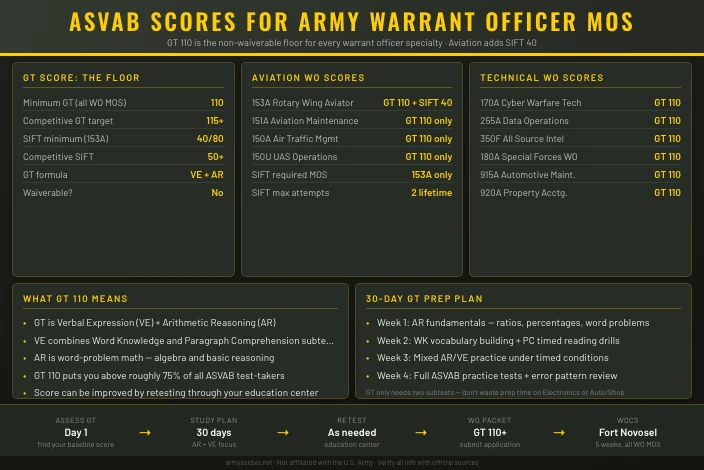
What the GT Score Actually Measures
The Army doesn’t use your overall ASVAB percentile to screen warrant officer candidates. It uses composite line scores built from specific subtest combinations. For warrant officers, only one composite matters: GT (General Technical).
GT is the sum of two subtest scores:
- VE (Verbal Expression) – itself a combination of Word Knowledge (WK) and Paragraph Comprehension (PC)
- AR (Arithmetic Reasoning) – word-problem math covering ratios, percentages, and algebraic reasoning
That’s it. Two subtests, one composite, one cutoff. A GT of 110 puts you above roughly 75% of all ASVAB test-takers. It’s a real threshold – not a rubber stamp – but it’s achievable with focused prep.
One thing worth knowing: the GT composite doesn’t care about Auto/Shop Information, Electronics Information, or Mechanical Comprehension. Those subtests feed other composites that matter for enlisted MOS but don’t factor into warrant officer eligibility at all. Prep time spent on them is wasted if GT is your only target.
How Warrant Officer Scores Differ from Enlisted and Officer Paths
Enlisted MOS selection uses multiple composites – Skilled Technical (ST), Electronics (EL), General Maintenance (GM), and others – depending on the job. An 11B infantry soldier needs a CO score of 87. A 68W combat medic needs ST 101. Different tests, different combinations.
Commissioned officers have it simpler on the ASVAB side: most just need GT 110. But officers have no SIFT requirement unless they’re in the aviation branch.
Warrant officers sit between both worlds. The ASVAB requirement is simpler than enlisted (one composite instead of several), but aviation warrant candidates must also pass the SIFT (Selection Instrument for Flight Training) – an entirely separate aptitude test with seven subtests that no enlisted soldier or non-aviation officer ever takes.
| Path | ASVAB Requirement | Additional Test |
|---|---|---|
| Enlisted MOS | 2-3 composites, varies by MOS | None |
| Commissioned Officer | GT 110 (most branches) | SIFT (aviation only) |
| Non-aviation Warrant | GT 110 | None |
| Aviation Warrant (153A) | GT 110 | SIFT 40 minimum |
The warrant officer ASVAB requirement is uniform across all 50+ specialties. The SIFT is the variable that separates aviation from everything else.
GT 110 Across All Non-Aviation Warrant MOS
Every non-aviation warrant officer MOS carries the same GT minimum: 110, non-waiverable. No exceptions appear across any of the profiles on this site. The table below covers the most commonly selected specialties.
| MOS | Title | GT Minimum | SIFT Required |
|---|---|---|---|
| 180A | Special Forces Warrant Officer | 110 | No |
| 170A | Cyber Warfare Technician | 110 | No |
| 255A | Data Operations Warrant Officer | 110 | No |
| 255N | Network Operations Warrant Officer | 110 | No |
| 255S | Cyberspace Defense Warrant Officer | 110 | No |
| 350F | All Source Intelligence Technician | 110 | No |
| 351L | Counterintelligence Technician | 110 | No |
| 351M | Human Intelligence Collection Technician | 110 | No |
| 352N | SIGINT Analysis Technician | 110 | No |
| 915A | Automotive Maintenance Warrant Officer | 110 | No |
| 915S | Stryker Maintenance Warrant Officer | 110 | No |
| 920A | Property Accounting Technician | 110 | No |
| 311A | CID Special Agent | 110 | No |
| 131A | Field Artillery Targeting Technician | 110 | No |
None of these MOS require any ASVAB composite beyond GT. The 350F (intelligence) and 311A (criminal investigation) are among the most competitive warrant officer packets, but the score requirement is identical: GT 110, nothing more.
Aviation Warrant Officer Scores: GT 110 Plus SIFT
Rotary-wing aviation is the one area where a second test enters the picture. The 153A Rotary Wing Aviator – the Army’s primary helicopter pilot designation – requires both a GT of 110 and a SIFT score of 40 out of 80.
When you purchase through links on our site, we may receive compensation at no extra cost to you.
Both the GT and SIFT require dedicated prep. An ASVAB prep course focuses on the AR and VE subtests that drive GT. If you’re targeting 153A or another aviation specialty, pair it with a SIFT prep course to cover spatial reasoning, Army aviation knowledge, and the math subtests specific to that exam.
The SIFT minimum of 40 is just that – a minimum. Competitive WOFT (Warrant Officer Flight Training) boards expect scores of 50 or higher. Strong packets push toward 60+. A score of 40 gets you technically eligible; it doesn’t make you competitive when other candidates are scoring in the 50s and 60s.
The SIFT has a hard lifetime limit of two attempts. A passing score cannot be retaken, even if you want a higher one. If you fail both attempts, you’re permanently disqualified from Army aviation as both a warrant officer and a commissioned officer. Treat the first attempt as your real attempt.
Aviation Warrant MOS and Their Score Requirements
| MOS | Title | GT Minimum | SIFT Required |
|---|---|---|---|
| 153A | Rotary Wing Aviator (WOFT) | 110 | Yes – 40 minimum |
| 151A | Aviation Maintenance Technician | 110 | No |
| 150A | Air Traffic and Airspace Management Technician | 110 | No |
| 150U | UAS Operations Technician | 110 | No |
The 151A, 150A, and 150U are aviation-related warrant specialties, but they do not require the SIFT. Only candidates entering the 153A track through Warrant Officer Flight Training must pass it. That’s true whether you’re applying as a civilian with no prior service (the “street to seat” path) or as a prior-enlisted soldier from CMF 15.
The 170A Exception: Civilians Can Apply
Most warrant officer MOS require prior enlisted service as a feeder. The 170A Cyber Warfare Technician is one of two warrant specialties that accepts civilian applicants with no prior military experience. The score requirement is still GT 110, no SIFT.
Civilian 170A applicants face a higher competitive bar in practice, because the Army wants documented technical competence – typically shown through industry certifications, relevant security clearance, and professional experience. The ASVAB score gets you eligible; the full packet gets you selected.
The Army evaluates civilian 170A applicants on the same GT minimum as prior-service soldiers. Targeting well above 110 (115 or higher) is advisable for civilian applicants who can’t offset a borderline score with years of operational experience.
Study Plan: Hitting GT 110
The GT composite is built from two subtests. Prep for those two and nothing else.
Verbal Expression combines Word Knowledge and Paragraph Comprehension. WK is vocabulary in context: given a sentence, pick the word that matches the underlined term’s meaning. PC is timed reading: short passages with 5-6 questions per passage. Both subtests reward readers who practice under time pressure, not just readers with large vocabularies.
Arithmetic Reasoning is word problems. The math itself tops out around algebra – percentages, ratios, rates, and basic geometry. The harder part is translating English sentences into equations quickly. AR feeds GT directly, and it’s also the subtest where targeted prep moves scores the most.
When you purchase through links on our site, we may receive compensation at no extra cost to you.
GT 110 is two subtests. An ASVAB study guide with section-specific AR and VE drills will move your score faster than a general ASVAB review that includes subtests you don’t need.
A practical four-week plan:
- Week 1: AR fundamentals – work through ratio, percentage, and rate problems at a slow pace. Get every step right before adding speed.
- Week 2: WK vocabulary and PC reading. Read actively every day. Practice answering PC questions under a strict two-minute-per-passage limit.
- Week 3: Mixed AR/VE timed sets. Simulate test conditions. Track which question types are still costing you points.
- Week 4: Full practice ASVAB tests. Focus your remaining time on error patterns from week three, not on reviewing topics you already know.
Candidates who score at or near 110 should plan to retest rather than submit a marginal packet. The score is non-waiverable, and a packet built around a barely-qualifying GT competes poorly against candidates who hit 115 or 120. Your education center can schedule a retest.
If You’re Also Targeting SIFT
The SIFT tests different cognitive abilities than the ASVAB. Spatial reasoning, aviation knowledge, and mechanical comprehension all appear on it – none of those feed into your GT score. Prep for the two tests separately and don’t let SIFT prep crowd out GT prep if your ASVAB score isn’t locked in yet.
SIFT prep should start at least 60 days before your test date. The spatial subtests (Spatial Apperception Test and Hidden Figures) require practice to build pattern recognition speed. Aviation knowledge (the AAIT subtest) requires specific study of rotary-wing systems, instruments, and flight principles. Neither is intuitive without preparation.
You may also find ASVAB line scores for every Army MOS and our Army ASVAB test prep guide helpful as you build your GT score and compare warrant officer requirements against other paths.
This site is not affiliated with the U.S. Army or any government agency. Verify all information with official Army sources before making enlistment or career decisions.