Best Combat Arms MOS for a Civilian Career
Combat arms is the hardest part of the Army to translate on a resume – and the easiest to translate in person. The skills are real: leadership under pressure, physical toughness, weapons proficiency, small-unit tactics. The challenge is that none of those things map cleanly to a job title on a LinkedIn profile. Some MOSs make that translation far easier than others. Picking the right one before you enlist can add years and tens of thousands of dollars to your post-service earnings.
This post ranks the major combat arms MOS families by civilian career value and explains exactly where each path leads after you separate.
Why Combat Arms Is Different From Other MOS Families
Most Army MOS have a direct civilian equivalent. A 68W works in emergency medicine. A 25U goes into IT. A 92A moves into supply chain management. The credential earns the interview.
Combat arms doesn’t work that way. There is no civilian job called “infantryman.” You can’t list “tank crew” on a construction application and expect a callback. The post-service value in combat arms comes from what the training builds in you – not from a specific technical skill set.
That matters because some combat arms MOS build more transferable technical skills alongside the leadership development. Engineers wire and demolish structures. Artillery operators run fire control systems. Air defense crews work sensor networks and tracking software. The more technical the job, the more direct the civilian application.
Three categories of post-service paths open up for most combat arms veterans:
- Law enforcement and federal agencies: Police departments, sheriff’s offices, Border Patrol, FBI, ATF, and federal corrections all actively recruit veterans. Infantry and armor veterans have a strong track record here.
- Defense contracting: Companies supporting the military need people who understand how the military operates – range safety officers, training support specialists, weapons system instructors, and logistics coordinators.
- Trades and construction: Engineer MOS in particular produce veterans with hands-on construction, demolition, and electrical skills that carry real civilian value.
Engineer MOS: The Best Civilian Starting Position
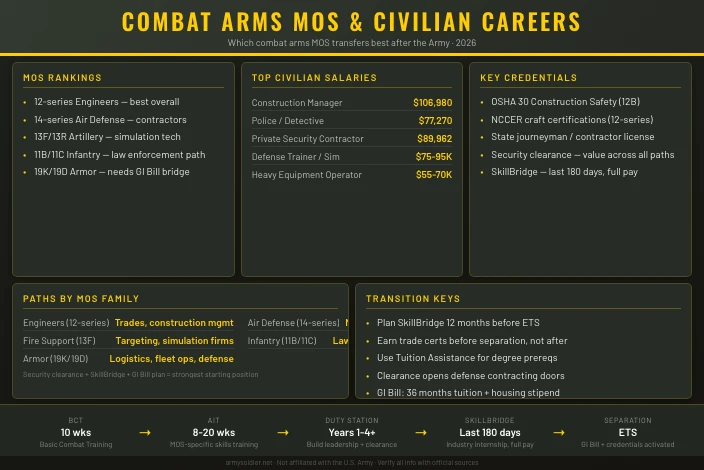
The Army Engineers career family produces the most directly employable combat arms veterans. The work involves construction, demolition, bridging, horizontal earthmoving, and electrical infrastructure – skills that map directly to licensed civilian trades.
12B (Combat Engineer) is the foundational MOS. Combat engineers breach obstacles, emplace and detect mines, and support assault operations. The OSHA construction safety training embedded in Army engineer courses translates to immediate value on any job site. Veterans leaving as an E-5 or E-6 with NCO leadership experience can realistically move into construction site supervisor or project lead roles.
The Army COOL program identifies certifications accessible to 12B veterans including the OSHA 30-hour construction safety credential, NCCER (National Center for Construction Education and Research) craft certifications, and state explosive handler licenses where applicable. The GI Bill covers school for a construction management degree or a contractor’s license exam prep course.
| Engineer MOS | Primary Civilian Path | Key Credential |
|---|---|---|
| 12B Combat Engineer | Construction, demolition, safety | OSHA 30, NCCER |
| 12N Horizontal Construction | Heavy equipment operation | CDL, NCCER earthwork |
| 12K Plumber | Licensed plumbing trades | State journeyman license |
| 12R Interior Electrician | Licensed electrical trades | State electrician license |
| 12W Carpentry and Masonry | Residential and commercial construction | State contractor license |
| 12P Prime Power | Generator and power grid work | NECA/IBEW apprenticeship |
Construction managers earned a median annual wage of $106,980 in 2024, per the Bureau of Labor Statistics, with the field projected to grow 9 percent through 2034. That’s a realistic ceiling for a 12B or 12N with a construction management degree funded by the GI Bill. Entry-level foreman work is accessible immediately after separation with the right certifications in hand.
Infantry MOS: Best Path to Law Enforcement
The infantry career family offers the clearest path into law enforcement and federal service. The daily job – small unit movement, threat assessment, use-of-force decisions, and team leadership – mirrors what police officers and federal agents do in a different context.
11B (Infantryman) and 11C (Indirect Fire Infantryman) are the two core MOSs. Police departments actively recruit veterans and often offer preference in hiring. The BLS reported a median wage of $77,270 for police and detectives in May 2024. Federal law enforcement roles – Border Patrol, FBI, DEA, ATF, and the U.S. Marshals – pay significantly more and draw heavily from the combat arms veteran pool.
Infantry NCOs with a combat deployment also compete well for private security management and government protective services. Firms supporting Department of State diplomatic security, for example, weight former infantry leaders heavily in their screening criteria.
The honest limitation: infantry translates well to law enforcement and security, but post-service options concentrate in those two fields unless you build additional credentials. Moving into corporate leadership, technology, or healthcare from a pure 11B background takes deliberate effort – usually a degree pursued using Tuition Assistance while still in uniform, or a SkillBridge placement before separation.
SkillBridge allows service members to complete an industry internship while still collecting full military pay – up to the last 180 days of active duty. Infantry veterans who arrange a SkillBridge placement in a target field well before their ETS significantly widen their post-service options beyond law enforcement.
Armor: Requires More Bridging Effort
Armor MOS – 19K (M1 Armor Crewmember) and 19D (Cavalry Scout) – have no direct civilian equivalent. Tanks don’t exist outside the military. The skills that transfer are the indirect ones: crew coordination, equipment readiness, communication under stress, and terrain analysis.
The strongest post-service paths for armor veterans run through logistics management, vehicle fleet operations, and defense contracting. Companies providing contractor support to armored units – maintenance contractors at installations like Fort Cavazos and Fort Stewart – value veterans who understand how armored platforms work and how units operate. Armor NCOs make competitive candidates for training support specialist roles and contractor-operated gunnery ranges.
Cavalry Scouts develop reconnaissance and intelligence collection skills that carry value in private security, fugitive recovery, and investigative support. The combination of mobile reconnaissance, land navigation, and small-unit leadership overlaps with federal investigative roles well enough that some scouts transition directly into Border Patrol, the U.S. Marshals, or law enforcement intelligence units.
The most realistic civilian paths from armor break down by MOS:
- 19D (Cavalry Scout): Federal law enforcement (Border Patrol, U.S. Marshals), private investigation, corporate security management, and intelligence analysis roles
- 19K (M1 Armor Crewmember): Fleet management, logistics coordination, defense contractor training support, and heavy vehicle operations
The path to higher-paying civilian work from 19K typically runs through education. An operations management or logistics degree, pursued while in service or immediately after using the GI Bill, puts armor veterans into supply chain and fleet management roles that pay competitively and don’t require any connection to tanks.
Artillery: Technical Depth Determines the Outcome
Field artillery splits into two groups by civilian value: fire direction and fire support roles on one side, and missile and air defense systems on the other.
13F (Fire Support Specialist) develops targeting, joint fires coordination, and digital communications skills that feed directly into defense contracting. Companies building targeting software, simulation systems, and fire control networks hire veterans who have worked those systems operationally. Training support and system integration roles at defense contractors routinely list fire support experience in their requirements.
Air defense MOS represent the strongest technical transfer in the artillery family. A 14E (Patriot Fire Control Enhanced Operator/Maintainer) or 14T (Patriot Launching Station Enhanced Operator/Maintainer) works on some of the most sophisticated sensor and missile systems in the U.S. inventory. Veterans with 14-series experience and a security clearance have a documented hiring advantage at missile defense contractors and across the broader aerospace and defense sector.
13B (Cannon Crewmember) has fewer specialized technical skills. The most common transitions for 13B veterans run toward operations coordination, logistics, and heavy equipment. The job builds strong maintenance habits and team coordination, but converting those into a high-earning civilian role takes more effort than 13F or 14-series paths.
| Artillery/Air Defense MOS | Best Civilian Path | Defense Contractor Interest |
|---|---|---|
| 14E Patriot Operator | Missile defense, aerospace firms | Very high |
| 14T Patriot Launching | Defense systems tech, maintenance | Very high |
| 13F Fire Support | Targeting, simulation, training tech | High |
| 13R Firefinder Radar | Radar and sensor operations | High |
| 13J Fire Control | Systems operations, technical training | Moderate |
| 13B Cannon Crew | Operations, logistics, heavy equipment | Low |
How the GI Bill and Transition Programs Fit In
The Post-9/11 GI Bill covers 36 months of education benefits: full in-state tuition at public universities, a monthly housing allowance pegged to the E-5 BAH rate at the school’s ZIP code, and up to $1,000 annually in book stipends. For combat arms veterans targeting fields that require a degree – construction management, criminal justice administration, operations management – this is the bridge.
The sequence matters more than the degree itself. Veterans who leave with these three things in place are positioned substantially better than those who separate without them:
- A security clearance, earned through any combat arms role with a background investigation
- A SkillBridge internship completed in the final six months of service
- A GI Bill plan targeting a specific degree or certification
The clearance alone is worth real money in the defense and government contracting sector. Many contracting firms will sponsor clearance upgrades, but getting hired in the first place without any clearance is harder. TAP (Transition Assistance Program) is mandatory before separation – use the optional Accessing Higher Education track if you plan to use the GI Bill, as it covers school selection, application timelines, and benefit activation in detail.
Ranked: Which Combat Arms MOS Transfers Best
If post-service career value is your primary goal, here is the honest ranking across the four main families:
1. Engineer MOS (12-series). Direct trade certifications, licensed career paths, and a construction labor market that pays well and consistently needs workers. The strongest overall starting position for any combat arms veteran.
2. Air defense MOS (14-series). The technical depth of Patriot and short-range air defense systems creates genuine civilian demand that other combat arms MOS can’t match. Very high contractor interest for veterans with clearances.
3. Fire support and radar (13F, 13R). A narrower market than 14-series but real demand from defense primes and simulation companies. Good path for veterans who enjoy technical work and want to stay adjacent to military operations.
4. Infantry (11B, 11C). The clearest, most accessible path to law enforcement and federal service careers. Less useful outside that lane without a degree or SkillBridge placement to complement it.
5. Armor (19K, 19D). Real leadership and logistics value, but civilian employers need help connecting those dots to a job title. Plan on using the GI Bill and budget extra time for the transition.
None of these is a wrong choice – every combat arms MOS builds something civilian employers notice. The difference is how much additional work each one requires to convert that experience into a competitive application.
For a broader look at the combat arms families and specific MOS available in each, the Army Combat Arms Jobs: Infantry, Armor, Artillery pillar covers the full picture. You may also find Best ASVAB Scores for Combat Arms MOS and 19D Cavalry Scout vs 19K Tanker useful when planning which job to target before you test.
This site is not affiliated with the U.S. Army or any government agency. Verify all information with official Army sources before making enlistment or career decisions.