Best Enlisted Aviation MOS for Civilian Jobs
Army aviation mechanics are in short supply in the civilian world. The commercial aviation industry faces a long-term technician shortage, defense contractors are competing for people with platform-specific experience, and helicopter EMS operators need licensed mechanics who can work fast under pressure. What you do in CMF 15 determines which of those doors opens for you after the Army. Some enlisted aviation MOSs set you up directly for an FAA mechanic certificate and airline hiring. Others push you toward defense contractors. A few do both.
Here is how the major 15-series maintenance MOSs stack up when the uniform comes off.
The A&P License: Why It Changes Everything
The Federal Aviation Administration’s Airframe and Powerplant (A&P) certificate is the entry ticket to civilian aviation maintenance. Airlines require it. Most MRO shops require it. Helicopter EMS operators require it. Without it, your military maintenance experience is difficult to market to civilian employers who cannot put you on an aircraft legally.
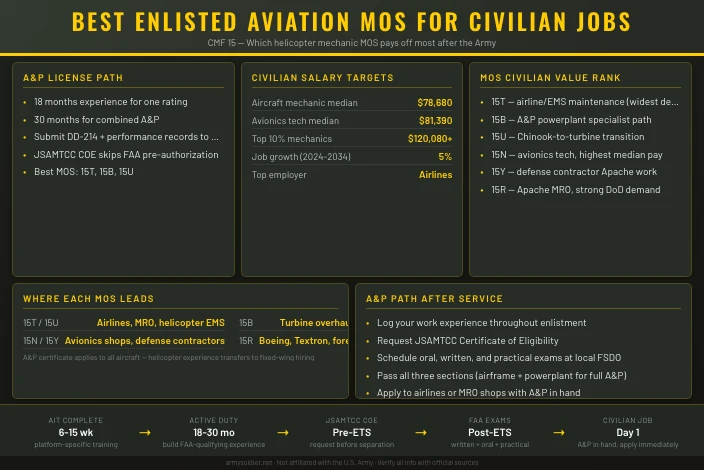
The good news is that military experience counts toward FAA eligibility. You need 18 months of documented hands-on experience with either airframes or powerplants to sit for one rating, or 30 months of concurrent experience with both to test for a combined A&P at the same time. The clock starts when you hit the flight line in your operational unit, not when you start AIT.
To qualify, you bring your DD-214, performance evaluation records, and a letter from your unit’s executive officer or classification officer to a local FAA Flight Standards District Office (FSDO). Veterans who obtain a Certificate of Eligibility (COE) from the Joint Service Aviation Maintenance Technician Certification Council (JSAMTCC) can skip the FAA pre-authorization interview entirely and go straight to scheduling the written, oral, and practical exams.
Three things matter here:
- The Army’s COOL program can cover prep costs for the written tests while you’re still serving
- Time in AIT does not count toward the experience requirement, only operational work does
- The A&P certificate names no specific aircraft, so helicopter experience qualifies you to maintain fixed-wing aircraft at civilian employers
The MOSs that produce the cleanest path to an A&P are the ones whose daily work maps directly to FAA airframe and powerplant work functions.
How the Six MOSs Compare
The six MOSs below are the ones civilian employers ask about most. They cover different aircraft systems and lead to different career outcomes, though all six leave you with transferable skills. Picking the right one before you enlist — or positioning yourself correctly before you separate — depends on understanding how each MOS maps to civilian hiring criteria.
| MOS | Specialty | A&P Path | Best Civilian Exit |
|---|---|---|---|
| 15T | UH-60 full airframe | Strong (airframe + powerplant) | Airlines, helicopter EMS, MRO |
| 15B | Turbine engines | Strong (powerplant) | Engine overhaul, airline powerplant shops |
| 15U | CH-47 full airframe | Strong (airframe + powerplant) | Heavy maintenance, MRO, airlines |
| 15N | Avionics systems | Partial (avionics-focused) | Avionics shops, defense contractors |
| 15Y | Apache weapons/avionics | Partial (electrical/avionics) | Defense contractors, foreign military |
| 15R | AH-64 full airframe | Moderate (airframe + powerplant) | Apache MRO, defense contractors |
The distinction between “strong” and “partial” A&P path matters. Avionics-focused MOSs like 15N and 15Y produce experience that overlaps with FAA avionics work, but the written tests and practical exams for the A&P certificate emphasize mechanical systems. Soldiers in those MOSs often need supplemental study or a short A&P program to fill the gaps before testing.
Two other factors separate these MOSs in civilian hiring beyond the A&P:
- Fleet size – MOSs tied to high-volume Army platforms (UH-60, CH-47) produce more veterans and more employer familiarity. Hiring managers at airline maintenance departments and helicopter EMS operators have processed many 15T and 15U candidates and know what the experience means.
- Clearance value – 15Y soldiers frequently hold Secret clearances from working on weapons systems. That clearance remains active for a period after separation and is directly marketable to defense contractors, adding a lane that purely mechanical MOSs don’t have by default.
Understanding both factors helps you evaluate your realistic exit options regardless of which MOS you currently hold.
15T: Widest Demand After Service
The 15T UH-60 Helicopter Repairer is the highest-volume maintenance MOS in CMF 15, and that volume works in your favor when you separate. More soldiers means more experienced veterans in the hiring pool, but it also means more recruiters who know exactly what a 15T did on active duty.
The Black Hawk’s T700 engine family is one of the most widely operated turboshaft platforms in the world. Sikorsky builds variants of the UH-60 that fly with dozens of foreign militaries, air ambulance operators, and fire suppression programs. Experience on the T700 is directly legible to civilian operators.
Helicopter EMS is a strong fit for 15T veterans. Air medical operators like Air Methods, PHI Health, and REACH Air Medical run fleets of UH-60-type and medium-twin aircraft. They want mechanics with rotorcraft maintenance experience, and an A&P certificate combined with 15T experience is close to the ideal candidate profile.
Airlines are also a realistic target. Major carriers like Delta, American, and United have long recruited from military aviation maintenance pipelines. A 15T with an A&P, a few years of post-service turbine experience, and a clean record is competitive for line maintenance positions that pay well above the national median.
Aircraft mechanics earn a median of $78,680 annually, with the top 10% exceeding $120,080. Airline mechanics typically sit at the upper end of that range.
15B: The Engine Specialist
The 15B Aircraft Powerplant Repairer works exclusively on turbine engines. That depth cuts in both directions. You build expert-level knowledge in powerplants, but your civilian path is narrower than a full-airframe MOS.
The powerplant A&P rating is the one 15B veterans test for immediately. The T700 and T55 engine families have direct civilian equivalents in the GE CT7 and other commercial turboshaft lines, and engine shops recognize the crossover. A 15B with documented operational hours on those engines can walk into a powerplant A&P practical exam with strong credentials.
Where 15B veterans typically land:
- Engine overhaul facilities – teardown, inspection, and rebuild of turboshaft and turboprop powerplants
- Airline engine maintenance departments – shop-level repair on commercial turbine variants
- Army depots – Corpus Christi Army Depot and similar facilities run by Boeing or Sikorsky
- Defense contractor programs – CH-47, Black Hawk, and Apache sustainment contracts
- OEM support roles – GE Aerospace and Honeywell hire technicians with turboshaft field experience for customer support and overhaul programs
The one constraint: powerplant-only experience requires supplemental airframe hours or coursework to earn a full A&P. Many 15B veterans pursue the powerplant rating first, then fill airframe hours through employer-sponsored on-the-job training or a short part-time AMTS course. Employers in the engine overhaul sector commonly sponsor this because retaining a trained turbine tech is worth the cost of filling the airframe gap.
Pay for engine shop technicians tracks close to the BLS median for aircraft mechanics. Senior powerplant techs at overhaul facilities and major airlines often earn in the $85,000–$110,000 range depending on location and employer.
15U: Chinook-to-Airline Pipeline
The 15U CH-47 Helicopter Repairer maintains the Army’s heavy-lift helicopter. The CH-47 is one of the most mechanically complex rotorcraft in service, with twin rotor systems, tandem transmissions, and a cargo configuration that puts the aircraft through more structural stress than most utility platforms.
That complexity is an advantage in hiring. A 15U veteran who has worked phase inspections on a CH-47F knows how to execute demanding maintenance tasks under pressure on a tight schedule. Heavy maintenance facilities and MRO shops value that background because their work is phase inspection-driven, and a technician who has run phase cycles on a tandem-rotor aircraft adapts quickly to heavy MRO environments on fixed-wing or large rotorcraft.
The 15U path to an A&P is clean. Work on both airframe and powerplant systems is routine in CMF 15U operations, so 30 months of service time can satisfy the combined experience requirement. The CH-47’s T55 engine family translates to turboshaft experience on large rotorcraft programs. Boeing and the Army Materiel Command also run CH-47 depot and field sustainment contracts that frequently hire 15U veterans at competitive rates, giving you a bridge job while you pursue civilian certifications.
Strong civilian fits for 15U veterans:
- MRO heavy maintenance – scheduled phase work on commercial and military helicopters
- Airlines – line and base maintenance programs that value rotorcraft structural experience
- Cargo and firefighting operators – large helicopter fleets with regular heavy maintenance cycles
- Boeing sustainment contracts – direct hire for CH-47 sustainment programs domestically and overseas
- Foreign military sales maintenance teams – countries operating CH-47s run contractor-staffed maintenance programs with competitive pay
The CH-47 flies with more than 20 nations, which means platform-specific experience stays marketable well beyond the U.S. military context.
15N: Avionics Tech, Higher Ceiling
The 15N Avionic Mechanic works on navigation systems, communication radios, flight computers, and electronic warfare systems. The civilian pay ceiling is higher than the mechanical MOSs.
Avionics technicians earn a median of $81,390 annually, with the top 10% earning more than $113,580. That premium reflects the specialized electronics knowledge required. Avionics shops at general aviation airports, commercial carriers, and helicopter operators need people who can work on navigation and communication systems, and former 15N soldiers arrive with verified system-level troubleshooting experience on military-grade avionics that most civilian-trained technicians have never touched.
The A&P path is the friction point. The certificate’s oral and practical exams cover mechanical airframe and powerplant systems in detail, and 15N work history is heavier on electronics than on mechanical systems. Many 15N veterans either pursue avionics technician roles without an A&P (legal and common in general aviation shops) or complete a short AMTS program to round out mechanical qualifications.
Where 15N veterans find strong demand:
- Defense contractors – Boeing Defense, L3Harris, and DRS Technologies hire avionics technicians with Army aircraft experience for depot-level maintenance contracts and systems integration work
- General aviation avionics shops – Garmin-authorized installers and avionics repair stations work on glass cockpit upgrades and navigation system repairs, with no A&P required
- Commercial airline avionics departments – line maintenance avionics roles at major carriers, where avionics work is separated from airframe/powerplant maintenance
- Foreign military sales programs – Army aviation exports include avionics-heavy platforms where contractors need technicians with U.S. military system familiarity
One advantage 15N veterans have over civilian-trained avionics techs: exposure to integrated electronic warfare and mission equipment systems. That background opens roles in government and defense that a commercial avionics cert alone doesn’t reach.
15Y and 15R: Defense Contractor Focus
The 15Y AH-64D Avionics and Armament Repairer and 15R AH-64 Attack Helicopter Repairer both focus on the Apache. That platform specialization creates a narrower civilian market but one with strong demand from specific employers.
Boeing holds the Apache production and maintenance contracts for both U.S. and foreign military customers. Former 15R and 15Y soldiers have an edge in Boeing’s defense maintenance programs because they know the platform from operational use, not just technical training. The same applies to Textron Aviation Defense and other contractors involved in Army aviation sustainment.
The 15R path to an A&P is workable. Apache maintenance covers both airframe and powerplant systems, so operational time builds toward the combined experience requirement. The 15Y’s avionics and weapons focus follows the same pattern as 15N when it comes to the mechanical gaps in the A&P exam — supplemental mechanical coursework or employer-sponsored OJT fills the gap for most veterans.
Civilian exit routes for 15R and 15Y veterans:
- Boeing Defense sustainment programs – Apache production support, modification programs, and depot maintenance contracts at Mesa, AZ and other Boeing sites
- Foreign military sales contractor roles – on-site maintenance support at international Apache operator bases, typically at day rates that significantly exceed domestic pay
- U.S. Army Apache field support – contractor field service representative (FSR) positions embedded with operational units
- Cleared defense contractor positions – weapons system integration and avionics roles that require Secret or TS clearance, where Apache experience is directly applicable
Countries operating AH-64s include Israel, the UAE, the Netherlands, Saudi Arabia, Greece, South Korea, and Japan. That global fleet means long-term demand for qualified maintenance technicians on foreign military sales contracts, and 15R or 15Y veterans with a current clearance are near the top of the candidate list for those positions.
Which MOS Should You Choose for Civilian Payoff
If you haven’t enlisted yet and civilian career value is the deciding factor, the ranking looks like this:
- 15T – highest civilian demand volume, strongest airline pipeline, helicopter EMS access
- 15U – similar profile to 15T with heavier maintenance emphasis, strong MRO value
- 15B – deepest powerplant expertise, clean path to powerplant A&P, engine overhaul jobs
- 15N – highest pay ceiling in avionics, strong defense contractor demand, different A&P path
- 15R – platform-specific but Boeing and contractor demand is consistent
- 15Y – narrow civilian market, premium defense contractor pay, requires active clearance
That ranking assumes you want the widest range of civilian options after service. If your goal is specifically defense contractor work — and you’re comfortable with clearance maintenance obligations — then 15Y and 15R move up because the premium pay on foreign military sales contracts can exceed what airline line maintenance pays.
If you’re already in CMF 15 and planning ahead, your current MOS doesn’t limit you as much as the quality of your experience log does. Three actions that apply to every 15-series soldier regardless of MOS:
- Document every maintenance action in your personal records, not just what your unit tracks. The FAA accepts records you bring; they don’t pull Army maintenance systems directly.
- Request JSAMTCC eligibility before your ETS date. The JSAMTCC process takes time, and having the Certificate of Eligibility ready means you can schedule A&P exams immediately after separation rather than waiting months.
- Use Army COOL while you’re still serving. COOL funding for A&P written test preparation is a benefit that expires when you leave. Soldiers who use it save $300–$500 in out-of-pocket prep costs.
The A&P certificate is what converts your military maintenance time into civilian wages. No matter which platform you worked on, getting that certificate before or immediately after separation shortens the gap between leaving the Army and reaching full civilian earning potential.
The Army aviation careers page has full profiles for each MOS, including ASVAB score requirements, training pipeline details, and duty station options.
For the full breakdown of all three Army aviation career tracks, see Army Aviation Jobs: Enlisted, Warrant, and Officer. You may also find ASVAB scores for Army aviation MOS jobs helpful if you’re still deciding which 15-series MOS to target.
This site is not affiliated with the U.S. Army or any government agency. Verify all information with official Army sources before making enlistment or career decisions.