Can You Be a 68W in the Army Reserve?
The short answer is yes. The 68W Combat Medic is one of the most widely available MOS jobs across both the Army Reserve and Army National Guard. You go through the same training as active-duty medics, earn a nationally recognized emergency medicine credential, and drill with units that genuinely need your skills. But the part-time structure changes everything from your daily schedule to how deployments work to how your military training connects with a civilian healthcare career.
Here’s what that actually looks like.
Training: Same Pipeline, Same Credential
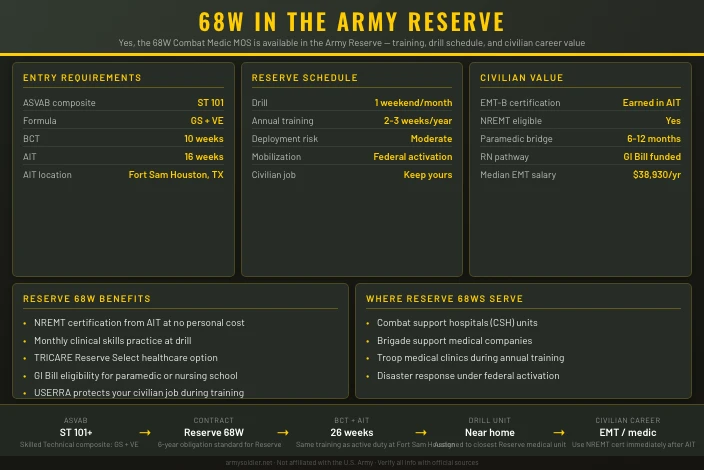
Reserve and Guard 68Ws attend the exact same training as their active-duty counterparts. There is no shortened or alternate version.
Basic Combat Training (BCT) runs 10 weeks at Fort Jackson, SC, Fort Moore, GA, or Fort Leonard Wood, MO. Every Army recruit goes through it regardless of component.
Advanced Individual Training (AIT) runs 16 to 18 weeks at Brooke Army Medical Center in San Antonio, TX. You study anatomy, pharmacology, trauma care, airway management, hemorrhage control, and casualty evacuation. The curriculum is identical to what active-duty 68W students complete.
At the end of AIT, you sit for the National Registry EMT (NREMT) exam. Pass it and you hold a civilian emergency medicine credential recognized in all 50 states. That certification belongs to you, not to your branch of service. You carry it whether you’re drilling one weekend a month or working a full-time EMS shift the other 28 days.
The ASVAB requirements are the same too: a minimum Skilled Technical (ST) score of 101 and General Technical (GT) score of 107. Reserve and Guard recruiters use the same qualifying standards as active-duty recruiters.
Total initial training time is roughly six to seven months, including BCT and AIT. During that period you’re on full-time active orders and receiving full active-duty pay and benefits. Once training ends, you return home and transition to the part-time drill schedule.
Drill Duties: What You Actually Do on Weekends
The standard Reserve and Guard commitment is one weekend per month plus two weeks of Annual Training each year. For most MOS jobs that’s close to the ceiling. For 68W it’s closer to a floor.
Medical skills are perishable. Units know this, and they build extra training requirements around it.
What 68Ws commonly do at drill:
- Run sick call and handle walk-in medical complaints for unit soldiers
- Conduct Combat Lifesaver (CLS) instruction for non-medical personnel
- Maintain and inventory medical equipment and aid bag supplies
- Run mass casualty (MASCAL) exercises
- Complete Tactical Combat Casualty Care (TCCC) refresher training
- Maintain NREMT recertification requirements (renewal every two years)
Some units schedule additional medical training days between official drill weekends, particularly before deployment cycles or after a long training gap. That’s not unusual, and it’s worth asking about before you sign.
The demand is real, but so is the benefit. A Reserve 68W who drills consistently will run more medical scenarios in a year than many civilian EMTs see in the same period.
Deployment: Medical Units Go
Combat medics deploy at higher rates than most other Reserve and Guard MOS jobs. The reason is straightforward: every infantry battalion, armor unit, aviation company, and logistics element needs organic medical support. When those units mobilize, their 68Ws go with them.
Reserve and Guard 68Ws have deployed in support of Operation Iraqi Freedom, Operation Enduring Freedom, and ongoing theater security missions in the Middle East, Europe, and the Pacific. Deployment frequency depends on your specific unit’s mission and readiness posture.
What to expect:
| Factor | Active Duty | Army Reserve / National Guard |
|---|---|---|
| Deployment trigger | Unit rotation schedule | Unit mobilization orders |
| Typical length | 9-12 months | 9-12 months |
| Frequency | Roughly once every 24-36 months | Varies by unit; less predictable |
| Notice | Months in advance | Mobilization timelines vary |
Active-duty units operate on a predictable deployment rotation. Reserve and Guard units mobilize when needs arise, which can mean shorter notice and less regular intervals. If you drill with a combat support unit, plan for a real deployment possibility during your service commitment.
The National Guard adds one layer active-duty doesn’t have: state activation. Governors can call Guard units for domestic emergencies, natural disasters, or civil support missions. Medics are among the first activated in those scenarios.
Pay: Part-Time Numbers
Pay for drills is calculated per “drill period,” with a standard drill weekend counting as four drill periods.
An E-4 Specialist with four years of service earns $3,659 per month on active duty. The same soldier drilling in the Reserve or Guard earns approximately $488 for a standard drill weekend. Annual Training at two weeks adds roughly $1,827 at that same pay grade.
Part-time military pay is designed to supplement civilian income, not replace it. Most Reserve and Guard 68Ws treat it as a bonus on top of their EMS, hospital, or fire department paycheck.
Benefits differ significantly from active duty:
- Healthcare: Tricare Reserve Select at $57.88 per month for the service member alone, or $286.66 per month for member plus family. Active-duty TRICARE has no premium.
- Education: The Montgomery GI Bill Selected Reserve (MGIB-SR) pays $493 per month for full-time students. Federal Tuition Assistance covers $250 per credit hour, capped at $4,500 per year. National Guard members may also qualify for state tuition waivers, which cover 100% of in-state public school tuition in many states.
- Retirement: Points-based, with the pension starting at age 60. Active-duty retirement pays immediately after 20 years of service.
If your civilian employer provides health insurance, compare it against Tricare Reserve Select before deciding which plan to use. Many 68Ws working full-time in healthcare already have employer-sponsored coverage that makes TRS redundant.
How This MOS Fits a Civilian Healthcare Career
The 68W-to-civilian career path is cleaner in the Reserve and Guard than in almost any other MOS. Your military schedule and your civilian schedule are designed to coexist.
EMS and fire departments operate on rotating shift schedules, typically 24 hours on and 48 hours off. That structure fits drill weekends well. Many departments actively recruit military medics because TCCC training translates directly to street medicine.
Common civilian jobs held by Reserve and Guard 68Ws:
- EMT or paramedic with a county EMS agency or private ambulance service
- Emergency room technician or trauma tech at a hospital
- Firefighter-medic with a department that integrates EMS functions
- Flight medic (requires additional civilian certifications beyond NREMT)
USERRA protects your position. The Uniformed Services Employment and Reemployment Rights Act requires your employer to hold your job, or an equivalent one, when you return from military duty. They can’t demote you, cut your benefits, or terminate you because of your service commitment.
Nursing school and paramedic programs often credit 68W training toward clinical hours. Some schools grant advanced standing based on your NREMT certification and documented military medical experience. If you plan to attend nursing school while drilling, ask the program director before you enroll. The answer matters for your timeline.
Active Duty vs Reserve 68W: Daily Life
The jobs are the same on paper. The daily reality is completely different.
Active-duty 68W:
- Works full-time at a battalion aid station, troop medical clinic, or in the field
- Deploys on a unit rotation, typically once every two to three years for nine to twelve months
- Moves duty stations every two to four years
- Has access to full TRICARE, Post-9/11 GI Bill, and on-post housing
Reserve or Guard 68W:
- Maintains a civilian career Monday through Friday
- Drills one weekend per month plus two weeks of Annual Training
- Deploys when the unit mobilizes, not on a fixed rotation
- Keeps civilian roots, home, and personal network intact
Neither version is superior. Active duty builds clinical volume faster and provides more consistent pay and benefits. The Reserve and Guard path lets you stay in your community, build a civilian career in parallel, and still serve.
Some 68Ws do both in sequence. They complete a first term on active duty, build their NREMT and military experience, then transition to the Reserve or Guard while entering civilian healthcare. That combination is one of the most effective career-building strategies available to someone entering the medical field without a college degree.
For a full breakdown of duties, qualifications, pay, and training, see the 68W Combat Medic career profile.
This site is not affiliated with the U.S. Army or any government agency. Verify all information with official Army sources before making enlistment or career decisions.
You may also find Active Duty vs Army Reserve vs National Guard and Best Army Reserve MOS Jobs for Civilian Careers helpful.