Day in the Life of an Army Soldier
Most people picture Army life as either a war movie or a recruiting ad. The reality sits somewhere between the two, and it changes completely depending on whether you’re in garrison or out in the field. Here’s an honest, hour-by-hour look at both.
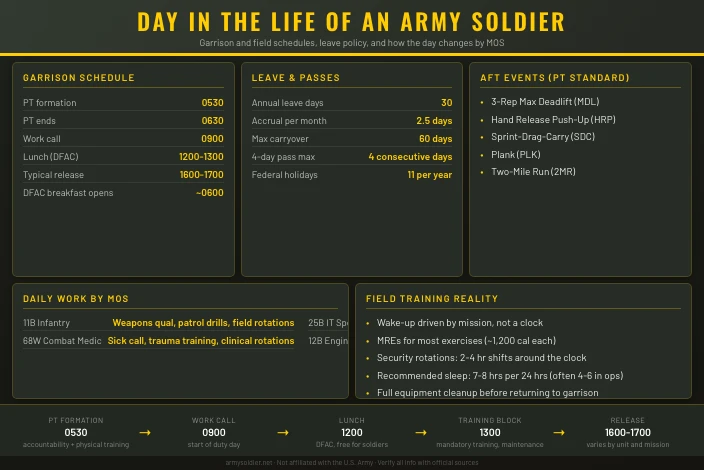
A Garrison Day: 0530 to Release
Garrison means you’re on post, living or working out of a permanent installation. No tents, no sleeping in the dirt. This is the baseline schedule most soldiers experience on any given weekday.
0530: PT Formation. The alarm goes off before the sun does. Soldiers form up in physical training gear for morning accountability. Unit physical training usually runs until about 0630 and can include runs, calisthenics, ruck marches, or a structured workout from the Army Fitness Test (AFT) event list. The AFT covers five events: the 3-rep max deadlift, hand release push-up, sprint-drag-carry, plank, and two-mile run. Daily PT isn’t a formal test, but units use those same movements to build toward it.
0630 to 0900. After PT, soldiers shower, change into uniform, and head to the DFAC (dining facility) for breakfast. Breakfast hours vary by installation but typically open by 0600. Work call is usually 0900, marking the official start of the duty day.
0900 to 1200. The morning block is where schedules diverge hard by MOS. An 11B Infantryman might spend this block on weapons qualification, land navigation, or small unit tactics rehearsals. A 25B IT Specialist is more likely troubleshooting network tickets or supporting a help desk. A 68W Combat Medic might run sick call, train on trauma scenarios, or work in a troop medical clinic. Same Army, very different mornings.
1200 to 1300. Lunch. The DFAC is the center of midday life on post. Hot food, a full tray, no cost. Soldiers get about an hour.
1300 to 1700. The afternoon block picks up where the morning left off. Mandatory training like sexual harassment prevention, weapons safety, or Army Readiness Assessments often lands here. Maintenance days fit in this window too, with units spending hours cleaning and servicing vehicles and equipment. On lighter days, soldiers wrap up around 1600.
Evening release. Most soldiers are off by 1700. What happens after that depends on the individual. On-post gym, hanging out in the barracks, or catching a meal off post. Soldiers in the barracks have a bit less freedom than those living off post, but evenings are generally their own.
Junior soldiers also pull additional duties that eat into evenings. Staff duty is an overnight administrative shift where one soldier from the unit stays in the building to handle emergencies and log activities. Guard duty at a gate or sensitive area works similarly. These details rotate through the junior enlisted ranks, so new soldiers can expect to pull them once every few weeks depending on unit size.
No two days are exactly the same. A training holiday can make Wednesday feel like Saturday. A last-minute tasking can turn a 1700 release into a midnight finish. That unpredictability is part of the deal.
How the Day Changes by MOS
The garrison framework above applies broadly, but the content of the work hours looks nothing alike across career fields.
| MOS Type | Typical Morning Work | Typical Afternoon Work |
|---|---|---|
| Infantry (11B) | Rifle qualification, patrol exercises, ruck PT | Maintenance, squad tactics, range prep |
| IT Specialist (25B) | Network support, help desk tickets, equipment setup | Cybersecurity training, system updates |
| Combat Medic (68W) | Sick call, trauma training, medication management | Clinical rotations, readiness reporting |
| Combat Engineer (12B) | Demolition training, obstacle construction | Equipment maintenance, bridging operations |
The skill you build every day directly reflects your MOS. Infantry soldiers become tactically sharp. Medics gain clinical hours. IT specialists work real systems. The training pipeline starts in basic, but the real skill development happens here, in the daily grind of the duty day.
Choosing the right MOS shapes not just your job, but how every day actually feels. A soldier who wants to be outside, moving, and tested physically will have a very different experience than one who wants to sit in a climate-controlled environment solving technical problems. Both paths exist in the same Army. Browse the enlisted career families to see which daily reality fits what you’re looking for.
A Field Day: Everything Changes
Garrison is structured. The field is not. When a unit moves to a training area for an exercise (anything from a two-day bivouac to a month-long rotation at a combat training center), the schedule gets rebuilt from scratch.
Field exercises happen throughout the year. A short tactical exercise might run two to five days. A full rotation at the National Training Center (NTC) at Fort Irwin, California, or the Joint Readiness Training Center (JRTC) at Fort Johnson, Louisiana, can run three weeks or longer. These rotations test everything the unit has trained at home station and push soldiers harder than most garrison duty ever does.
Wake-up happens when the mission demands it. On a quiet night, that might be 0500. During a 24-hour operations cycle, there is no traditional wake-up at all. Soldiers rotate on and off security duty in two to four hour shifts, catching sleep when they can in a sleeping bag under camouflage netting.
Eating in the field means MREs (Meals Ready to Eat) for most exercises. Each MRE runs about 1,200 calories and comes with an entree, snacks, and a chemical heating pouch. Soldiers eat when there’s a break in the mission. On longer exercises at larger training areas, units may get hot chow delivered from a field kitchen, but that’s not guaranteed.
The ops cycle follows the mission, not the clock. A typical training day might run through:
- Pre-dawn movement to an objective
- Actions on the objective (assault, defend, or recon)
- Consolidation and reorganization
- After-action review (AAR)
- Refit and resupply before the next mission
Rest is a resource, treated the same as ammo or fuel. Army doctrine recommends 7 to 8 hours of sleep per 24-hour period, but during sustained operations that number often drops to 4 to 6 hours. Leaders rotate soldiers through rest cycles to maintain combat effectiveness. Sleeping in the field means a sleeping bag on the ground, or inside a vehicle if the mission allows it. There are no barracks beds, no pillows, and no privacy.
Coming back from the field means cleaning every weapon, vehicle, and piece of equipment before anything else happens. That process can take a full day after returning to garrison. Soldiers call it “weapons and equipment maintenance,” and there’s no leaving until the sergeant inspects and signs off. The field may have ended, but the work hasn’t.
Weekends, Leave, and 4-Day Passes
The Army doesn’t run on a Monday-through-Friday schedule, but weekends in garrison are mostly free when no training is scheduled. Soldiers get 30 days of paid leave per year, accruing at 2.5 days per month. They can carry up to 60 days forward into the next fiscal year.
Commanders can authorize a 4-day pass for long weekends, particularly around federal holidays. A pass doesn’t count against leave days, but it can’t exceed four consecutive days. Anything beyond that comes out of the soldier’s leave balance.
How freely leave gets approved depends on the unit’s training calendar. Units preparing for a deployment or a major rotation tend to lock down leave. Units in garrison between cycles are more flexible. New soldiers should expect limited leave in their first few months while they get settled into the unit.
What Makes the Day Feel Long or Short
Leadership is the honest answer. A good first sergeant runs a tight, predictable schedule. Soldiers know when they’ll be released, they know what’s on the training calendar, and they can plan their lives around it. A disorganized unit runs on rumor and last-minute changes. That’s where the “Army Hurry Up and Wait” reputation comes from.
Your MOS shapes the day just as much. Combat arms soldiers spend more days in the field and more time on physical and tactical training. Technical MOS soldiers spend more time at a desk or in a maintenance bay. Neither is objectively harder, just different.
Your installation rounds out the picture. Soldiers at large stateside posts like Fort Cavazos or Fort Campbell tend to have more structure and resources. Smaller installations or overseas duty stations can feel more isolated but sometimes offer more independence. The duty station guide breaks down what that looks like across the Army’s major installations.
The Army benefits package covers housing, healthcare, and steady pay regardless of how busy the day gets. What varies is how much of your day you actually control.
Explore the full range of Army enlisted careers to see how daily life stacks up across different MOS families. What Happens at Army Basic Training covers the ten weeks that come before your first real duty day. For the bigger picture beyond any single day, What Army Life Is Really Like in 2026 is the best starting point.
This site is not affiliated with the U.S. Army or any government agency. Verify all information with official Army sources before making enlistment or career decisions.