Highest-Paying Army MOS Jobs
Most people compare Army pay by looking at basic pay tables, and those tables don’t tell the full story. A Specialist pulling aviation flight pay can take home more each month than a Sergeant in a standard infantry unit. A cyber operator who signs a six-year contract walks away from MEPS with a check that rivals a year of civilian wages. Pay in the Army is a package: base pay plus allowances plus bonuses plus special incentive pays, and the mix varies a lot by MOS.
This post breaks down which enlisted jobs carry the highest total compensation, where the biggest upside comes from, and what you typically need to qualify.
How Army Pay Actually Works
Basic pay is just the starting point. Every Soldier earns it, and it scales the same way for everyone at the same rank and years of service. What separates the high earners from everyone else is what gets added on top.
The four layers of Army compensation:
- Basic Pay: monthly taxable pay based on rank (E-grade) and time in service
- BAH (Basic Allowance for Housing): non-taxable, varies by duty station and dependent status
- BAS (Basic Allowance for Subsistence): flat $476.95/month for enlisted in 2026
- Special and Incentive Pays: flight pay, hazardous duty pay, dive pay, enlistment bonuses, and more
The MOS you choose determines whether you access those top layers. An E-4 Specialist in an aviation MOS with flight pay earns more per month than an E-5 Sergeant in a job with no special pays. That gap is real, and it compounds over a career.
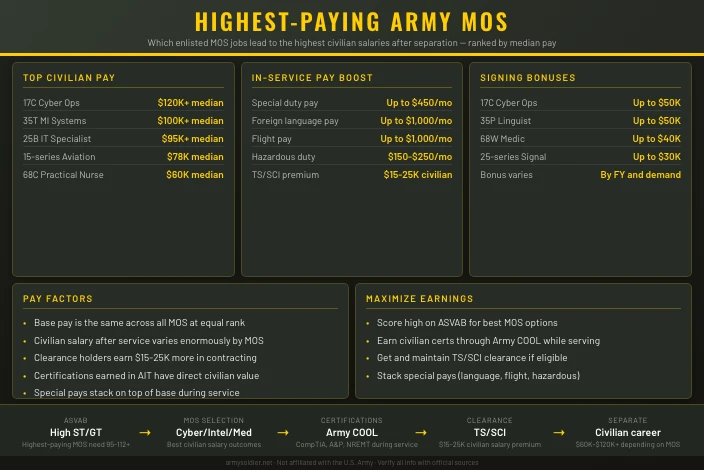
One other factor: enlistment bonuses are front-loaded cash that doesn’t recur, but for high-demand jobs they can reach $42,000 or more on a six-year contract. That changes the math significantly for the first enlistment.
Aviation: The Biggest Monthly Incentive Pays
Army aviation warrant officers are among the highest-compensated Soldiers in any given rank. The reason is straightforward: flight pay stacks on top of base pay and allowances, and it scales with years of aviation service.
Aviation Incentive Pay (AvIP) rates for Army officers and warrant officers:
| Years of Aviation Service | Monthly AvIP |
|---|---|
| 2 or less | $125 |
| Over 2 | $200 |
| Over 6 | $700 |
| Over 10 | $1,000 |
| Over 22 | $700 |
| Over 24 | $400 |
A Chief Warrant Officer 3 (W-3) with ten-plus years of service earns $6,911/month in base pay plus $1,000/month in flight pay. Add BAH at a mid-cost installation and BAS, and total monthly compensation before taxes can clear $10,000 or more depending on location.
153A (Rotary Wing Aviator) is the primary path to this pay. These are helicopter pilots. The warrant officer route, Warrant Officer Flight Training (WOFT), is open to civilians with no prior military service, not just active-duty Soldiers. Aviation Continuation Pay (ACP), a retention incentive, can add up to $25,000 per year for pilots who agree to extended service commitments.
Enlisted crew members don’t get ACIP, but they do earn Hazardous Duty Incentive Pay (HDIP) for flight duty: up to $240/month for E-7 through E-9 and $150-$240 for lower grades. It’s smaller than officer flight pay, but it adds up over a career.
Cyber and Intelligence: Bonus Money Up Front
Cyber and intelligence MOSes don’t pay flight-level monthly bonuses, but they make up for it at the front end with enlistment bonuses. In some cases, retention bonuses keep paying throughout a career.
17C (Cyber Operations Specialist) is one of the most bonus-eligible jobs in the Army. It requires an ASVAB Skilled Technical (ST) score of 112, a security clearance, and a lengthy training pipeline. That combination makes 17C hard to fill, which drives the bonus tier up. Contracts of six years in cyber and related intelligence MOSes have reached $42,000 under recent Army bonus charts.
35P (Signals Intelligence Voice Interceptor) is another high-bonus job, particularly for applicants who arrive with qualifying foreign language skills. Bonuses for 35P have reached $40,000 for six-year contracts in some bonus periods.
35L (Counterintelligence Agent) and 35N (Signals Intelligence Analyst) also sit in elevated bonus tiers. These jobs require GT scores in the 100+ range and often require polygraph clearances. The combination of high qualification barriers and chronic Army need keeps the bonus levels elevated.
Beyond enlistment, cleared cyber and intelligence Soldiers who stay past the ten-year mark can access selective retention bonuses. The Army has run targeted programs specifically to retain E-5 and E-6 cyber operators who might otherwise leave for private-sector security jobs paying twice their military salary.
Medical: Steady Pay Plus Skill-Based Upside
Army medical MOSes don’t carry the same headline bonus numbers as cyber, but they offer a different kind of financial stability: specialized training that translates to licensed civilian careers, combined with solid base pay and room for promotion.
68W (Combat Medic Specialist) is the most well-known medical MOS. It requires a Skilled Technical (ST) score of 101 and produces graduates with EMT-Basic certification and a foundation in emergency trauma care. 68W sits in a mid-tier bonus range, and experienced Combat Medics who complete advanced training can earn additional incentive pays.
68D (Operating Room Specialist) trains Soldiers in surgical assist procedures. It requires an ST of 101 as well. The civilian equivalent, surgical technologist, earns a median of around $60,000 per year, which makes this MOS worth considerably more in post-service earning power than its base pay alone suggests.
More specialized medical MOSes carry higher ASVAB requirements and different pay profiles:
| MOS | Title | ASVAB Requirement |
|---|---|---|
| 68W | Combat Medic Specialist | ST 101 |
| 68D | Operating Room Specialist | ST 101 |
| 68E | Dental Specialist | ST 101 |
| 68J | Medical Logistics Specialist | CL 90 |
| 68S | Preventive Medicine Specialist | ST 101 |
| 68X | Behavioral Health Specialist | ST 101 |
For Soldiers who eventually want to pursue healthcare officer commissioning programs (like 68W moving toward officer medical roles), the training pipeline builds credentials that accelerate that path. That long-term earning trajectory is part of the total compensation picture.
EOD and Hazardous Duty: High-Risk, High Reward
Explosive Ordnance Disposal (EOD) and a handful of other hazardous duty specialties carry incentive pays specifically because of the physical risk involved.
89D (Explosive Ordnance Disposal Specialist) is one of the most physically demanding and psychologically difficult jobs in the Army. It requires a Skilled Technical (ST) score of 112, matching 17C for ASVAB difficulty, and a demanding selection pipeline. EOD Soldiers receive Hazardous Duty Incentive Pay (HDIP) for demolition duty on top of base pay.
12D (Diver) also earns hazardous duty pay. Army divers support combat and construction operations underwater, and dive pay adds to their monthly compensation. DFAS publishes the dive pay tables, and rates scale by certification level.
Parachutist and HALO pay are also HDIP categories. Standard static-line parachutists earn $150/month. Soldiers qualified for High-Altitude Low-Opening (HALO) jumps earn $225/month. For Special Operations Soldiers who combine multiple HDIP categories, the Army allows up to two types of HDIP simultaneously, which means two monthly incentive streams running in parallel.
Special Forces and Ranger-Track: Bonuses at Every Gate
Special Operations jobs carry both enlistment bonuses and multiple milestone bonuses tied to pipeline completion.
18X (Special Forces Candidate) contracts include an Airborne Bonus up to $10,000 plus a Ranger Bonus up to $20,000 for those who complete Ranger School, and the 18-series MOS bonus on top of that once the full Special Forces Qualification Course is complete. A Soldier who goes in as 18X and completes the full pipeline can stack multiple bonuses across the enlistment.
37F (Psychological Operations Specialist) and 38B (Civil Affairs Specialist) are SOF-adjacent jobs that also carry elevated bonuses due to the selectivity and length of their training pipelines.
These are not the highest base-pay jobs in the Army, but the front-loaded bonus structure and the access to hazardous duty pays during deployment cycles push their total first-term compensation above many higher-ranking garrison jobs.
How to Maximize Total Compensation: What to Weigh
No single formula ranks every MOS by pay because the variables interact: a six-year cyber contract with a $42,000 bonus averages out differently than a three-year contract with flight pay starting at $700/month after year six. The time horizon matters.
Factors that drive total first-term pay up:
- Enlistment length (longer = more bonus)
- MOS bonus tier (driven by Army shortage, training cost, and qualification difficulty)
- Special pays eligibility (flight, dive, jump, EOD)
- Duty station BAH rate (high-cost locations like Northern Virginia or Hawaii add thousands per month)
- Security clearance (opens access to cleared civilian jobs after service, extending the pay advantage beyond separation)
What to watch out for:
- Bonus timing: most Army enlistment bonuses pay 50% at Basic Training graduation and the rest across subsequent years
- Bonus eligibility is not guaranteed at signing. It depends on the current HRC bonus list, which updates frequently.
- High-bonus MOSes often carry longer Active Duty Service Obligations (ADSOs) that delay separation
The jobs in this post rank well across multiple dimensions: Army jobs that transfer to civilian careers often overlap heavily with the high-pay list because the skills that earn bonuses in the Army are the same ones employers compete for on the outside. If you’re evaluating MOS options from a total-compensation standpoint, the Best Army Jobs for 2026 breakdown covers the full picture across pay, training, and post-service value.
Browse the full Army enlisted careers directory to compare MOS requirements, training pipelines, and career progression across every career family.
This site is not affiliated with the U.S. Army or any government agency. Verify all information with official Army sources before making enlistment or career decisions.