How to Become an Army Helicopter Pilot (WOFT)
Most civilian flight school programs cost $80,000 or more and still don’t guarantee a career. The Army’s Warrant Officer Flight Training program gives you free flight training, a warrant officer commission, and a 10-year flying career – if you can get selected. The program accepts civilians with zero military experience, no flight hours, and just a high school diploma. The bar is not low, but it’s a different kind of bar than most people expect.
Here’s exactly how the program works, from first eligibility check to your first duty assignment flying Black Hawks or Apaches.
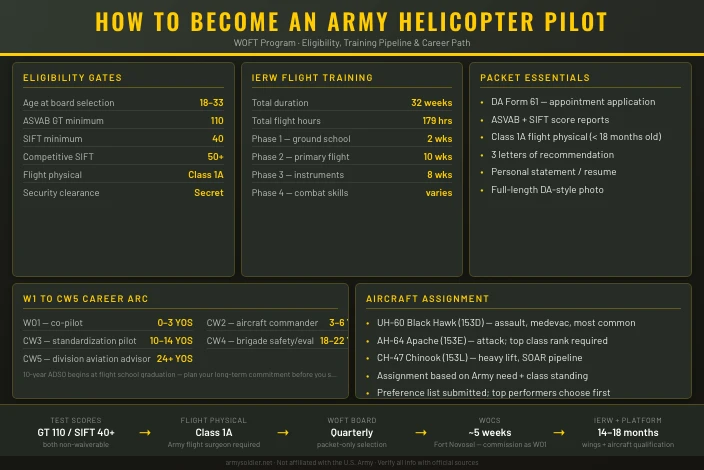
Eligibility: What You Need Before Applying
The WOFT program has a short list of hard requirements. None of them are waiverable once you’re past the age limit.
Basic eligibility:
- U.S. citizen
- Age 18-33 at the time of board selection (not enlistment – know the difference)
- High school diploma (GED accepted for select applicants with college credits)
- Height 64-76 inches
- Secret security clearance (background, local agency, and credit checks)
Test scores (both non-waiverable):
- GT score of 110 on the ASVAB – this is the General Technical composite, calculated as Verbal Expression plus Arithmetic Reasoning
- SIFT score of 40 – the Selection Instrument for Flight Training, scored on a 20-80 scale
The SIFT minimum gets you in the door. A score of 50 or above makes your packet competitive. Boards see the full range of applicants, and a 40 next to a 62 is not a coin flip. The SIFT study guide covers all seven subtests and how to score well on the ones that trip most candidates.
Flight physical:
You need a Class 1A Army flight physical, performed by an Army flight surgeon and valid within 18 months of application. Vision must be correctable to 20/20 (no worse than 20/50 uncorrected), with normal color vision and depth perception. Get this physical early – it’s the most common source of unexpected disqualifications, and finding out after you’ve built a packet is a hard way to learn.
Building the Application Packet
The WOFT application packet is not a form – it’s a file that a selection board reads to decide whether to invest $500,000+ in flight training on you. Weak letters or a generic personal statement will not help a marginal test score.
What goes in the civilian WOFT packet:
- DA Form 61 (Application for Appointment as Warrant Officer)
- Official ASVAB scores showing GT 110+
- SIFT score report
- Class 1A flight physical results (less than 18 months old)
- High school diploma or transcripts (college transcripts if applicable)
- Professional resume
- Personal statement (statement of purpose)
- Letters of recommendation (LORs)
- Full-length photo (Department of the Army file photo style)
- DD 214 and prior service documents (if applicable)
Letters of recommendation:
Three LORs are required. For civilian applicants, these come from employers, community leaders, educators, or military officers who know you personally. The board reads them to assess leadership potential, character, and reliability – not just to confirm you exist. A generic letter that summarizes your job history does nothing. Letters that include specific examples of leadership under pressure, decision-making, and personal integrity carry real weight.
The board:
WOFT selection boards convene quarterly. Packets go through the Army Warrant Officer Recruiting Command. The board does not interview applicants in person – your packet is your only representation. Results typically release about two weeks after the board closes. If selected, you have 30 days to report to MEPS and execute your contract.
Warrant Officer Candidate School
Selected candidates enlist for an initial three-year period, then attend Warrant Officer Candidate School (WOCS) at Fort Novosel, Alabama. WOCS is approximately five weeks of leadership training, physical conditioning, Army doctrine, and officership – not flying. Think of it as a compressed version of officer basic training focused on the warrant officer role.
The pace is intense. Training days run roughly 18 hours. Physical standards are enforced from day one. An ACFT failure early in WOCS has consequences. The mental pressure – inspections, evaluations, minimal sleep – is intentional. The Army is testing whether you’ll perform when conditions aren’t comfortable.
What WOCS covers:
- Leadership and doctrine: Small-group instruction on officership, the Uniform Code of Military Justice, and Army leadership principles
- Physical training: Daily PT sessions, road marches, and obstacle courses – expect to maintain a level of conditioning well above the minimum ACFT standard
- Tactical skills: Land navigation, field craft, basic operations orders, and map reading
- Evaluations: Peer and instructor evaluations throughout the course that factor into your final standing and class ranking
Attrition at WOCS is lower than most candidates expect – roughly 10 to 15 percent – because the selection board already screened heavily. Most who fail do so from physical shortfalls or integrity violations, not academic gaps.
Graduates commission as WO1 (Warrant Officer 1) and proceed directly to flight school.
Initial Entry Rotary Wing Training
Flight school runs at Fort Novosel – the Army’s Aviation Center of Excellence. The Initial Entry Rotary Wing (IERW) program is 32 weeks and 179 total flight hours, broken into four phases.
| Phase | Length | What Happens |
|---|---|---|
| Phase 1 | 2 weeks | Ground school: aerodynamics, weather, systems, regulations – no flight time |
| Phase 2 | 10 weeks | Primary flight: 60 hours in the TH-67 Creek, including first solo |
| Phase 3 | 8 weeks | Instrument training: 30 simulator hours + 20 helicopter hours, instrument rating |
| Phase 4 | Varies | Combat skills: night vision goggle operations, tactical missions |
Phase 2 is where most washouts happen. The first solo is a milestone, but the real pressure comes from checkrides – practical flight evaluations with an Army standardization pilot. Fail too many checkrides and you’re out of the program. The Army doesn’t hold students back to fix struggling flyers; it moves forward with those who meet the standard.
After IERW, students transition to Advanced Individual Flight Training for aircraft-specific qualification. This phase runs 14-23 weeks depending on platform.
Aircraft Selection
Aircraft assignment is not purely a preference list. The Army fills positions based on fleet needs first, then factors in student performance rankings from checkrides and academic scores. Students submit a preference order, and class standing matters – the top-ranked students in a class tend to get better choices.
Current primary platforms for 153A warrant officers:
- UH-60 Black Hawk (153D) – assault, medevac, general support; the most common assignment
- AH-64 Apache (153E) – attack helicopter; requires above-average class standing
- CH-47 Chinook (153L) – heavy lift, special operations support
Apache seats are the most competitive. Chinook assignments are in high demand for soldiers interested in the 160th Special Operations Aviation Regiment pipeline. A handful of students each year receive fixed-wing assignments (C-12 King Air or similar), but these are rare and generally not available to new warrant officers.
Your advanced aircraft training phase runs 14 to 23 weeks depending on the platform. The Black Hawk advanced course is the shortest. The Apache course runs longest because of the weapons systems, targeting pod, and sensor suite that new pilots must qualify on before arriving at their unit. Regardless of platform, you leave Fort Novosel with an instrument rating, a tactical qualification, and orders to your first operational assignment.
First Duty Assignment
After platform qualification, new warrant officers receive their first duty station. Aviation units are concentrated at specific posts, and your platform determines which installations are available.
Major aviation duty stations:
- Fort Campbell, KY – 101st Combat Aviation Brigade and the 160th Special Operations Aviation Regiment (Night Stalkers)
- Fort Cavazos, TX – 1st Cavalry Division and III Corps aviation units
- Hunter Army Airfield, GA – 3rd Infantry Division aviation
- Fort Liberty, NC – XVIII Airborne Corps aviation
- Fort Wainwright, AK – Arctic-focused aviation operations
- OCONUS – Camp Humphreys (South Korea), various installations in Germany and Italy
The Army matches new aviators to open billets by platform and unit need. Geographic preference matters less than Army requirements, though joint spouse programs work to co-locate military couples where possible.
Your first assignment is where you log the most important hours of your career. WO1 pilots are co-pilots building experience and watching how aircraft commanders make decisions. You will fly right-seat missions alongside a more experienced aircraft commander who controls the training pace. Expect to fly 10 to 20 hours per month in garrison and substantially more during field exercises and deployments. Those first two years set the baseline for everything that follows.
Career Progression: W1 to CW5
The warrant officer aviator path is one of the Army’s longest and most structured career tracks.
| Grade | Typical YOS | Role |
|---|---|---|
| WO1 | 0-3 | Co-pilot, building flight hours under aircraft commander supervision |
| CW2 | 3-6 | Aircraft commander, eligible for instructor pilot qualification |
| CW3 | 10-14 | Standardization pilot, battalion aviation officer, tactical expert |
| CW4 | 18-22 | Brigade aviation safety officer, senior standardization evaluator |
| CW5 | 24+ | Division/corps aviation advisor, institutional flying standards authority |
WO1 to CW2 promotion is essentially automatic after completing flight school and minimum time in grade. CW3 and above require HQDA board selection. Flight hours, instructor qualifications, deployment experience, and evaluation reports all drive board competitiveness.
The 10-year ADSO starts at flight school graduation, not at WOCS. A no-prior-service civilian who signs a WOFT contract will serve a minimum of 13+ years before any service obligation expires. That’s a long commitment, and it’s worth thinking through before you sign.
Pay at key career points:
- WO1 entering with no prior service: $4,057/month base pay
- WO1 with 6 years of prior enlisted service: $5,152/month
- CW2 at 8-10 YOS: $6,051-$6,283/month
- CW3 at 14 YOS: $7,398/month
- CW4 at 20 YOS: $9,229/month
Rated aviators also receive Aviation Career Incentive Pay (ACIP), which adds up to $1,000/month at senior grades if minimum flight hours are maintained. A CW3 at 14 years with ACIP and BAH included is looking at roughly $10,000+ per month in total compensation.
At the 10-year ADSO expiration, many Army aviators face a decision: stay for a CW4 career or transition to commercial aviation. Major airlines actively recruit Army helicopter pilots, and the pay differential at senior airline captains makes this a financially significant choice. The Army has historically responded with substantial retention bonuses for CW3 and CW4 aviators.
What Makes a Competitive WOFT Packet
A SIFT of 40 and a GT of 110 gets your packet submitted. It doesn’t get you selected.
Boards are looking for people they’d trust in a cockpit under pressure. Beyond test scores, the strongest packets show:
- A SIFT score of 50 or higher (60+ is genuinely competitive)
- Demonstrated leadership in civilian or military roles
- LORs with specific examples, not generic endorsements
- A personal statement that explains why aviation, not just why Army
- A clean background (credit issues and legal history matter)
Prior flight experience helps but is not required – the Army provides all your training. What it can’t provide is the judgment and reliability that makes a good aircraft commander. That’s what the board is trying to see in your packet.
Explore the full 153A Rotary Wing Aviator career profile for complete details on pay, duty stations, and post-service civilian aviation careers.
You may also find Army Aviation Jobs: Enlisted, Warrant, and Officer and Best ASVAB Scores for Army Aviation MOS Jobs helpful as you plan your path into Army aviation.
This site is not affiliated with the U.S. Army or any government agency. Verify all information with official Army sources before making enlistment or career decisions.