How to Become an Army Warrant Officer
Most people approaching the Army officer question hear two options: enlist or commission. The warrant officer path sits between both and beats both for certain people. It requires no four-year degree. It asks you to go deep into one technical specialty rather than rotating through leadership roles across a career. And it opens doors to some of the Army’s most in-demand jobs – helicopter pilot, cyber warfare technician, intelligence analyst, criminal investigator – without the overhead of a full commissioned officer pipeline.
This is how the warrant officer path works from eligibility to first duty assignment, across all specialties.
What a Warrant Officer Actually Does
Warrant officers are technical experts, not generalists. A commissioned officer manages people and resources, rotates through multiple assignments, and is expected to build breadth across a career. A warrant officer does the opposite: picks one specialty, gets exceptionally good at it, and stays there.
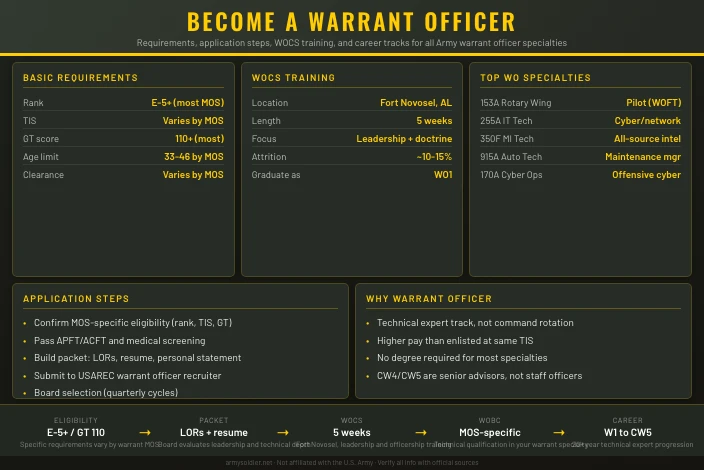
That structure shows up in the rank system. Warrant officers progress from WO1 through CW5 (Chief Warrant Officer 5). They hold authority over enlisted Soldiers but serve below commissioned officers in the chain of command. In practice, warrant officers are the technical authority in their domain. A CW4 cyber warfare technician advises colonels on network operations. A CW3 helicopter pilot runs a flight operations cell. A CW5 intelligence technician is often the most experienced analyst in a battalion.
The Army uses 51 warrant officer MOS codes across functional areas including:
- Aviation: rotary wing pilots (153A), air traffic management (150A), UAS operations (150U), aviation maintenance (151A)
- Cyber and electronic warfare: cyber warfare (170A), electromagnetic warfare (170B), cyber capability development (170D)
- Military intelligence: all-source intelligence (350F), SIGINT (352N/352S), counterintelligence (351L), HUMINT (351M)
- Maintenance: automotive (915A), armament systems (913A), electronic systems (948B), Stryker (915S)
- Criminal investigation: CID special agent (311A)
- Special Forces: SF warrant officer (180A)
- Signal and IT: data operations (255A), network operations (255N), cyberspace defense (255S)
- Supply and logistics: property accounting (920A), petroleum systems (923A), airdrop systems (921A)
Aviation and cyber are the most competitive specialties. Maintenance and supply warrant officer MOS codes have more available seats and are often accessible for enlisted Soldiers already working in those fields.
Eligibility Requirements
The Army sets hard eligibility floors for warrant officer accessions. Most of these are non-waiverable.
Age:
- Most warrant officer MOS: maximum age 46 at time of selection
- Aviation specialties (153A, 150A, 150U, 151A): maximum age 33 at time of board selection
The aviation age limit is the one that catches people off guard. It applies when the board selects you, not when you enlist. If you are 32 when selected, you will finish WOCS and flight school well past 33, and that is fine. Applying at 33 with a weak packet is a gamble you can lose.
Education:
A high school diploma is the floor for most MOS. Some technical specialties have additional prerequisites tied to related civilian credentials or training. A bachelor’s degree is not required for accession into any warrant officer MOS, though officers who stay past the CW3 mark often pursue degrees voluntarily.
Prior enlisted service:
Most non-aviation warrant officer MOS require candidates to already be enlisted Soldiers with experience in the relevant career field. Typical requirements run E-5 or above with three to seven years of related experience, though the exact figure varies by MOS. Aviation is the primary exception: the Army actively recruits civilians for the rotary wing pilot (153A) path.
ASVAB GT score:
Every warrant officer candidate needs a GT score of 110 or higher. GT is calculated from Verbal Expression (combining Word Knowledge and Paragraph Comprehension) and Arithmetic Reasoning. That cutoff is non-waiverable – a 109 is a closed door regardless of everything else in a packet.
Aviation candidates also need the SIFT:
Aviation warrant officer MOS require a SIFT score of 40 or higher on top of the GT 110. The SIFT is a seven-subtest aviation aptitude test. A 40 gets your packet considered; scores in the 50s and above make it competitive. The SIFT vs ASVAB breakdown covers what each test measures and how preparation differs between them.
Citizenship and clearance:
All candidates must be U.S. citizens. Most specialties require a Secret clearance minimum. Intelligence, cyber, and CID MOS require Top Secret/SCI, which means a more thorough background investigation before selection.
The Application Packet
Warrant officer selection is board-based. A selection board reviews your complete packet and decides whether to invest a training pipeline in you. Weak letters or a vague personal statement do real damage regardless of your test scores.
Standard packet contents:
- DA Form 61 (Application for Appointment)
- Official ASVAB scores showing GT 110+
- SIFT score report (aviation candidates only)
- Educational transcripts or diploma
- Letters of recommendation (three required)
- Personal statement
- Military records for enlisted applicants: OMPF, NCOERs, DA photo
- Civilian applicants: professional resume, character references, full-length DA-style photo
Letters of recommendation are read carefully. The board wants evidence of leadership potential, sound judgment, and reliability under pressure. A letter that confirms your job history does nothing. Letters from supervisors or officers who can describe specific examples of your decision-making carry real weight.
Selection boards convene on a schedule published by Army Human Resources Command. For most specialties, boards meet once or twice per year. Aviation boards through the Warrant Officer Recruiting Command run on a separate cycle. Results typically publish within a few weeks of the board close date.
Warrant Officer Candidate School
Every warrant officer candidate, civilian or enlisted, attends Warrant Officer Candidate School (WOCS) at Fort Novosel, Alabama before receiving their appointment. WOCS runs approximately five weeks and is not specialty training – it is officership training.
Candidates leave WOCS understanding Army doctrine, leadership principles, and the responsibilities that come with a warrant officer appointment. The physical and mental demands are intentional: the Army is testing whether you will perform when conditions are not comfortable.
What the five weeks cover:
- Leadership and officership: Army doctrine, the Uniform Code of Military Justice, and the obligations of a warrant officer
- Physical training: Daily AFT-standard PT, road marches, and obstacle courses
- Tactical skills: Land navigation, field craft, map reading, and basic operations orders
- Evaluations: Peer reviews and instructor assessments that factor into final standing
Attrition at WOCS runs roughly 10 to 15 percent. Most failures come from physical shortfalls or integrity violations, not academic gaps. The selection board already filtered heavily; the people who arrive are largely capable of graduating. Graduates are appointed as WO1 and proceed directly to their specialty training.
Specialty Training After WOCS
Newly appointed WO1s attend their Warrant Officer Basic Course (WOBC), which is MOS-specific. This is where actual job training happens. WOBC lengths vary significantly by specialty.
| Specialty Area | Typical WOBC Length |
|---|---|
| Aviation (153A) – Initial Entry Rotary Wing | 32 weeks (179 flight hours) |
| Cyber Warfare (170A) | Approximately 6 months |
| Military Intelligence (350F, 352N) | 14-20 weeks |
| CID Special Agent (311A) | Approximately 16 weeks |
| Maintenance (915A, 913A) | 8-16 weeks |
| Supply and Logistics (920A, 923A) | 10-14 weeks |
Aviation has the longest pipeline by a wide margin. Flight school alone runs 32 weeks at Fort Novosel, following the five weeks of WOCS. Non-aviation candidates generally complete WOBC in 2 to 5 months and then report to their first duty station.
The 153A aviation path involves four distinct training phases covering ground school, primary flight, instrument qualification, and combat skills. That specific pipeline is covered in detail in how to become an Army helicopter pilot, which focuses entirely on WOFT.
Pay as a Warrant Officer
Warrant officers enter at WO1 and advance through five grades. Pay is set by grade and years of service, the same structure as enlisted and commissioned officers.
2026 monthly basic pay (selected grades and service points):
| Grade | Under 2 Years | 4 Years | 8 Years | 12 Years |
|---|---|---|---|---|
| WO1 | $4,057 | $4,859 | $5,584 | $6,069 |
| CW2 | $4,622 | $5,286 | $6,051 | $6,509 |
| CW3 | $5,223 | $5,737 | $6,431 | $7,136 |
| CW4 | $5,720 | $6,502 | $7,098 | $7,848 |
Basic pay does not include BAH, BAS, or special pays. Aviation warrant officers receive flight pay (aviator incentive pay) on top of basic pay. Cyber and intelligence MOS with required clearances are eligible for special duty pays that can add meaningfully to total compensation.
For enlisted Soldiers weighing the transition: a Sergeant (E-5) with 4 years earns $3,947 per month in basic pay. A WO1 at the same service point earns $4,859. By the CW3 grade at 8 years, the gap widens further. The officer vs enlisted pay comparison shows how compensation tracks across all three paths at every major career milestone.
Career Progression from WO1 to CW5
Warrant officer promotions are time-based with performance requirements, not purely competitive like enlisted promotions. Most career warrant officers retire at CW3 or CW4 after 20 years. CW5 positions are limited and go to warrant officers who have held senior advisory roles in major commands or training institutions.
| Grade | Typical Years of Service | Role |
|---|---|---|
| WO1 | 0-2 | Entry-level specialist, often mentored by a CW3 or CW4 |
| CW2 | 2-5 | Independent performer, leading small technical teams |
| CW3 | 5-12 | Senior specialist, advisory role to battalion-level leadership |
| CW4 | 12-18 | Primary technical advisor, often the senior warrant in a brigade |
| CW5 | 18+ | Army-level subject matter expert; very few billets |
The 20-year retirement threshold applies the same as it does for enlisted and commissioned officers. A CW3 who retires at 20 years collects a pension based on 50% of their final basic pay under the legacy High-3 system, or a reduced annuity with TSP matching under the Blended Retirement System.
Civilian vs Enlisted Applicant Paths
The application process differs depending on where you start.
Civilian applicants are competitive primarily for aviation warrant officer MOS, especially 153A rotary wing aviator. The Army recruits civilians through the Warrant Officer Recruiting Command because it needs pilots and is willing to build them from scratch. Civilians who are selected enlist, attend WOCS, and proceed to flight school. Non-aviation warrant officer MOS are rarely accessible to civilians without prior military service.
Enlisted Soldiers have access to virtually all non-aviation warrant officer MOS, provided they meet the grade and experience requirements. A Signal Sergeant with five years in 25U can apply for a 255N or 255S warrant officer MOS. A 35F intelligence analyst can pursue a 350F designation. The transition keeps the Soldier in their career field while changing the role from operator to technical advisor.
Reserve Component positions exist across most specialties. Reserve warrant officers follow the same WOCS and WOBC requirements as active-duty candidates and serve one weekend per month with two-week annual training rather than full-time. Browse the Army warrant officer career directory for the complete list of available MOS codes and specialty profiles.
You may also find Army officer vs enlisted: which path is right for you and Army direct commission programs explained helpful when deciding between warrant officer and other officer tracks.
This site is not affiliated with the U.S. Army or any government agency. Verify all information with official Army sources before making enlistment or career decisions.