How to Get an 18X Special Forces Contract
The 18X is one of the only enlistment contracts in the Army that doesn’t guarantee you a job. You sign up to try out for Special Forces. If you pass every phase of the pipeline, you earn a Green Beret and one of four permanent MOS designations. If you don’t, the Army picks your job for you. Roughly 70% of 18X candidates never earn the tab. Getting the contract is just the first step.
Here’s exactly how to get there.
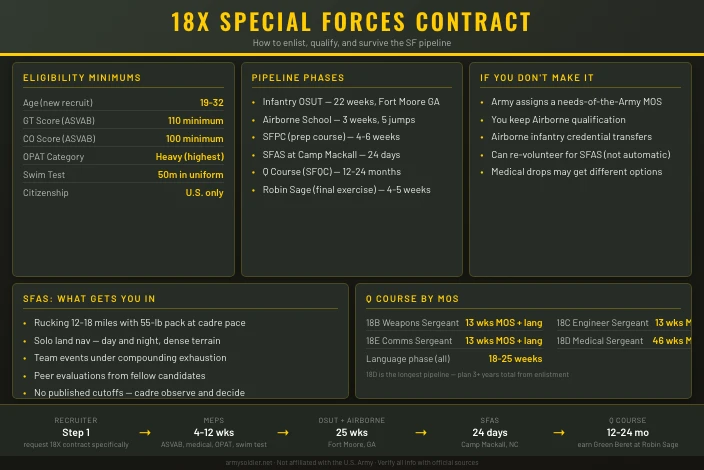
Eligibility: What You Need Before You Walk Into a Recruiter
The 18X program screens harder than any standard Army enlistment. Most requirements can’t be waived.
Hard Requirements
| Requirement | Standard |
|---|---|
| Citizenship | U.S. citizen only. Permanent residents are not eligible. |
| Age | 19-32 for new recruits. Active-duty reclassification candidates can be up to 36. |
| Education | High school diploma or GED |
| Security clearance | Eligible for Secret clearance. Criminal history, significant foreign contacts, or financial problems can disqualify you. |
| Vision | Correctable to 20/20 |
| Airborne | Must volunteer for Airborne School |
The citizenship requirement is absolute. No pathway exists for non-citizens, regardless of immigration status or military service in other branches.
ASVAB Line Scores
The 18X contract requires two ASVAB composites:
- GT (General Technical): minimum 110. GT combines Verbal Expression (VE) and Arithmetic Reasoning (AR). A 110 puts you above roughly 75% of test-takers.
- CO (Combat): minimum 100. CO combines Arithmetic Reasoning (AR), Coding Speed (CS), Auto/Shop Information (AS), and Mechanical Comprehension (MC).
Both scores must clear simultaneously. A GT of 112 with a CO of 98 doesn’t qualify you. There’s no trading one against the other.
If your current scores fall short, you can retest. Retesting at MEPS has waiting periods and rules. The Army’s ASVAB retesting policy covers what those limits are and how to plan around them.
OPAT and Physical Standards
At MEPS, you’ll take the Occupational Physical Assessment Test (OPAT). The 18X contract requires the Heavy physical demand category, the highest tier. OPAT tests power, strength, speed, and aerobic capacity through four events: standing long jump, seated power throw, 1-rep max deadlift, and interval aerobic run. You must hit the Heavy standard or you cannot sign the contract.
The swim assessment also happens at MEPS or during processing: 50 meters in uniform and boots. No lifeguard technique required, just completion. Candidates who can’t swim need to get that skill before they show up.
Working with a Recruiter
Not every Army recruiter handles 18X enlistments. Walk in and ask specifically for the 18X Special Forces Candidate contract. If your local office doesn’t process SF contracts, they’ll refer you to a Special Operations recruiter. Larger recruiting stations in metro areas are more likely to have an SO-qualified recruiter on staff.
A few things to nail down with your recruiter before signing anything:
- Current bonus amount. The page on goarmy.com shows eligibility for up to a $40,000 signing bonus, but amounts change quarterly based on Army fill rates. Get the current figure in writing before you sign.
- Contract length. The 18X typically runs 5 or 6 years. A 6-year contract usually carries a higher bonus. The longer commitment also gives you more time to complete the full pipeline without pressure from your ETS date.
- Training pipeline dates. Your OSUT ship date and subsequent training slots should be confirmed in writing. Gaps between phases are common and can stretch the timeline.
- Bonus recoupment terms. If you wash out of the pipeline and get reclassified, understand what happens to your bonus. Some bonus structures are tied to completing the SF pipeline, not just enlisting.
Expect the recruiter-to-ship timeline to run 4 to 12 weeks for most candidates. Medical waivers or clearance delays can extend that. Use the waiting period to build your rucking base and land navigation skills – that time is not wasted.
What Happens at MEPS
MEPS is a full day of medical and administrative processing. For 18X candidates, here’s what to expect:
Basic Combat Training and OSUT
After shipping from your home station, you report to Fort Moore, Georgia for Infantry One Station Unit Training (OSUT). This is 22 weeks of continuous training combining BCT and infantry AIT into one program.
You don’t separate from other infantry trainees during OSUT. You learn the same core skills alongside every other 11-series recruit:
- Rifle marksmanship – qualify with the M4 on standard Army qualification tables
- Land navigation – basic map reading and compass work (build on this before SFAS)
- Squad tactics – react to contact, battle drills, movement formations
- Basic soldiering – first aid, field hygiene, communications, and physical conditioning
The difference is what comes next. At the end of OSUT, you receive orders to continue the SF pipeline rather than report to a conventional infantry unit.
Directly after OSUT, you attend Airborne School at Fort Moore. Three weeks, five qualifying parachute jumps. Passing is required to continue. No pass, no continuation in the 18X pipeline.
SFAS at Fort Liberty
After Airborne School, you PCS to Fort Liberty, North Carolina and begin the Special Forces pipeline in earnest.
The first phase is the Special Forces Preparation Course (SFPC), running 4 to 6 weeks. SFPC conditions you for what comes next: long ruck marches, land navigation under pressure, and PT designed to find your breaking point. It’s not selection. It’s preparation.
Selection itself is Special Forces Assessment and Selection (SFAS), conducted at Camp Mackall near Southern Pines, NC. SFAS runs 24 days and assesses candidates across several dimensions:
- Physical endurance under sustained load. Expect ruck marches in the 12-18 mile range with a 55-pound pack, conducted at cadre pace with no rest stops.
- Land navigation, solo, day and night, in dense terrain with no trails and no help.
- Team events that evaluate how you perform and lead under exhaustion and stress.
- Peer evaluations. Your teammates rate you. These scores matter.
There are no published pass/fail cutoffs. Cadre observe and evaluate. They look for people who sustain effort when quitting would be the rational choice. Prior athletic records, rank, and civilian achievements don’t carry weight here. Consistent performance under compounding stress does.
You’ll learn at the end of SFAS whether you’ve been selected to continue. If selected, you move to Phase 2 of the SF pipeline.
The Q Course Pipeline
The Special Forces Qualification Course (SFQC), commonly called the Q Course, is the longest school in the Army’s initial training pipeline. Plan for 12 to 24 months from SFAS graduation to earning your Green Beret, depending on your specialty.
| Phase | Location | Duration | What Happens |
|---|---|---|---|
| Phase 1: Orientation | Fort Liberty | 7 weeks | SF history, organization, unconventional warfare theory |
| Small Unit Tactics (SUT) | Camp Mackall | 13 weeks | Patrolling, raids, ambushes, reconnaissance, field leadership |
| MOS Training | Fort Liberty | 13-46 weeks | Specialty skills: 18B (weapons), 18C (engineer), 18D (medical), 18E (comms) |
| Language and Culture | Fort Liberty | 18-25 weeks | Assigned foreign language to working proficiency |
| SERE | Camp Mackall | 3 weeks | Survival, Evasion, Resistance, Escape |
| Robin Sage (CULEX) | NC Uwharrie region | 4-5 weeks | Culminating unconventional warfare exercise |
18D Medical Sergeant training at 46 weeks is by far the longest MOS phase. If you’re assigned 18D, your total pipeline is on the long end of the range.
Robin Sage is the final evaluation. You infiltrate a fictional country, link up with guerrilla forces played by civilian role-players, and run a complete unconventional warfare campaign. Passing Robin Sage earns you the Green Beret and an SF tab.
Upon completing the Q Course, you’re promoted to E-5 (Sergeant) regardless of how much time in service you’ve accumulated, and you receive your permanent SF MOS (18B, 18C, 18D, or 18E).
What Happens If You Don’t Make It
This is the part most recruiting conversations skip. The 18X contract does not guarantee you a Green Beret. It guarantees you a shot at one.
If you’re dropped from the pipeline at any phase, including SFAS or the Q Course, the Army reassigns you to a needs-of-the-Army MOS. You do not get to choose. Depending on Army-wide shortages at the time, you could end up in logistics, infantry, maintenance, finance, or any other open MOS.
A few things are worth knowing:
- You’ve already completed Infantry OSUT and Airborne School. You enter your new MOS as an Airborne-qualified infantryman. That credential has value and transfers with you.
- Soldiers dropped for medical reasons (injury) may be held in a medical hold status or offered a specific MOS rather than pure needs-of-the-Army assignment. The process varies by case.
- Soldiers dropped from SFAS for performance reasons can, in some cases, volunteer to return to SFAS after a waiting period. This requires unit and command support and is not automatic.
Going in clear-eyed matters. If you’re not willing to accept a random MOS assignment as the downside scenario, the 18X contract carries risk that other enlistment options don’t.
Realistic Expectations
From your enlistment date to earning your Green Beret, expect 2.5 to 3.5 years. Your civilian peers will finish college degrees during that window. That’s the honest math.
Physical preparation before shipping is decisive. Candidates who prepare seriously for 6 to 12 months before their OSUT ship date pass SFAS at significantly higher rates than those who don’t. That means daily rucking with a loaded pack, sustained running, swimming, and solo land navigation practice. PT at OSUT won’t prepare you for SFAS.
Land navigation eliminates more candidates than physical failure does. Learning to read a military topographic map and navigate at night in dense terrain before you ship is one of the highest-value preparation activities available. Many people who are physically capable of finishing SFAS never make it because they can’t find checkpoints in the dark.
Roughly 30% of candidates who start the full pipeline earn the Green Beret. That number isn’t pessimism. The people who complete it are specifically selected for their ability to keep functioning when every signal says to stop. If reading that sentence makes you more motivated rather than more cautious, you’re the target audience for this program.
The 18X Special Forces Candidate profile covers pay, advanced schooling, deployment cycles, and the career path after earning your tab.
You may also find best ASVAB scores for special operations MOS and Army special operations careers: SF, PSYOP, and Civil Affairs helpful for understanding where the 18X sits across the broader SOF career field.
This site is not affiliated with the U.S. Army or any government agency. Verify all information with official Army sources before making enlistment or career decisions.