How to Negotiate Your Army Enlistment Contract
Most people walk into a recruiter’s office thinking the Army sets all the terms. They’re wrong. Your enlistment contract has real variables, and the choices you lock in before you sign follow you for three to six years. A higher ASVAB score, a willingness to pick a less popular job, or the ability to ship out fast can each shift your contract in a meaningful way.
This guide covers what’s actually on the table, what isn’t, and how to position yourself to get the most out of your deal.
What You Can and Cannot Negotiate
The Army’s core terms – basic pay, GI Bill eligibility, TRICARE, and leave accrual – are fixed by federal law. Your recruiter has no authority to adjust those. What recruiters can work with are the items written into the contract’s incentive and preference annexes.
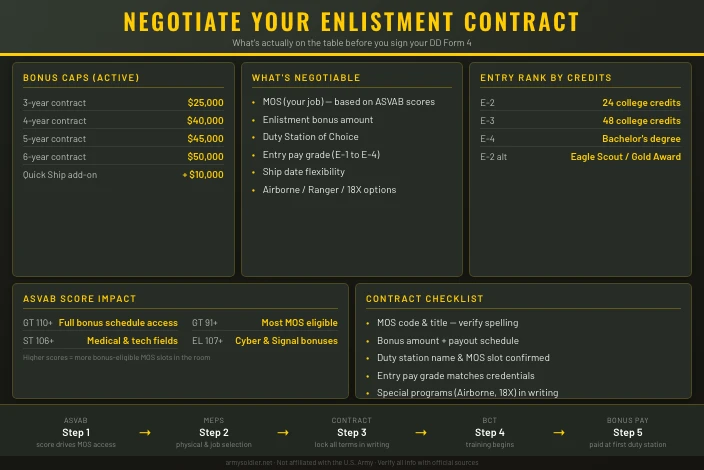
Four areas are genuinely negotiable:
- MOS (your job) – subject to your ASVAB line scores and Army needs
- Enlistment bonus amount – determined by MOS, contract length, and quick-ship eligibility
- Duty station – available at select installations under the Duty Station of Choice program
- Entry rank – based on college credits, JROTC, or Eagle Scout/Gold Award status
One item is often overlooked: ship date. Recruiters work quotas with specific training seats. If you’re flexible on when you leave, you may be able to trade that flexibility for a better MOS or bonus slot that would otherwise have a waitlist.
How Bonuses Are Structured
The Army ties enlistment bonuses to three things: your MOS, your contract length, and how fast you can ship to Basic Combat Training.
Bonus caps by contract length (active duty, current as of September 2025):
| Contract Length | Maximum Job Bonus |
|---|---|
| 3 years | $25,000 |
| 4 years | $40,000 |
| 5 years | $45,000 |
| 6 years | $50,000 |
A Quick Ship Bonus adds up to $10,000 on top of the job bonus if you can report to BCT within 30 days of enlisting. The quick ship amount scales with your ASVAB tier – Tier I and II applicants (high school diploma, strong scores) get more than Tier IIIB.
Bonuses are not paid at enlistment. The first payment arrives after you complete all required training and report to your first duty station. If your contract includes AIT and additional schooling, expect to wait six months to over a year.
Improve your score, expand your options. A higher ASVAB score qualifies you for more bonus-eligible jobs. An ASVAB prep course that focuses on Arithmetic Reasoning, Word Knowledge, and Paragraph Comprehension – the three subtests with the highest composite impact – is the fastest way to build negotiating power before you meet with a recruiter.
When you purchase through links on our site, we may receive compensation at no extra cost to you.
How ASVAB Scores Affect Your Options
Your ASVAB score doesn’t just determine eligibility – it determines how many slots are actually open to you. Jobs with the largest bonuses tend to be in high-demand technical fields: signals, intelligence, cyber, and some healthcare specialties. Those jobs have high line score requirements.
An applicant who scores a GT of 110+ has access to the full bonus schedule across most career fields. Someone with a GT of 90 qualifies for fewer jobs, which means fewer bonus-eligible MOS options in the room.
The line scores that open the most doors:
| Composite | Formula | Why It Matters |
|---|---|---|
| GT (General Technical) | VE + AR | Officer eligibility, warrant officer, intel, most bonused MOSs |
| ST (Skilled Technical) | GS + VE + MC + MK | Medical, cyber, signal, technical fields |
| EL (Electronics) | GS + AR + MK + EI | 25-series signal, 17-series cyber |
If you haven’t tested yet, or you tested below target, retesting is allowed after one month for a second attempt – and again after six months if needed. A meaningful score increase before you sit down with a recruiter puts you in a fundamentally different negotiating position.
Duty Station of Choice
The Army’s Duty Station of Choice program lets active-duty recruits request their first assignment at a participating installation. This is a guaranteed contract term, not a request that can be overridden at the Army’s convenience.
Available installations span eight states and include locations in the continental United States and Hawaii. The program operates on vacancy – if your MOS has an open slot at a given installation, you can lock it in. If there are no vacancies in your MOS at your preferred base, you either pick a different base or a different MOS.
Bases with the most vacancies tend to be those with larger force structure and more MOS variety:
- Fort Liberty, NC (formerly Fort Bragg)
- Fort Cavazos, TX (formerly Fort Hood)
- Fort Campbell, KY
- Schofield Barracks, HI
- Joint Base Lewis-McChord, WA
The station guarantee appears as a contract annex. Confirm the installation name, the MOS code, and the reporting window are all printed correctly before you sign.
Advanced Entry Rank
Starting at a higher pay grade costs you nothing but benefits you immediately. The Army allows entry above E-1 based on verifiable credentials:
| Entry Grade | Requirement |
|---|---|
| E-2 | 24 college credits, Eagle Scout (BSA), or Gold Award (GSUSA) |
| E-3 | 48 college credits |
| E-4 | Bachelor’s degree (4-year) |
The pay difference between E-1 and E-4 at entry is roughly $735 per month – money that accumulates from your first day in BCT. If you have a degree or significant college credit, there is no reason to enter as an E-1.
For applicants with vocational school credits or prior college coursework, there’s also a College Credit Enlistment Bonus of up to $6,000 separate from the job signing bonus.
Additional Contract Options Worth Asking About
Beyond the four main levers, a few other options appear in Army enlistment contracts and are worth discussing with your recruiter.
The Airborne option adds a contract guarantee for Airborne School – up to $10,000 in bonus value after you complete the three-week course at Fort Moore, GA. Your job must be compatible with Airborne assignment.
The 18X (Special Forces) contract is a structured pipeline for candidates who want to pursue Special Forces. It does not guarantee a Special Forces MOS – you still have to pass selection – but it does guarantee a chance at the pipeline with bonuses up to $42,000 for a six-year contract.
Two less common options:
- Ranger School – Infantry or Special Operations recruits who complete Ranger School can receive a bonus of up to $20,000 paid at their first duty station.
- Buddy enlistment – Two recruits who enlist within 30 days of each other and request the same duty station can receive a buddy assignment guarantee, provided both qualify for the same installation and MOS.
A solid ASVAB study guide with practice tests walks through every composite formula with drills organized by subtest – useful for targeting the exact scores that open up the bonused MOS categories above.
When you purchase through links on our site, we may receive compensation at no extra cost to you.
Before You Sign: A Checklist
Read every page of your DD Form 4 and all annexes before the oath. The items below should all match what you discussed with your recruiter:
- MOS code and title printed exactly
- Contract length (years)
- Enlistment bonus amount and payout schedule
- Quick ship bonus (if applicable)
- Duty station guarantee (installation name and MOS slot)
- Entry pay grade (E-2, E-3, or E-4 if you qualified)
- College credit bonus (if applicable)
- Any special program (Airborne, Ranger, 18X)
- Buddy assignment (if applicable)
If anything is missing or different from what you agreed on verbally, ask for it to be corrected before you sign. Corrections after signing are possible but significantly harder.
This site is not affiliated with the U.S. Army or any government agency. Verify all information with official Army sources before making enlistment or career decisions.
For a deeper look at how bonuses are calculated and what determines your payout, see Army Enlistment Bonuses: How They Work. If you’re still mapping out your path to service, the Army enlistment guide covers the full process from MEPS to signing day.