How to Prepare for Army OCS Selection
Most OCS applicants know they need a college degree and a clean record. Fewer understand that selection is competitive well before you step on Fort Moore’s training grounds. Boards review hundreds of packets, and the ones that advance share a common trait: every component was prepared with the final score in mind, not minimum eligibility. This guide walks through every requirement and shows you how to build a packet that boards actually select.
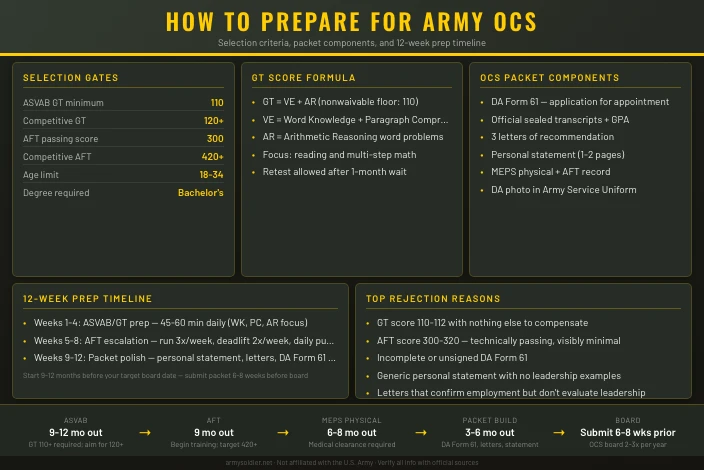
OCS Selection Criteria
The Army sets hard eligibility gates for OCS. Meet all of them or the recruiter cannot submit your packet.
Recommended resource: The ASVAB prep course includes GT-focused practice tests and Arithmetic Reasoning drills built specifically for officer track candidates.
When you purchase through links on our site, we may receive compensation at no extra cost to you.
The baseline requirements:
- U.S. citizen
- Bachelor’s degree from an accredited institution (any major)
- Age 18 to 34 at the time of commissioning (waivers available to 42 in certain circumstances)
- ASVAB GT score of 110 – nonwaivable, no exceptions
- Pass the Army Fitness Test (AFT)
- No felony convictions; moral character screening required
Age is where candidates get surprised. If you’re 31 with a degree and a plan, OCS is still accessible, but you need to start immediately because the waiver window closes fast. The felony bar is also absolute – unlike some civilian jobs where records can be expunged for consideration, OCS will not commission candidates with felony history regardless of circumstances.
What “Competitive” Looks Like
Meeting minimums gets your packet reviewed. It doesn’t get you selected. Boards look for a full picture, and several metrics create distance between candidates who are eligible and candidates who win a slot.
| Factor | Minimum | Competitive Target |
|---|---|---|
| ASVAB GT score | 110 | 120+ |
| AFT total score | 300 (pass) | 420+ |
| GPA | No official floor | 3.0+ |
| Letters of recommendation | As required | Senior military officers or executives |
| Leadership positions | Not specified | Documented, substantive roles |
Combat arms branches – Infantry, Armor, Special Forces – set the highest informal GT expectations because those boards see the most candidates per slot. A GT of 120 or higher signals academic readiness to those boards. Other branches are competitive at 115.
The ASVAB and the GT Score
The GT composite is the only ASVAB output that matters for OCS. It combines two subtests: Verbal Expression (VE) and Arithmetic Reasoning (AR). VE is itself derived from Word Knowledge and Paragraph Comprehension scores.
That formula has a practical consequence: reading skills and basic math move your GT more than any other subject area on the test. A candidate who struggles with algebra but reads well can still hit 120. Conversely, strong math skills with weak reading comprehension often land candidates at 113 to 116 – close, but not impressive to a competitive board.
Where GT Points Come From
Focus your ASVAB prep on these three subtests:
- Word Knowledge (WK): vocabulary in context. The fastest subtest to improve with deliberate practice.
- Paragraph Comprehension (PC): short passages with inference questions. Rewards reading speed and accuracy.
- Arithmetic Reasoning (AR): word problems requiring multi-step math. Algebra, ratios, percentages, and basic geometry.
Mathematics Knowledge also appears on the ASVAB but does not feed the GT composite. Study AR before MK if GT is your goal.
Retesting Rules
You can retake the ASVAB if you want to raise your GT. The retest policy: one month wait after the initial test, six months after any subsequent attempt. If you scored 108 on your first attempt, you have a realistic shot at 112 or higher with focused prep before a retest. Do not leave a borderline GT score on the table if there’s time to fix it before your packet submission window.
AFT Standards for OCS Candidates
The Army Fitness Test (AFT) replaced the ACFT in June 2025. It has five events:
- 3 Repetition Maximum Deadlift (MDL)
- Hand Release Push-Up – Arm Extension (HRP)
- Sprint-Drag-Carry (SDC)
- Plank (PLK)
- Two-Mile Run (2MR)
Each event is scored 60 to 100 points. The passing threshold is 300 total points with at least 60 per event, using sex- and age-normed standards. OCS candidates are held to the same minimum scoring as enlisted soldiers.
But boards do not evaluate you at the minimum. A candidate who passes with a 305 and one who scores a 435 both met the standard – boards know the difference. A score at or above 420 demonstrates genuine physical commitment. The two-mile run and the deadlift are the highest-variance events; improving your time on the run and adding weight to your deadlift typically produces the largest score jumps.
The OCS Application Packet
Your packet is a board’s first impression. Every document in it either builds or erodes confidence that you’re the right candidate.
Core packet components:
- DA Form 61 (Application for Appointment): the master form that drives the packet. It captures your personal data, education, civilian employment, military history if applicable, and branch preferences.
- Official transcripts: sealed and sent directly from your institution. The board verifies your degree and reviews your GPA. A low GPA in a demanding major is more forgivable than a low GPA in an easy one.
- Letters of recommendation: three is standard. At least one from a military officer adds credibility. Civilian supervisors, professors, and community leaders can fill the remaining slots. The letters need to speak to leadership, character, and performance – not just confirm that you are a good person.
- Personal statement: typically one to two pages. This is your only direct voice in the packet. Boards read hundreds; generic statements about wanting to serve read as filler. Specific leadership examples with measurable outcomes read as substance.
- Physical exam: Military Entrance Processing Station (MEPS) physical or equivalent. Documents your medical fitness. Any disqualifying conditions will stop the packet here regardless of other scores.
- AFT record: your official test results administered at your unit or installation.
- Official photo: DA photo in Army Service Uniform.
Civilian applicants with no prior service rely heavily on their transcript, letters, personal statement, and test scores to make the case. Prior-enlisted applicants can include their service record, NCOER or OER evaluations, and awards – all of which carry significant weight with boards.
Timeline to Selection
OCS boards typically convene two to three times per year. Work backward from the board date to build a realistic preparation timeline.
Recommended lead time: 9 to 12 months before your target board.
| Milestone | Recommended Timing |
|---|---|
| Take ASVAB (first attempt) | 9-12 months out |
| Begin AFT training program | 9 months out |
| Identify recommendation writers | 8 months out |
| MEPS physical | 6-8 months out |
| Request official transcripts | 6 months out |
| Draft personal statement | 5 months out |
| Submit complete packet to recruiter | 6-8 weeks before board |
Your recruiter manages the submission timeline and can tell you the next board date. Do not plan to submit within two weeks of a board – recruiters need time to review and request corrections. Missing a board because of an administrative error sets your timeline back four to six months.
12-Week Prep Plan
This plan assumes you’ve already confirmed your eligibility and identified your target board date. Start 12 weeks out from packet submission.
Common Rejection Reasons
Boards reject packets for predictable reasons. Most are avoidable.
Administrative failures:
- Incomplete DA Form 61 (missing dates, incorrect entries, unsigned)
- Unofficial or unsealed transcripts submitted instead of official copies
- Letters of recommendation that address the wrong board or are undated
- AFT scores recorded under the old ACFT format
Competitive failures:
- GT score at 110 to 112 with nothing else in the packet to compensate
- AFT score in the 300 to 320 range – technically a pass, but visibly minimal
- Personal statement that reads like a resume summary rather than a leadership narrative
- Letters that confirm employment but don’t evaluate character or leadership capability
- No documented leadership experience in civilian or military roles
Waiver issues:
- Age waiver requested without a documented exceptional record to support approval
- Medical condition flagged at MEPS without a pre-existing waiver or documented resolution
The fastest fix for most of these is time. Candidates who try to compress the packet process into four to six weeks frequently produce a packet that reflects the rush. Build to the timeline above and give each component the attention it needs.
This site is not affiliated with the U.S. Army or any government agency. Verify all information with official Army sources before making commissioning or career decisions.
You may also find Army Officer Selection Tests: SIFT, ASVAB for OCS and the ASVAB for OCS test prep guide helpful as you build your preparation plan.