How to Raise Your Army GT Score
Your GT score follows you through your entire Army career. It opens MOS options before you enlist, determines whether you can reclass into a better job later, and clears the way to warrant officer if that’s where you’re headed. A score that felt acceptable at enlistment can become a hard ceiling three years down the road.
The good news: GT is one of the more trainable ASVAB composites. It comes from just three subtests, and each one responds well to focused preparation.
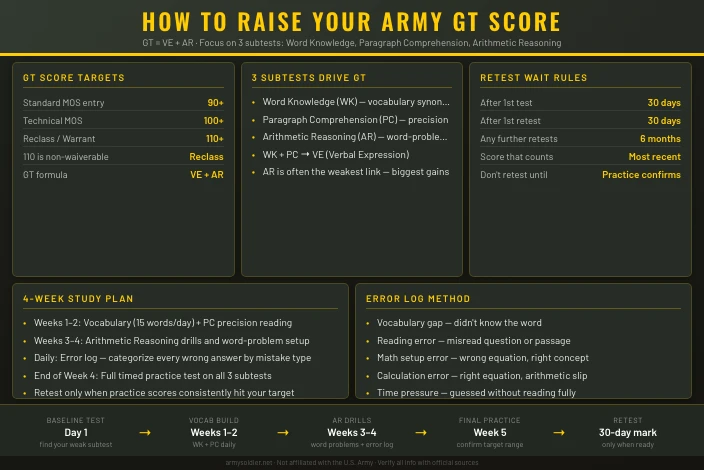
What the GT Score Is and Why It Matters
GT stands for General Technical. The formula is straightforward: GT = VE + AR. VE (Verbal Expression) is a standardized score derived from Word Knowledge (WK) and Paragraph Comprehension (PC). Arithmetic Reasoning (AR) is the third subtest feeding into it.
That’s it. Three subtests drive your entire GT score.
The Army uses GT across a wide range of decisions:
- MOS qualification at enlistment: many jobs require GT 90 or higher
- Reclassification: Active Component reclass requires GT 110 minimum, non-waiverable
- Warrant Officer selection: the baseline GT requirement is 110 for most warrant programs
- Promotion board competitive packets: a strong GT reflects positively in reclassification and board packets
Common GT thresholds you’ll run into:
| GT Target | Doors It Opens |
|---|---|
| 90 | Standard entry for many combat support and administrative MOS |
| 100 | Intelligence, signal, and technical MOS options |
| 110 | Active Component reclassification, most warrant officer programs |
If you’re active duty and your GT is below 110, you are cut off from most voluntary reclassification paths. That’s a concrete problem worth fixing before your retention window opens.
An ASVAB prep course with section-by-section drills covers all three GT subtests with targeted practice tests and video lessons.
When you purchase through links on our site, we may receive compensation at no extra cost to you.
The Three Subtests That Drive GT
Most ASVAB study guides spread your time across nine or ten subtests. That approach makes sense if you’re trying to improve a broad range of composites. But if GT is your specific target, you can focus entirely on three sections and get results faster.
Word Knowledge (WK)
WK is a vocabulary test. You see a word and choose the best synonym from four options. Sometimes the word appears in a sentence and you pick the closest meaning in context.
This subtest is almost entirely trainable. Unlike reasoning tests, vocabulary improves in direct proportion to how much time you put into it. The catch: you can’t cram words the night before and expect them to stick. Vocabulary builds through repeated exposure over weeks.
The WK section on the CAT-ASVAB runs about 16 questions.
Paragraph Comprehension (PC)
PC tests whether you can extract accurate information from short passages. You’ll read a paragraph and answer one or two questions about what it says or implies.
This subtest trips up a lot of test-takers because the wrong answers are designed to sound plausible. They often include real words from the passage but misrepresent the meaning. The skill to practice is reading with precision: don’t assume, don’t infer beyond what’s written, and don’t let a familiar-sounding word pull you to the wrong choice.
The PC section runs about 11 questions.
Arithmetic Reasoning (AR)
AR is word-problem math. Each question describes a real-world situation and asks you to solve it: rates, distances, costs, percentages, basic algebra. The math itself is not advanced, but the problems require you to read carefully and set up the equation correctly before you calculate.
AR is where most people have the most room to gain points on GT. Strong readers often hit decent WK and PC scores without much prep. AR tends to be the weak link that drags the composite down.
4-Week GT Study Plan
Four weeks is enough time for a meaningful GT improvement if you study consistently. This plan assumes about 45 to 60 minutes per day, six days a week.
Weeks 1 and 2: Vocabulary and Reading
The first two weeks go entirely to WK and PC. Vocabulary takes time to consolidate, so you want to front-load it.
Daily vocabulary routine (Weeks 1-2):
- Learn 15 new words per day using flashcards or a word list
- Review yesterday’s words before adding new ones (spaced repetition)
- Read one short article per day and look up any words you didn’t know
- Do 20 WK practice questions at the end of each session
Daily reading routine (Weeks 1-2):
- Do 10 PC practice questions each day
- For every wrong answer, write down why the correct answer is right, not just what it is
- Practice reading actively: pause after each sentence and state the main point in your own words
By the end of Week 2, you should have a working vocabulary of 150 to 200 new words and a sharper habit of reading for precision rather than impression.
Weeks 3 and 4: Arithmetic Reasoning
Once your verbal foundation is in place, shift all focus to AR for the final two weeks.
Daily AR routine (Weeks 3-4):
- Review core math concepts first: fractions, percentages, ratios, basic algebra, rates, and averages
- Do 15 to 20 AR practice problems per session
- Write out every step of each problem, even when you think you can do it in your head
- Use your error log (described below) to identify and fix patterns
By the end of Week 4, run a full timed practice section for each of the three subtests. Compare to your baseline scores from Week 1. If you’ve improved by 5 to 10 percentage points across all three, you’re in position for a real GT gain on test day.
The Error Log Method
Random practice doesn’t produce consistent improvement. The error log method does.
After every practice session, go back through every question you got wrong. For each one, identify the reason you missed it:
- Vocabulary gap: didn’t know the word
- Reading error: understood the word but misread the question or passage
- Math setup error: knew the concept but set up the equation wrong
- Calculation error: set up correctly but made an arithmetic mistake
- Time pressure: ran out of time and guessed
Log each error in a simple table. After a few sessions, patterns emerge. If 60% of your AR mistakes are math setup errors, you’re not spending time on the right thing by drilling more calculations. You need to slow down on the problem-reading step.
This method turns practice tests into diagnostic data instead of just score snapshots.
Retest Rules and How to Plan Your Calendar
The Army and MEPS follow a fixed retest schedule. Know this before you book your test date.
| Attempt | Wait Period |
|---|---|
| After initial test | 30 days minimum |
| After first retest | 30 days minimum |
| After second retest and beyond | 6 months minimum |
The most important rule: your most recent score is the score that counts, not your highest. Don’t retest until your practice results show a real, consistent jump. If you’re scoring 95 on GT in practice, you’re ready. If you’re hovering at 85 while your target is 110, more time in the study plan is worth more than an early retest.
Sample calendar if your current GT is around 95 and your target is 110:
- Week 0: Baseline practice test, identify weak subtest
- Weeks 1-4: Study plan above
- Week 5: Final full practice tests, confirm you’re consistently hitting target range
- Book retest for 30 days after initial test or most recent retest, whichever applies
If your target date is a specific reclassification board or warrant officer packet deadline, work backward from that date to set your study start date. Rushing the retest risks a flat or lower score and restarts the clock.
A structured ASVAB study guide with section-by-section practice tests lets you focus specifically on WK, PC, and AR rather than studying all nine subtests at equal weight.
When you purchase through links on our site, we may receive compensation at no extra cost to you.
What to Expect on the Real Test
The CAT-ASVAB (computer adaptive version used at MEPS) adjusts question difficulty based on your answers. That means two things for GT-focused test-takers:
First, the better you do early in a subtest, the harder the questions get. Don’t panic if questions feel harder than your practice tests. That’s usually a sign you’re doing well.
Second, you can’t skip questions or go back to review. On paper-format tests (used in some settings), you can skip and return. On the CAT-ASVAB, each question must be answered before moving on. If a word problem is giving you trouble, work through it methodically rather than leaving it blank.
Pace yourself on AR especially. Read the full problem before doing any math. The most common mistake is skimming the setup and solving for the wrong thing.
You may also find ASVAB line scores explained and the Army ASVAB test prep guide helpful for building out your full study plan.