Is the Army Worth It? Honest Pros and Cons
Every year, hundreds of thousands of Americans ask this same question, usually sitting in a recruiter’s office or lying awake at 2 AM. The Army comes with real advantages that are hard to find anywhere else. It also comes with real costs that recruiters tend to gloss over. Both sides deserve an honest look.
This post covers the actual pros and cons, using current figures, so you can make a decision based on what the Army really is.
What the Army Gets Right
The Army’s core value proposition is straightforward: guaranteed employment, free healthcare, subsidized housing, and funded education, all in exchange for your time and compliance. For the right person, that trade is genuinely good.
Job security that’s hard to find elsewhere. When you sign a contract, you have a job for its full term. There’s no layoff, no downsizing, no “the market shifted.” You show up, you perform, you get paid. For someone entering the workforce without a degree or trade credential, that’s not a small thing.
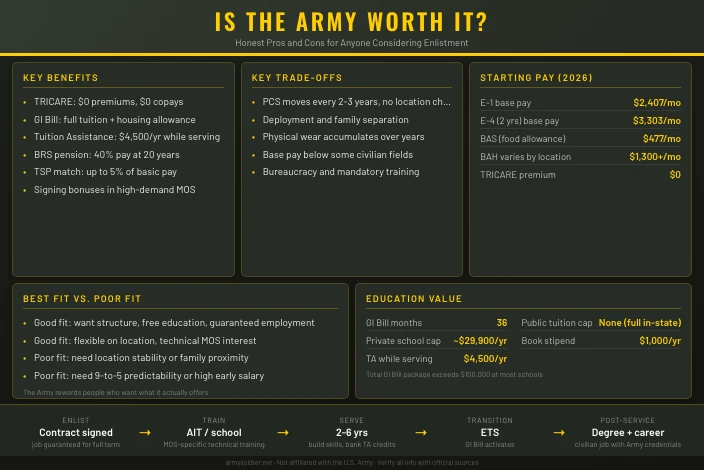
Healthcare with no premiums and no copays. Active-duty soldiers are covered by TRICARE Prime. The enrollment fee is $0. The copay for in-network care is $0. That covers medical, dental, vision, mental health, prescriptions, and hospitalization. Your dependents are enrolled at no cost too, subject to a $1,000 annual catastrophic cap for out-of-network care. Civilian employers offering anything close to this are increasingly rare.
The GI Bill is real money. The Post-9/11 GI Bill covers full in-state tuition at public universities with no dollar cap. At private schools, the annual cap is $29,920.95 for the current academic year. You also receive a monthly housing allowance tied to the local E-5 BAH rate at your school’s location, plus up to $1,000 per year for books. Across 36 months of benefit, that package is worth well over $100,000 at most schools. And if you want to take classes while still serving, Tuition Assistance covers up to $4,500 per year.
Hands-on training in 150+ career fields. The Army doesn’t just hand you a job title. It sends you to school first. A combat medic goes through 16 weeks of clinical training before ever seeing a unit. A signal soldier learns network infrastructure on live equipment. A maintenance technician gets formal instruction plus supervised practice on vehicle systems. Many of these skills map directly to civilian certifications and job openings.
Retirement that actually pays out. Under the Blended Retirement System, soldiers who reach 20 years receive a pension equal to 40% of their high-36 average basic pay. The government also contributes up to 5% of basic pay into a Thrift Savings Plan account, starting full matching at the three-year mark. That’s a retirement package most private employers dropped years ago.
Enlistment bonuses for high-demand jobs. Some MOS fields carry signing bonuses ranging from a few thousand dollars to over $40,000 for certain specialties. Bonus amounts change with Army manning needs, so the recruiter’s current sheet is the only reliable source. But if you’re flexible on your MOS, targeting a high-demand field at enlistment can put significant money on the table.
Travel and location variety. Duty stations span the continental US, Alaska, Hawaii, Germany, South Korea, Japan, and other locations. If you’ve never lived outside your hometown, the Army will fix that fast. Some soldiers experience more of the world in four years than most civilians do in a lifetime.
What the Army Costs You
None of the benefits above come free. The Army asks for something concrete in return, and it’s worth naming those costs directly before you sign.
You lose control of your location. The Army decides where you live, and it tells you on relatively short notice. Permanent Change of Station moves happen every two to three years on average. Your family moves with you or manages without you. If your parents are aging, your spouse has a career, or your kids are in school, this disruption is real and recurring.
- PCS orders can send you anywhere the Army needs you
- You may request preferences but have no guarantee
- Overseas assignments can include remote or unaccompanied tours
- Moves happen at Army convenience, not yours
Deployment and family separation. Combat deployments have decreased from the Iraq and Afghanistan peak years, but they have not ended. Training rotations, field exercises, and temporary duty away from home are routine even without a deployment. Long stretches without your family are part of the job. For some people that’s manageable. For others, it’s a dealbreaker.
The physical toll accumulates. The Army’s physical demands are real. Rucksack marches with 60-pound loads, sleep deprivation during field exercises, and repetitive physical stress take a toll over years of service. Hearing damage from weapons fire, knee and back injuries from carries and jumps, and chronic pain after long careers are not rare outcomes. This isn’t an argument against enlisting, but it should factor into a long-term calculation.
Base pay looks low compared to some civilian fields. A new E-1 earns roughly $2,400 per month in base pay. An E-4 with two years in earns around $3,300. When you add BAH and BAS, the total compensation picture improves significantly, but base pay alone benchmarks below what experienced tradespeople and tech workers earn. If your civilian alternative is a $70,000 software job, the Army’s pay structure looks different than if your alternative is an entry-level retail position. The Army pay and benefits overview breaks down total compensation in more detail.
Bureaucracy is a real day-to-day experience. The Army is a large, hierarchical institution. There will be mandatory computer-based training on topics you don’t care about. There will be formations for the sake of formations. There will be rules that seem designed to frustrate rather than accomplish anything. Soldiers who go in expecting a meritocracy sometimes find the pace and logic of military bureaucracy genuinely demoralizing.
Not every MOS converts cleanly to civilian work. Combat arms MOS fields (infantry, armor, artillery) build discipline, leadership, and physical toughness. They don’t always translate directly into civilian job titles. The skills are real, but the translation work falls on you. Healthcare, IT, intelligence, and maintenance MOS fields tend to convert more directly. Job choice at enlistment matters more than most 18-year-olds realize.
Who Gets the Most Out of It
The people who look back on Army service as one of the best decisions of their lives tend to share a few traits.
Structure suited them. Clear expectations, defined rules, and direct feedback fit their working style better than an open-ended civilian job ever did. The Army’s rigidity, which frustrates some people, gave this group a framework they could build on. They liked knowing exactly what was expected at 0530 and exactly what happened if they didn’t deliver.
They picked a technical MOS. A 68W Combat Medic leaves service with EMT certification and clinical hours that fast-track a civilian healthcare career. A 25B IT Specialist spends four years managing real networks and can walk into a help desk or sysadmin role with experience most college graduates don’t have. The translation gap between Army job and civilian job is smallest in medical, cyber, signal, intelligence, and maintenance fields.
They used the education benefits. The GI Bill is the single best financial return the Army offers, but only if you cash in on it. Soldiers who start taking classes through Tuition Assistance while still serving and then use the GI Bill for a full degree after separation can leave the Army with a bachelor’s degree and zero student debt. That puts them years ahead of civilian peers who borrowed $30,000 or more.
Four things that correlate with a strong service experience:
- A MOS with civilian application (68W, 25B, 91B, and most technical fields transfer well)
- Willingness to relocate without resenting the disruption
- Using Tuition Assistance during service, not just the GI Bill after
- Entering with realistic expectations about pay in the early years
Who Should Think Twice
The Army asks for specific things that conflict with specific life situations. If any of these describe you, think carefully before signing:
- Your spouse has a state-licensed career (nursing, teaching, law, real estate). Every PCS move means a new state license application, potential gaps in employment, and starting over with a new employer. Military spouse unemployment rates are significantly higher than the national average for this reason.
- You have aging parents or a family member who depends on you locally. The Army won’t station you near home because your mother needs help. Compassionate reassignment exists but is granted only in extreme cases.
- You want the highest possible early-career salary. A civilian path in tech, skilled trades, or healthcare can outpace Army base pay by the mid-twenties. The gap narrows when benefits are included, but if raw paycheck size is the priority, the Army’s compensation structure doesn’t compete at the entry level.
- You struggle with authority you didn’t choose. The chain of command is non-negotiable. You will have leaders you disagree with and orders you wouldn’t have given. If that dynamic makes you miserable rather than motivated, four years is a long time.
None of this means the Army is the wrong choice. It means the Army rewards people who want what it actually offers, not people who want something else but figure the Army might do.
The Honest Bottom Line
For the right person, the Army is one of the strongest career entry points available. Job security, zero-cost healthcare, a real pension, and an education benefit worth six figures are hard to match in the civilian world, especially without a college degree.
The cost is real. Location control, schedule predictability, and family proximity take a hit for the duration of your contract. Those aren’t minor inconveniences for everyone. They’re dealbreakers for some people, and that’s a legitimate conclusion.
The best way to think about it is to start with the Army careers section to understand what jobs are actually available and what each one involves. A decision based on a specific MOS and realistic expectations beats a decision based on a recruiting poster.
For a fuller picture of daily service before you commit, What Army Life Is Really Like covers the day-to-day reality that doesn’t always come up in recruiting conversations. If pay is your primary question, Army vs Civilian Pay: The Real Comparison walks through total compensation from base pay through retirement. Where you end up living matters too, and Army Duty Stations covers the major installations and how assignments work.
This site is not affiliated with the U.S. Army or any government agency. Verify all information with official Army sources before making enlistment or career decisions.