Joining the Army in 2027: What Is Actually Changing
When you purchase through links on our site, we may receive compensation at no extra cost to you.
If you are thinking about enlisting in the Army in 2027, the job itself has not changed. What has changed, or is still being argued over in Congress, is the paycheck, the bonus money, and a couple of eligibility rules that already loosened up in 2026. Here is what is actually different for someone signing up in 2027, what is still just a proposal, and what to check before you sign.
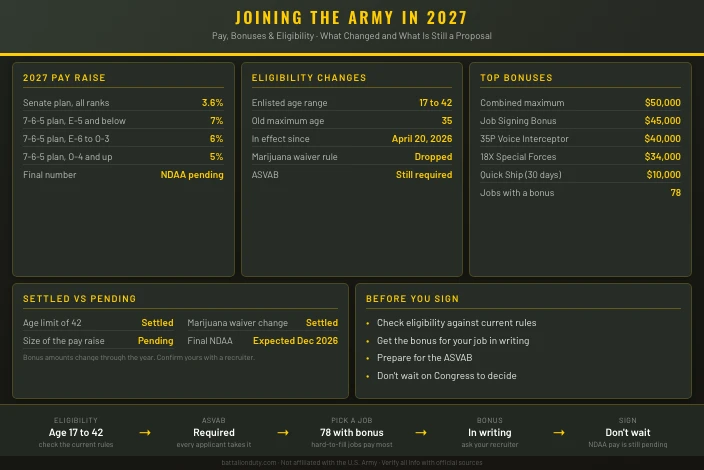
What actually changes for a 2027 Army enlistee, and what does not
What changes year to year for a new recruit is mostly pay, bonuses, and which jobs are open to sign up for. The physical training, the ASVAB test, and the oath you take have stayed the same for a long time. We see no sign that any of that will change for 2027.
Two Army rules already changed, and neither one happened because 2027 arrived. In April 2026, the Army raised its maximum enlistment age from 35 to 42 and dropped the rule requiring a waiver for a single marijuana possession or drug paraphernalia conviction, under an updated Army regulation. Those changes apply across the Regular Army, Army Reserve, and Army National Guard. If you are reading this in 2027, both of those are just how the Army works now, not new developments.
The Army is also rebuilding its own recruiting enterprise. It created two new specialties, an enlisted talent acquisition specialist and a warrant officer, to build a more permanent, more skilled recruiting workforce. That is a career move inside the Army, not something a new recruit deals with directly. But it explains why the recruiting pitch you get in 2027 may look different from what someone heard five years ago. Becoming one of those recruiters is its own path open only to soldiers already serving. Applicants need to already be a sergeant, staff sergeant, or sergeant first class, among other requirements.
The 2027 pay raise: two competing figures, neither final until the NDAA is signed
The biggest open question for anyone thinking about joining in 2027 is what your paycheck will actually look like starting January 1, 2027. Two competing numbers are on the table, and neither is final.
The administration’s fiscal year 2027 budget request proposes what it calls a 7-6-5 raise: 7 percent for troops at E-5 and below, 6 percent for E-6 through O-3, and 5 percent for O-4 and above. The House of Representatives passed a version of the National Defense Authorization Act that backs this tiered structure.
The Senate went a different way. Its version of the NDAA rejects the tiered raise and proposes a flat 3.6 percent increase for every rank instead. That 3.6 percent is not a guess. It comes from a formula written into law that ties military pay to civilian wage growth. That formula sets the smallest raise the law allows.
Congress still has to work out the differences between the House and Senate versions before either number becomes real. That work is expected before the end of December 2026. Until a final bill reaches the president’s desk, any 2027 pay chart you find online, including this page, is describing a proposal, not a paycheck.
What a 7-6-5 raise versus a flat 3.6% raise is worth at E-1 through E-4
Most new Army enlistees start at E-1 and move up to around E-4 during their first term. Both proposals treat that whole band the same way, since the tiered plan groups everyone from E-1 through E-5 together.
| Proposal | Raise for E-1 through E-4 |
|---|---|
| Administration’s 7-6-5 plan, backed by the House | 7 percent |
| Senate’s flat-rate plan | 3.6 percent |
That gap matters more the longer you stay in the Army, since basic pay raises compound each year you serve. But if you are deciding whether to enlist at all, the point is simple: junior enlisted pay is going up in 2027 either way. The only question left is by how much.
Eligibility rules that already changed: age 42, and the marijuana conviction waiver
Two rule changes already reshaped who can enlist in the Army, and both happened in 2026, not 2027.
The Army raised its maximum enlistment age from 35 to 42, effective April 20, 2026. Current Army recruiting materials list the enlisted age range as 17 to 42. That same update dropped the requirement that anyone with a single marijuana possession or drug paraphernalia conviction get a waiver before enlisting. If that kind of conviction kept you out, or slowed you down, in past years, it is worth asking a recruiter again.
The Army’s new age limit matches the Air Force and Space Force, which already allowed enlistment up to 42. The Marine Corps still caps at 28 for active duty, the most restrictive of any branch. Every other baseline requirement for enlisting stayed the same: being a U.S. citizen or a Green Card holder who can read, write, and speak English fluently, and passing a medical exam.

Enlistment bonuses: the advertised maximums, the job-by-job reality, and where to check the current list
Enlistment bonuses are still one of the biggest tools the Army uses to fill hard-to-staff jobs, and the advertised numbers are large. A qualified active-duty recruit can combine several bonuses into a total of up to $50,000.
| Bonus | Maximum amount |
|---|---|
| Combined active-duty enlistment bonuses | Up to $50,000 |
| Job Signing Bonus, select jobs | Up to $45,000 |
| Signals Intelligence Voice Interceptor (35P) | Up to $40,000 |
| Special Forces Candidate (18X) | Up to $34,000 |
| Ranger Bonus | Up to $20,000 |
| Parachute Rigger, Bradley Fighting Vehicle Maintainer, EOD Specialist, or Patriot System Repairer | Up to $20,000 each |
| Quick Ship Bonus, reporting within 30 days | Up to $10,000 |
| Airborne Bonus | Up to $10,000 |
| College Credit Enlistment Bonus | Up to $6,000 |
The job-by-job reality is narrower than the $50,000 headline suggests. The Army currently lists 78 jobs that carry an enlistment bonus, out of hundreds of jobs total. Two things are worth knowing before you count on a specific number. First, which jobs qualify shifts with the Army’s training quotas and recruiting needs, so the list you see today may not match the list when you actually sign a contract. Second, a recruiter is the only source for the current, official bonus amount tied to a specific job. The most current place to check is the Army’s own bonus page, not a roundup written months earlier, including this one.

What to do before you sign, and what is not worth waiting for
Three things are worth doing now, and one is not worth waiting for.
Check your own eligibility against the current rules, not what you remember from a few years ago. The enlisted age range now runs 17 to 42, and the marijuana waiver rule that used to trip people up is gone. If age or a past conviction kept you out before, it may not now.
Ask your recruiter for the specific bonus tied to the job you actually want, in writing, rather than relying on any published list. Bonus eligibility runs on training quotas that shift through the year.
Take the ASVAB seriously going in. Every applicant has to take the Armed Services Vocational Aptitude Battery before enlisting, and it is a fixed step regardless of what happens with pay or bonuses.
Do not wait for the NDAA to pass before deciding whether to enlist at all. Both pay proposals on the table raise junior enlisted pay, and neither cuts it. Congress still has to work through the House and Senate differences, expected before the end of December 2026, and waiting that long buys you nothing if the job or bonus you want does not wait for you either. Treat any 2027 pay chart you see, including this one, as a proposal, not a final number, until a bill reaches the president’s desk.
If you are still weighing whether the Army is the right move at all, apart from what is new this year, that is a separate question with its own tradeoffs, covered in our pros and cons breakdown. If you are ready to see what is actually open right now, start with the current career listings.