PiCAT vs ASVAB at MEPS: Which Should You Take?
Your recruiter may have mentioned the PiCAT as an option before your MEPS date. Most applicants take it without fully understanding how it differs from the ASVAB, or what happens if the verification test at MEPS doesn’t go well. This post covers both paths, what the scores mean, and how to decide which route gives you the best shot.
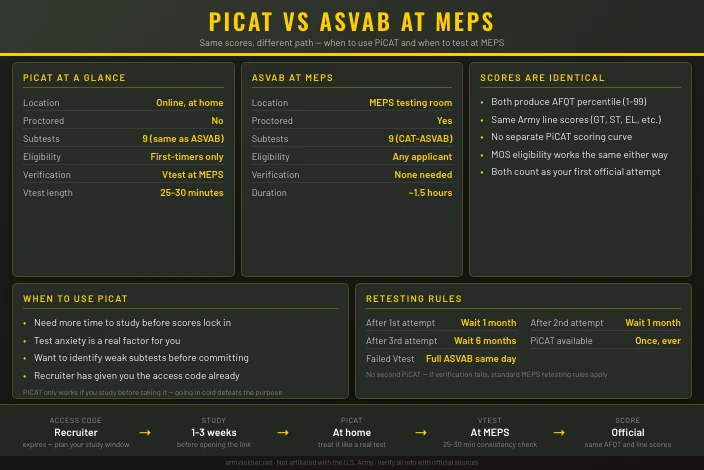
What PiCAT Is (and What It Isn’t)
PiCAT stands for Pending Internet Computerized Adaptive Test. It is the full ASVAB, taken online without a proctor watching you.
The test covers the same 9 subtests as the CAT-ASVAB administered at MEPS. Your results produce an AFQT score and Army line scores that work the same way as any other ASVAB. The only structural difference is where you sit and who is in the room.
One hard rule: PiCAT is available only to applicants who have never taken the ASVAB before. If you have already tested at MEPS or a testing site, PiCAT is not an option.
Your recruiter provides an access code with an expiration window. The clock starts when you open the link, and you have a limited time to finish once you begin. Do not open it casually. Plan for two to three hours of uninterrupted focus.
The Verification Test at MEPS
Taking the PiCAT does not replace your MEPS visit. It changes what happens when you get there.
Instead of sitting for the full ASVAB, you take a shorter proctored test called the Vtest. It runs 25 to 30 minutes and covers the same content areas you saw on the PiCAT. The question it answers is simple: did you perform at home at the same level you perform in a supervised room?
If your Vtest results are consistent with your PiCAT scores, the PiCAT becomes your official score of record. Those scores drive your MOS options and enlistment qualification.
If your Vtest results deviate significantly, the PiCAT is discarded. You take the full ASVAB at MEPS that same day, and those results become your record instead.
The Vtest is not a trap. It does not require a perfect replay of every answer you gave. It checks whether your performance is genuinely yours. If you studied honestly and answered without outside help, the Vtest should feel familiar: a shorter, calmer version of what you already did.
PiCAT vs ASVAB at MEPS: Side by Side
| Factor | PiCAT | ASVAB at MEPS |
|---|---|---|
| Location | Online, any location | MEPS testing room |
| Proctored | No | Yes |
| Format | 9 subtests, same as CAT-ASVAB | 9 subtests, CAT-ASVAB |
| Time to complete | 2-3 hours | ~1.5 hours |
| Verification required | Yes, Vtest at MEPS (25-30 min) | No |
| If verification fails | Full ASVAB at MEPS same day | N/A |
| Eligibility | First-time test-takers only | Any eligible applicant |
| Score output | Same AFQT and line scores | Same AFQT and line scores |
| Retesting impact | Counts as your first attempt | Counts as your first attempt |
When PiCAT Is the Smarter Move
PiCAT’s real advantage is time. Taking the ASVAB at MEPS locks in whatever you know on that day. PiCAT gives you weeks to prepare before the score counts.
Three situations where PiCAT works in your favor:
- You need more prep time. Your recruiter sent the link but your math or vocabulary is shaky. The window between receiving the code and using it is your study period. Use it.
- You have test anxiety. MEPS is a bureaucratic, high-stakes environment. PiCAT removes the fluorescent lights, the strangers, and the ticking clock. If you perform better in a calm setting, that is a real, measurable advantage.
- You want to preview your weak spots. Because the PiCAT mirrors the CAT-ASVAB exactly, taking it honestly gives you a clear read on which subtests need work before any score is locked in.
The key word in all three scenarios is “prepare.” PiCAT only delivers an advantage if you study between receiving the code and taking the test. Taking it cold and hoping the at-home format will somehow boost your scores is the wrong calculation.
When to Stick With the MEPS ASVAB
PiCAT is not always the better path. There are situations where taking the standard ASVAB at MEPS is the cleaner choice.
- Your recruiter recommends it. Recruiters see patterns across hundreds of applicants. If yours is steering you toward MEPS testing rather than PiCAT, ask why. The answer is usually worth hearing.
- You are already well-prepared. If you have spent weeks studying and your practice scores are where they need to be, there is no strategic benefit to adding a verification test layer. Walk into MEPS confident and test there.
- You want to start the retesting clock sooner. Both the PiCAT (if verified) and the ASVAB at MEPS count as your first official attempt. The retesting sequence runs one month after your first attempt, another month after your second, then six months between any subsequent attempts. Testing at MEPS on a known date gives you a predictable timeline if a quick second attempt is the goal.
Recommended resource: The PiCAT Study Guide includes full-length practice tests and section-specific tutorials built around the actual test format. The PiCAT Online Course walks through each subtest with structured lessons and progress tracking.
When you purchase through links on our site, we may receive compensation at no extra cost to you.
Score Equivalency: Same Numbers, Different Path
A common question: do PiCAT scores “count as much” as ASVAB scores from MEPS?
Yes. PiCAT scores, once verified, convert directly to the same AFQT and line score system as the CAT-ASVAB. There is no separate scoring curve or PiCAT-adjusted scale. An AFQT of 72 from a verified PiCAT is the same as an AFQT of 72 from a MEPS test room.
The Army cares about what the numbers are, not which format produced them. MOS qualification thresholds, enlistment bonuses, and MOS selection all work from the same score regardless of whether it came from your living room or a MEPS computer station.
The Honest Math
PiCAT gives you an edge only if you use the preparation window. The at-home format does not inflate scores on its own. Looking up answers during the PiCAT is self-defeating: your scores appear stronger than your real ability, and then the Vtest at MEPS reveals the gap. You take the full ASVAB that afternoon having wasted the opportunity.
The math is direct. Study for two to three weeks, take the PiCAT honestly, and you will likely score higher than you would going in cold at MEPS. That higher score follows you into the MOS selection process and potentially into an enlistment bonus conversation.
If you do not have the time or motivation to prepare, the at-home format provides no structural advantage. Take the ASVAB at MEPS, see where you land, and build from there.
You may also find the Army officer and warrant officer selection tests guide and the PiCAT test prep guide helpful as you build your testing strategy.
This site is not affiliated with the U.S. Army or any government agency. Verify all information with official Army sources before making enlistment or career decisions.