Should I Go Active Duty or Reserve After ROTC
You finished ROTC. You have your commission. Now comes the question nobody fully prepares you for: do you go active duty and serve full time, or accept a Reserve component slot and build a civilian career alongside your officer obligations? Both paths lead to the same rank structure, the same branch assignments, and the same Army. The daily reality of each is about as different as two careers can get.
This post covers what actually separates the two tracks after commissioning – obligations, pay, branch opportunities, and the moments in an officer’s career where the choice becomes irreversible.
What You’re Actually Choosing
ROTC cadets access into one of three components: Active Duty (AD), U.S. Army Reserve (USAR), or Army National Guard (ARNG). Your component determines whether the Army is your employer or your weekend obligation.
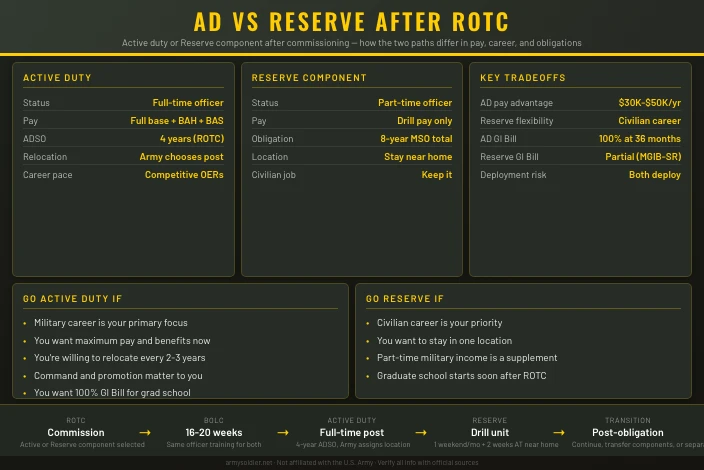
Active duty means the Army owns your schedule. You report to a duty station, work a standard duty day, and are available for deployment, training, and unit requirements full time. Reserve component means you keep your civilian life intact and serve on a part-time basis – one weekend per month and two weeks of annual training – unless you’re mobilized.
The branch assignment process is the same for both components. Army ROTC uses a Talent-Based Branching (TBB) system that matches cadets to branches based on their talent profile, preferences, and Army needs. In the most recent cycle, nearly 90% of cadets received one of their top branch preferences. Your component choice doesn’t change which branch you might receive, but it changes which units in that branch you’ll serve in.
One critical distinction: your component request is part of your accessions package, but it’s not guaranteed. The Army assigns cadets to active duty and Reserve component slots based on the Army’s needs at the time your commissioning class processes. High performers on the Order of Merit List (OML) carry more influence over their outcome.
Service Obligations
The obligation structure differs depending on whether you received an ROTC scholarship and which type.
Active Duty obligations:
- Standard non-scholarship commission: 3 years minimum active service
- Four-year ROTC scholarship: 4 years active duty, then 4 years in the Individual Ready Reserve (IRR)
- Green to Gold scholarship: 8 years total service obligation, fulfilled in active or Reserve/Guard status
Reserve component obligations:
- GRFD (Guaranteed Reserve Forces Duty) scholarship: 8 years of drilling status in ARNG or USAR
- Minuteman Cadet Scholarship: 8 years of drilling status
- Non-scholarship Reserve commission: typically 6 years of drilling status followed by IRR time
The IRR portion of any obligation is worth understanding. You are technically in the military during IRR time but not drilling, not paid, and not accumulating retirement points. You can be recalled involuntarily in a major mobilization, but most IRR officers are never activated. Active duty minimum obligations look shorter on paper, but total service requirements including IRR time are longer than they first appear.
Pay: What Each Component Actually Earns
Pay during drilling status is calculated from the same 2026 DFAS basic pay tables, but Reserve officers only draw pay for the days they serve.
An O-1 on active duty earns $4,150 per month in base pay plus BAH and BAS. That’s a full salary every month. The same O-1 in a Reserve unit draws approximately $553 per weekend drill (calculated as 4 drill periods at the daily rate). Annual training adds 14 additional days of active duty pay on top.
| Scenario | O-1 Monthly Income from Army |
|---|---|
| Active Duty | ~$4,150 base pay + BAH + BAS |
| Reserve (drilling only) | ~$1,200/year in drill pay + ~$580 annual training |
| Reserve (mobilized to AD) | Full active duty pay + BAH at duty location |
The Reserve pay picture looks thin compared to active duty, but that’s the design. Reserve officers are expected to have civilian income. A new officer in the Reserve earns combined income from their civilian job and Army pay. A civilian engineer earning $75,000 who also serves as a Reserve officer draws meaningful additional income and builds military retirement points without leaving their career.
When a Reserve officer mobilizes, they shift off drill pay and onto full active duty pay. The gap closes the moment orders are cut.
Branch and Unit Access
Not every branch exists in every Reserve unit, and geography matters far more for Reserve officers than for their active duty peers.
Active duty officers receive a duty station assignment. You go where the Army sends you – Fort Moore, Fort Sill, Fort Campbell, Korea. Most branches have active duty units at multiple installations, so your branch of interest rarely limits where you can serve.
Reserve officers must find a unit vacancy in their area, or one they’re willing to travel to. Before commissioning, USAR cadets must obtain a Vacancy Hold Request from the USARC G1 to confirm a valid unit slot. If no unit near you needs your branch, your options narrow fast.
Branches generally well-represented in Reserve units:
- Signal (25 series) and Cyber (17)
- Finance and HR (36, 42)
- Transportation and Logistics (88, 92)
- Medical and AMEDD branches (68-series MOS officers)
- Military Police (31)
- Engineers (12, some units)
Branches with fewer Reserve slots:
- Field Artillery and Air Defense Artillery
- Infantry and Armor (units exist but fewer than active duty)
- Aviation (warrant-heavy; commissioned aviation Reserve slots are limited)
- Special Forces (not available in traditional Reserve component)
If your desired branch is Combat Arms, active duty is the path with the most options. A Combat Arms officer in a metro area with no combat arms Reserve units faces a real constraint.
Career Trajectory After Commissioning
The two paths diverge most visibly in the first four years after commissioning.
Active Duty Officer Timeline
Active duty officers attend their Basic Officer Leader Course (BOLC) immediately after commissioning. BOLC is branch-specific and ranges from several weeks to several months depending on the branch. From there, they report to a duty station and take a platoon leader or similar O-1 position.
Key milestones in a typical active duty officer career:
- O-1 to O-2 (18 months): Automatic time-based promotion. Still in platoon leader or similar role.
- O-2 to O-3 (2 years at O-2): First Lieutenant to Captain. First competitive evaluation period begins.
- O-3 Captain (4-6 years total service): Company command is the defining assignment. Officers who don’t compete for command begin separating from the promotion track.
- O-4 promotion (~10-12 years): Competitive selection, with rates around 70-80% for fully qualified officers. A non-select at this point typically triggers separation planning.
Advancement on active duty is driven by Officer Evaluation Reports (OERs), command selections, and time in service. The “up or out” system creates real stakes at every promotion board.
Reserve Component Officer Timeline
Reserve officers follow the same rank structure and promotion timelines, but the career looks different day to day. A Reserve O-1 attends BOLC after commissioning, then returns to civilian life and reports to their assigned unit for monthly drills.
Promotions still require OERs and board selection, but Reserve officers accumulate fewer evaluation periods per year because they serve fewer days. An active duty platoon leader might have 250+ days of evaluable service in a single year. A Reserve officer has roughly 38 drill and annual training days. This slower accumulation means promotions sometimes come later in calendar years, though not later in years-of-service terms.
The career ceiling for Reserve officers is real but not low. Reserve component officers can reach O-6 Colonel rank. General officer selection exists in the Reserve, though it typically requires prior active duty experience or significant service on Active Guard Reserve (AGR) orders.
AGR officers serve full time in the Reserve or Guard in an administrative or operational capacity. They earn full active duty pay and benefits while remaining in the Reserve component. For officers who want a full-time military career without crossing entirely to active duty, AGR positions offer a middle path worth researching.
Deployment and Life Disruption
This factor matters more than most ROTC graduates expect, and it cuts both ways.
Active duty officers in operational units deploy on a cycle tied to their unit’s readiness status. The frequency depends on branch, unit type, and operational tempo. A Combat Arms officer might spend 24 of their first 48 months in some form of deployment or pre-deployment cycle. That’s demanding, but it’s generally scheduled months in advance.
Reserve officers mobilize less frequently in peacetime, but mobilizations have become more common since 2001. Both the Reserve and National Guard deploy regularly under federal orders. A Reserve officer who joins a unit with a deployment scheduled could mobilize within their first year or two. The separation between civilian and military life is not guaranteed during a mobilization.
The practical difference is predictability. Active duty disruption is frequent and expected. Reserve mobilizations are less frequent but harder to anticipate and plan around in a civilian career.
Long-Term Outcomes
The choice between active duty and Reserve isn’t just about the next four years. It shapes your resume, your retirement, and your professional positioning for decades.
What Active Duty Builds
Active duty builds deep leadership experience in resource-constrained, high-stakes environments. That experience translates directly into competitive MBA and law school applications, federal employment, and defense contracting. Top business schools actively recruit military officers for their decision-making backgrounds.
The financial case for a full active duty career is strongest at 20 years. Under the Blended Retirement System, a soldier who completes 20 years retires with a pension equal to 40% of their high-36 average basic pay, starting immediately at retirement. An O-5 Lieutenant Colonel retiring at 20 years earns approximately $4,680 per month in pension, starting in their early-to-mid forties.
Active duty also provides full TRICARE Prime coverage for you and your family at no cost, plus TSP matching up to 4% of basic pay beginning in year three.
What the Reserve Builds
Reserve service lets your civilian career grow without interruption. A Reserve officer who spends 20 years building a career in engineering, medicine, finance, or law while serving part time often exits with a stronger combined compensation picture than a peer who served active duty and transitioned at the 4 or 8-year mark.
The Reserve retirement pension begins at age 60 after 20 good years. It’s smaller than an active duty pension because Reserve officers accumulate fewer retirement points per year, but it compounds alongside civilian retirement savings and any TSP contributions during active service periods. State National Guard benefits can add further value – some states offer full in-state tuition waivers at public universities for Guard members.
The Decision Framework
Neither path is objectively better. The right answer depends on what you actually want your life to look like.
| Factor | Active Duty | Reserve / Guard |
|---|---|---|
| Primary income source | Army salary | Civilian career |
| Healthcare | TRICARE Prime (free) | TRICARE Reserve Select (~$58-$287/mo) |
| Housing | BAH or on-post | Civilian housing, no BAH |
| Deployment frequency | Higher, scheduled | Less frequent, less predictable |
| Civilian career impact | Paused during service | Runs concurrently |
| Retirement pension | Starts at separation (20+ yrs) | Starts at age 60 (20 good years) |
| Geography flexibility | Army assigns your location | Must find unit near you |
Go active duty if you want the Army to be your primary career, you want to live the full military life, and you’re willing to move where the Army sends you.
Go Reserve if you have a civilian career you want to maintain, you’re in an area with Reserve units that match your branch, and you’re prepared to manage the friction of mobilization in a civilian professional context.
One question that sharpens the decision fast: where do you want to be at 40? If the answer includes a military pension, significant leadership credentials from command, and a clear post-service transition, active duty builds that path most directly. If the answer involves a civilian career at a specific company or in a specific city, the Reserve preserves that option while keeping you in uniform.
For a detailed side-by-side breakdown of how officer and enlisted pay compare across a full career, Army officer vs enlisted pay comparison covers every career stage with current figures.
Explore Army officer career paths to see which branches and roles exist before locking in your component decision.
You may also find Army officer vs. enlisted: which path is right for you helpful as you work through the broader question of where the officer path fits in your plans.
This site is not affiliated with the U.S. Army or any government agency. Verify all information with official Army sources before making enlistment or career decisions.