Should I Go Officer or Enlisted After College
A college degree changes the math on both Army paths. You can commission as an officer, go enlisted and skip the degree requirement entirely, or take a third route most people with college backgrounds overlook. None of these is automatically the right answer. The one that fits you depends on what you want the first five years of your Army career to look like, how much leadership weight you’re ready to carry on day one, and what you plan to do after service ends.
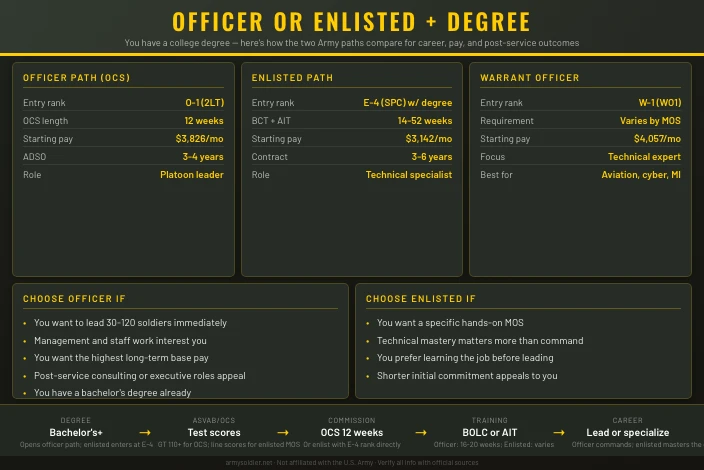
What Your Degree Actually Gets You
Holding a bachelor’s degree before you enlist doesn’t change your enlisted entry rank. You start as an E-1 Private, the same as everyone else without prior service. The degree earns you nothing on the pay scale at that point.
What it does change is your eligibility. A degree makes you a competitive OCS candidate, which most enlisted recruits are not. It also opens direct commission programs if you hold a professional credential, and it affects how quickly you can pursue Officer Candidate School if you enlist first and later change direction.
The three paths available to you:
| Path | Entry Grade | Degree Required | Timeline to Lead a Unit |
|---|---|---|---|
| Enlisted | E-1 | No | 5-8 years (to NCO leadership) |
| Officer via OCS | O-1 (2LT) | Yes | Immediately after BOLC (~6 months) |
| Officer via ROTC | O-1 (2LT) | Yes (during program) | Same post-BOLC timeline |
The enlisted path through OCS later is also real. Some people enlist first, serve 2-4 years, then apply to OCS as prior-service candidates. They commission with tactical credibility that fresh-from-college officers don’t have. That hybrid approach has real merit and comes up more below.
The Officer Path After College
OCS is the most direct route to a commission for a college graduate without prior service. The course runs 12 weeks at Fort Moore, Georgia. It’s high-intensity and selective. Roughly 10-15% of candidates are dropped or voluntarily withdraw.
After OCS comes your branch’s Basic Officer Leader Course (BOLC), which runs several months depending on your specialty. At the end of that pipeline, you receive your first assignment and lead a platoon of around 30 Soldiers, most of whom have more time in service than you do.
That last point is where a lot of new officers struggle. You won’t have the hands-on technical knowledge your NCOs have built over years. Your job isn’t to out-expert them. Your job is to make decisions, manage resources, and take responsibility for outcomes. That shift from individual contributor to unit leader happens fast, and some people find it energizing while others find it uncomfortable.
What the officer path looks like in years 1-3:
- Complete OCS (12 weeks) and BOLC (varies by branch)
- Report to first unit as a Platoon Leader (O-1/O-2)
- Lead 30-40 Soldiers with your Platoon Sergeant as your senior advisor
- Move to a staff role or company executive officer position around year 2-3
- Compete for Captain (O-3) promotion at roughly the 4-year mark
Officers also receive a different compensation structure from day one. A new O-1 earns $4,150 per month in base pay. By the time you pin on Captain (O-3) at roughly the 4-year mark, base pay reaches $7,383 per month plus BAH and BAS. The full career-stage pay breakdown shows how the gap between officer and enlisted compensation evolves over time.
ROTC is a parallel entry option if you’re still in college or willing to complete a master’s degree at a host university. It produces more Army officers than any other commissioning source. If you already have your degree, OCS is the faster route.
The Enlisted Path After College
Enlisting with a degree isn’t unusual, and it’s not a downgrade. Some people genuinely want to start in a hands-on technical role before they lead. Others enlist into a specific MOS they couldn’t access as an officer. Intelligence, special operations support, and certain technical fields attract college graduates who want the job, not the commission.
The honest tradeoff is time. The enlisted path to a leadership role takes longer. You’ll spend your first years learning your MOS, deploying, and working toward Specialist (E-4) and then Sergeant (E-5). Sergeant is the first NCO rank and the point where you start formally leading other Soldiers. That typically takes 3-5 years depending on your MOS and performance.
Your degree does give you one significant advantage as an enlisted Soldier: you can apply to OCS at any point, and prior-service candidates are competitive. Many of the Army’s strongest officers spent 4-6 years enlisted before commissioning. They arrive at their platoon with credibility that fresh college graduates have to earn.
Reasons college graduates choose to enlist:
- Specific MOS only available on the enlisted side (18X Special Forces pipeline, certain intelligence jobs)
- Want hands-on experience before leading
- Plan to use OCS later as a prior-service candidate
- Shorter initial contract in some MOS cases
- ASVAB line scores already exceeded, and bonus incentives are strong
Entry pay as an E-1 is $2,407 per month in base pay. That’s lower than an O-1’s $4,150, but enlisted Soldiers also receive BAS of $476.95 per month and BAH based on their installation and grade. The first few years of enlisted pay are lower, but senior NCO pay at E-7 or E-8 is competitive with mid-grade officer salaries in some career stages.
How Responsibility Differs on Each Path
This is the factor most college graduates underestimate. The officer path puts you in a leadership role before you’ve done the job. The enlisted path lets you master the job before you lead others in it. Neither is inherently better, but they require different things from you.
As an O-1 Platoon Leader, you are legally and operationally responsible for your Soldiers on day one. If your platoon fails a readiness inspection, that falls on you. If a Soldier in your unit has a legal issue, you’re involved. If your training plan is poorly constructed, your NCOs will quietly compensate, but you’ll know. Some people thrive under that immediate weight. Others find it more effective to earn credibility over time.
As an enlisted Soldier, your responsibility scales with your rank. An E-2 or E-3 is responsible for themselves and their equipment. An E-5 Sergeant is responsible for 3-5 Soldiers. An E-7 Sergeant First Class may run a section of 10-15 people. The progression is gradual and experience-backed.
What You Want After Service Matters
Post-service outcomes differ more between officer and enlisted paths than most recruits realize, and they should factor into your decision.
Officers receive more structured professional development during service: command and staff schools, broadening assignments, operational planning experience. That translates into MBA-equivalent resume credentials, program management roles, and senior government positions. An officer who served 6-10 years and separated has a career profile that looks like a mid-level executive.
Senior NCOs come out with hands-on technical and people management experience that civilian employers respect, especially in logistics, healthcare, law enforcement, and federal government. An E-7 or E-8 with 12-15 years of service has deep leadership depth that doesn’t require translation for most hiring managers.
The Post-9/11 GI Bill applies to both paths under the same rules. Thirty-six months of full in-state tuition at a public school, plus a housing allowance and book stipend. If you already have a bachelor’s degree, this benefit is most useful for a graduate degree after separation.
Post-service outcomes by path:
- Officer (O-3 to O-5 separation): Program manager, federal GS-13/14, consulting, law school, MBA programs, executive leadership roles
- Senior NCO (E-6 to E-8 separation): Federal law enforcement, logistics management, healthcare technician, defense contracting, first responder leadership
- Officer with prior enlisted service: Combines both profiles; strongest overall civilian resume in terms of breadth
The Direct Commission Option
If your degree is in law, medicine, theology, nursing, cyber, or certain engineering fields, a third path is worth knowing. Army direct commission programs let you enter as an officer based on your professional credential, bypassing OCS and ROTC entirely.
You’d complete a 5-8 week Direct Commission Course instead, then your branch’s BOLC. Entry rank varies by program and years of experience in your field. Army lawyers typically enter at O-2 or O-3. Medical officers often enter at O-3.
This matters for college graduates because many people going into law, medicine, or graduate cyber programs don’t realize Army service is compatible with those careers. If you’re finishing a JD or an MD, the direct commission path lets you practice your profession inside the Army rather than putting it on hold to serve.
Making the Call
There is no universal answer. But a few clear signals should move your decision.
Commission if:
- You want to lead from the start and are comfortable carrying responsibility before you’ve mastered every technical detail
- Your degree is in a field that maps to officer branches (engineering, business, liberal arts for most combat arms and support branches)
- You hold a professional license that qualifies for direct commission (law, medicine, chaplaincy, cyber)
- Long-term post-service goals lean toward executive or government leadership
Enlist if:
- You want a specific MOS that isn’t available as an officer
- You want to master the job before you lead others doing it
- You’re considering OCS after a few years of service, not right now
- You want hands-on technical work as your primary day-to-day experience
The officer vs enlisted comparison guide covers all three paths in detail, including warrant officer, which is worth considering if you’re drawn to technical mastery over unit command. Browse Army officer career branches to see what roles are available by specialty before you decide.
This site is not affiliated with the U.S. Army or any government agency. Verify all information with official Army sources before making enlistment or career decisions.