SIFT vs ASVAB: What Army Officers and Warrant Officers Need to Know
When you purchase through links on our site, we may receive compensation at no extra cost to you.
Most people preparing for officer selection spend weeks studying the wrong test. An aspiring warrant officer pilot shows up without a SIFT score. A future infantry officer burns time on aviation prep he never needed. The Army uses two different tests for two different purposes, and whether you need one or both comes down entirely to your specific path.
The Two-Test Reality
The ASVAB and the SIFT are not interchangeable. They measure different things, serve different functions, and apply to different career tracks.
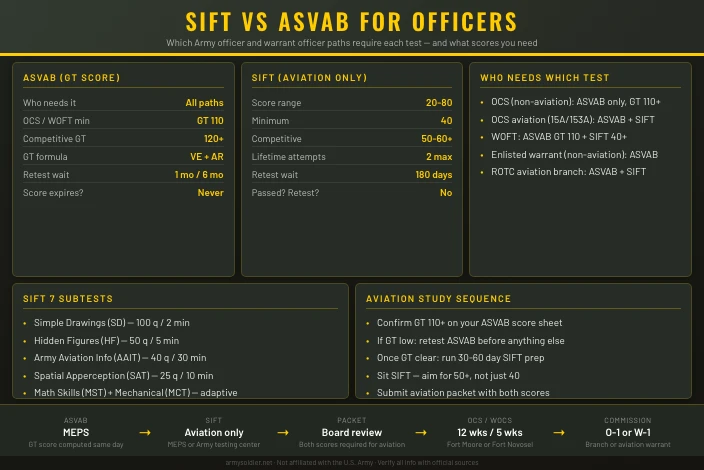
The ASVAB (Armed Services Vocational Aptitude Battery) supports enlistment and the officer or warrant paths that require a GT score. OCS and warrant applicants use the GT score, General Technical, which combines Verbal Expression and Arithmetic Reasoning. ROTC and West Point do not use the ASVAB as a general commissioning requirement.
The SIFT (Selection Instrument for Flight Training) is the Army’s aviation aptitude test. It has nothing to do with enlistment and everything to do with whether you are suited for flight school. Seven subtests measure spatial reasoning, mechanical understanding, aviation knowledge, math, and perceptual speed: all skills tied to performance in flight training.
Here is the clearest way to think about it: the ASVAB GT score gates OCS and warrant applications, while the SIFT gates Army flight-training paths.
Candidates on a flight-training path can use the SIFT prep buying checklist to confirm that a resource covers all seven subtests before paying.
Who Needs What
Your accession source determines the tests. OCS and warrant applicants must document a qualifying GT score. The SIFT applies to 153A WOFT applicants and commissioned candidates competing for Aviation.
| Path | ASVAB Required | SIFT Required | Notes |
|---|---|---|---|
| OCS (non-aviation) | Yes, GT 110 minimum | No | GT is a hard gate, nonwaivable |
| OCS candidate pursuing Aviation | Yes, GT 110 minimum | Required for Aviation selection | Follow the OCS and Aviation packet instructions |
| ROTC (non-aviation) | No general ASVAB requirement | No | ROTC uses its own academic and accession standards |
| ROTC (aviation branch) | No general ASVAB requirement | Yes, score 40 to qualify | SIFT required to compete for Aviation branch |
| WOFT (Warrant Officer Flight Training) | Yes, GT 110 minimum | Yes, score 40 to qualify | Most common aviation path; neither is waivable |
| Enlisted-to-warrant (non-aviation) | Already on file, GT 110 needed | No | ASVAB taken at enlistment; verify GT on your record |
If you are already enlisted and applying to WOFT, your ASVAB score is already on file at MEPS. Pull your ASVAB score sheet and confirm your GT score before you do anything else. If GT is below 110, you will need to retest before your packet goes to a board.
The ASVAB: What Officers and Warrant Officers Actually Need to Know
The ASVAB has 10 subtests, but for officer and warrant officer candidates, most of the score pressure falls on two of them.
GT = VE + AR. Verbal Expression (VE) is itself derived from Word Knowledge and Paragraph Comprehension. Arithmetic Reasoning (AR) is multi-step word problems. Together they set your GT. Raising your AR and VE scores is the fastest way to move your GT number.
The AFQT (Armed Forces Qualification Test) is a separate percentile score used for basic enlistment eligibility. The Army minimum AFQT for diploma holders is 31. For officer and warrant officer selection, AFQT matters mainly as an initial gate. GT is the number that boards and programs look at.
GT Score Minimums
- 110 is the published minimum for OCS and the 153A WOFT application
- A score above the minimum does not replace the rest of the selection packet
A GT of 110 clears the gate. It does not make your packet stand out. If you have time before testing, aim higher.
Retaking the ASVAB
Retakes follow a specific schedule. You wait one month after your first attempt, another month after that retest, then six months between any further attempts. Do not treat a retest as a backup plan. Study before your first test, not after a disappointing score.
The SIFT: Flight-Training Candidates Only
The SIFT replaced the old AFAST and is used for Army flight-training selection. Commissioned candidates competing for Aviation and 153A WOFT applicants take the test. Technical aviation warrant specialties such as 150A, 150U, and 151A do not.
Score Range and Minimums
The SIFT produces a single composite score on a 20 to 80 scale. A score of 40 qualifies. Current 153A recruiting guidance lists 55 or higher as Most Preferred for that warrant path. The Army does not publish one competitive score for every commissioned accession source.
| Score | Published meaning |
|---|---|
| Below 40 | Does not qualify for Army flight training |
| 40 or higher | Qualifying score; cannot be retaken |
| 55 or higher | Most Preferred for 153A applicants |
The score is one part of the packet. It does not guarantee selection.
The 7 Subtests
The SIFT runs approximately 100 minutes and covers seven sections. Each one measures something distinct.
- Simple Drawings (SD): 100 questions, 2 minutes. Rapid visual matching under extreme time pressure. Wrong answers are penalized.
- Hidden Figures (HF): 50 questions, 5 minutes. Find a simple shape embedded in a complex pattern. Also penalizes wrong answers.
- Army Aviation Information Test (AAIT): 40 questions, 30 minutes. Helicopter aerodynamics, Army aircraft, instruments, weather, and aviation terminology. The most knowledge-dependent section.
- Spatial Apperception Test (SAT): 25 questions, 10 minutes. View a ground scene from a cockpit and determine the aircraft’s orientation. A pure spatial reasoning challenge.
- Reading Comprehension Test (RCT): 20 questions, 30 minutes. Standard passage-based comprehension. More time per question than most reading tests.
- Math Skills Test (MST): Adaptive format, roughly 40 minutes. Arithmetic, algebra, geometry, and word problems. Adapts to your performance level.
- Mechanical Comprehension Test (MCT): Adaptive format, roughly 15 minutes. Levers, pulleys, gears, forces, and basic physics.
The AAIT and the spatial sections (SD, HF, SAT) are where most candidates struggle. They are also the sections that most general test prep misses entirely.
Retake Rules
The SIFT allows 2 lifetime attempts. If the first score is below 40, the second attempt may be administered on or after day 45. If you score 40 or higher, you cannot retest to improve that score. Fail both attempts and you are disqualified from Army aviation flight training.
This makes your first attempt consequential. Show up prepared, not curious.
Side-by-Side Comparison
| ASVAB (GT score) | SIFT | |
|---|---|---|
| Who needs it | OCS and warrant applicants who must document GT | Commissioned Aviation and 153A WOFT applicants |
| Score type | Percentile-based line score (GT = VE + AR) | Composite 20-80 scale |
| Minimum | GT 110 | 40 |
| Published guidance above the minimum | Varies by selection process | 55 or higher is Most Preferred for 153A |
| Lifetime attempts | No hard cap (but wait periods apply) | 2 max |
| Retest rules | 1 month, 1 month, then 6 months | 45 days after a failed first attempt; no retest after a qualifying score |
| Score validity | No expiration | No expiration |
| Where you test | MEPS | MEPS or authorized Army testing centers |
| When to take it | Before OCS or WOFT packet | Before aviation packet submission |
What to Study First
If you are applying for 153A WOFT, you need both a qualifying GT score and the SIFT. Commissioned Aviation candidates should confirm the ASVAB requirement for their accession source instead of assuming every path uses the same tests.
Start with the ASVAB. Your GT score must clear 110 before you can submit a packet at all. If your GT is already verified and strong, you can skip this step. But if you have not tested or your GT is below 110, the ASVAB is the prerequisite. Locking in a GT of 120+ also strengthens your packet before you move to aviation prep.
Then prepare for the SIFT. Once your GT is solid, shift focus entirely to SIFT prep. The two tests have almost no content overlap. ASVAB math and verbal skills are not the same as SIFT spatial and aviation knowledge. Treat them as separate study campaigns.
For non-aviation officers, there is no SIFT. OCS candidates still need the required GT score, while ROTC and West Point use their own academic and accession standards.
For prior-enlisted soldiers applying to WOFT, check your GT first. Many enlisted soldiers took the ASVAB years ago and have a score on file. If GT clears 110, your ASVAB work is done: everything from that point is SIFT preparation.
Aviation Study Sequence
If GT is below 110, study and retest the ASVAB before doing anything else. Target 120+ for a competitive packet.
Once GT is confirmed, begin SIFT prep. Plan 30 to 60 days of structured study.
Take the SIFT only after your practice work is stable. A score of 40 qualifies, but selection still depends on the full packet.
Submit your aviation packet with both verified scores.
A Note on WOFT vs Commissioned Aviation
WOFT is the most common aviation path. It produces Army warrant officer pilots starting at W-1, without requiring a bachelor’s degree. The age cutoff for the 153A (Rotary Wing Aviator) warrant officer MOS is your 33rd birthday at the time of enlistment: check current recruiting guidance for the exact standard, as this can shift.
Commissioned Aviation officers use area of concentration 15A. The 153A designation belongs to warrant officer aviators. Both flight-training paths use the SIFT, but their commissioning and application requirements differ.
The SIFT requirement overlaps. The ASVAB requirement does not apply in the same way to every commissioned accession source.
You may also find Army Officer Selection Tests: SIFT Score and ASVAB for OCS and the Army SIFT Study Guide helpful as you build your preparation plan.