Special Operations ASVAB and Fitness Requirements
Getting into Army special operations isn’t a single test. It’s a sequence of gates, and you have to pass all of them. Most candidates know the ASVAB is one gate. Fewer understand that the physical standards are just as specific, and that each SOF path (Special Forces, PSYOP, Civil Affairs, and the 75th Ranger Regiment) has its own set of minimums. Knowing exactly what’s required lets you prep for the right targets instead of training blind.
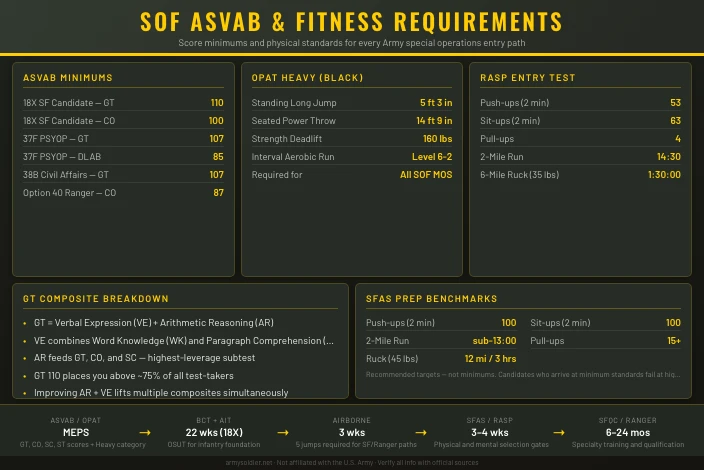
ASVAB Line Scores by Entry Path
Army MOS assignments don’t use your AFQT percentile. They use composite line scores: combinations of specific ASVAB subtests weighted toward the skills each job demands. Special operations jobs require some of the highest composites in the enlisted Army.
Special Forces Candidate (18X)
The 18X is an enlistment contract, not a permanent MOS. It guarantees you a slot in the SF pipeline. If you pass SFAS and the SF Qualification Course (SFQC), you earn one of four Green Beret specialties. If you don’t pass, the Army assigns you a different job.
| Composite | Minimum |
|---|---|
| GT (General Technical) | 110 |
| CO (Combat) | 100 |
Both scores must be met simultaneously. The GT composite combines Verbal Expression (VE) and Arithmetic Reasoning (AR). The CO composite pulls from Arithmetic Reasoning (AR), Coding Speed (CS), Auto and Shop Information (AS), and Mechanical Comprehension (MC). Neither score alone qualifies you.
Why GT 110 matters: it places you above roughly the top quarter of ASVAB test-takers. The Army sets this floor because SF candidates need to absorb advanced language, medicine, communications, and demolitions training quickly.
Green Beret Specialties (18B, 18C, 18D, 18E)
After passing SFAS, your second composite requirement shifts based on your assigned specialty.
| MOS | Title | GT | Second Composite |
|---|---|---|---|
| 18B | Weapons Sergeant | 110 | CO: 100 |
| 18C | Engineer Sergeant | 110 | SC: 100 |
| 18D | Medical Sergeant | 110 | ST: 100 |
| 18E | Communications Sergeant | 110 | SC: 100 |
The ST composite (Skilled Technical: GS + VE + MK + MC) required for 18D is the hardest to hit in this group because it includes General Science, a subtest that doesn’t appear in any other special operations composite. Candidates who want the medical specialty should target General Science and Mathematics Knowledge specifically.
The SC composite (Surveillance and Communications: VE + AR + AS + MC) for 18C and 18E rewards strong verbal skills alongside mechanical knowledge. Both specialties require soldiers who can write plans and teach techniques while managing complex technical equipment.
PSYOP Specialist (37F)
| Composite | Minimum |
|---|---|
| GT | 107 |
| DLAB | 85 |
The Defense Language Aptitude Battery is the additional filter that separates 37F from most Army jobs. It measures your ability to learn a foreign language, not your current language skill. Your score on DLAB correlates with performance on ASVAB verbal sections (VE), but they test different things. Candidates who score in the high 100s on GT tend to do better on DLAB, though it’s not guaranteed.
Not every MEPS station administers the DLAB automatically. Ask your recruiter to schedule it when you go in.
Civil Affairs Specialist (38B)
| Composite | Minimum |
|---|---|
| GT | 107 |
No DLAB required for 38B. The GT 107 floor reflects the analytical and writing demands of producing civil affairs assessments and engaging with local government officials in deployed environments. U.S. citizenship is mandatory, and a Secret clearance investigation will examine foreign contacts and travel history.
Option 40 Ranger Contract
The Option 40 contract is the civilian enlistment path into the 75th Ranger Regiment. It guarantees you a slot at Ranger Assessment and Selection Program (RASP) after completing BCT and AIT. There is no Ranger-specific MOS. Most Option 40 candidates enlist as 11B (Infantry) or 11C (Indirect Fire Infantryman).
| Composite | Minimum |
|---|---|
| CO (Combat) | 87 |
The CO 87 requirement for 11B is the applicable standard. ASVAB scores are a lower bar for Option 40 candidates than for 18X. The physical and mental filters at RASP carry more weight in this pipeline.
Composite Score Reference
Every composite above draws from the same pool of nine ASVAB subtests. The table below shows the formula for each one relevant to SOF entry.
| Composite | Formula | SOF Paths |
|---|---|---|
| GT | VE + AR | 18X, 37F, 38B |
| CO | AR + CS + AS + MC | 18X, 18B, 11B (Option 40) |
| SC | VE + AR + AS + MC | 18C, 18E |
| ST | GS + VE + MK + MC | 18D |
Arithmetic Reasoning feeds into both GT and CO. Verbal Expression feeds into GT, SC, and ST. These overlapping subtests are where prep time pays off across multiple composites at once. If your GT is borderline, improving AR and VE will lift both composites simultaneously.
Physical Standards: OPAT at Accession
Before shipping to training, every new Army recruit takes the Occupational Physical Assessment Test (OPAT). It evaluates whether your body can handle the physical demands of your intended MOS. Special operations MOS require the Heavy (Black) category.
| OPAT Event | Heavy Minimum |
|---|---|
| Standing Long Jump | 5 ft 3 in |
| Seated Power Throw | 14 ft 9 in |
| Strength Deadlift | 160 lbs |
| Interval Aerobic Run | Level 6-2 (43 shuttles) |
These aren’t hard to meet if you’re in reasonable athletic shape. Failing to meet Heavy disqualifies you from combat roles and forces a different MOS assignment. Don’t show up to MEPS undertrained.
Physical Standards: 18X / SFAS Pipeline
The Special Forces pipeline has three physical phases before you earn a Green Beret: SFPC, SFAS, and SFQC. Each builds on the one before it.
Army Fitness Test (AFT)
The AFT replaced the ACFT in June 2025. It has five events: 3 Repetition Maximum Deadlift (MDL), Hand Release Push-Up (HRP), Sprint-Drag-Carry (SDC), Plank (PLK), and Two-Mile Run (2MR). Scoring is age-normed and sex-neutral for combat MOS.
For the 18X pipeline, the AFT score that matters at SFAS is a competitive total, not just a passing score. Candidates routinely score well above the 300-point passing floor. A score of 260 points on the legacy APFT was the historic benchmark; under the AFT, the equivalent expectation is near the top of the combat specialty standard (350+ on a 500-point scale).
Swim Assessment
SFAS includes a 50-meter swim in full uniform, including boots. No time standard is published. The event tests composure in water under stress, not swimming speed. Candidates who can’t complete it do not continue.
Ruck Standards
Rucking is woven through every phase:
- SFPC (pre-selection prep): Rucks beginning at short distances, increasing to multiple long-distance events
- SFAS: Long-distance rucks with full kit, often at night, with minimal rest between
- Recommended pre-SFAS standard: 12 miles with a 45-pound rucksack in under 3 hours
Candidates who arrive at SFAS without ruck experience fail at a higher rate. Weekly ruck training starting 6-9 months out is the standard recommendation from SF prep coaches.
SFPC Prep Standards (Recommended, Not Minimum)
These benchmarks come from SF training guidelines and reflect what competitive candidates target:
- Push-ups: 100 in 2 minutes
- Sit-ups: 100 in 2 minutes
- Two-mile run: under 13 minutes
- Pull-ups: 15+ strict dead-hang repetitions
Meeting the minimum AFT standard isn’t enough. These recommended targets reflect what candidates who actually pass SFAS tend to bring on day one.
Physical Standards: Option 40 / RASP
The 75th Ranger Regiment uses a two-phase selection process. Before RASP starts, you take the RASP Entry Fitness Test. The fitness test minimums are harder than standard BCT graduation standards.
RASP Entry Test
| Event | Minimum |
|---|---|
| Push-ups (2 min) | 53 |
| Sit-ups (2 min) | 63 |
| Pull-ups (dead-hang) | 4 |
| 2-Mile Run | 14:30 |
| 6-Mile Ruck (35 lbs) | 1:30:00 |
Fail any event and you don’t enter RASP. These are minimums. Candidates who arrive at exactly the minimum are at a disadvantage.
RPFT Standards
The Ranger Physical Fitness Test is administered during RASP and sets higher bars than the entry test.
| Event | Minimum (Pass) |
|---|---|
| Push-ups (2 min) | 58 |
| Sit-ups (2 min) | 69 |
| Pull-ups (dead-hang) | 6 |
| 5-Mile Run | 40:00 |
| 12-Mile Ruck March | 3:00:00 |
The jump from a 2-mile entry run to a 5-mile RPFT run is where many candidates discover their aerobic base was built around short efforts. Running volume in training needs to reflect what the test actually demands.
RASP Swim
RASP Phase 1 includes a 15-meter swim in full uniform. Like the SFAS swim, it’s pass/fail. Comfort in water under load is the standard, not stroke technique.
DLAB and Language Assignment
The Defense Language Aptitude Battery affects the 37F pipeline directly and can appear in the SF pipeline when candidates are flagged for language-critical assignments.
A DLAB score of 85 is the 37F minimum. Language assignment after the SF Qualification Course depends on your DLAB result and the language needs of your assigned SF Group. Higher scores open more language options. Candidates targeting regional SF Groups with specific language requirements (e.g., Special Forces Group assignments focused on East Asia or the Middle East) benefit from DLAB scores above 95.
The DLAB is not an ASVAB subtest and cannot be prepped by studying ASVAB content. The best preparation is sustained exposure to foreign language grammar structures and reading under time pressure.
How to Build a Prep Plan
A focused preparation strategy looks different depending on your current baseline and target path.
If you need GT 110 for 18X:
- Verbal Expression (VE) is the most impactful subtest. It combines Word Knowledge (WK) and Paragraph Comprehension (PC). Improving VE lifts both GT and SC simultaneously.
- Arithmetic Reasoning (AR) feeds GT, CO, and SC. Work word problems daily with timed sessions.
- For the CO 100 requirement, add Auto/Shop Information (AS) and Mechanical Comprehension (MC) to your prep.
If you’re targeting 37F or 38B at GT 107:
- The gap between GT 107 and GT 110 is small. Prep the same way. If you hit 110, you have 18X as an option.
- For 37F, take a language aptitude practice test before assuming DLAB will be easy. The two tests measure different cognitive skills.
For physical prep across all paths:
The Army ASVAB study guide covers composite breakdowns and section-specific prep strategies that apply to every SOF entry path.
A realistic timeline for candidates starting from a non-athlete baseline:
| Phase | Duration | Focus |
|---|---|---|
| Foundation | Months 1-3 | Base running, bodyweight strength, ASVAB subtests |
| Build | Months 4-6 | Ruck introduction, pull-up volume, timed events |
| Peak | Months 7-9 | OPAT prep, full AFT practice, ASVAB final prep |
| Test | Month 9+ | MEPS ASVAB, OPAT, ship date |
Don’t compress this timeline. Candidates who show up to MEPS without a competitive ASVAB score and OPAT numbers are turned away or steered to non-SOF MOS.
This site is not affiliated with the U.S. Army or any government agency. Verify all information with official Army sources before making enlistment or career decisions.
You may also find Army Special Operations Careers: SF, PSYOP, and Civil Affairs and Best ASVAB Scores for Special Operations MOS helpful as you map out your path.