How a TS/SCI Clearance Boosts Your Civilian Salary
Most Army veterans transition out with solid skills and no particular edge over the civilian labor market. Intelligence soldiers transition out with something different: a TS/SCI clearance. Employers in the defense and intelligence sectors pay a measurable premium for it, and that premium shows up on day one of civilian employment – before experience, before degrees, before certifications. Understanding exactly how that works helps you time your transition, pick the right job category, and avoid the one mistake that wipes out the advantage entirely.
Why Cleared Candidates Earn More
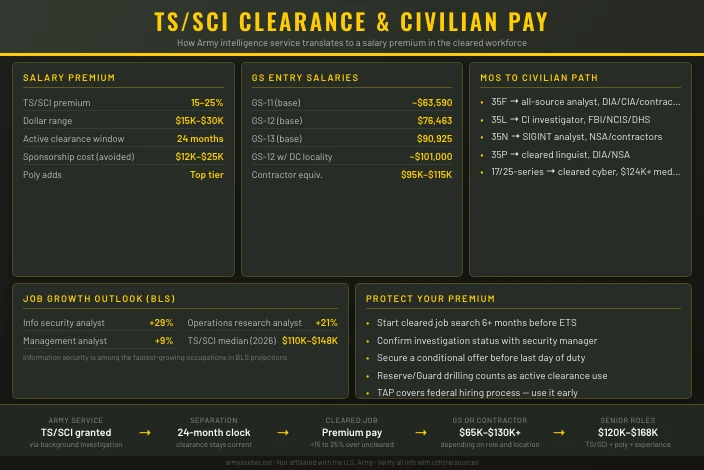
The short answer is supply and demand. The federal government and its contractors need thousands of cleared workers, and there aren’t enough of them to go around. Sponsoring a new clearance costs an employer real money – investigation fees, lost productivity during the processing window, and the risk that a candidate doesn’t adjudicate. For a TS/SCI with a polygraph, the total cost to an employer can run $12,000 to $25,000 per candidate. When you walk in already cleared, you eliminate that cost entirely.
That savings gets passed to you in salary. The clearance premium for TS/SCI holders across intelligence and cybersecurity roles runs 15 to 25 percent above comparable uncleared positions. In dollar terms, that’s roughly $15,000 to $30,000 added to a starting offer.
The premium grows with the type of clearance. A basic Secret clearance commands a modest bump. TS/SCI is the standard for most intelligence community work. Add a full-scope polygraph – which 35L Counterintelligence Agents and some 35N SIGINT analysts carry – and you reach the top tier of the market.
What Drives the Premium
Three factors determine how much your clearance adds to a specific offer:
| Factor | Effect on Premium |
|---|---|
| Clearance level (Secret vs. TS/SCI vs. TS/SCI + poly) | Higher level = larger premium |
| Active vs. current vs. expired status | Active earns the most; expired may require reinvestigation |
| Technical role vs. non-technical role | Cleared cybersecurity and SIGINT roles earn more than cleared admin |
The cleanest way to protect your premium is to land a cleared civilian role within 24 months of separation. After that window closes, your clearance is archived with the Defense Counterintelligence and Security Agency (DCSA) and reinstating it can require a full re-investigation.
What the Numbers Look Like in Practice
Average TS/SCI salaries as of early 2026 run $110,500 to $147,500 for the middle 50 percent of earners, with top-end roles in high-cost markets reaching $168,000 or more. Washington, D.C. metro – home to NSA, DIA, NGA, and hundreds of defense contractors – sets the ceiling, with cleared cybersecurity professionals averaging around $149,000 in the region.
Federal civilian roles follow the General Schedule (GS) pay scale. Entry points for cleared analysts typically land at GS-11 or GS-12:
| GS Grade | 2026 Base Pay (Step 1) | With DC Locality | Typical Role |
|---|---|---|---|
| GS-11 | ~$63,590 | ~$84,000 | Entry-level intelligence analyst |
| GS-12 | $76,463 | ~$101,000 | Mid-level analyst, cleared IT specialist |
| GS-13 | $90,925 | ~$121,000 | Senior analyst, team lead |
| GS-14 | ~$107,400 | ~$143,000 | Subject matter expert, program manager |
GS base pay from OPM 2026 salary tables. DC locality adds roughly 32 percent. Other markets like San Antonio or Colorado Springs add less but still push total compensation well above private-sector equivalents without a clearance.
Defense contractors often pay above GS rates for the same job. A GS-12 equivalent analyst at a major defense contractor in the D.C. suburbs can earn $95,000 to $115,000 depending on contract and scope. That gap widens at senior levels.
By Career Field
Not every cleared job commands the same premium. The multiplier is highest where technical skills combine with clearance requirements.
Top-paying cleared career fields for intelligence veterans:
- Cybersecurity and information security – 35N, 35T, and 17-series backgrounds translate directly. Information security analysts with TS/SCI earned a BLS median of $124,910, and cleared roles push above that.
- SIGINT and technical intelligence analysis – 35N and 35P veterans slot into NSA contractor roles, DIA SIGINT positions, and defense contractor analysis shops.
- All-source intelligence analysis – 35F veterans compete for GS-11 to GS-13 federal positions and contractor analytical roles at $65,000 to $120,000 depending on scope and location.
- Counterintelligence and investigations – 35L veterans pursue FBI, NCIS, DHS, and defense contractor CI roles. Cleared CI investigators at defense contractors typically start around $80,000 to $120,000.
The BLS projects information security analyst jobs to grow 29 percent over the next decade – the fastest of any major occupation category. Operations research analysts, a strong fit for 35F veterans, are projected to grow 21 percent.
How Army Intelligence MOS Backgrounds Map to Civilian Jobs
Your specific MOS shapes which cleared roles you’ll be most competitive for on day one. That matters because some roles let you start immediately, while others require additional training or degrees.
| MOS | Civilian Role | Starting Salary (Active TS/SCI) |
|---|---|---|
| 35F Intelligence Analyst | DIA/CIA analyst, contractor analyst | $65,000 – $95,000 |
| 35L CI Agent | FBI, NCIS, DHS, contractor CI | $80,000 – $120,000 |
| 35N SIGINT Analyst | NSA, SIGINT contractor | $80,000 – $130,000 |
| 35P Cryptologic Linguist | DIA, NSA, State Dept contractor | Premium above standard TS/SCI |
The 35F’s all-source background translates to GS-11 or GS-12 entry with 3 to 6 years of experience. The 35L’s investigative skills and polygraph credential open the 0132 Intelligence and 1811 Criminal Investigator federal job series. The 35N maps directly to NSA and its contractor base – the largest cleared civilian workforce in the country. The 35P stacks language skills on a TS/SCI, one of the rarest combinations in the market. Rare-language specialists command premiums well above the standard TS/SCI rate.
The 24-Month Window: Your Biggest Post-Service Risk
The most common mistake cleared veterans make is waiting too long to use the clearance. After separation, you have 24 months before your clearance goes into archive status. Once archived, reinstating it can require a new full-scope investigation – a process that takes months and must be sponsored by an employer who has a contract requiring that level of access.
That creates a practical problem: employers want cleared candidates, but they can’t always sponsor a re-investigation before hiring. Many will pass on an archived clearance and hire someone with an active one instead.
Three things to do before your ETS date:
- Start the cleared job search at least 6 months out. Use USAJobs.gov for federal positions; ClearanceJobs, LinkedIn, and contractor career pages for industry roles.
- Confirm your clearance status and last investigation date with your unit security manager before you separate.
- Line up at least one conditional offer that requires and transfers your clearance before your last day of duty. The transition doesn’t have to be immediate, but the clock starts when you leave.
The Transition Assistance Program (TAP) covers the cleared job search process and federal hiring. Use it early. Federal GS applications are slower and require a different resume format than private-sector applications – both work against veterans who start late.
Reserve and Guard Service: One Way to Keep the Clearance Current
Some veterans transition to Army Reserve or National Guard 35-series positions while working civilian intelligence jobs. Drilling with an MI unit keeps the clearance in active use, maintains military benefits, and builds dual-track experience that strengthens your civilian profile.
A Reserve 35F or 35N working a contractor or federal analyst job during the week while drilling on weekends runs both tracks in parallel. What drill weekends include:
- Classified system access and SCIF time
- Intelligence product development and analytical exercises
- Current training on updated collection platforms and TTPs
All of this counts as active clearance use. USERRA protects the civilian job during any activations.
The caveat: maintaining a TS/SCI in a Reserve billet requires the unit to sponsor periodic re-investigations. Confirm before you sign that the specific position includes active clearance sponsorship.
Common Questions About Cleared Civilian Pay
Does the salary premium apply everywhere, or only in D.C.?
The D.C./Baltimore corridor has the highest concentration of cleared jobs and the highest salaries. But Colorado Springs, San Antonio, Huntsville, and Honolulu all have active cleared job markets. The premium exists wherever cleared work is performed, though absolute salary levels are lower outside high-cost areas.
Does my clearance transfer automatically to a federal civilian job?
Not automatically, but the reciprocity framework allows a federal agency to accept your existing clearance without a new investigation in many cases. The hiring agency verifies through DCSA that your clearance is current and the investigation is in scope. The gaining organization’s security officer handles the actual transfer.
Does a TS/SCI from the Army transfer to civilian federal roles outside the intelligence community?
Yes. A TS/SCI is recognized across federal agencies through the same reciprocity process, regardless of whether it was granted by an Army unit or a civilian agency.
The clearance is an asset. Like any asset, it depreciates if you don’t use it. Veterans who move directly from active intelligence service into cleared civilian roles capture the full premium. Those who wait, take unrelated work, or let the 24-month window close often have to rebuild from a weaker starting position.
Army intelligence and cyber MOS jobs covers the full range of 35-series and 17-series roles that qualify for TS/SCI clearances. Army jobs that require a security clearance breaks down clearance requirements across every MOS. Explore Army intelligence careers to see all MOS profiles in the intelligence family.
This site is not affiliated with the U.S. Army or any government agency. Verify all information with official Army sources before making enlistment or career decisions.