What Army Life Is Really Like in 2026
Most people thinking about joining the Army have one of two mental images: a recruiter’s glossy brochure or a war movie. Neither is accurate. The reality is more routine, more structured, and more varied than either picture. It’s worth knowing what you’re actually signing up for before you walk into a recruiting station.
This guide covers what daily Army life looks like across different situations: garrison life on a post, field exercises in the woods, a deployment overseas, and the parts that rarely come up in recruiting conversations.
The Daily Routine
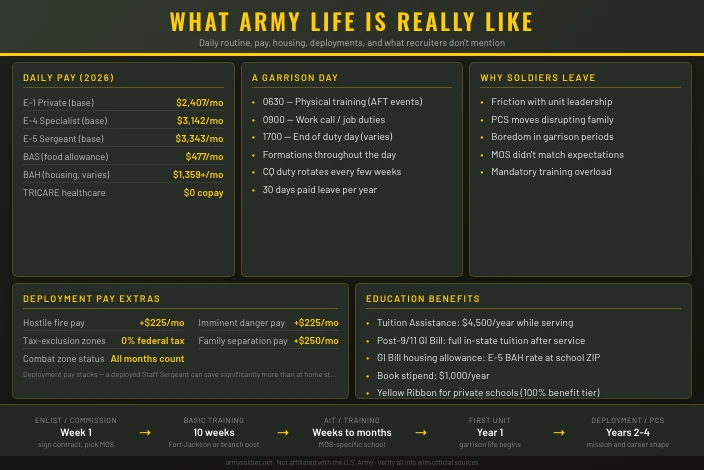
Army days start early. On a standard garrison day, soldiers report for physical training around 0630. PT runs 60 to 90 minutes and covers the events on the Army Fitness Test: deadlifts, push-ups, a sprint-drag-carry, a plank, and a two-mile run. After PT, soldiers clean up, eat breakfast, and report for work call around 0900.
The workday runs to about 1700 (5 PM) on most days, though that varies by unit, mission, and what the Army needs from you that week. Some days are administrative: mandatory training modules, medical appointments, equipment checks. Others involve hands-on job work: a mechanic turning wrenches, a signal soldier running cable, a medic running sick call.
Formations happen constantly. Morning formation, end-of-day formation, random accountability formations. You are never too senior to stand in a formation. If your unit wants to find everyone in one place at one time, a formation is how that happens. New soldiers are often surprised by how much time formations consume each week.
Fridays frequently include a unit run or formation PT, and then soldiers are released for the weekend unless they have Charge of Quarters (CQ) duty, staff duty, or a weekend exercise. CQ involves sitting in a barracks dayroom or unit headquarters for 24 hours, answering phones and logging anything unusual. It rotates through junior enlisted soldiers and can hit every few weeks depending on unit size.
A typical day in more detail shows how much the schedule shifts between an infantry unit in the field and a signal unit at a headquarters.
Pay and What It Actually Covers
Basic pay is only part of the picture. A new E-1 Private earns $2,407 per month in base pay. An E-4 Specialist with under two years in earns $3,142 per month. A Sergeant (E-5) hits $3,343 per month at the same experience level. These are 2026 figures after a 3.8% raise that took effect January 1.
On top of base pay, soldiers get two major allowances:
- Basic Allowance for Subsistence (BAS): $476.95 per month for enlisted soldiers. This is meant to cover food and does not vary by location.
- Basic Allowance for Housing (BAH): Varies by duty station, rank, and whether you have dependents. At Fort Sam Houston in San Antonio, an E-4 without dependents gets $1,359 per month. With dependents, that jumps to $1,728.
Neither allowance is taxable income. That matters more than most people realize. A soldier earning $3,142 in base pay plus $1,359 in BAH and $477 in BAS takes home closer to $4,978 in combined compensation, most of it tax-free. The full pay and benefits breakdown covers how these figures stack across ranks and locations.
Beyond monthly pay, enlistment bonuses can add a lump sum upfront for in-demand MOS jobs. Some critical skill bonuses run into the tens of thousands of dollars, paid out at enlistment or after training.
Healthcare is free through TRICARE Prime for active-duty soldiers. Zero enrollment fee, zero copays, zero deductible. Family members enrolled under the soldier’s plan also pay nothing for in-network care, with an annual out-of-pocket cap of $1,000. For someone used to paying $400 a month in civilian health premiums, that benefit alone adds significant value.
Honest Army vs. civilian pay comparisons put these numbers in context, accounting for housing, healthcare, and the 30 days of paid leave soldiers earn each year.
Housing and Where You’ll Live
Where you live is largely not your choice. The Army assigns you to a duty station based on your MOS, the needs of the force, and available slots. You can request preferences, but you do not get a guarantee.
First-term soldiers without dependents typically live in barracks on post. Barracks quality ranges widely. Newer facilities at some installations have private rooms with shared bathrooms. Older facilities have two soldiers per room, communal bathrooms at the end of the hall, and not much space for anything else. You will share a wall with someone regardless.
Soldiers with dependents or who reach a certain rank typically live off post and receive BAH to cover rent. Some installations have on-post family housing managed by private contractors, though quality and wait times vary by location.
Every few years, the Army moves you. A Permanent Change of Station (PCS) move sends you to a new installation, often across the country or overseas. The Army pays moving expenses and gives you a lump sum to cover incidentals, but PCS moves are disruptive.
Spouses change jobs. Kids change schools. You rebuild your social network from scratch. For some families, this is an adventure. For others, it becomes the primary stress of Army life.
The full guide to Army duty stations covers major installations from Fort Liberty in North Carolina to Schofield Barracks in Hawaii, and what life looks like at each one.
The Field and Deployments
Garrison life is not representative of Army life as a whole. Units regularly leave post for field exercises, which can run anywhere from a few days to several weeks. During field exercises, soldiers live in tents or under vehicles, eat MREs or meals prepared in field conditions, and train on mission tasks without the comforts of a normal workday.
For combat arms soldiers in infantry, armor, artillery, and engineer units, field time is heavier. An infantry unit might spend two to three months per year in the field across multiple exercises. Support and administrative MOS soldiers typically see less field time, though “typically” does not mean “never.”
Deployments are separate from field exercises. An active-duty career of four to eight years will very likely include at least one. Length and frequency depend on your MOS, your unit, and what’s happening in the world.
A support MOS at a stateside headquarters deploys less often than an infantry battalion. Some soldiers deploy once in four years. Others deploy two or three times in the same window.
Deployment comes with additional pay. Hostile fire pay adds $225 per month. Imminent danger pay runs the same amount. Soldiers deployed to tax-exclusion zones also pay zero federal income tax on all earnings for every month with at least one qualifying day. That can mean significant savings on a Staff Sergeant’s salary.
The hardest part of deployment for most people is not danger. It is the sustained separation from family, the spotty communication, and the uncertainty of when it ends. Families back home manage everything alone. That weight is real and should factor into your decision.
What the Recruiter Won’t Tell You
Every institution has a gap between its marketing and its reality. These are the things that take new soldiers by surprise:
- The paperwork never stops. MEDPROS updates, training completions, vehicle dispatch requests, leave forms, counseling statements. Digital systems have improved this, but not eliminated it.
- Promotions E-1 through E-4 are mostly automatic. Time-in-grade handles the first few. The jump from Specialist (E-4) to Sergeant (E-5) requires a board, fitness scores, and points that vary by MOS.
- Your MOS determines your quality of life more than any other factor. A 25U signal specialist in a climate-controlled comms room lives a different life than an 11B infantryman who spends weeks in the woods.
- You will be bored. Long stretches of garrison life involve mandatory training videos, waiting for appointments, and standing by for things that never happen. The pace swings between slow periods and sudden intense demands.
- The Army will move your career forward whether you like it or not. Every assignment cycle, soldiers get orders. You can try to influence the outcome, but the Army’s needs come first.
The Career Side
The Army has over 150 enlisted MOS jobs and dozens of officer branches. Picking the right one matters enormously. Browsing the career fields before you sign is worth more than any conversation with a recruiter.
Most enlisted soldiers enter at E-1 or E-2 and spend their first two years completing training and proving themselves in a unit. The pay section above covers how compensation grows with rank.
The Army also offers career paths outside the enlisted and officer tracks. Warrant officers fill highly technical roles: helicopter pilots, intelligence technicians, cyber operators. They progress through a separate rank structure from W-1 to W-5 without taking on the command responsibilities of commissioned officers.
Education benefits make Army service financially valuable beyond the paycheck. Active-duty soldiers can use Tuition Assistance to take college courses during service, up to $4,500 per year toward tuition. After separation, the Post-9/11 GI Bill covers full in-state tuition at public universities plus a monthly housing allowance while in school.
Why Some People Love It and Why Others Leave
People who thrive in the Army tend to share a few traits. They find meaning in belonging to something larger than themselves. They adapt quickly and don’t need personal control over every aspect of their schedule. They enjoy physical challenge and don’t mind living with institutional constraints.
People who struggle, or leave at their first contract, often cite one of the same few reasons:
- Friction with leadership in their specific unit
- The PCS cycle disrupting personal relationships or family stability
- Boredom and frustration during slow garrison periods
- An MOS that didn’t match what they expected
The Army is not a uniform experience. A soldier in a good unit with a meaningful MOS and a stable duty station can find genuine satisfaction in a military career. A soldier in a dysfunctional unit, assigned to a job they didn’t want, at a remote post they didn’t choose, can count down days until ETS from week one.
Unit culture varies more than most people expect. Before signing, talk to people who served in the specific MOS and installation you’re considering. Skip the recruiter pitch and skip the worst-case Reddit threads.
Whether the Army is worth it comes down to what you want from the next four years and what trade-offs you’re willing to accept. What to expect at Basic Training is the best starting point if you’ve already made up your mind and want to know what comes first.
Explore Army enlisted careers or officer paths to find the specific roles that align with what you’re looking for.
This site is not affiliated with the U.S. Army or any government agency. Verify all information with official Army sources before making enlistment or career decisions.