What Happens at Army Basic Training
Most people heading to Army Basic Combat Training have a vague idea of what to expect: yelling drill sergeants, early morning runs, and something involving an obstacle course. The reality is more structured than that. BCT runs 10 weeks, follows a defined phase system, and covers everything from Army values and rifle marksmanship to land navigation and a multi-day field exercise that ends your training cycle.
If you know what’s coming, it’s a lot less overwhelming. Here’s what actually happens, week by week.
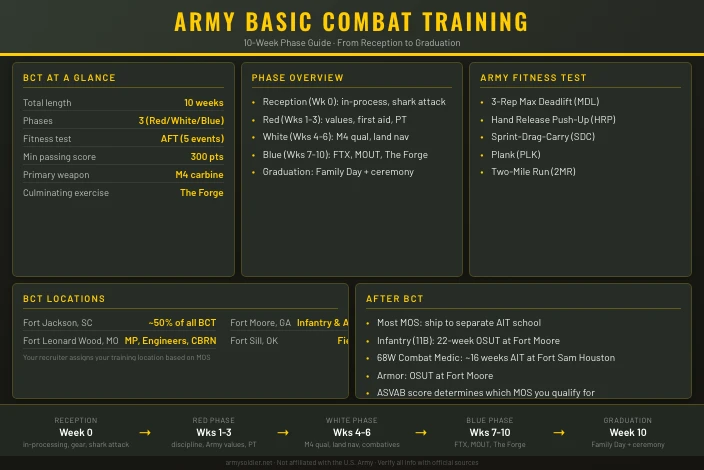
Reception: Before Training Even Starts
Reception is sometimes called “Week Zero” because it happens before the official training clock begins. It’s also one of the most disorienting parts of the whole process.
You’ll spend one to several days at a Reception Battalion getting in-processed. This includes medical screenings, dental checks, immunizations, issuing your uniforms and gear, getting your head shaved (or hair cut to regulation for women), and completing a mountain of administrative paperwork. You’ll set up direct deposit and provide emergency contact information.
Then comes the moment recruits talk about afterward: the shark attack. When your bus arrives at the training unit, drill sergeants board immediately and start screaming instructions at maximum volume. You have seconds to get off the bus, fall into formation, and do exactly what you’re told. It’s designed to shock you out of civilian mode fast. Nobody passes out or gets hurt. But almost everyone’s heart rate doubles.
What to bring to reception:
- Photo ID (driver’s license or state ID)
- Social Security card
- All military orders from your recruiter
- Two combination locks
- Basic toiletries (toothbrush, soap, razor, deodorant, shampoo)
- White underwear, white athletic socks, comfortable civilian clothes for travel
- Running shoes
- Small amount of cash or an ATM card
- Prescription glasses if you wear them (contacts are generally not allowed during BCT)
- Required documents: high school diploma, immunization records, direct deposit form, marriage or birth certificates if applicable
What not to bring:
- Expensive electronics (laptops, tablets, smartwatches)
- Food of any kind (gum, candy, snacks)
- Tobacco products
- Anything alcohol-based
- Weapons of any kind, including pocketknives
- Books, magazines, or playing cards
Your cell phone will likely be secured during training and only returned when phone privileges are earned. Bring it for travel, but expect to go days or weeks without access.
Red Phase: Weeks 1-3
Red Phase is about breaking down civilian habits and building a baseline. Drill sergeants run everything by the book, with zero tolerance for shortcuts.
The first three weeks cover Army values, customs and courtesies, drill and ceremony, and a significant amount of classroom instruction. You’ll learn the seven Army values, the rank structure, Army history, and basic first aid. Physical training begins immediately, with morning PT every day building strength and endurance progressively.
Red Phase also includes the gas chamber: a controlled exercise where you enter a room with CS gas (tear gas) while wearing your protective mask, then remove the mask briefly. It confirms your equipment works and teaches you to trust it. Nobody enjoys it, but everyone gets through it.
Early in Red Phase, you’ll also get a fitness baseline assessment. The Army replaced the ACFT with the Army Fitness Test (AFT) in June 2025. The AFT has five events:
| Event | Abbreviation |
|---|---|
| 3 Repetition Maximum Deadlift | MDL |
| Hand Release Push-Up | HRP |
| Sprint-Drag-Carry | SDC |
| Plank | PLK |
| Two-Mile Run | 2MR |
The minimum passing score is 300 total points (60 per event minimum), with scoring scaled by age and sex. The baseline assessment at the start of BCT isn’t a pass/fail test. It gives drill sergeants a starting point to track your progress through training.
White Phase: Weeks 4-6
White Phase shifts the focus from discipline to weapons. This is where most recruits spend the most time on the firing range.
The primary weapon in BCT is the M4 carbine. You’ll start with weapons handling, safety rules, and clearing procedures before you ever fire a round. From there, training progresses through zeroing the weapon, grouping shots, and eventually qualifying at multiple distances. Qualification requires hitting a defined number of targets to earn a marksmanship badge.
White Phase also covers:
- Land navigation using a map and compass, including night land navigation
- Bayonet training and combatives (Army hand-to-hand combat)
- Confidence course obstacles including rappelling from a 40-foot tower
- Tactical foot marches carrying load-bearing equipment
The physical training workload increases through White Phase, and the runs get longer. By the end of Week 6, most recruits are running several miles without stopping.
Blue Phase: Weeks 7-10
Blue Phase applies everything from the first two phases in realistic, tactical scenarios. The classroom and the range give way to the field.
Training in this phase includes Military Operations in Urban Terrain (MOUT): room-clearing and building-entry drills in a simulated village. Key Blue Phase activities:
- Crew-served weapons and grenade launcher familiarization
- Live-fire exercises with team movement under overhead fire
- Tactical foot marches of 15 kilometers or more with a full rucksack
- Night operations and land navigation under limited visibility
The Forge is the final event of BCT: a 72- to 96-hour field exercise that integrates everything you’ve trained on. Your squad navigates terrain, performs tactical tasks, handles simulated casualties, and completes physical challenges in sequence.
Sleep is limited. The pace is sustained. Completing The Forge is required to graduate.
The Forge is deliberately demanding, but it’s also where most recruits experience the biggest mental shift. By the end, the people who struggled with homesickness in Week 2 are functioning as a unit.
The Mental Game
Nobody talks enough about this part. BCT is physically hard, but most people who struggle do so mentally, not physically.
Homesickness hits hardest in the first two weeks. You’re sleep-deprived, overwhelmed, and surrounded by strangers. The pace doesn’t slow down to let you process. The best approach is to focus entirely on the next task. Not the next week, not graduation. Just the next formation, the next meal, the next training block.
Sleep deprivation is real and intentional. The early weeks involve less sleep than your body wants. Your ability to follow instructions, stay patient, and make decisions under fatigue is part of what the training builds.
The recruits who wash out most often are those who make BCT about the individual. The ones who graduate are those who figure out, usually around Week 4, that the goal is keeping the person next to them going.
Graduation and What Comes Next
Family Day typically falls the day before graduation. Families can visit the installation, meet the drill sergeants, and see the barracks. Graduation itself is a formal ceremony on the parade field with the entire BCT company marching in formation.
After graduation, what happens next depends on your MOS:
- Standard BCT graduates ship to an Advanced Individual Training (AIT) school at a separate installation for MOS-specific training. Length varies from a few weeks (for some support roles) to many months. A 68W Combat Medic, for example, attends AIT at Fort Sam Houston for roughly 16 weeks after BCT.
- Infantry and Armor recruits attend One Station Unit Training (OSUT), which combines BCT and AIT into a single continuous program at the same installation. An 11B Infantryman completes a 22-week OSUT cycle at Fort Moore, Georgia with no separate graduation between phases.
BCT Locations
Four installations run BCT for the Army:
| Installation | Location | Notable specialty |
|---|---|---|
| Fort Jackson | Columbia, SC | Trains roughly half of all BCT soldiers |
| Fort Moore | Columbus, GA | Infantry and Armor OSUT |
| Fort Leonard Wood | Waynesville, MO | Military Police, Engineers, CBRN |
| Fort Sill | Lawton, OK | Field Artillery |
Your recruiter determines your training location based on your MOS. You don’t choose it.
Communicating with Family During BCT
Phone access is earned, not guaranteed. Most soldiers get limited phone time starting around the end of Red Phase, often on Sundays. Drill sergeants control when and how long. Expect calls to be short.
Mail works throughout BCT. Letters and care packages (within restrictions) can arrive from Day 1. This is the most reliable communication method during the first few weeks. Your family will receive your mailing address after you arrive at your training unit.
Email access varies by installation. Some units allow limited computer time; others do not. Assume letters are the primary channel until you can tell your family otherwise.
BCT is ten weeks. It is hard on purpose. But it’s a known course, the same program that tens of thousands of soldiers have completed before you. Knowing what’s in each phase removes the unknown, and the unknown is usually what makes people most anxious.
Browse the enlisted career fields to understand what your MOS training looks like after BCT. If you haven’t taken the ASVAB yet, your score determines which jobs you qualify for before you ever step onto a bus to reception. Day in the Life of an Army Soldier covers what a normal duty day looks like once training is behind you. Your first assignment after AIT depends partly on where the Army needs you, and Army Duty Stations breaks down the major installations. For the broader picture, read What Army Life Is Really Like.
This site is not affiliated with the U.S. Army or any government agency. Verify all information with official Army sources before making enlistment or career decisions.