Why the Army Is Better Than the Marines
On this page
How you get a job in the Army
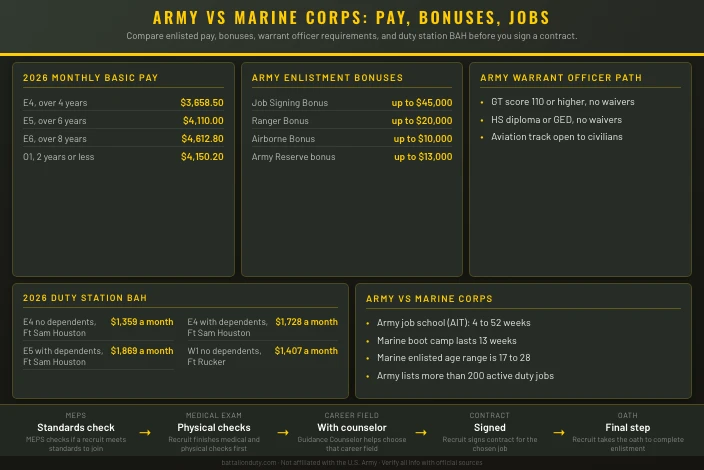
At the Military Entrance Processing Station, the Army checks if a recruit meets the standards to join. If so, the recruit chooses a career field, signs a contract, and takes the oath.
First, the recruit finishes medical and physical checks. Then the recruit works with a Guidance Counselor to choose that career field.
The Army lists more than 200 active-duty jobs in fields like mechanics, engineering, science, medicine, and aviation. A recruit can explore Army jobs that might interest them.
Many factors decide which jobs a recruit can pick, including their ASVAB score and which positions are open at the time. That ASVAB score helps show which Army jobs best fit a recruit’s skills and mental aptitude.

Army enlistment bonuses
The Army advertises that full-time recruits can combine bonuses worth up to an extra $50,000 when they enlist in certain jobs.
Recruits in certain in-demand jobs can earn up to $10,000 if they report to Basic Training within 30 days of enlisting. A handful of enlisted job openings also come with a Job Signing Bonus of up to $45,000.
The Army’s Ranger Bonus pays qualified Soldiers up to $20,000. It is paid once a Soldier completes the required Ranger training and reaches their first permanent duty station.
The Army’s Airborne Bonus pays up to $10,000 to Soldiers who complete Airborne School and earn their Airborne qualification.
Army Reserve recruits who qualify may receive up to $13,000 in bonuses.
Rank doesn’t decide bonus eligibility for a first-time enlisted Soldier, since most Soldiers join with the same starting rank. Instead, the amount depends on the job specialty, called the MOS, and how fast the recruit can report to Basic Combat Training.
Army pay and allowances in 2026
In 2026, an E-4 with over 4 years of service earns $3,658.50 a month in basic pay. An E-5 with over 6 years earns $4,110 a month, and an E-6 with over 8 years earns $4,612.80 a month.
A new O-1 officer with 2 years of service or less earns $4,150.20 a month. Basic pay for officers at O-6 and below is capped at $15,408.30 a month in 2026, a limit set by Executive Schedule Level V.
These basic pay tables cover every service, so a Marine at the same grade and years of service earns the same. Unlike 2025, the 2026 tables don’t add an extra targeted raise for junior enlisted troops.
Basic Allowance for Subsistence, the money that covers food, is $476.95 a month for enlisted troops in 2026 and $328.48 a month for officers. The enlisted rate is about 2.4% higher than the 2025 rate of $465.77.
Duty stations, deployments, and family life
In 2026, an Army E-4 without dependents at Fort Sam Houston, Texas gets a Basic Allowance for Housing (BAH) of $1,359 a month. An E-4 with dependents at the same post gets $1,728 a month.
At Fort Sam Houston, an E-5 with dependents gets $1,869 a month in BAH. A first-year Warrant Officer (W1) without dependents at Fort Rucker, Alabama gets $1,407 a month.
The average Army deployment to a combat region lasts nine months. Soldiers cannot bring their families along on that deployment.
The Army job a soldier picks changes this rhythm. Infantry soldiers deploy roughly 9 to 12 months, then spend 18 to 24 months at home station.
Indirect fire infantry soldiers also deploy roughly 9 to 12 months, then spend 24 to 36 months at home station. Active-duty Cavalry Scouts deploy about once every 24 to 36 months.
The Army’s warrant officer and aviation track
Warrant Officer Candidate School trains soldiers for 14 of the Army’s 16 basic branches. Infantry and Armor don’t have warrant officer positions. The Aviation track, called WOFT, accepts civilians with no prior service.
To apply, a soldier or civilian needs a General Technical composite score of 110 or higher, and no waivers are allowed. A high school diploma or GED is also required, and that rule can’t be waived either.
Active-duty applicants can have no more than 12 years of active federal service when they sign the application, or 8 years for aviators, though the Army can waive this. To move from W-1 to CW2, a warrant officer must finish the Warrant Officer Basic Course and meet time in grade rules. After that, the move from W-1 to CW2 happens on its own, with no board review.
Technical warrant officers take on a 6-year active duty commitment after finishing the Warrant Officer Basic Course. Aviation warrant officers take on a 10-year commitment that starts once they finish the common core phase of flight training.

Marine Corps training and entry rules
Marine Corps Recruit Training, the Marines’ boot camp, lasts 13 weeks. In the Army, job school comes after Basic Training: Advanced Individual Training can run from four to 52 weeks, depending on the job.
Marine Corps enlisted applicants must be between the ages of 17 and 28 and need a high school diploma or GED. Marine Corps applicants with a GED or nontraditional diploma need an ASVAB score of 50 or higher. Marine Corps officers need a four-year college degree by the time they get commissioned.
In the Marine Corps, Physical Fitness Test scores count toward promotion and shape which leadership roles a Marine can earn. The Combat Fitness Test has three parts. Marines sprint 880 yards, lift a 30-pound ammo can overhead again and again, and finish a 300-yard course that mixes crawling, dragging a casualty, a fireman’s carry, and a grenade throw.
What to get in writing before you sign
Before you sign at MEPS, check that your exact job and your exact bonus dollar amount are written on your enlistment paperwork. Ask your recruiter what the Delayed Entry Program does and does not lock in.
The Army advertises its enlistment bonuses as “up to” amounts. Army active-duty contracts usually run two to six years, and the length can depend on your Army job or a decision to reenlist.
Ask your recruiter, in writing, how many years the contract runs and which specific jobs your ASVAB scores open right now.
Talk to an Army recruiter first, and do not sign anything the same day you meet. Read the contract slowly with someone you trust. If your job and bonus are not written into the contract, they are not guaranteed.