13B Cannon Crewmember
Every fire mission starts the same way: a call comes over the radio, the crew scrambles, and within minutes a 95-pound high-explosive round is headed downrange at a target miles away. The 13B Cannon Crewmember is the soldier who loads, aims, and fires the Army’s howitzers. You are the ground force’s long-range punch, delivering indirect fire that infantry and armor units depend on to move, fight, and survive. If you want a combat arms job where teamwork, speed, and precision matter more than anything else, this is the one.
Qualifying requires specific ASVAB line scores — our ASVAB study guide covers what to target and how to prepare.
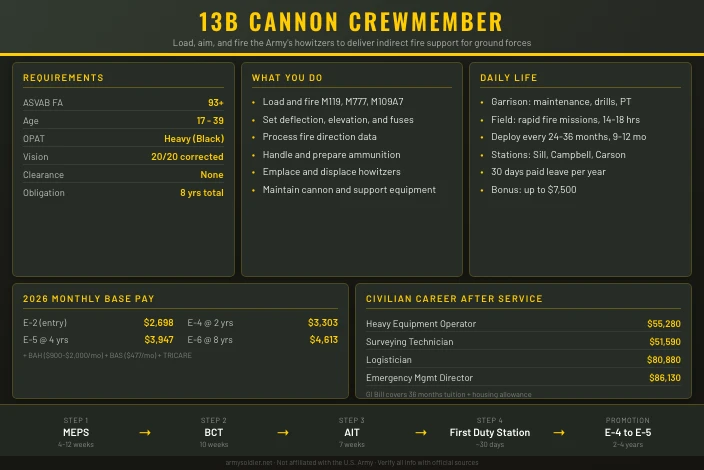
Job Role and Responsibilities
The 13B Cannon Crewmember operates and maintains field artillery cannon systems in support of infantry, armor, and special operations units. You load and fire howitzers, prepare ammunition with correct fuses and charges, process fire direction data, and keep your weapon system ready to shoot at all times. In combat, your crew delivers indirect fire on enemy positions, vehicles, and fortifications from several miles away.
Daily Tasks
In garrison, your day revolves around equipment maintenance and training. You clean the howitzer tube, inspect the breech and recoil mechanisms, inventory ammunition, and run through crew drills. Physical training fills the early morning. Afternoons often mean classes on fire direction procedures, safety protocols, or new digital fire control systems.
In the field, the pace changes fast. Your section receives a fire mission, and the crew has seconds to set the correct deflection and elevation on the gun. The gunner lays the tube. The assistant gunner sets fuses. The loader rams the round. The section chief calls “fire,” and the gun goes off. You repeat this until the mission is complete, then displace to a new position before counter-battery fire lands on your old one.
Howitzer Systems
13B soldiers train on three primary weapon systems:
- M119A3 – a 105mm towed howitzer used by light infantry and airborne divisions. Weighs about 4,700 pounds and can be sling-loaded under a helicopter.
- M777A2 – a 155mm towed howitzer with a digital fire control system. Fires standard rounds out to 24 kilometers and precision-guided Excalibur rounds beyond 40 kilometers.
- M109A7 Paladin – a 155mm self-propelled howitzer mounted on a tracked chassis. The newest variant is being fielded across armored divisions in 2026.
Your assignment determines which system you operate. Light units run the M119A3. Heavy and mechanized units use the Paladin. The M777A2 sits in between, serving both infantry brigade combat teams and division artillery battalions.
Specialized Roles and Identifiers
The 13B MOS has three skill levels that define your responsibilities at each stage:
| Skill Level | MOSC | Role |
|---|---|---|
| Skill Level 1 | 13B10 | Cannon crewmember: loads, fires, sets fuses and charges |
| Skill Level 2 | 13B20 | Senior crewmember: supervises ammunition handling and howitzer operations |
| Skill Level 3 | 13B30 | Section chief: directs movement, emplacement, camouflage, and defense of the howitzer section |
Available Additional Skill Identifiers (ASIs) include A7 (Field Artillery Master Gunner) for skill level 4 NCOs and U6 (Field Artillery Weapons Maintenance). The SQI “M” applies to senior FA NCOs serving in principal duty positions.
Mission Contribution
Field artillery delivers the majority of firepower in ground combat. A single battery of six howitzers can suppress an enemy position, destroy a vehicle convoy, or break up an assault before friendly troops ever make contact. Your crew’s speed and accuracy directly affect whether soldiers on the ground live or die. That weight is real, and it never goes away.
Salary and Benefits
Financial Benefits
Military pay depends on your rank and years of service. You enter as E-1 (Private) and typically promote to E-2 after completing Basic Combat Training.
| Rank | Pay Grade | Years of Service: 2 | Years of Service: 4 | Years of Service: 6 | Years of Service: 8 |
|---|---|---|---|---|---|
| Private (PV2) | E-2 | $2,698 | $2,698 | $2,698 | - |
| Specialist (SPC) | E-4 | $3,303 | $3,659 | $3,816 | $3,816 |
| Sergeant (SGT) | E-5 | $3,599 | $3,947 | $4,109 | $4,299 |
| Staff Sergeant (SSG) | E-6 | $3,743 | $4,069 | $4,236 | $4,613 |
Source: DFAS 2026 pay tables. Figures reflect the 2026 pay raise.
Beyond base pay, you receive tax-free allowances. BAH (Basic Allowance for Housing) ranges from roughly $900 to $2,000+ per month for a single E-4, depending on duty station. BAS (Basic Allowance for Subsistence) adds about $477 per month for food. The Army sometimes offers enlistment bonuses for 13B, though amounts change based on recruiting needs. As of early 2026, GoArmy.com lists eligibility for up to a $7,500 signing bonus.
Additional Benefits
You and your family get TRICARE health coverage at little or no cost. That includes doctor visits, hospital stays, dental, vision, prescriptions, and mental health services. Tuition Assistance lets you take college courses while on active duty. After you separate, the Post-9/11 GI Bill pays up to 36 months of tuition at public universities (full in-state rate) plus a monthly housing allowance and book stipend.
Retirement runs through the Blended Retirement System (BRS):
- Serve 20 years and receive a pension worth 40% of your base pay
- The government matches up to 5% of your Thrift Savings Plan (TSP) contributions
- Survivor Benefit Plan (SBP) protects your family
Work-Life Balance
You earn 30 days of paid leave per year (2.5 days per month). In garrison, most artillery units work standard hours with occasional weekend duties or CQ shifts. Field training and deployments break that routine hard. Gunnery exercises, rotations at the National Training Center, and live-fire qualifications can mean weeks in the field with 14 to 18 hour days and minimal rest.
The general deployment cycle targets 9 to 12 months deployed for every 24 to 36 months at home, but readiness demands can compress that ratio.
Qualifications and Eligibility
Basic Qualifications
You need a minimum score of 93 on the Field Artillery (FA) composite of the ASVAB. The FA line score combines four subtests: Arithmetic Reasoning (AR), Coding Speed (CS), Mechanical Comprehension (MC), and Mathematics Knowledge (MK). A 93 FA is not a high bar compared to technical MOSs, but you still need solid math skills.
No security clearance is required. The physical demands rating is “Heavy,” which means you must pass the Heavy category on the Occupational Physical Assessment Test (OPAT) at MEPS before shipping to training.
| Requirement | Details |
|---|---|
| Age | 17-39 years old |
| Citizenship | U.S. citizen or permanent resident |
| Education | High school diploma or GED |
| AFQT (ASVAB) | Minimum 31 (diploma) or 50 (GED) |
| Field Artillery (FA) | Minimum 93 (AR + CS + MC + MK) |
| Security Clearance | None required |
| OPAT Category | Heavy |
| Vision | Correctable to 20/20 |
| Physical Profile | Must meet combat arms standards |
Application Process
Walk into your local Army recruiting office and tell them you want 13B. The recruiter checks your basic eligibility, helps you schedule MEPS, and explains your options: Active Duty, Army Reserve, or National Guard.
At MEPS, you take the ASVAB (if you haven’t already), get a full medical exam, and complete a background check. If your FA score hits 93 and you pass the OPAT Heavy standard, you lock in a 13B training slot. The whole process from first visit to swearing in typically takes 4 to 12 weeks. Medical holds or background issues can stretch that.
Selection Criteria and Competitiveness
The 13B is one of the most common combat arms MOSs. The Army needs a lot of cannon crewmembers, so slots are usually available. That said, competition for specific duty stations or bonus packages exists. Higher ASVAB scores and a clean record give you more bargaining power with your recruiter.
Prior experience with heavy machinery, athletics, or team sports helps, but no civilian certifications are required.
Upon Accession into Service
You enter as E-1 (Private) and promote to E-2 after Basic. Most soldiers finish AIT as E-2. Some arrive at their first unit as E-3 (PFC) if they have college credits or a referral bonus. The standard service obligation is 8 years total: typically 3 to 6 years active duty plus the remainder in the Individual Ready Reserve (IRR).
See our ASVAB study guide for strategies to hit these line scores, or take the PiCAT from home if you are a first-time tester.
Work Environment
Setting and Schedule
Cannon crewmembers work in three settings:
- Garrison – motor pools, maintenance bays, battery operations centers. Normal duty hours with PT in the morning and maintenance or training in the afternoon.
- Field training – firing ranges, maneuver areas, and National Training Center rotations. Days run 14+ hours. Sleep happens when the mission allows.
- Deployment – forward operating bases, fire bases, or austere positions. The schedule is dictated by the enemy and the mission. Twelve to 18 hour days are standard.
Most of your time is outdoors. Rain, snow, mud, dust, extreme heat. The howitzer doesn’t care about the weather, and neither does the fire mission.
Leadership and Communication
Your chain of command runs through the battery (company-level unit). The section chief (E-6) leads your gun crew. The platoon sergeant (E-7) manages two sections. The battery commander (Captain) and First Sergeant own everything.
Fire missions come through digital fire control systems or voice radio from the Fire Direction Center (FDC). Communication is fast, standardized, and leaves no room for confusion. A wrong deflection or charge means rounds land on the wrong people.
Team Dynamics and Autonomy
Artillery is a crew-served weapon. Every person on the gun has a specific job, and the system breaks down if one person fails. The section chief calls commands. The gunner sets deflection and elevation. The assistant gunner prepares the round. The loader rams it home. This is pure teamwork with zero room for freelancing.
As you gain rank, you earn more autonomy. Section chiefs make positioning decisions. Platoon sergeants coordinate logistics. But at the gun line, the crew acts as one body with one purpose.
Job Satisfaction and Retention
Cannon crewmembers who love the job talk about the adrenaline of live fire, the tight bond with their gun crew, and the pride of knowing their rounds hit the target. The biggest complaints are repetitive maintenance, long field problems, and limited civilian career crossover compared to technical MOSs.
Re-enlistment rates for combat arms MOSs hover around 30% to 40% after the first term. Many 13Bs leave after one enlistment, but those who stay tend to make a career out of it and push toward senior NCO ranks.
Training and Skill Development
Initial Training
Training has two phases: Basic Combat Training (BCT) and Advanced Individual Training (AIT). Total time from day one to your first duty station is about 17 weeks.
| Training Phase | Location | Duration | Focus |
|---|---|---|---|
| BCT | Fort Jackson, SC; Fort Moore, GA; Fort Leonard Wood, MO | 10 weeks | Soldier skills: marksmanship, land navigation, squad tactics, physical fitness |
| AIT | Fort Sill, OK (Fires Center of Excellence) | 7 weeks | Cannon operations: howitzer firing, ammunition handling, fire direction, artillery tactics |
BCT turns you into a soldier. Rifle qualification, first aid, drill and ceremony, basic tactics. Every MOS does this phase.
AIT at Fort Sill is where you become a cannon crewmember. Training splits between classroom instruction and hands-on time at the gun line. You learn how to calculate firing data manually and with digital systems. You handle live ammunition, set fuses and propellant charges, and fire howitzers on impact areas. Safety procedures for high-explosive munitions get drilled into you until they’re automatic.
You also learn vehicle operations for the trucks and tracked vehicles that tow or carry the howitzer. By graduation, you can operate the gun, prepare ammunition, communicate over tactical radio, and move the section from one position to another.
Advanced Training
After AIT, your training continues at your unit. New 13Bs spend their first months learning the specific howitzer system their battery operates. Gunnery certifications, section qualification tables, and live-fire exercises build your skills over the first year.
Strong performers can pursue advanced opportunities:
- Field Artillery Master Gunner (ASI A7) – an advanced course for E-6 and above that produces the battery’s technical expert on gunnery
- Master Fitness Trainer (ASI P5) – qualifies you to design and lead physical training programs
- Battle Staff Operations (ASI 2S) – for E-5 and above, teaches operations center procedures
- Drill Sergeant School – a broadening assignment that builds leadership and public speaking skills
- Airborne, Air Assault, Ranger – combat schools open to motivated 13Bs in eligible units
The Army pays for civilian education through Tuition Assistance while you serve. Many cannon crewmembers earn college credits or associate degrees during their first enlistment.
Everything starts with qualifying ASVAB scores — our study guide covers what to study first.
Career Progression and Advancement
Career Path
Promotion to Specialist (E-4) is mostly automatic after about 2 years if you meet the requirements. Sergeant (E-5) requires a promotion board and competition against your peers. At E-5, you transition from operating the gun to leading other soldiers.
| Rank | Pay Grade | Typical Years | Typical Role |
|---|---|---|---|
| Private (PV2) | E-2 | 0-1 | AIT graduate, cannon crewmember |
| Private First Class (PFC) | E-3 | 1-2 | Experienced crewmember, gunner |
| Specialist (SPC) | E-4 | 2-3 | Senior crewmember, assistant section chief |
| Sergeant (SGT) | E-5 | 4-6 | Section chief (M119) or assistant chief (M109) |
| Staff Sergeant (SSG) | E-6 | 6-9 | Howitzer section chief, gunnery expert |
| Sergeant First Class (SFC) | E-7 | 9-12 | Platoon sergeant, battery operations |
| Master Sergeant / First Sergeant | E-8 | 12+ | Battery First Sergeant, battalion operations |
| Sergeant Major | E-9 | 18+ | Senior enlisted advisor, 13Z designation |
At E-7 and above, 13Bs compete for key developmental positions: platoon sergeant, first sergeant, and operations sergeant. NCOs who serve 24+ months as section chief with a “Most Qualified” rating on their NCOER move ahead. The 13Z (Senior Field Artillery NCO) designation applies at the senior NCO level and covers leadership across all FA specialties.
Role Flexibility and Transfers
You can request a transfer to another MOS, but you need leadership approval and an open slot. Common lateral moves include 13F (Fire Support Specialist), 13M (MLRS/HIMARS Crewmember), or 13J (Fire Control Specialist). Staying within CMF 13 is easier than crossing to a different career field.
Any MOS change requires completing the new job’s AIT and accepting a new service obligation. Soldiers with strong NCOERs get more options.
Performance Evaluation
NCOs receive an annual NCOER (NCO Evaluation Report) from their rater and senior rater. The report evaluates leadership, training effectiveness, technical competence, and character. A strong NCOER is the single most important factor in getting promoted to E-6 and above.
What actually sets you apart: running a tight section, keeping your howitzer qualified, mentoring junior soldiers, staying physically fit, and volunteering for schools and hard assignments. The soldiers who do those things consistently get noticed.
Physical Demands and Medical Evaluations
Physical Requirements
This is one of the most physically demanding MOSs in the Army. A standard 155mm round weighs about 95 pounds. Propellant charges, fuses, and packing materials add more. During a sustained fire mission, your section can move over 3,000 pounds of ammunition in 15 minutes. You do this in body armor, in any weather, after hours of movement and setup.
Daily physical demands include lifting heavy rounds, carrying equipment, digging gun pits, and setting up camouflage netting. Trail legs on a towed howitzer require multiple soldiers to lift and position. The Paladin crew handles ammunition in a confined turret space, which brings its own strain.
Every soldier takes the Army Fitness Test (AFT) at least once a year. The 13B is one of 21 combat MOSs held to the higher combat standard. Here are the minimums for the 17-21 age group under the sex-neutral combat standard:
| Event | Combat Minimum (60 pts) |
|---|---|
| 3-Rep Max Deadlift (MDL) | 150 lbs |
| Hand-Release Push-Up (HRP) | 15 reps |
| Sprint-Drag-Carry (SDC) | 2:28 |
| Plank (PLK) | 1:10 |
| Two-Mile Run (2MR) | 19:57 |
Each event is scored 0 to 100. Combat MOS soldiers need at least 60 per event and 350 total. That 350 floor is sex-neutral and age-normed, meaning every 13B in the same age bracket meets the same standard regardless of sex. You cannot make up for a failed event with a higher score on another.
Meeting the minimum keeps you in the Army. Exceeding it puts you ahead of your peers for promotion.
Medical Evaluations
After enlistment, you get an annual Periodic Health Assessment: weight check, blood pressure, vision, hearing, dental, and a provider conversation. Before any deployment, you go through a separate medical screening. Conditions that limit your ability to serve in austere field conditions get flagged and treated, or you stay behind.
Hearing loss is a real concern for cannon crewmembers. The concussion from howitzer fire damages hearing over time, even with double ear protection (plugs plus muffs). The Army tracks this with annual audiograms.
Deployment and Duty Stations
Deployment Details
Active-duty field artillery units deploy on a rotation cycle. The target is 9 to 12 months deployed for every 24 to 36 months at home station. Units aligned to combatant commands may deploy more often.
Current and recent deployment locations include:
- Middle East – Iraq, Syria, Kuwait, Jordan
- Europe – Poland, Germany, Romania (NATO rotational forces)
- Pacific – South Korea
- Africa – various advisory and training missions
Field artillery deployments involve setting up fire bases, conducting live-fire operations, and supporting maneuver units. Even “non-combat” deployments mean long hours, harsh conditions, and time away from family.
Location Flexibility
The Army assigns your duty station based on unit needs. You can submit a preference, but there are no guarantees. Common duty stations for 13B soldiers include:
- Fort Sill, OK
- Fort Campbell, KY
- Fort Carson, CO
- Fort Cavazos, TX
- Fort Drum, NY
- Fort Stewart, GA
- Fort Liberty, NC
- Fort Riley, KS
- Joint Base Lewis-McChord, WA
- USAG Bavaria, Germany
- USAG Yongsan-Casey, South Korea
Expect to move every 2 to 4 years. Overseas tours run 2 to 3 years for accompanied assignments (with family) or 1 year for unaccompanied tours like Korea.
Risk, Safety, and Legal Considerations
Job Hazards
Cannon crewmembers face real dangers in training and combat.
In garrison and field training:
- Accidental detonation or misfire of live ammunition
- Crush injuries from howitzer trail legs, breech blocks, or tracked vehicles
- Hearing damage from repeated exposure to muzzle blast (170+ decibels)
- Heat injuries during summer gunnery exercises
- Vehicle rollovers during convoy operations
In combat zones:
- Counter-battery fire (the enemy shoots back at your position)
- IEDs during convoy movements
- Small arms and rocket attacks on fire bases
- Extreme heat, cold, and altitude depending on theater
Safety Protocols
Every live-fire exercise follows strict range safety procedures. Ammunition handling drills cover proper fuse settings, charge preparation, and misfire procedures. The section chief verifies every firing command before the round is loaded.
You wear hearing protection at all times near the gun. Body armor and helmets are standard in the field. Ammunition storage follows distance and quantity regulations. After every fire mission, crews inspect the tube and breech for damage.
Security and Legal Requirements
No security clearance is needed for the standard 13B billet. NCOs in fire direction centers or staff positions may eventually need a Secret clearance, but that is uncommon at the junior level.
All soldiers fall under the Uniform Code of Military Justice (UCMJ). Before deployment, you complete rules of engagement and law of armed conflict training. Artillery crews have specific legal obligations around target verification and collateral damage assessment. You fire where the FDC tells you to fire, but your chain of command is legally responsible for every round.
Impact on Family and Personal Life
Family Considerations
Field artillery units spend a lot of time away from home even when not deployed. Monthly field exercises run 3 to 5 days. Gunnery qualifications can take weeks. National Training Center rotations last about a month. Add a 9 to 12 month deployment every few years, and the time away stacks up.
Spouses and children adjust to irregular schedules and sudden changes. A fire mission at 0200 means you leave the house without warning. A field exercise extension means you miss a birthday or anniversary.
Support resources at most installations:
- Family Readiness Groups (FRGs) – peer support through your battery
- Military OneSource – free counseling, financial planning, and family services
- Army Community Service (ACS) – relocation help, employment assistance, crisis support
- Exceptional Family Member Program (EFMP) – support for families with special medical or educational needs
Relocation and Flexibility
You will move. After AIT, you go where the Army needs you. After that, a PCS (permanent change of station) happens every 2 to 4 years. The Army pays for each move, but every relocation disrupts your spouse’s career, your kids’ schools, and your social connections.
You can request preferred duty stations, but the Army’s needs come first. Larger posts like Fort Campbell and Fort Carson tend to offer more family amenities and longer tours.
Reserve and National Guard
Component Availability
The 13B MOS is available in both the Army Reserve and the Army National Guard. Artillery is one of the most common combat arms specialties in the Guard, and most states have at least one artillery battalion. The Guard typically has more 13B slots than the Reserve, which has fewer dedicated artillery units. Both components support the same cannon artillery platforms as active duty.
Drill Schedule and Training Commitment
Standard commitment is one weekend per month (Battle Assembly) plus two weeks per year (Annual Training). For 13B soldiers, Annual Training almost always centers on gunnery exercises – live-fire qualification tables on howitzer systems like the M109A7 Paladin. You will also need to complete gunnery qualification tables during training weekends or extra duty days throughout the year to stay certified. Budget for at least one or two additional training days per year beyond the standard schedule.
Part-Time Pay
At the E-4 level with roughly three years of service, each drill weekend pays approximately $422 for four drill periods. Over 12 weekends, that comes to roughly $5,064 per year. Annual Training (two weeks) adds another approximately $1,583. For part-time service, the total annual pay lands around $6,600 – on top of your civilian income.
Benefits Differences
Healthcare is the biggest difference from active duty. Active-duty soldiers pay nothing for TRICARE. Reserve and Guard soldiers on drilling status can enroll in TRICARE Reserve Select (TRS) at $57.88 per month for member-only coverage or $286.66 per month for member plus family (2026 rates).
Education benefits include:
- Federal Tuition Assistance: $4,500 per year for drilling members
- MGIB-SR: roughly $416 per month while enrolled in school
- Post-9/11 GI Bill: kicks in after 90 or more days of federal activation; benefit percentage scales with cumulative active-duty time
- National Guard state tuition waivers: many states cover 100% of tuition at in-state public schools – this does not apply to Army Reserve soldiers (federal component, no state benefit)
Retirement uses a points-based system. Each drill period earns points, and a pension starts drawing at age 60. Under the Blended Retirement System (BRS), TSP matching up to 5% is available just like active duty.
Deployment and Mobilization
Artillery units in the Reserve and Guard mobilize at a moderate rate. Historically, artillery soldiers have deployed to support combat operations in Iraq, Afghanistan, and Europe. Expect a mobilization roughly every four to six years depending on your unit. A typical deployment runs nine to twelve months, including pre-mobilization training. Active-duty artillery soldiers typically rotate to new assignments and potential deployments every two to three years, so the active-duty operational tempo is higher.
Civilian Career Integration
The 13B MOS has limited direct civilian job equivalents, but the underlying skills transfer broadly. Operating and maintaining a 155mm howitzer teaches precision teamwork, heavy machinery operation, logistics coordination, and the ability to work under pressure. These skills are valued in manufacturing, heavy industry, logistics management, and military-adjacent contracting. USERRA protects your civilian job while you are on active orders, requiring your employer to hold your position and restore you to your previous role when you return.
| Feature | Active Duty | Army Reserve | Army National Guard |
|---|---|---|---|
| Commitment | Full-time | One weekend/month + 2 weeks/year | One weekend/month + 2 weeks/year |
| Monthly Pay (E-4, ~3 yrs) | $3,166/month | ~$422/drill weekend | ~$422/drill weekend |
| Healthcare | TRICARE, $0 premiums | TRS, $57.88/month (member) | TRS, $57.88/month (member) |
| Education | TA + Post-9/11 GI Bill | Federal TA, MGIB-SR; Post-9/11 after activation | Federal TA, MGIB-SR, state tuition waivers |
| Deployment | Rotation every 2-3 years | Mobilization every 4-6 years | Mobilization every 4-6 years |
| Retirement | BRS pension at 20 years | Points-based, age 60 | Points-based, age 60 |
Post-Service Opportunities
Transition to Civilian Life
The 13B does not have a direct civilian equivalent. Nobody hires you to fire a howitzer. But the skills you build transfer in ways that are not obvious at first.
You learn to operate and maintain complex mechanical systems under pressure. You work with precision measurement tools and digital fire control computers. You lead teams in high-stress environments with zero margin for error. You drive heavy vehicles and tracked equipment. Employers in construction, logistics, manufacturing, and public safety value all of that.
The Transition Assistance Program (TAP) provides resume help, interview coaching, and benefits counseling during your last 12 months on active duty. The Post-9/11 GI Bill covers up to 36 months of tuition at public schools plus a housing allowance and book stipend.
Civilian Career Prospects
Here are common post-service careers for former cannon crewmembers:
| Civilian Job | Median Annual Salary (2024) | 10-Year Outlook |
|---|---|---|
| Construction Equipment Operator | $58,320 | +4% |
| Surveying and Mapping Technician | $51,940 | +5% |
| Logistician | $80,880 | +17% |
| Firefighter | $59,530 | +3% |
| Emergency Management Director | $86,130 | +3% |
Your leadership experience opens doors in law enforcement, federal agencies, and defense contracting. The Army COOL program maps your military training to civilian certifications and licenses, helping you document what you know in terms employers understand.
Post-Service Policies
An honorable discharge gives you lifetime access to VA healthcare, disability compensation (if applicable), and education benefits. You can separate after your initial active-duty obligation if you choose not to re-enlist. Talk to your career counselor at least 12 months before your ETS date to plan the transition.
Is This a Good Job for You?
Ideal Candidate Profile
The best cannon crewmembers thrive on teamwork, physical work, and adrenaline.
Traits that predict success:
- Comfortable with loud, fast, physically intense work
- Good at following precise procedures under pressure
- Team player who takes pride in collective results, not individual glory
- Mentally tough enough to handle repetitive tasks, bad weather, and exhaustion
- Interested in mechanics, math, or outdoor work
If you like working with your hands, operating heavy equipment, and being part of something bigger than yourself, this MOS fits. The satisfaction of a fire mission well executed is hard to match.
Potential Challenges
This MOS is a poor fit if you:
- Need a predictable 9-to-5 schedule with weekends off
- Want a job that transfers directly to a high-paying civilian career
- Dislike outdoor work in extreme weather
- Struggle with teamwork or taking orders without question
- Have chronic back, knee, or shoulder issues
The physical wear and tear is real. Years of loading 95-pound rounds, sleeping on the ground, and absorbing muzzle blast take a toll on your body and hearing. The field time cuts into personal life more than most people expect before they enlist.
Career and Lifestyle Alignment
If you want a combat arms experience with real-world firepower, the 13B delivers. You will fire weapons that shape the outcome of battles. You will work with a tight crew that depends on you completely. You will learn discipline, toughness, and precision that stay with you for life.
The trade-off is that this job is hard on your body, hard on your family, and does not translate neatly to civilian employment. Soldiers who plan ahead by using Tuition Assistance and the GI Bill during or after service come out in a much stronger position. Those who treat the Army as a stepping stone to education or a trade get the most long-term value from this MOS.
If you just want to blow things up, you will get bored after the first year. If you want to master a weapon system, lead soldiers, and earn a place in a combat team that matters, you will find what you’re looking for.
More Information
Talk to an Army recruiter about the 13B. Ask about current bonuses, training dates, and duty station availability. If you can, request to speak with a current or former cannon crewmember to hear what the job is really like.
Take the MOS Finder quiz at goarmy.com
Schedule an ASVAB at your nearest MEPS to see where your scores land
Talk to military families in your area for an honest picture of Army life
Prepare for the ASVAB with our study guide to make sure your line scores qualify
This site is not affiliated with the U.S. Army or any government agency. Verify all information with official Army sources before making enlistment or career decisions.
Explore more Army artillery and air defense careers such as 13F Fire Support Specialist.