13F Fire Support Specialist
You are the person who decides where the bombs land. The 13F Fire Support Specialist is the Army’s forward observer, embedded with infantry and armor units on the front edge of the battlefield. You locate enemy targets, call for artillery and mortar fire, coordinate close air support, and confirm the rounds hit where they need to. Every maneuver commander in the Army depends on a 13F to bring the full weight of American firepower onto the right grid square at the right time.
Qualifying requires specific ASVAB line scores — our ASVAB study guide covers what to target and how to prepare.
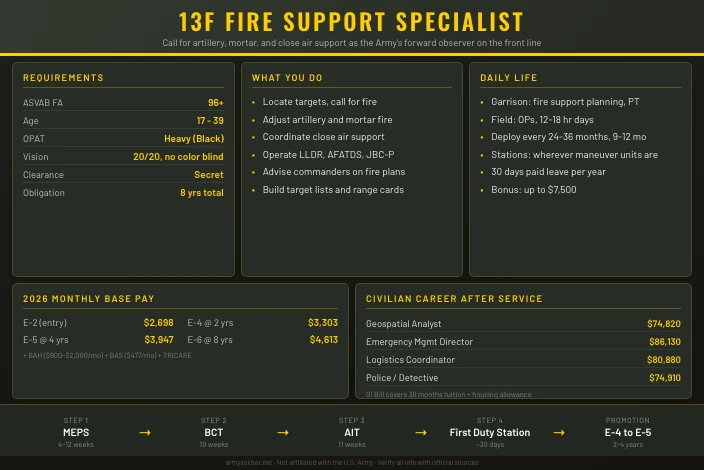
Job Role and Responsibilities
The 13F Joint Fire Support Specialist locates enemy targets, computes firing data, requests and adjusts indirect fire from artillery and mortars, coordinates close air support, and advises maneuver commanders on how to integrate fires into their battle plan. You operate as part of a Fire Support Team (FIST) attached to infantry, armor, or cavalry units.
Your primary job is calling for fire. You identify a target through observation, binoculars, or laser rangefinder. Then you send a call-for-fire message over the radio with the target’s grid coordinates, a description of what you see, and how you want it destroyed. Once rounds start landing, you adjust fire until the target is neutralized.
In garrison, you spend most of your time in classrooms and motor pools. You train on digital fire support systems, run map exercises, rehearse call-for-fire procedures, and maintain your equipment. Physical training happens every morning. Afternoons often involve radio drills, land navigation, or fire support planning exercises with your maneuver unit.
In the field, the job changes fast. You move with the lead elements of your unit, set up observation posts in concealed positions, and stay on the radio for hours. You build range cards, sketch visibility diagrams, and plan targets along likely enemy avenues of approach. When contact happens, you are expected to put steel on target within minutes.
Equipment and Technology
The 13F works with specialized targeting and communication systems:
- LLDR (Lightweight Laser Designator Rangefinder) – determines precise target coordinates using GPS and laser technology
- AFATDS (Advanced Field Artillery Tactical Data System) – the Army’s digital fires planning hub that processes fire missions and routes them to the right firing unit
- JBC-P (Joint Battle Command-Platform) – tracks friendly and enemy positions on a digital map
- AN/PRC-117G and AN/PRC-152A radios – secure tactical communications for calling fire missions and coordinating with aircraft
- Vector 21 binoculars – day/night observation and rangefinding
Specialized Roles
13F soldiers can earn Additional Skill Identifiers (ASIs) that open specialized assignments:
| ASI Code | Specialization |
|---|---|
| D3 | Bradley Fighting Vehicle Operations and Maintenance |
| F9 | Advanced Field Artillery Tactical Data System (AFATDS) |
| J3 | Bradley Infantry Fighting Vehicle System Master Gunner (Skill Level 4) |
| L7 | Joint Fires Observer |
| 5A | Joint Air Tactical Operations (Skill Level 3+) |
| 5U | Tactical Air Operations (Skill Level 3+) |
The L7 (Joint Fires Observer) and 5A (Joint Air Tactical Operations) identifiers are the most sought-after. JFO-qualified 13Fs can directly coordinate with fighter jets and attack helicopters to deliver precision munitions. That skill set puts you at the center of joint operations alongside Air Force and Navy assets.
Mission Contribution
Fire support specialists give maneuver commanders a direct line to every indirect fire asset on the battlefield. Without you, an infantry company has rifles, machine guns, and grenades. With you, that same company can bring 155mm howitzer rounds, 120mm mortar fire, Apache helicopter rockets, and Air Force bombs into the fight. You multiply the unit’s combat power by a factor that no other enlisted MOS can match.
Salary and Benefits
Financial Benefits
Military pay is based on rank and time in service, not your MOS. Most 13Fs enter service as E-1 and reach E-2 by the end of Basic Combat Training.
| Rank | Pay Grade | Years of Service: 2 | Years of Service: 4 | Years of Service: 6 | Years of Service: 8 |
|---|---|---|---|---|---|
| Private (PV2) | E-2 | $2,698 | $2,698 | $2,698 | - |
| Specialist (SPC) | E-4 | $3,303 | $3,659 | $3,816 | $3,816 |
| Sergeant (SGT) | E-5 | $3,599 | $3,947 | $4,109 | $4,299 |
| Staff Sergeant (SSG) | E-6 | $3,743 | $4,069 | $4,236 | $4,613 |
Source: DFAS 2026 pay tables. Figures reflect the 2026 pay raise.
On top of base pay, you receive housing and food allowances. BAH (Basic Allowance for Housing) depends on your duty station and whether you have dependents. A single E-4 receives roughly $900 to $2,000+ per month depending on location. BAS adds about $477 monthly for food.
The 13F MOS is eligible for enlistment bonuses up to $7,500 depending on the needs of the Army and your contract terms. Bonus amounts change frequently, so ask your recruiter what is currently available.
Additional Benefits
You and your family get TRICARE health coverage at little or no cost. That includes doctor visits, hospital stays, prescriptions, dental, vision, and mental health care. While on active duty, Tuition Assistance pays up to $4,500 per year toward college courses. After separation, the Post-9/11 GI Bill covers up to 36 months of tuition at a public university (full in-state rate) plus a monthly housing allowance.
Retirement works through the Blended Retirement System (BRS):
- Serve 20 years and you get a pension worth 40% of your base pay
- The government matches up to 5% of your Thrift Savings Plan (TSP) contributions
- Survivor Benefit Plan (SBP) protects your family if something happens to you
Work-Life Balance
You earn 30 days of paid leave per year (2.5 days per month). In garrison, fire support soldiers typically work 0630 to 1700 with occasional evenings or weekends for field prep. But when the unit goes to the field, expect 12 to 18 hour days for weeks straight with no days off.
The general rotation for active-duty units is 1 year deployed, 2 years home. Units on rapid-deployment status sometimes compress that ratio.
Qualifications and Eligibility
Basic Qualifications
You need to be a U.S. citizen or permanent resident between ages 17 and 39. High school graduates need at least a 31 on the AFQT. GED holders need a 50.
The 13F requires one specific ASVAB line score:
- Field Artillery (FA): 96 minimum
The FA composite score combines Arithmetic Reasoning (AR), Mathematics Knowledge (MK), and Mechanical Comprehension (MC). That 96 is slightly higher than the 93 required for other field artillery MOSs like 13B. You need solid math skills and mechanical aptitude.
Vision requirements are strict. You need normal depth perception, no color blindness, and distant visual acuity correctable to 20/20 with lenses. A Secret security clearance is required for initial award and to maintain the MOS.
| Requirement | Details |
|---|---|
| Age | 17-39 years old |
| Citizenship | U.S. citizen or permanent resident |
| Education | High school diploma or GED |
| AFQT (ASVAB) | Minimum 31 (diploma) or 50 (GED) |
| Field Artillery (FA) | Minimum 96 |
| Vision | Correctable to 20/20; normal depth perception; no color blindness |
| Security Clearance | Secret (required for initial award) |
| OPAT Category | Heavy (Black) |
| Physical | Must pass OPAT at Heavy standard |
Application Process
Start at your local Army recruiting station. The recruiter checks your qualifications and helps you pick between Active Duty, Reserve, or National Guard.
Next is MEPS (Military Entrance Processing Station). You take the ASVAB if you haven’t already, get a full medical exam, and begin your background investigation. This usually takes one full day. If your FA score hits 96 and your medical results are clean, the recruiter books you a training slot for the 13F MOS.
The whole process from first recruiter meeting to swearing in takes 4 to 12 weeks. Security clearance investigations can stretch that timeline.
Selection Criteria and Competitiveness
The 13F is moderately competitive. The FA score of 96 is higher than most field artillery MOSs, which filters out some candidates. The Army needs 13Fs wherever there are maneuver units, so slots are usually available. Higher ASVAB scores, strong physical fitness, and a clean background make you a stronger candidate.
Upon Accession
You enter as E-1 (Private) and earn promotion to E-2 after Basic. After AIT, most soldiers are E-2 or E-3 depending on time in service and any promotion-eligible programs. The standard service obligation is 8 years total: typically 3 to 4 years active duty plus the remainder in the Reserve or Individual Ready Reserve (IRR).
See our ASVAB study guide for strategies to hit these line scores, or take the PiCAT from home if you are a first-time tester.
Work Environment
Setting and Schedule
Fire support specialists work in three settings:
- Garrison – fire support offices, motor pools, and classrooms. Normal duty hours with occasional extended days for training prep.
- Field training – observation posts, tactical vehicles, and command posts. Hours follow the training schedule, often 16+ hour days for weeks.
- Deployment – forward operating bases, patrol bases, combat outposts. Sleep is irregular. The weather might be 120 degrees or below freezing. You live where the maneuver unit lives.
Because 13Fs are attached to maneuver units rather than artillery batteries, your day-to-day life mirrors infantry or armor soldiers. You run with them, train with them, and deploy with them. The fire support office in the battalion or brigade headquarters is your home base, but you spend most of your time forward with the companies and platoons you support.
Leadership and Communication
Your chain of command runs through the Fire Support Officer (FSO), typically a Field Artillery lieutenant or captain assigned to the maneuver battalion. Your direct supervisor is usually the Fire Support NCO (FSNCO), an E-6 or E-7. Within the FIST, you work alongside the FSO, other 13Fs, and sometimes a radiotelephone operator.
During operations, you communicate simultaneously on multiple radio nets: the maneuver net (to hear what the infantry or armor unit is doing), the fire support net (to send fire missions), and sometimes an air net (if coordinating close air support). Managing those nets under stress is one of the hardest parts of the job.
Feedback comes through annual evaluations and day-to-day mentoring from your FSNCO. Most fire support sections hold regular training meetings to review call-for-fire procedures and share lessons learned from field exercises.
Team Dynamics and Autonomy
In garrison, you follow established training schedules and answer to your FSO and FSNCO. In the field, a junior 13F at a company observation post often operates with significant independence. You decide where to set up your OP, which targets to engage first, and how to adjust fire. The maneuver commander trusts you to make those calls because nobody else in the unit has your training.
That blend of teamwork and solo decision-making defines the MOS. You need the technical skills to compute firing data and the tactical awareness to read a battlefield. You also need the communication skills to work inside a tight-knit infantry or armor platoon where you are the only artilleryman.
Job Satisfaction and Retention
Fire support specialists who enjoy the job talk about two things: the responsibility and the front-row seat to combined arms warfare. You control assets that most soldiers never touch. The biggest complaints are the physical grind of keeping up with infantry units, the long field rotations, and the pressure of knowing that a bad call-for-fire can kill friendly troops.
Retention for combat arms MOSs runs around 30% to 40% after the first enlistment. The 13F falls in that range. Many who leave cite the deployment tempo and the physical toll. Those who stay tend to be soldiers who want the warrant officer track or who genuinely love the tactical side of the job.
Training and Skill Development
Initial Training
Training has two phases: Basic Combat Training (BCT) and Advanced Individual Training (AIT).
| Training Phase | Location | Duration | Focus |
|---|---|---|---|
| BCT | Fort Jackson, SC; Fort Moore, GA; Fort Leonard Wood, MO | 10 weeks | Soldier basics: marksmanship, tactics, fitness, discipline |
| AIT | Fort Sill, OK (Fires Center of Excellence) | 11 weeks | Fire support skills: call for fire, targeting, digital systems, field craft |
BCT teaches you to be a soldier. Rifle marksmanship, land navigation, squad tactics, and physical fitness. Every MOS does this phase.
AIT at Fort Sill is where you become a fire support specialist. The 11-week course covers the fundamentals of observed fire procedures, target location, and fire support planning. You learn to read maps at a professional level, compute grid coordinates, send call-for-fire messages, and adjust rounds onto a target.
Classroom instruction covers fire support doctrine, the military decision-making process (MDMP), and how indirect fire assets are organized from battery level up to division. You study the capabilities of every weapon system you can call: 105mm and 155mm howitzers, 60mm and 120mm mortars, HIMARS rockets, attack aviation, and close air support.
Field training puts you in simulated combat scenarios. You set up observation posts, communicate on tactical radios, and execute live-fire call-for-fire missions. The final field exercise tests your ability to plan and execute fire support for a company-level operation under pressure.
You earn the 13F MOS designation after graduating AIT and report to your first duty station within a few weeks.
Advanced Training
Several paths open up after AIT. The most common next step is the Joint Fires Observer (JFO) course, which qualifies you to control close air support and coordinate with aircraft. JFO certification is a major career milestone for any 13F.
Other advanced training opportunities:
- Fire Support Sergeant Course – required for E-5 promotion, focuses on planning and leadership
- Master Gunner Course – for Bradley-equipped fire support teams
- Ranger School – open to 13Fs assigned to infantry units; earns the Ranger tab
- Airborne School – 3-week course at Fort Moore for paratroop-qualified assignments
- Air Assault School – 10-day course for helicopter operations
- Pathfinder Course – navigation and air traffic control for landing zones
Strong performers assigned to light infantry or special operations units often attend multiple schools. An E-5 13F with Ranger, Airborne, and JFO tabs is highly competitive for promotion and assignment to elite units.
The Army pays for professional development through Tuition Assistance and the GI Bill. Many 13Fs use these benefits to earn degrees while serving or after separation.
Everything starts with qualifying ASVAB scores — our study guide covers what to study first.
Career Progression and Advancement
Career Path
Promotion to E-4 (Specialist) is semi-automatic after about 2 years if you meet the requirements. E-5 (Sergeant) requires passing a promotion board and earning enough promotion points through military education, physical fitness, awards, and civilian education. At E-5, you shift from executing fire missions to planning them and leading other 13Fs.
| Rank | Pay Grade | Typical Years | Typical Role |
|---|---|---|---|
| Private (PV2) | E-2 | 0-1 | AIT graduate, FIST member |
| Specialist (SPC) | E-4 | 2-3 | Senior observer, team lead |
| Sergeant (SGT) | E-5 | 4-6 | Company FSNCO, fire support planner |
| Staff Sergeant (SSG) | E-6 | 6-9 | Battalion fire support NCO |
| Sergeant First Class (SFC) | E-7 | 10-14 | Brigade fire support NCO, operations |
E-6 (Staff Sergeant) usually comes around 6 to 9 years. At this level, you manage the fire support section for a battalion. You plan fire support for battalion-level operations, mentor junior 13Fs, and coordinate with the FSO on targeting priorities.
Warrant Officer Path
The 13F MOS feeds directly into the 131A Field Artillery Targeting Technician warrant officer track. This is one of the strongest reasons to stay in the MOS long-term. As a 131A, you become the technical expert on targeting and fires integration at the brigade and division level.
Requirements for 131A include documented section chief experience, strong NCOERs, and an interview with a senior 131A warrant officer (CW3 or above). An associate degree or higher strengthens your packet.
Role Flexibility and Transfers
You can request a transfer to a different MOS with leadership approval and an open slot. Common lateral moves for 13Fs include 13J (Fire Control Specialist), 13B (Cannon Crewmember), or a jump into intelligence (35 series) given the overlap in targeting skills. Any MOS change means completing that job’s training and taking on a new service obligation.
Performance Evaluation
NCOs get rated through the NCOER (NCO Evaluation Report) once a year. Your rater and senior rater score you on leadership, training, and technical proficiency. Strong NCOERs are the single biggest factor in getting promoted to E-6 and above.
What sets you apart: accuracy on live-fire exercises, ability to plan fire support for complex operations, physical fitness scores, completion of advanced schools, and the respect you earn from the maneuver unit you support. 13Fs who are trusted by their infantry or armor commanders get noticed fast.
Physical Demands and Medical Evaluations
Physical Requirements
This is a combat arms MOS. You carry 60 to 80 pounds of equipment over rough terrain, including your weapon, radio, LLDR, batteries, water, and ammunition. You move on foot with infantry soldiers or ride in Bradley Fighting Vehicles with mechanized units. Running, climbing, low-crawling, and sprinting under load are all routine.
In garrison, daily physical training is mandatory. Most fire support sections run, ruck march, and do strength training 5 days a week. Field exercises push you harder. Expect sleep deprivation, long movements on foot, and extended periods in observation posts where you must stay alert for hours.
Every soldier takes the Army Fitness Test (AFT) at least once a year. The AFT has five events scored 0 to 100 each, for a 500-point maximum. Combat MOS soldiers must score at least 60 per event and 350 total under a sex-neutral, age-normed standard.
Here are the minimum standards for ages 17 to 21:
| Event | Male Minimum | Female Minimum |
|---|---|---|
| 3-Rep Max Deadlift (MDL) | 140 lbs | 80 lbs |
| Hand-Release Push-Up (HRP) | 10 reps | 10 reps |
| Sprint-Drag-Carry (SDC) | 2:40 | 3:40 |
| Plank (PLK) | 2:00 | 2:00 |
| Two-Mile Run (2MR) | 15:54 | 18:54 |
Those are bare minimums. Competitive 13Fs score well above 350. Units that train hard expect scores in the 450+ range.
OPAT Requirements
Before shipping to BCT, you must pass the Occupational Physical Assessment Test (OPAT) at the Heavy (Black) category. That means:
- Standing Long Jump: 160 cm
- Seated Power Throw: 450 cm
- Strength Deadlift: 160 lbs
- Interval Aerobic Run: 43 shuttles
Medical Evaluations
After enlistment, you get an annual health check: weight, blood pressure, vision, hearing, and a conversation with a provider. Before deployment, you go through a separate medical clearance. Any condition that limits your ability to operate in a combat environment gets resolved first, or you stay behind. Vision and hearing checks are especially important for a 13F because your job depends on seeing and hearing clearly over long distances and through radio static.
Deployment and Duty Stations
Deployment Details
Active-duty 13Fs usually deploy once every 24 to 36 months for 9 to 12 months. Units on high-readiness status go more often. Because fire support specialists are embedded with maneuver units, your deployment tempo matches the infantry or armor brigade you belong to.
Common deployment regions:
- Middle East – Iraq, Syria, Jordan, Kuwait
- Europe – Poland, Romania, Germany (rotational deployments under Operation Atlantic Resolve)
- Pacific – South Korea, Japan
13Fs in infantry and armor brigade combat teams face a higher chance of forward deployment than those in division-level headquarters. Domestic deployments happen for natural disasters or homeland defense missions, but they are rare for this MOS.
Location Flexibility
The Army assigns your duty station based on what it needs. You can submit a preference list, but there are no guarantees. Expect to move every 2 to 4 years.
Common CONUS duty stations:
- Fort Moore, GA (Infantry and Armor)
- Fort Campbell, KY (101st Airborne)
- Fort Carson, CO (4th Infantry Division)
- Fort Cavazos, TX (1st Cavalry Division, III Corps)
- Fort Liberty, NC (82nd Airborne, XVIII Airborne Corps)
- Fort Drum, NY (10th Mountain Division)
- Fort Riley, KS (1st Infantry Division)
- Fort Stewart, GA (3rd Infantry Division)
- Joint Base Lewis-McChord, WA (I Corps, 7th Infantry Division)
Common OCONUS stations:
- USAG Humphreys, South Korea
- Schofield Barracks, HI
- Fort Wainwright, AK
- USAG Bavaria / Grafenwoehr, Germany
Risk, Safety, and Legal Considerations
Job Hazards
The 13F is a combat arms MOS. The risks are real.
In the field and training:
- Hearing damage from proximity to live-fire artillery impacts
- Injury during airborne or air assault operations
- Vehicle accidents in tactical convoys
- Heat and cold injuries during extended field operations
- Falls and musculoskeletal injuries from rucking under heavy loads
In combat zones:
- Direct enemy fire (you operate at the forward edge)
- IEDs and mines
- Indirect fire and counter-battery attacks
- Psychological stress from sustained combat operations
- Risk of fratricide if fire missions are computed incorrectly
Safety Protocols
All fire missions go through a safety verification process. The Fire Direction Center checks every fire mission against friendly positions before clearing the battery to fire. In training, range safety officers enforce minimum safe distances and danger-close procedures.
Personal protective equipment includes body armor, helmet, eye protection, and hearing protection. In tactical vehicles, you follow rollover drills and convoy procedures. During airborne and air assault operations, standard aviation safety protocols apply.
Security and Legal Requirements
A Secret security clearance is required to hold the 13F MOS. The investigation process begins at MEPS and takes 2 to 6 months. You must maintain your clearance throughout your career. Any drug use, serious debt, or criminal activity can revoke it and end your time in the MOS.
All soldiers follow the Uniform Code of Military Justice (UCMJ). As a 13F, you have specific legal responsibilities tied to the Law of Armed Conflict: you must verify targets before calling fire, follow rules of engagement, and report any observed violations. Calling fire on a protected target (hospital, school, place of worship) without proper authorization has severe legal consequences.
Impact on Family and Personal Life
Family Considerations
Fire support specialists face the same family challenges as any combat arms soldier. Frequent field training (2 to 4 weeks at a time, multiple times per year), 9 to 12 month deployments, and irregular hours put strain on relationships. Spouses and children adjust to weeks or months of separation.
Support resources at most installations:
- Family Readiness Groups (FRGs) – peer support through your unit
- Military OneSource – free counseling and family services (available 24/7)
- Spousal employment assistance – job help at each new duty station
- Exceptional Family Member Program (EFMP) – support for families with special needs
- Army Community Service (ACS) – financial counseling, relocation help, family programs
Relocation and Flexibility
You will move. After AIT, you go where the Army sends you. After that, expect a PCS (permanent change of station) every 2 to 4 years. The Army covers moving costs, but each PCS disrupts your spouse’s career, your kids’ school, and your community ties.
You can request preferred locations through the Assignment Satisfaction Key (ASK) system, but the Army fills its needs first. Larger installations with multiple brigade combat teams (Fort Cavazos, Fort Liberty, Fort Carson) tend to have more 13F slots and longer tour options.
Single soldiers in barracks have it simpler logistically but still feel the isolation of frequent field time and deployments. Married soldiers with families carry a heavier personal load every time the unit goes to the field.
Reserve and National Guard
Component Availability
The 13F MOS is available in both the Army Reserve and the Army National Guard. Because 13F soldiers attach directly to infantry and armor companies, you will typically find them assigned to field artillery battalions or maneuver brigade combat teams in both components. Positions exist across most states in the Guard, and the Reserve also maintains field artillery units with 13F slots. The skill ceiling and responsibilities are the same as active duty.
Drill Schedule and Training Commitment
The standard schedule is one weekend per month plus two weeks of Annual Training. For 13F soldiers, extra training investment is common. Call-for-fire certifications and proficiency on the Advanced Field Artillery Tactical Data System (AFATDS) require regular rehearsals and formal recertification. Joint Fires Observer (JFO) qualification – a valuable add-on for 13F soldiers – may require additional school days. Expect that staying truly proficient in this MOS as a part-time soldier takes discipline between drill weekends.
Part-Time Pay
At E-4 with about three years of service, a drill weekend pays roughly $422 for four drill periods. Across 12 weekends, that totals roughly $5,064 per year. Annual Training adds approximately $1,583 for two weeks. Total part-time pay runs around $6,600 annually, stacked on top of your civilian job income.
Benefits Differences
Active-duty soldiers get TRICARE at zero cost. Reserve and Guard drilling members can buy into TRICARE Reserve Select (TRS) at $57.88 per month for yourself or $286.66 per month for you and your family (2026 rates). That is significantly cheaper than most civilian employer health plans.
Education benefits available to drilling members:
- Federal Tuition Assistance: $4,500 per year
- MGIB-SR: roughly $416 per month for school enrollment
- Post-9/11 GI Bill: requires 90 or more days of federal activation to begin accessing; scales with accumulated active-duty time
- National Guard state tuition waivers: vary by state, some covering full tuition at in-state public universities – not available to Army Reserve soldiers
Retirement follows a points-based system, with a pension beginning at age 60. TSP matching up to 5% applies under BRS, same as active duty.
Deployment and Mobilization
A 13F attached to an infantry or armor battalion will mobilize when that battalion mobilizes. The call-for-fire mission is in demand during combat operations, and 13F soldiers have seen consistent deployments through Iraq and Afghanistan. In the Reserve and Guard, mobilizations happen roughly every four to six years and typically run nine to twelve months. Active-duty 13F soldiers face higher operational tempo, rotating through assignments and deployments more frequently.
Civilian Career Integration
Fire support skills do not map cleanly to a single civilian job, but the underlying competencies are genuinely marketable. Coordinating air strikes and indirect fire under pressure develops communication clarity, decision-making speed, and systems-level thinking. Those translate to emergency management, logistics coordination, project management, and government contracting roles. USERRA guarantees your civilian employer holds your position while you are on federal orders.
| Feature | Active Duty | Army Reserve | Army National Guard |
|---|---|---|---|
| Commitment | Full-time | One weekend/month + 2 weeks/year | One weekend/month + 2 weeks/year |
| Monthly Pay (E-4, ~3 yrs) | $3,166/month | ~$422/drill weekend | ~$422/drill weekend |
| Healthcare | TRICARE, $0 premiums | TRS, $57.88/month (member) | TRS, $57.88/month (member) |
| Education | TA + Post-9/11 GI Bill | Federal TA, MGIB-SR; Post-9/11 after activation | Federal TA, MGIB-SR, state tuition waivers |
| Deployment | High tempo, every 2-3 years | Mobilization every 4-6 years | Mobilization every 4-6 years |
| Retirement | BRS pension at 20 years | Points-based, age 60 | Points-based, age 60 |
Post-Service Opportunities
Transition to Civilian Life
Your fire support training builds skills that transfer to several civilian fields. Target location and analysis map to geospatial work. Fire support planning translates to operations coordination and logistics. Radio communications and digital systems experience gives you a foundation in telecommunications and IT.
The Transition Assistance Program (TAP) provides resume help, interview coaching, and benefits counseling during your last 12 months on active duty. The Post-9/11 GI Bill covers up to 36 months of tuition (full in-state rate at public schools) plus a housing allowance and book stipend. Many 13Fs use the GI Bill to finish bachelor’s degrees in criminal justice, emergency management, GIS, or business.
Federal agencies actively recruit veterans with Secret clearances and tactical experience. DHS, FEMA, the FBI, and defense contractors all value the planning, communications, and decision-making skills you build as a 13F.
Civilian Career Prospects
Here are civilian jobs that align with 13F skills:
| Civilian Job | Median Annual Salary (2024) | 10-Year Outlook |
|---|---|---|
| Cartographer / Geospatial Analyst | $82,860 | +6% |
| Emergency Management Director | $86,130 | +3% |
| Operations Research Analyst | $91,290 | +21% |
| Logistician | $80,880 | +17% |
Your leadership experience and security clearance also open doors in defense contracting, law enforcement, and federal intelligence work. Companies that build targeting systems, communications equipment, and military simulation software hire former 13Fs regularly.
Post-Service Policies
An honorable discharge gives you lifetime access to VA healthcare, disability compensation (if applicable), and education benefits. You can separate after your service obligation ends. Talk to your career counselor about options well before your ETS date.
A discharge other than honorable strips most VA benefits. Keep your record clean.
Is This a Good Job for You?
Ideal Candidate Profile
The best fire support specialists stay calm under pressure and think in three dimensions: where the enemy is, where friendlies are, and where the rounds need to land.
Traits that predict success:
- Strong math skills (you compute firing data under stress)
- Comfortable with radios and digital systems
- Good spatial reasoning and map-reading ability
- Physically tough enough to keep up with infantry soldiers
- Confident communicator who can brief a commander clearly and quickly
- Self-starter who works well with minimal supervision
This role fits people who want to be at the center of the action without being limited to a rifle. If you like solving problems fast with real consequences, you will do well here.
Potential Challenges
This MOS is a poor fit if you:
- Need a predictable 9-to-5 with weekends off
- Struggle with math under pressure
- Cannot handle extended time in the field (weeks living in the dirt)
- Have difficulty with radios, digital systems, or multitasking across multiple communication nets
- Are uncomfortable making life-or-death decisions quickly
Fire support specialists carry the weight of knowing that a wrong grid coordinate kills friendly soldiers. That responsibility is constant. If you have untreated anxiety or difficulty performing under extreme stress, think carefully about whether this MOS fits you.
Career and Lifestyle Alignment
If you want a combat arms job that emphasizes brains as much as brawn, the 13F is one of the best options in the Army. You get tactical experience that most soldiers never see, a direct path to warrant officer, and civilian-transferable skills in geospatial analysis, operations planning, and communications.
The trade-off is real. You live with infantry soldiers and keep their schedule. Deployments last months. The physical demands are high. And the mental pressure of controlling lethal fires never goes away.
This job works for people who want to be the most dangerous person on the battlefield without pulling a trigger. If that sounds like you, talk to a recruiter.
More Information
Talk to an Army recruiter about the 13F. Ask about current enlistment bonuses, training dates, and whether your ASVAB scores qualify. If you can, ask to speak with a current fire support specialist so you hear what the job is really like day-to-day.
Take the MOS Finder quiz at goarmy.com
Schedule an ASVAB at your nearest MEPS to see where your FA score lands
Talk to military families in your area for an honest picture of Army life
Prepare for the ASVAB with our study guide to make sure your line scores qualify
This site is not affiliated with the U.S. Army or any government agency. Verify all information with official Army sources before making enlistment or career decisions.
Explore more Army artillery and air defense careers such as 13B Cannon Crewmember.