13J Fire Control Specialist
Every artillery round that hits the right target at the right time started with a fire control specialist running the numbers. The 13J is the soldier behind the screen in a fire direction center, turning raw targeting data into firing solutions for cannons, rockets, and missiles. Gun crews and forward observers get the visible jobs. You make sure the math is right and the digital network stays up. Without a functioning fire direction center, the entire field artillery system stops.
If you’re good with computers and comfortable under pressure, this combat arms MOS puts you at the center of every fire mission the Army executes.
Qualifying requires specific ASVAB line scores — our ASVAB study guide covers what to target and how to prepare.
Job Role and Responsibilities
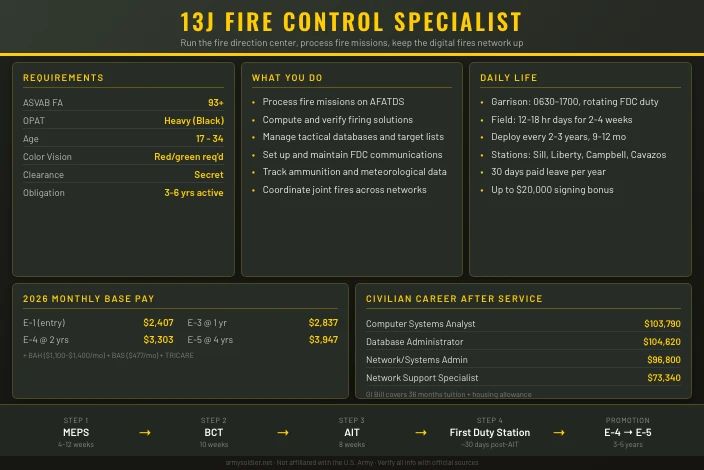
The 13J Fire Control Specialist operates the Army’s automated fire control systems to process fire missions, compute firing data, manage tactical databases, and integrate targeting information from multiple sensors across Army and joint networks. You work inside a fire direction center at every echelon from battery to corps, turning calls for fire into precise instructions that howitzer crews, rocket launchers, and missile batteries use to engage targets.
Daily Tasks
In garrison, your day starts with physical training at 0630. Mornings involve system checks on the Advanced Field Artillery Tactical Data System (AFATDS), practice fire missions, and updating digital maps and target lists. Afternoons rotate between equipment maintenance, communications drills, and classes on software updates or gunnery procedures.
You spend a lot of time on computers. AFATDS is the backbone of everything you do, and keeping it running means troubleshooting network connections, verifying database entries, and testing backup communications paths. Between field exercises, you also handle ammunition tracking, meteorological data logs, and fire support coordination documents.
In the field, the pace changes fast. Fire missions come over the radio at unpredictable intervals, day and night. You enter target data into AFATDS, verify the firing solution, and transmit it to the gun line. Between missions, you update the fire support plan, process meteorological corrections, and coordinate with adjacent units. During gunnery exercises, you may process dozens of missions in a single day.
Specific Roles
The 13J replaced the old 13D (Field Artillery Tactical Data Systems Specialist) and 13P (MLRS Operations/Fire Direction Specialist) when those MOSs merged in 2017. Today, 13J soldiers serve across every field artillery formation.
| Identifier | Type | Description |
|---|---|---|
| 13J | Primary MOS | Fire Control Specialist |
| ASI P5 | Additional Skill Identifier | Master Gunner (Field Artillery) |
| ASI 2A | Additional Skill Identifier | Non-Lethal Weapons |
| SQI 8 | Special Qualification Identifier | Instructor |
| SQI G | Special Qualification Identifier | Recruiter |
Mission Contribution
Field artillery is the Army’s primary indirect fire system, and the 13J is the technical linchpin that makes it work. Maneuver commanders at every level depend on fires to suppress enemy positions, destroy fortifications, and shape the battlefield before ground troops move in. Your fire direction center takes targeting data from forward observers (13F), radar operators (13R), and intelligence feeds, then processes that data into firing commands and routes them to the right weapon system.
In large-scale combat, a single battalion FDC may coordinate fires from multiple batteries while deconflicting airspace with aviation and routing joint fires from Navy or Air Force assets.
Technology and Equipment
You work with some of the most data-heavy systems in the field artillery:
- AFATDS (Advanced Field Artillery Tactical Data System) processes fire missions, manages target lists, and routes firing commands across the digital network
- JCR (Joint Capabilities Release) provides a shared tactical picture across Army and joint forces
- GBS (Global Broadcast Service) receives satellite data feeds for intelligence and meteorological updates
- Paladin Digital Fire Control System integrates with M109A7 self-propelled howitzers for automated gunnery
- HF/VHF/SATCOM radios maintain voice and data communications when digital networks degrade
- Meteorological equipment collects weather data that affects artillery ballistic calculations
Salary and Benefits
Base Pay
All 13J soldiers earn the same base pay as every other soldier at their rank and time in service. The Army does not pay differently by MOS.
| Rank | Typical Time in Service | Monthly Base Pay (2026) |
|---|---|---|
| E-1 Private (PV1) | Entry | $2,407 |
| E-2 Private (PV2) | 6 months | $2,698 |
| E-3 Private First Class (PFC) | 1-2 years | $2,837 |
| E-4 Specialist (SPC) | 2-3 years | $3,303 |
| E-5 Sergeant (SGT) | 4-6 years | $3,947 |
| E-6 Staff Sergeant (SSG) | 8-10 years | $4,613 |
| E-7 Sergeant First Class (SFC) | 12+ years | $5,537 |
The goarmy.com 13J page lists a signing bonus of up to $20,000 for qualified recruits. Bonus amounts change frequently based on Army manning needs, so confirm the current offer with your recruiter before signing.
Additional Compensation
Base pay is only part of the package:
- BAS (Basic Allowance for Subsistence): $476.95/month for enlisted soldiers
- BAH (Basic Allowance for Housing): Varies by duty station and dependency status. A single E-4 at Fort Sill, OK typically receives $1,100-$1,400/month
- TRICARE Prime: Full medical, dental, and vision coverage at zero premium, zero copay for the soldier and enrolled family members
- Annual leave: 30 days paid leave per year, plus 11 federal holidays
Retirement
The Blended Retirement System (BRS) combines a pension with a Thrift Savings Plan (TSP). Twenty years of service earns a pension worth 40% of your highest 36-month average base pay. The government also contributes 1% to your TSP automatically and matches up to 4% more if you put in at least 5%.
Qualifications and Eligibility
Requirements
| Requirement | Details |
|---|---|
| ASVAB Line Score | FA 93 (Field Artillery: AR + CS + MK + MC) |
| OPAT Category | Heavy (Black) |
| Education | High school diploma or GED (AFQT 31 with diploma, 50 with GED) |
| Citizenship | U.S. citizen or permanent resident |
| Age | 17-34 (17 requires parental consent) |
| Color Vision | Must distinguish red and green |
| Dexterity | Full finger dexterity in both hands |
| Hearing | Must hear and understand voices through headphones |
| Security Clearance | Secret (background investigation required) |
The FA 93 score is the gatekeeper for this MOS. The Field Artillery composite is calculated from Arithmetic Reasoning (AR), Coding Speed (CS), Mathematics Knowledge (MK), and Mechanical Comprehension (MC). Soldiers who score FA 96 or higher can choose between 13J and 13F (Fire Support Specialist). If your math and mechanical aptitude are strong, this score is achievable with focused ASVAB prep.
Enlistment Process
Competitiveness
The 13J is not the most competitive MOS in the Army, but the FA 93 score filters out soldiers who struggle with math and mechanical reasoning. Color vision and the Secret clearance investigation also disqualify some applicants. If you have any criminal history, significant debt, or foreign contacts, expect the clearance process to take longer and potentially delay your training slot.
Prior experience with computers, networking, or database management gives you a real advantage in AIT, but it’s not required.
See our ASVAB study guide for strategies to hit these line scores, or take the PiCAT from home if you are a first-time tester.
Work Environment
Setting and Schedule
The fire direction center (FDC) is your office. In garrison, that’s a room with AFATDS terminals, radios, and map boards. In the field, the FDC fits inside a tracked vehicle (M577 command post carrier) or an expandable shelter on a truck. Either way, you work in a small, equipment-packed space with 2-4 other soldiers.
Garrison hours run 0630-1700 on weekdays, with rotating 24-hour FDC duty shifts. Field exercises mean 12-18 hour days and sometimes around-the-clock operations during live-fire events. Field rotations last 2-4 weeks, with several per year.
Leadership and Communication
Your chain of command runs from your section sergeant (E-5 or E-6) up through the battery commander. Junior soldiers (E-1 through E-4) get monthly counseling sessions. E-5 and above are rated through the NCOER (NCO Evaluation Report) system.
During fire missions, the FDC operates flat. The section chief makes calls quickly and every soldier has a defined role. Rank matters less than competence when the radio is hot.
Team Dynamics
A fire direction section has 4-6 soldiers. One enters data, one verifies the solution, one handles communications, one tracks ammunition. Every error gets caught (or missed) by the person next to you. There’s no room for a lone wolf.
Outside fire missions, you have more autonomy. Senior soldiers manage their own training schedules, troubleshoot equipment independently, and mentor junior 13J soldiers.
Retention
Field artillery retention rates fluctuate with Army manning priorities. The 13J bonus of up to $20,000 for initial enlistment suggests the Army needs more fire control specialists. Soldiers who enjoy the technical work and can tolerate field conditions tend to stay in. Those who expected more action and less screen time sometimes reclassify to other MOSs after their first enlistment.
Training and Skill Development
Initial Training Pipeline
| Phase | Location | Length | Focus |
|---|---|---|---|
| Basic Combat Training (BCT) | Fort Sill, OK / Fort Jackson, SC / Fort Moore, GA / Fort Leonard Wood, MO | 10 weeks | Soldier fundamentals: rifle marksmanship, land navigation, first aid, drill, Army values |
| Advanced Individual Training (AIT) | Fort Sill, OK (428th Field Artillery Brigade) | 8 weeks | AFATDS operations, fire mission processing, gunnery fundamentals, communications setup, meteorological data, database management |
BCT is the same for every soldier. Ten weeks of rifle marksmanship, land navigation, first aid, and basic tactics. Physical fitness and discipline are the focus.
AIT at Fort Sill is where you become a fire control specialist. The 8-week course covers operating AFATDS, processing calls for fire into digital firing commands, setting up tactical communications equipment, managing databases, and applying gunnery principles to verify computed solutions. You also learn basic vehicle and generator maintenance.
The training mixes classroom instruction with hands-on exercises. You process simulated fire missions on live AFATDS terminals, set up field communications networks, and run a full FDC under realistic conditions during the culminating exercise.
Advanced Training Opportunities
After your first duty assignment, you can pursue additional schools and certifications:
- Master Gunner Course earns the P5 ASI and makes you the subject matter expert on gunnery and fire control procedures in your battalion. This is a career-defining qualification for 13J NCOs.
- Air Assault School (10 days, Fort Campbell, KY) teaches sling-load operations and rappelling. Common for soldiers in light or airborne artillery units.
- Airborne School (3 weeks, Fort Moore, GA) qualifies you for parachute duty in airborne field artillery units like the 82nd Airborne Division’s 319th Airborne Field Artillery Regiment.
- Advanced Leader Course (ALC) and Senior Leader Course (SLC) are required for promotion to E-6 and E-7 respectively.
- Warrior Leader Course is required before promotion to E-5.
- CompTIA Security+, Network+, or A+ certifications are available through Army Credentialing Assistance and align well with the 13J’s technical skill set.
The Army also provides Tuition Assistance of up to $4,500/year for college courses while you’re on active duty.
Everything starts with qualifying ASVAB scores — our study guide covers what to study first.
Career Progression and Advancement
Rank Progression
| Rank | Grade | Typical Time in Service | Key Position |
|---|---|---|---|
| Private (PV1) | E-1 | 0-6 months | Fire Control Specialist (trainee) |
| Private (PV2) | E-2 | 6 months | Fire Control Specialist |
| Private First Class (PFC) | E-3 | 12 months | Fire Control Specialist |
| Specialist (SPC) | E-4 | 24 months | Fire Control Specialist, assistant to section chief |
| Sergeant (SGT) | E-5 | 3-5 years | Fire Control Sergeant (section chief in a battery FDC) |
| Staff Sergeant (SSG) | E-6 | 6-10 years | Senior Fire Control Sergeant (battalion-level FDC) |
| Sergeant First Class (SFC) | E-7 | 12-16 years | Fire Control NCOIC, battalion or brigade fires cell |
| Master Sergeant (MSG) | E-8 | 16-20 years | Senior Fire Control NCO, Operations SGM (brigade/division) |
| Sergeant Major (SGM) | E-9 | 20+ years | Operations SGM, Field Artillery Command Sergeant Major |
Promotions to E-2 through E-4 happen on a time-based schedule. E-5 and above are competitive, based on promotion points earned through military education, civilian education, awards, and NCOER ratings. A 13J who earns the Master Gunner ASI (P5) stands out on promotion boards because it demonstrates technical mastery.
Role Flexibility
Lateral transfers to 13F (Fire Support Specialist) or 13R (Weapons Locating Radar Operator) are possible depending on Army needs. Reclassification to a different career field requires a DA Form 4187 and commander approval.
Technically skilled NCOs can also pursue Warrant Officer MOS 131A (Field Artillery Technician) to stay in the fires community as a subject matter expert without the administrative load of senior NCO positions.
Performance Evaluation
Enlisted soldiers E-5 and above receive an annual NCOER that rates performance across six competency areas. Your rater and senior rater write narrative comments and assign ratings that directly affect promotion board results.
Strong NCOERs are the single most important factor in competitive promotions. “Excels” ratings with specific bullet comments about fire mission accuracy, FDC readiness, and soldier development put you ahead of peers on the board.
Physical Demands and Medical Evaluations
Physical Requirements
The 13J carries an OPAT category of Heavy, the highest physical demand tier. The daily work is less physically grinding than a 13B Cannon Crewmember’s, but you still carry equipment, set up antennas, load generators, and move in full kit during field operations.
Field exercises require you to break down and set up the FDC fast, run cable, and operate in body armor for extended periods. Dismounted operations with light artillery units are the most physically demanding assignment a 13J can draw.
Army Fitness Test Standards
The AFT (Army Fitness Test) applies equally to all soldiers. The 13J falls under the combat specialty standard, which requires a minimum total score of 350 points (sex-neutral, age-normed) across five events:
| Event | Description | Minimum (60 pts) |
|---|---|---|
| MDL | 3 Repetition Maximum Deadlift | Varies by age |
| HRP | Hand Release Push-Up (Arm Extension) | Varies by age |
| SDC | Sprint-Drag-Carry | Varies by age |
| PLK | Plank | Varies by age |
| 2MR | Two-Mile Run | Varies by age |
Each event is scored 0-100 points. Maximum total is 500. You must score at least 60 on every event and reach 350 total. Soldiers who score 465 or higher are exempt from body fat assessments.
Medical Evaluations
Beyond the initial MEPS physical, you complete a Periodic Health Assessment (PHA) annually. The Army tracks your medical readiness through MEDPROS, and you must stay current on immunizations, dental exams, and vision checks. The color vision requirement (red-green discrimination) is checked at MEPS and is not waiverable for 13J.
Hearing conservation is important for field artillery soldiers. You get an annual audiogram, and hearing protection is mandatory around firing positions and generators.
Deployment and Duty Stations
Where You Could Be Stationed
Field artillery units are spread across the Army’s major installations. Common duty stations for 13J soldiers include:
- Fort Sill, OK (Fires Center of Excellence, III Corps Artillery)
- Fort Liberty, NC (XVIII Airborne Corps, 82nd Airborne Division)
- Fort Campbell, KY (101st Airborne Division)
- Fort Cavazos, TX (1st Cavalry Division, III Corps)
- Fort Drum, NY (10th Mountain Division)
- Fort Stewart, GA (3rd Infantry Division)
- Joint Base Lewis-McChord, WA (I Corps, 7th Infantry Division)
- Overseas: Camp Humphreys (South Korea), Grafenwoehr (Germany), various CENTCOM rotations
Deployment Patterns
Field artillery deploys on the same cycle as its parent division or brigade. Rotational deployments to Europe (Operation Atlantic Resolve) and the Middle East are common. Combat deployments depend on the current threat environment.
Most units follow a 2-3 year cycle between deployments or rotations. Overseas rotations last 9-12 months. During deployment, 13J soldiers run the FDC 24/7 in shifts.
You can request specific installations through DA Form 4187, but the Army fills slots based on its needs first. Airborne or air assault qualifications open more options at posts like Fort Liberty or Fort Campbell.
Risk, Safety, and Legal Considerations
Job Hazards
The 13J works near artillery firing positions, which means constant exposure to loud noise, concussive blasts, and heavy equipment. Generator fumes in enclosed FDC vehicles are a real concern during extended field operations. Eye strain from long hours on computer screens is the most common daily complaint in garrison.
In combat, the FDC is a high-value target. Enemy forces prioritize disrupting command and control nodes, and your vehicle or shelter may draw counter-battery fire, drone strikes, or electronic warfare attacks.
Safety Protocols
Hearing protection is mandatory at all times near firing positions. FDC vehicles carry fire extinguishers and carbon monoxide detectors. Army safety regulations require ventilation standards for enclosed vehicles running generators, though compliance varies by unit.
All soldiers wear body armor, helmet, and eye protection during field operations. COMSEC procedures, frequency hopping, and backup manual fire direction techniques counter electronic warfare threats.
Security Clearance
The 13J requires a Secret security clearance. The investigation covers criminal history, financial record, foreign contacts, and character. Expect it to take 3-6 months. Interim clearances let you start training while the full investigation runs.
Maintain your clearance throughout your career. Significant debt, criminal charges, or unreported foreign travel can result in clearance revocation and reclassification out of the MOS. Your service contract obligates you to the full term, with early separation only in limited circumstances.
Impact on Family and Personal Life
Family Considerations
Field artillery units deploy and go to the field frequently. Expect to spend 60-90 days per year in the field for training exercises, plus any deployment rotations. That time away affects relationships, and it’s worth being honest about that before you sign up.
Married soldiers receive BAH at the with-dependents rate, which is significantly higher than the single rate. At Fort Sill, an E-4 with dependents receives about $1,400-$1,500/month in housing allowance. On-post family housing is available at most installations, though wait lists can run several months.
The Army provides support through Family Readiness Groups (FRGs) at every battalion, Military OneSource counseling services, and child development centers on post. TRICARE covers your family at no premium, including pediatric care, mental health services, and prescriptions.
Relocation
Expect to PCS (permanent change of station) every 2-3 years. The Army covers moving costs and provides a dislocation allowance, but frequent moves remain one of the biggest quality-of-life complaints across the force. New school districts, new communities, new spouse job searches – every 2-3 years.
Single soldiers live in the barracks until E-6 or until they get a waiver. Barracks quality varies by installation.
Reserve and National Guard
Component Availability
The 13J MOS exists in both the Army Reserve and Army National Guard, but there are fewer positions than for 13B cannon crewmembers. Fire Direction Centers require only a handful of 13J soldiers per battalion, so available slots are more limited. If you want this MOS in a part-time role, confirm that a unit with 13J positions exists in your area before committing. Both components use the same platforms and doctrine as active duty.
Drill Schedule and Training Commitment
Standard commitment is one weekend per month plus two weeks of Annual Training. 13J soldiers must stay sharp on the Advanced Field Artillery Tactical Data System (AFATDS) and fire direction computers. These systems require hands-on time to maintain proficiency, and software or version updates may require extra training days or off-site schools. Annual Training typically includes gunnery support alongside the howitzer battery, which means the FDC is running missions and computing firing data in a live-fire environment.
Part-Time Pay
At E-4 with roughly three years of service, a drill weekend pays about $422 across four drill periods. That adds up to roughly $5,064 for 12 drill weekends per year, plus approximately $1,583 for two weeks of Annual Training. Combined part-time Army pay runs around $6,600 per year on top of whatever you earn at your civilian job.
Benefits Differences
Active-duty soldiers get TRICARE at no cost. Drilling Reserve and Guard members can enroll in TRICARE Reserve Select (TRS) at $57.88 per month for individual coverage or $286.66 per month for family coverage (2026 rates).
Education benefits available as a drilling member:
- Federal Tuition Assistance: $4,500 per year – a straight payment toward tuition at most accredited schools
- MGIB-SR: roughly $416 per month to offset education costs while enrolled
- Post-9/11 GI Bill: requires 90 or more days of federal activation to access; benefit grows with accumulated active-duty time
- National Guard state tuition waivers: many states offer full or partial in-state tuition waivers at public universities; Army Reserve soldiers do not have access to state waivers
Retirement is points-based. Drill weekends, Annual Training, and any activation days all earn retirement points. The pension starts at age 60, and TSP matching up to 5% applies under BRS.
Deployment and Mobilization
Artillery units mobilize to support combat operations when the demand is there. 13J soldiers are critical to the FDC and deploy with their batteries. Expect a mobilization roughly every four to six years in the Reserve or Guard, typically running nine to twelve months. Active-duty soldiers face a faster rotation cycle – roughly every two to three years. The part-time pace is much more manageable if you want to build a parallel civilian career.
Civilian Career Integration
The 13J skill set translates more directly to civilian work than most combat arms MOSs. Working with AFATDS and fire direction computers builds real-world data processing, systems operation, and technical troubleshooting skills. IT specialist, data analyst, computer operator, and systems administrator roles are realistic civilian targets. Defense contractors who support Army fire control systems are an especially strong match. USERRA protects your civilian position during any federal activation.
| Feature | Active Duty | Army Reserve | Army National Guard |
|---|---|---|---|
| Commitment | Full-time | One weekend/month + 2 weeks/year | One weekend/month + 2 weeks/year |
| Monthly Pay (E-4, ~3 yrs) | $3,166/month | ~$422/drill weekend | ~$422/drill weekend |
| Healthcare | TRICARE, $0 premiums | TRS, $57.88/month (member) | TRS, $57.88/month (member) |
| Education | TA + Post-9/11 GI Bill | Federal TA, MGIB-SR; Post-9/11 after activation | Federal TA, MGIB-SR, state tuition waivers |
| Deployment | Rotation every 2-3 years | Mobilization every 4-6 years | Mobilization every 4-6 years |
| Retirement | BRS pension at 20 years | Points-based, age 60 | Points-based, age 60 |
Post-Service Opportunities
Civilian Career Translation
The 13J’s technical skills transfer well to IT and data management careers. You spend your service operating networked computer systems, managing databases, troubleshooting hardware and software, and maintaining communications infrastructure. That experience maps directly to several civilian occupations.
The Army Credentialing Assistance program pays for certifications like CompTIA Security+, Network+, and A+ while you’re still serving. Veterans can also use the GI Bill to pursue bachelor’s or master’s degrees in computer science, information systems, or cybersecurity after separation.
| Civilian Job Title | Median Salary (BLS, 2024) | Job Outlook (2024-2034) |
|---|---|---|
| Computer Systems Analyst | $103,790 | +9% (faster than average) |
| Database Administrator | $104,620 | +4% (about average) |
| Network/Computer Systems Administrator | $96,800 | -4% (declining) |
| Computer Network Support Specialist | $73,340 | -3% (declining) |
Defense contractors like Raytheon, Lockheed Martin, and General Dynamics actively recruit former fires soldiers for command and control system positions. Many of those jobs use the same AFATDS software you trained on. The Army’s Soldier for Life office and Hiring Our Heroes fellowships also help bridge the gap between military service and civilian employment.
Is This a Good Job for You? The Right (and Wrong) Fit
Who Thrives as a 13J
You’ll do well in this MOS if you’re comfortable with computers and enjoy solving technical problems under time pressure. The best fire control specialists are detail-oriented, good with numbers, and able to stay calm when multiple radio nets are screaming at the same time. You don’t need to love math, but you can’t hate it. Every fire mission involves coordinates, azimuths, and ballistic calculations.
People who enjoy systems thinking do well here. You’re not just pressing buttons; you’re managing a network that connects observers, radars, gun lines, and higher headquarters into a single fires system. When something breaks, you troubleshoot it. When data conflicts, you figure out which source is right.
Who Should Look Elsewhere
This is not the MOS for someone who wants constant physical action. You spend most of your time at a computer terminal or on a radio. If you joined the Army to kick down doors or drive tanks, the FDC will feel like a cage. The 13B (Cannon Crewmember) or 13F (Fire Support Specialist) are better fits for soldiers who want hands-on combat roles.
Soldiers who struggle with attention to detail will have a hard time. A transposed digit in a grid coordinate sends rounds to the wrong location. That’s not a minor mistake in this job.
The field time can wear on you too. Artillery units train hard, and you’ll spend weeks living out of a tracked vehicle or shelter, eating MREs, and sleeping when the fire missions stop. If you need predictable hours and a clean workspace, this MOS will test your patience.
Long-Term Fit
The 13J gives you a combat arms credential with IT-transferable skills. That combination works whether you plan to stay for 20 years or separate after 4. Career soldiers who make E-7 and above manage fires operations at battalion through division level, which translates to operations management roles in the civilian world.
The 131A Warrant Officer track is another option for soldiers who want technical authority over fire control systems without the administrative load of senior NCO positions.
More Information
Talk to your local Army recruiter to confirm the current ASVAB requirements, bonus availability, and training dates for MOS 13J. They can walk you through the enlistment process and help you understand what to expect at MEPS and BCT. Call 1-888-550-ARMY (2769) or visit your nearest recruiting station.
- Prepare for the ASVAB with our study guide to make sure your line scores qualify
This site is not affiliated with the U.S. Army or any government agency. Verify all information with official Army sources before making enlistment or career decisions.
Explore more Army artillery and air defense careers such as 13B Cannon Crewmember and 13F Fire Support Specialist.