13M MLRS/HIMARS Crewmember
The M142 HIMARS can strike targets 300 kilometers away with precision-guided munitions and be ready to fire again in minutes. The soldiers who make that happen are 13M crewmembers. You’re operating one of the most powerful artillery systems on the modern battlefield, and the tactical decisions your crew makes have consequences at the operational level of war.
Qualifying requires specific ASVAB line scores — our ASVAB study guide covers what to target and how to prepare.
Job Role and Responsibilities
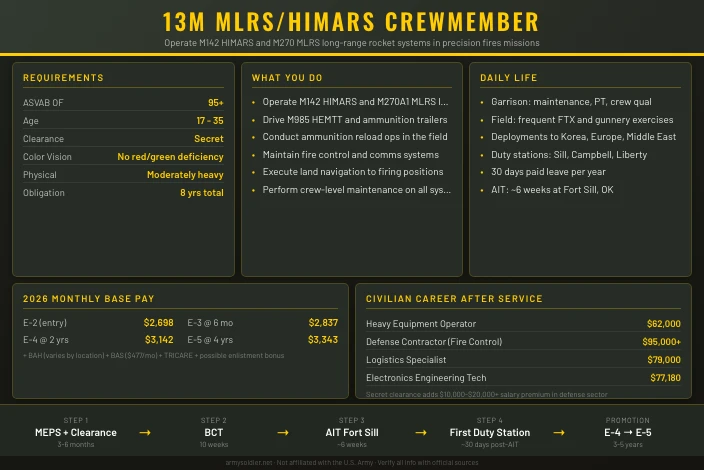
The 13M MLRS/HIMARS Crewmember operates and maintains the M270/M270A1 Multiple Launch Rocket System (MLRS) or the M142 High Mobility Artillery Rocket System (HIMARS). Crewmembers conduct long-range precision fires against enemy formations, supply points, air defense systems, and command facilities in support of ground force commanders.
Daily Tasks
In garrison, crewmembers spend much of their time on preventive maintenance, crew training, and qualification exercises. During field operations, the pace becomes intense and time-critical.
Daily duties include:
- Operating the M270A1 or M142 HIMARS Self-Propelled Launcher (SPLL)
- Driving and maintaining the M985 Heavy Equipment Mobile Tactical Truck (HEMTT) and M989A1 ammunition trailer (HEMAT)
- Conducting ammunition reload operations in the field
- Mounting and operating radio communications equipment
- Performing crew-level maintenance on launcher systems
- Executing land navigation to firing positions
- Conducting reconnaissance of firing points and displacement routes
- Performing resupply vehicle operations for multi-rocket ammunition
Specific Roles
The 13M serves under CMF 13 (Field Artillery). Soldiers may be assigned to either MLRS or HIMARS platforms depending on their first unit of assignment.
| System | Code | Notes |
|---|---|---|
| Primary MOS | 13M | MLRS/HIMARS Crewmember |
| Career Management Field | CMF 13 | Field Artillery |
Both platforms fire the same family of munitions, including the Army Tactical Missile System (ATACMS) and Precision Strike Missile (PrSM). HIMARS uses a single-pod launcher mounted on a wheeled platform for air-deployable operations. MLRS uses a tracked dual-pod launcher with greater ammunition capacity.
Mission Contribution
Long-range precision fires from MLRS and HIMARS have reshaped modern warfare. During combat operations, these systems suppress enemy air defense systems to enable aviation, destroy logistics nodes to starve enemy forces, and deliver mass fires against troop concentrations. Ukraine’s use of HIMARS demonstrated the strategic impact of this system in peer-level conflict. Being a 13M means being at the center of some of the Army’s highest-priority capabilities.
Technology and Equipment
You’ll work directly with:
- M142 HIMARS – wheeled, air-deployable rocket launcher
- M270A1 MLRS – tracked launcher with dual pod capacity
- M985 HEMTT – heavy tactical truck for ammunition and support
- Launcher System Support Device (LSSD) – maintenance and diagnostic computer
- Digital fire control and communications systems integrated with the launcher
Salary and Benefits
Base Pay
All pay figures reflect 2026 DFAS rates.
| Rank | Grade | Monthly Base Pay (entry) |
|---|---|---|
| Private (PV2) | E-2 | $2,698 |
| Private First Class | E-3 | $2,837 |
| Specialist | E-4 | $3,142 |
| Sergeant | E-5 | $3,343 |
| Staff Sergeant | E-6 | $3,401 |
Soldiers also receive BAS of $476.95/month and BAH based on duty location. BAH for an E-4 without dependents varies significantly by installation, ranging from roughly $1,000 to over $1,800/month at CONUS locations.
Additional Benefits
TRICARE Prime provides no-cost health coverage for active-duty soldiers and eligible family members. Education benefits include Tuition Assistance (TA) up to $4,500/year and the Post-9/11 GI Bill covering full in-state tuition for up to 36 months.
Under the Blended Retirement System (BRS), soldiers with 20 years receive a pension at 40% of their high-36 average basic pay, plus TSP matching up to 5% of base pay starting in the third year of service.
Work-Life Balance
Field artillery soldiers earn 30 days of paid leave per year. The operational tempo in a fires battalion is typically higher than in support units. Expect frequent field exercises, gunnery qualifications, and deployment cycles with short notice. Combat arms soldiers generally accept a more demanding garrison schedule as part of the job.
Qualifications and Eligibility
Requirements Table
| Requirement | Standard |
|---|---|
| ASVAB Line Score | OF: 95 |
| Minimum AFQT | 31 (diploma); 50 (GED) |
| Age | 17-35 |
| Citizenship | U.S. citizen |
| Color Vision | No red/green color deficiency |
| Physical Demand Rating | Moderately heavy |
| Security Clearance | Secret |
| Gender | Open to all |
The OF (Operators and Food) composite = VE + NO + AS + MC. Study verbal expression, mechanical comprehension, and auto/shop information to improve this score.
Application Process
- Meet with an Army recruiter and complete the ASVAB at MEPS
- Pass the physical examination and color vision test at MEPS
- Begin the security clearance process (SF-86 form submission)
- Select 13M during MOS selection
- Sign your enlistment contract and ship to BCT
The security clearance process adds time to the standard enlistment pipeline. Budget for 3-6 months from recruiter contact to BCT ship date.
Selection and Competitiveness
The 13M is a combat arms MOS with moderate competition. The Secret clearance requirement screens some applicants. Soldiers with mechanical aptitude and no significant financial or legal history have the strongest applications.
Service Obligation
Enlistment contracts for 13M are typically 3 or 4 years active duty with an 8-year total service obligation. Entry grade is E-1 (Private). Soldiers who require advanced individual training and a clearance investigation typically enter at E-1 regardless of prior college credits.
See our ASVAB study guide for strategies to hit these line scores, or take the PiCAT from home if you are a first-time tester.
Work Environment
Setting and Schedule
HIMARS and MLRS crews split time between maintenance bays, motor pools, and field training areas. Garrison life includes physical training, maintenance formation, and crew training throughout the week. Field exercises take crews to remote firing points, sometimes for weeks at a time.
During deployment, operational tempo depends heavily on mission requirements. Fires soldiers may conduct shoot-and-scoot operations that demand precise coordination, rapid movement, and extended hours of readiness.
Leadership and Communication
A launcher section has a section chief (E-5 to E-6) over a crew of 3-5 soldiers. The section chief coordinates with the battalion fire direction center (FDC) and higher-level fires cells. Communication is critical – firing solutions from the FDC reach the launcher in minutes, and crews must execute precisely.
Performance feedback comes through the NCOER system annually, with counseling sessions required quarterly. Leaders in fires units tend to be direct and performance-focused.
Team Dynamics
A 13M crew depends on each other completely. Everyone has a role in the firing sequence, the reload, and the displacement. Soldiers who can’t be trusted to execute their part put the entire crew at risk. Cohesion and mutual accountability are not optional in this MOS.
Job Satisfaction
13M soldiers consistently report pride in operating high-value, high-demand systems. The technical complexity of HIMARS and MLRS operations keeps the work mentally engaging. Deployments and field exercises maintain a high operational relevance that many combat support MOS lack.
Training and Skill Development
Training Pipeline
| Phase | Location | Length | Focus |
|---|---|---|---|
| Basic Combat Training (BCT) | Various | 10 weeks | Soldiering fundamentals, physical fitness, weapons qualification |
| Advanced Individual Training (AIT) | Fort Sill, OK | ~6 weeks | MLRS/HIMARS platform operations, HEMTT driving, ammunition reload, maintenance, communications, land navigation |
AIT at Fort Sill, Oklahoma runs through the Fires Center of Excellence. The course covers both M270A1 and HIMARS platforms, though first-unit platform assignment depends on the gaining unit.
Training phases include:
- Weeks 1-2: Platform familiarization and LSSD maintenance training on M270A1 MLRS
- Weeks 2-3: HEMTT driver training and M142 HIMARS vehicle systems
- Week 4: Resupply vehicle operations and HIMARS reload procedures
- Weeks 5-6: Field training exercise (FTX) and culminating training event – approximately 72 hours in the field applying all learned skills
The total pipeline from BCT ship date to first duty station is approximately 18 weeks.
Advanced Training
After reaching E-5, soldiers attend the 13M Advanced Leader Course (ALC) at Fort Sill. Senior NCOs may attend the Multiple Launch Rocket System Master Gunner course to become platform subject matter experts. Master Gunners train crews and develop gunnery programs across their units.
Additional opportunities include:
- Ranger School (open to qualified 13M soldiers)
- Air Assault School
- Airborne School (particularly relevant for HIMARS units, which are air-deployable)
Everything starts with qualifying ASVAB scores — our study guide covers what to study first.
Career Progression and Advancement
Career Path
| Rank | Grade | Typical Time | Milestone |
|---|---|---|---|
| Private (PV1/PV2) | E-1/E-2 | Entry | BCT and AIT |
| Private First Class | E-3 | 6-12 months | Arrive at first unit, complete Soldier qualification |
| Specialist | E-4 | 1-2 years | Crew proficiency, begin NCO preparation |
| Sergeant | E-5 | 3-5 years | Section chief candidate, attend ALC |
| Staff Sergeant | E-6 | 6-10 years | Section chief, train crews |
| Sergeant First Class | E-7 | 12-17 years | Platoon sergeant, battalion fires coordinator |
| Master Sergeant / 1SG | E-8 | 18-22 years | Senior fires NCO |
Role Flexibility
Soldiers can reclassify to other field artillery MOS such as 13B (Cannon Crewmember), 13F (Fire Support Specialist), or 13J (Fire Control Specialist) after their first enlistment. They can also pursue warrant officer selection (WO1) in the 135A (Field Artillery Technician) specialty.
Performance Evaluation
NCOs are rated on the NCOER system. Key performance indicators in a fires battalion include gunnery qualification scores, crew proficiency ratings, maintenance readiness percentages, and the quality of training provided to subordinates. Soldiers who pursue Master Gunner qualification and voluntary education advance more quickly.
Physical Demands and Medical Evaluations
Physical Requirements
The 13M is classified as a moderately heavy physical demand MOS. Ammunition handling, equipment movement, and field operations require significant upper body and leg strength. MLRS rockets are heavy – reload operations are physically demanding even with equipment assistance.
As a combat MOS, the 13M standard for the Army Fitness Test (AFT) is 350 total points (sex-neutral, age-normed). The general minimum for each event remains 60 points.
| AFT Event | Description | Minimum Score |
|---|---|---|
| 3-Rep Max Deadlift (MDL) | Strength | 60 pts |
| Hand Release Push-Up (HRP) | Upper body endurance | 60 pts |
| Sprint-Drag-Carry (SDC) | Anaerobic capacity | 60 pts |
| Plank (PLK) | Core stability | 60 pts |
| Two-Mile Run (2MR) | Aerobic endurance | 60 pts |
Combat MOS soldiers must achieve 350 total points to meet the higher standard. AFT administrative enforcement for active duty began January 1, 2026.
Medical Evaluations
No red/green color deficiency is allowed. Secret clearance requires a favorable background investigation (NACLC). Soldiers with significant medical history may require a waiver. Periodic SRP events throughout the career maintain medical readiness.
Deployment and Duty Stations
Deployment
HIMARS and MLRS units have deployed to Korea, Europe, and the Middle East. HIMARS units in particular have seen significant operational demand given the system’s performance in recent conflicts. Deployment lengths typically run 9-12 months, with some rotational deployments running 6-9 months.
Units supporting near-peer deterrence missions (Korea, Europe) maintain higher readiness tempos with frequent exercises and short-notice deployment drills.
Duty Station Options
MLRS and HIMARS units are concentrated at a relatively small number of installations:
- Fort Sill, OK (training base; some operational units)
- Fort Campbell, KY (101st Airborne Division fires)
- Fort Lewis-McChord, WA (I Corps)
- Fort Hood, TX / Fort Cavazos, TX (III Corps fires)
- Fort Bragg/Fort Liberty, NC (XVIII Airborne Corps fires)
- OCONUS locations (Germany, South Korea)
HIMARS units are particularly concentrated in airborne and Stryker formations for strategic mobility.
Risk, Safety, and Legal Considerations
Job Hazards
The 13M deals with live rockets, propellants, and high-explosive warheads. Improper handling, misfires, and vehicle accidents during tactical movement are the primary hazards. The blast radius from a MLRS rocket or ATACMS is significant, and crews must follow strict safety clearances.
Safety Protocols
All firing operations follow FM 3-09 (Field Artillery) and applicable technical manuals. Ammunition handling requires full PPE and adherence to safety standoff distances. Crew certification and range safety officer oversight are mandatory for live-fire exercises.
Security and Legal Requirements
The Secret clearance requires an NACLC. Soldiers must report changes in financial status, foreign contacts, and legal issues that could affect clearance eligibility. The clearance is maintained through periodic reinvestigation throughout the career.
Impact on Family and Personal Life
Family Considerations
Field artillery has a high operational tempo. Expect 3-6 months per year in the field for training and gunnery, plus deployment cycles. Families deal with frequent and sometimes unexpected absences. The Army provides FRGs, childcare, and Military OneSource support, but spouses should plan for significant solo parenting time.
Soldiers stationed at installations with strong community infrastructure (Fort Sill, Fort Campbell) generally report better family support experiences.
Relocation
PCS moves every 2-3 years are standard. The relatively small number of HIMARS/MLRS installations means some soldiers spend multiple tours at the same location, which can benefit families with established roots.
Reserve and National Guard
Component Availability
The 13M MOS is available in both the Army Reserve and Army National Guard. The Guard in particular has expanded its HIMARS battalions in recent years as the Army grows its long-range precision fires capability. Several states maintain HIMARS units, making this MOS increasingly accessible to part-time soldiers. Reserve artillery units also carry 13M positions, though fewer than the Guard.
Drill Schedule and Training Commitment
Standard commitment is one weekend per month plus two weeks of Annual Training. HIMARS crewmembers face extra training requirements because live-fire rocket qualifications and crew certifications need regular renewal. Annual Training almost always involves a gunnery exercise at a major training area. Expect one or two additional training days per year beyond the baseline for crew qualification tables.
Part-Time Pay
An E-4 with about three years of service earns roughly $422 per drill weekend in 2026. Over 12 weekends, that totals about $5,064 per year. Annual Training adds approximately $1,583, bringing the annual total to roughly $6,647. Active-duty E-4 base pay is $3,166 per month.
Benefits Differences
Reserve and Guard 13M soldiers receive Tricare Reserve Select instead of free active-duty TRICARE. TRS costs $57.88 per month for member-only coverage or $286.66 for member plus family in 2026.
Education benefits include:
- Federal Tuition Assistance: $4,500 per year for drilling members
- MGIB-SR: roughly $416 per month while enrolled
- Post-9/11 GI Bill: requires 90 or more days of federal activation; scales with cumulative active time
- State tuition waivers (Guard only): vary by state, with some covering full tuition at state schools
Retirement uses a points-based system. The pension draws at age 60, with potential reductions for qualifying mobilizations down to age 50. TSP matching up to 5% applies under the Blended Retirement System.
Deployment and Mobilization
HIMARS units are in high demand. Reserve and Guard 13M soldiers face a moderate to high mobilization rate as the Army relies on long-range fires in every theater. Mobilizations typically last 9 to 12 months. Guard HIMARS battalions have deployed to the Middle East, Europe, and the Pacific. Expect at least one mobilization during a six-year enlistment, possibly more given current operational demand.
Civilian Career Integration
The 13M skill set does not transfer directly to a single civilian job, but the heavy vehicle operation, logistics coordination, and technical maintenance experience you build carries value in trucking, heavy equipment operation, and manufacturing supervision. Many 13M soldiers pursue CDL certifications that pair well with their military vehicle experience. USERRA protects your civilian job when you are mobilized, and your employer must hold your position until you return.
| Feature | Active Duty | Army Reserve | Army National Guard |
|---|---|---|---|
| Commitment | Full-time | One weekend/month + 2 weeks/year | One weekend/month + 2 weeks/year |
| Monthly Pay (E-4, ~3 yrs) | $3,166/month | ~$422/drill weekend | ~$422/drill weekend |
| Healthcare | TRICARE, $0 premiums | TRS, $57.88/month (member) | TRS, $57.88/month (member) |
| Education | TA + Post-9/11 GI Bill | Federal TA, MGIB-SR; Post-9/11 after activation | Federal TA, MGIB-SR, state tuition waivers |
| Deployment | Regular rotation every 2-3 years | Mobilization every 3-4 years | Mobilization every 3-4 years + state missions |
| Retirement | BRS pension at 20 years | Points-based, age 60 | Points-based, age 60 |
Post-Service Opportunities
Transition to Civilian Life
The leadership, mechanical maintenance, and technical operations skills from the 13M MOS transfer to civilian careers in logistics, heavy equipment operations, and defense contracting. The Secret clearance is a direct asset for defense industry employment.
The SkillBridge program and TAP provide transition support. Many 13M veterans move into defense contractor roles supporting HIMARS sustainment and training programs – a direct application of their exact skill set.
Civilian Career Prospects
| Civilian Job | Median Salary (BLS, May 2024) | Outlook |
|---|---|---|
| Heavy Equipment Operator | ~$62,000/year | Moderate growth |
| Electrical/Electronics Engineering Technician | $77,180/year | Stable |
| Defense Contractor (Fire Control Systems) | $80,000-$110,000/year | High demand |
| Logistics Specialist / Operations Manager | $79,000/year | Growing |
| First-Line Supervisor, Transportation | $73,000/year | Stable |
The Secret clearance significantly expands options in defense, intelligence, and government contracting. Veterans with HIMARS experience are actively recruited by defense contractors supporting Army programs.
Is This a Good Job for You? The Right (and Wrong) Fit
Ideal Candidate Profile
A strong 13M candidate:
- Wants to operate high-consequence, technically complex systems
- Is comfortable with physical work in field environments
- Can perform precise tasks under time pressure
- Is reliable and accountable – crew members depend on each other
- Accepts a high operational tempo and frequent field time
Mechanical aptitude and the ability to work well in small teams are critical. Soldiers who want to be part of the Army’s high-end precision fires capability will find this MOS deeply satisfying.
Potential Challenges
The operational tempo is demanding. Field time is frequent, and HIMARS units are among the first to deploy in crisis scenarios. The clearance requirement means your personal life – finances, relationships, foreign contacts – receives scrutiny. Soldiers who struggle with the required physical demands or who need a more predictable schedule will find this a tough career.
Lifestyle Alignment
If you want to operate the systems that feature prominently in modern long-range precision warfare, the 13M MOS is a direct path there. The technical complexity keeps the work engaging, and the career opens strong options in the defense industry after service.
More Information
Talk to an Army recruiter or a Field Artillery branch representative to find out about current 13M openings, duty station options, and any available enlistment bonuses. Given the strategic priority placed on long-range fires, this MOS sees consistent recruiting demand.
- Prepare for the ASVAB with our study guide to make sure your line scores qualify
This site is not affiliated with the U.S. Army or any government agency. Verify all information with official Army sources before making enlistment or career decisions.
Explore more Army artillery and air defense careers such as 13B Cannon Crewmember and 13F Fire Support Specialist.