13R Field Artillery Firefinder Radar Operator
An enemy artillery crew fires a single round. Within seconds, a Firefinder radar tracks its trajectory, calculates the firing point, and sends that data to field artillery units ready to suppress it. The 13R Field Artillery Firefinder Radar Operator runs the system that makes that possible – a technical and tactically critical role at the intersection of radar technology, fire support, and battlefield intelligence.
Qualifying requires specific ASVAB line scores — our ASVAB study guide covers what to target and how to prepare.
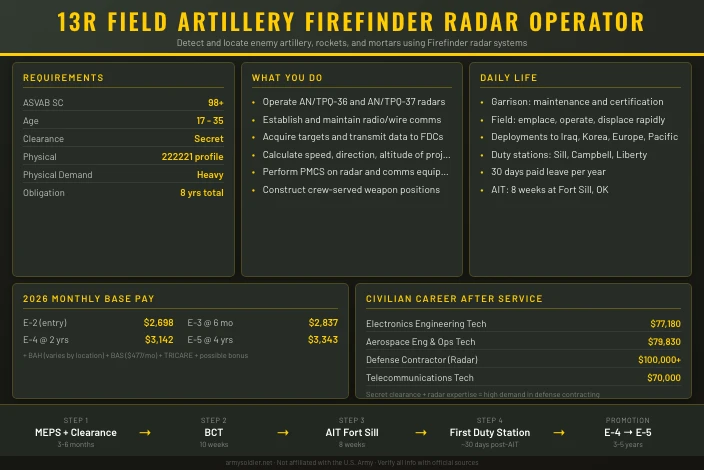
Job Role and Responsibilities
The 13R Field Artillery Firefinder Radar Operator prepares, operates, and maintains the AN/TPQ-36 and AN/TPQ-37 Firefinder weapon-locating radar systems to detect incoming mortar, artillery, and rocket fire and locate enemy firing positions. Operators transmit acquired data to fire direction centers and other battlefield assets to enable immediate counter-fire.
Daily Tasks
In garrison, operators spend time on maintenance, technical training, and operator certification exercises. The systems require consistent upkeep and calibration to maintain reliability.
Typical duties include:
- Setting up and preparing the AN/TPQ-36 (shorter-range) or AN/TPQ-37 (longer-range) radar for operation
- Establishing and maintaining radio and wire communications with fire direction centers (FDC)
- Operating the radar during training and operational missions to acquire targets
- Calculating and recording speed, direction, and altitude data on detected projectiles
- Transmitting target data to fire direction centers for counter-fire missions
- Performing scheduled preventive maintenance (PMCS) on radar systems and associated equipment
- Constructing crew-served weapon positions and fighting positions when emplaced
- Processing digital fire support data through tactical communications systems
Specific Roles
The 13R serves under CMF 13 (Field Artillery). Firefinder units are found in both division artillery (DIVARTY) and corps-level field artillery brigades.
| System | Code | Notes |
|---|---|---|
| Primary MOS | 13R | Field Artillery Firefinder Radar Operator |
| Career Management Field | CMF 13 | Field Artillery |
| Radar System 1 | AN/TPQ-36 | Shorter-range, counter-mortar/rocket focused |
| Radar System 2 | AN/TPQ-37 | Longer-range, counter-artillery focused |
Mission Contribution
Counter-battery fire – silencing enemy artillery before it can fire again – is one of the most time-sensitive missions in land warfare. The Firefinder radar is the sensor that enables it. When a 13R team is operating effectively, friendly units have near-real-time knowledge of where enemy fire is coming from and can respond immediately. When the radar goes down, that intelligence gap costs lives. The 13R role carries genuine tactical weight.
Technology and Equipment
Key systems and equipment:
- AN/TPQ-36 Firefinder Radar – detects and locates mortar, artillery, and rocket fire at shorter ranges
- AN/TPQ-37 Firefinder Radar – extended-range weapon-locating radar
- Tactical communications equipment (radios, wire systems)
- Digital fire support terminals and battle command systems
- Associated vehicles, generators, and power distribution equipment
Salary and Benefits
Base Pay
All figures reflect 2026 DFAS pay rates.
| Rank | Grade | Monthly Base Pay (entry) |
|---|---|---|
| Private (PV2) | E-2 | $2,698 |
| Private First Class | E-3 | $2,837 |
| Specialist | E-4 | $3,142 |
| Sergeant | E-5 | $3,343 |
| Staff Sergeant | E-6 | $3,401 |
Soldiers also receive BAS of $476.95/month and BAH based on duty location, ranging from roughly $1,000 to over $1,800/month depending on installation.
Additional Benefits
TRICARE Prime covers active-duty soldiers and eligible family members at no cost. Education benefits include Tuition Assistance (TA) up to $4,500/year and the Post-9/11 GI Bill for full in-state tuition at public schools, up to 36 months.
The Blended Retirement System (BRS) provides a 20-year pension at 40% of high-36 pay, with TSP matching up to 5% of base pay starting in the third year.
Work-Life Balance
Field artillery soldiers earn 30 days paid leave per year. Firefinder units have a high operational tempo, with frequent field exercises and gunnery certifications. Radar sections must maintain readiness at all times, which can mean irregular hours during training cycles and deployment.
Qualifications and Eligibility
Requirements Table
| Requirement | Standard |
|---|---|
| ASVAB Line Score | SC: 98 |
| Minimum AFQT | 31 (diploma); 50 (GED) |
| Age | 17-35 |
| Citizenship | U.S. citizen |
| Physical Profile | 222221 |
| Physical Demand Rating | Heavy |
| Security Clearance | Secret |
| Gender | Open to all |
The SC (Surveillance and Communications) composite = VE + AR + AS + MC. This is one of the more demanding ASVAB composites, requiring strength across verbal expression, arithmetic reasoning, auto/shop, and mechanical comprehension. A score of 98 means you need to be genuinely strong across all four subtests.
Application Process
- Meet with an Army recruiter and take the ASVAB at MEPS
- Pass the physical examination at MEPS
- Submit the SF-86 for security clearance processing
- Select 13R during MOS selection
- Sign enlistment contract and ship to BCT
Budget 3-6 months from recruiter contact to ship date, accounting for clearance processing time.
Selection and Competitiveness
The 13R is more selective than most support MOS. The SC:98 requirement is one of the higher ASVAB thresholds in the field artillery branch. Combined with the clearance requirement, this screens for candidates with both technical aptitude and a clean background.
Service Obligation
Standard contracts are 3 or 4 years active duty with an 8-year total service obligation. Entry grade is E-1 (Private).
See our ASVAB study guide for strategies to hit these line scores, or take the PiCAT from home if you are a first-time tester.
Work Environment
Setting and Schedule
Firefinder sections operate in tactical positions, often away from main unit areas. The radar must be emplaced, operated, and displaced frequently – “shoot and scoot” tactics apply to radar sections too, since an active radar can be detected and targeted. In garrison, teams work in maintenance areas and simulation facilities.
Field work is physically demanding and often conducted at night or in austere conditions. Radar sections work in close coordination with fires cells and brigade-level headquarters.
Leadership and Communication
A radar section consists of 4-8 soldiers under a section chief (E-6 to E-7). The section chief communicates directly with the battalion or brigade fire direction center. Given the time-sensitive nature of counter-battery fire, communication discipline and accuracy are non-negotiable.
Team Dynamics
Firefinder sections are technically specialized teams that must function as a cohesive unit. Each soldier has specific roles in emplacement, operation, and displacement. Errors in the radar setup or communications process directly degrade the unit’s counter-fire capability.
Job Satisfaction
13R soldiers report high satisfaction tied to the technical complexity of the job and its direct tactical relevance. Operating sophisticated radar systems in demanding environments appeals to soldiers who want more technical depth than conventional artillery offers. The downside is the demanding schedule and relatively few duty stations compared to other MOS.
Training and Skill Development
Training Pipeline
| Phase | Location | Length | Focus |
|---|---|---|---|
| Basic Combat Training (BCT) | Various | 10 weeks | Soldiering fundamentals, physical fitness, weapons qualification |
| Advanced Individual Training (AIT) | Fort Sill, OK | 8 weeks | Firefinder radar systems operation and maintenance, communications, fire support integration, field operations |
AIT at Fort Sill, Oklahoma is conducted at the Fires Center of Excellence. Students learn to operate both the AN/TPQ-36 and AN/TPQ-37 systems, establish communications nets, process target data, and perform operator-level maintenance. Field exercises apply classroom skills to tactical scenarios.
The total pipeline from BCT ship date to first duty station is approximately 20 weeks.
Advanced Training
Senior 13R soldiers can pursue the Radar Section Chief Course and attend Advanced Leader Course (ALC) at Fort Sill. Top performers may be selected for the 13R Master Gunner program, qualifying them as platform subject matter experts for unit-level training and certification programs.
Additional voluntary schools open to 13R soldiers include:
- Air Assault School
- Airborne School
- Equal Opportunity Leader (EOL) course
- Battle Staff NCO Course (for E-6+)
Everything starts with qualifying ASVAB scores — our study guide covers what to study first.
Career Progression and Advancement
Career Path
| Rank | Grade | Typical Time | Milestone |
|---|---|---|---|
| Private (PV1/PV2) | E-1/E-2 | Entry | BCT and AIT |
| Private First Class | E-3 | 6-12 months | First unit, operator qualification |
| Specialist | E-4 | 1-2 years | Full operator certification, crew proficiency |
| Sergeant | E-5 | 3-5 years | Section team leader, attend ALC |
| Staff Sergeant | E-6 | 6-10 years | Section chief |
| Sergeant First Class | E-7 | 12-17 years | Platoon sergeant or senior fires NCO |
| Master Sergeant / 1SG | E-8 | 18-22 years | Senior NCO, company/battalion level |
Role Flexibility
Soldiers can reclassify within CMF 13 to 13M (MLRS/HIMARS Crewmember), 13B (Cannon Crewmember), or 13J (Fire Control Specialist) after completing their first enlistment. The technical foundation of 13R also supports a lateral move to signal intelligence or electronic warfare MOS through reclassification.
Performance Evaluation
The NCOER evaluates NCOs on technical proficiency, radar operational readiness, leadership, and training of subordinates. Soldiers who pursue master gunner qualifications and voluntary education consistently rank higher in competitive promotions.
Physical Demands and Medical Evaluations
Physical Requirements
The 13R is rated heavy physical demand. Setting up radar systems involves lifting heavy antennas and equipment, digging fighting positions, and emplacing communications wire in all terrain conditions. Soldiers must be able to sustain this level of physical work across extended field operations.
The Army Fitness Test (AFT), effective June 2025, has a combat MOS standard of 350 total points (sex-neutral, age-normed) for designated combat specialties.
| AFT Event | Description | Minimum Score |
|---|---|---|
| 3-Rep Max Deadlift (MDL) | Strength | 60 pts |
| Hand Release Push-Up (HRP) | Upper body endurance | 60 pts |
| Sprint-Drag-Carry (SDC) | Anaerobic capacity | 60 pts |
| Plank (PLK) | Core stability | 60 pts |
| Two-Mile Run (2MR) | Aerobic endurance | 60 pts |
Verify the specific AFT standard for 13R with your unit – whether the 300 general or 350 combat standard applies depends on official designation. Administrative enforcement began January 1, 2026 for active duty.
Medical Evaluations
No special color vision requirement is documented for 13R. The Secret clearance requires a background investigation. Soldiers with complex medical histories may require waivers. Periodic SRP events maintain medical readiness throughout service.
Deployment and Duty Stations
Deployment
Firefinder units have deployed to Iraq, Afghanistan, South Korea, Europe, and the Pacific. Counter-battery radar capability is in constant demand wherever artillery is employed or threatened. Deployment lengths typically run 9-12 months for combat theater rotations, with rotational deterrence missions often running 6-9 months.
Duty Station Options
Firefinder units are found primarily at artillery and combined arms installations:
- Fort Sill, OK (Fires Center of Excellence and field units)
- Fort Campbell, KY (101st Airborne Division)
- Fort Hood/Fort Cavazos, TX (III Corps)
- Fort Lewis-McChord, WA (I Corps)
- Fort Liberty, NC (XVIII Airborne Corps)
- OCONUS (Germany, South Korea)
Risk, Safety, and Legal Considerations
Job Hazards
Radar systems emit radio frequency radiation. Operators follow strict safety standoff distances and use RF safety protocols during operation. In tactical environments, an emitting radar is a target – counter-radar fires are a real threat, requiring rapid displacement after operations.
Physical hazards include heavy lifting, working at heights on antenna systems, and vehicle operation in austere conditions.
Safety Protocols
All radar operations follow applicable technical manuals and safety regulations. RF hazard awareness is part of initial training. Tactical operations follow Army doctrine for radar employment, including emissions control to reduce electromagnetic signature.
Security and Legal Requirements
The Secret clearance requires an NACLC and periodic reinvestigation. Soldiers must report significant changes in personal circumstances – financial problems, foreign contacts, arrests – that could affect clearance status. UCMJ applies throughout service.
Impact on Family and Personal Life
Family Considerations
Field artillery has a demanding operational tempo. Firefinder sections deploy with the units they support and conduct frequent field exercises in garrison. Families should plan for extended absences and the unpredictability of training cycles.
Army family support programs – FRGs, Military OneSource, Army Community Service – are available at all installations. BAH provides housing allowance during deployment.
Relocation
PCS moves occur every 2-3 years. The concentration of fires units at a limited number of installations may result in multiple assignments at the same location. Families benefit from this stability, though it limits geographic flexibility.
Reserve and National Guard
Component Availability
The 13R MOS is available in both the Army Reserve and Army National Guard, but positions are limited. Firefinder radar sections exist within artillery battalions, and each battalion only has a small number of 13R slots. You may need to search beyond your nearest unit to find an opening. Both components carry positions up through senior NCO grades.
Drill Schedule and Training Commitment
Standard commitment is one weekend per month plus two weeks of Annual Training. 13R soldiers need to maintain proficiency on the AN/TPQ-53 radar system, which means hands-on training during drill weekends and AT. Radar system certifications require periodic renewal, and some units schedule extra training days for technical qualification. Annual Training often involves field deployment of the radar to support artillery live-fire exercises.
Part-Time Pay
An E-4 with about three years of service earns roughly $422 per drill weekend in 2026. Over 12 drill weekends, that comes to about $5,064 annually. Annual Training adds around $1,583, for a total near $6,647. Active-duty E-4 base pay is $3,166 per month for comparison.
Benefits Differences
Reserve and Guard 13R soldiers receive Tricare Reserve Select rather than active-duty TRICARE. TRS runs $57.88 per month for member-only coverage or $286.66 for member plus family in 2026. Active-duty TRICARE has no premiums.
Education benefits include:
- Federal Tuition Assistance: $4,500 per year for drilling members
- MGIB-SR: roughly $416 per month while enrolled
- Post-9/11 GI Bill: requires 90 or more days of federal activation
- State tuition waivers (Guard only): vary by state, some cover full tuition at state schools
Retirement follows the points-based system with pension payable at age 60. Qualifying mobilizations can reduce that age by 90 days per qualifying period, down to age 50.
Deployment and Mobilization
Reserve and Guard 13R soldiers mobilize at a moderate rate. Radar operators deploy with their artillery battalions to provide counter-fire detection in theater. Mobilizations typically last 9 to 12 months. The frequency is lower than many combat arms MOSs because of the limited number of 13R positions, but when your unit deploys, you go with it.
Civilian Career Integration
The 13R skill set transfers to civilian radar and electronics work. Radar technician positions in aviation, weather services, and defense contracting value the hands-on radar operation and maintenance experience you gain. Many 13R soldiers pursue electronics or IT certifications that complement their military training. USERRA protects your civilian job during mobilization, requiring your employer to hold your position and restore benefits when you return.
| Feature | Active Duty | Army Reserve | Army National Guard |
|---|---|---|---|
| Commitment | Full-time | One weekend/month + 2 weeks/year | One weekend/month + 2 weeks/year |
| Monthly Pay (E-4, ~3 yrs) | $3,166/month | ~$422/drill weekend | ~$422/drill weekend |
| Healthcare | TRICARE, $0 premiums | TRS, $57.88/month (member) | TRS, $57.88/month (member) |
| Education | TA + Post-9/11 GI Bill | Federal TA, MGIB-SR; Post-9/11 after activation | Federal TA, MGIB-SR, state tuition waivers |
| Deployment | Regular rotation | Mobilization every 4-6 years | Mobilization every 4-6 years |
| Retirement | BRS pension at 20 years | Points-based, age 60 | Points-based, age 60 |
Post-Service Opportunities
Transition to Civilian Life
The 13R MOS builds strong foundations in radar electronics, tactical communications, and systems maintenance – all of which translate to high-demand civilian technical fields. The Secret clearance is a direct qualification for defense contractor and government positions.
SkillBridge and TAP support the transition. Defense contractors supporting Army radar programs actively recruit 13R veterans, both for technical roles and for training and sustainment support contracts.
Civilian Career Prospects
| Civilian Job | Median Salary (BLS, May 2024) | Outlook |
|---|---|---|
| Electrical/Electronics Engineering Technician | $77,180/year | Stable (1% growth) |
| Aerospace Engineering & Operations Technician | $79,830/year | 8% growth (faster than avg) |
| Defense Contractor (Radar/Fire Control Systems) | $85,000-$120,000/year | High demand |
| Telecommunications Technician | $60,000-$80,000/year | Moderate demand |
| Air Traffic Control Specialist | $92,000+/year | Competitive entry |
The civilian electronics technician field pays a median of $77,180 annually. Radar and defense electronics specialists typically earn above that median due to clearance premiums and specialized knowledge.
Is This a Good Job for You? The Right (and Wrong) Fit
Ideal Candidate Profile
A strong 13R candidate:
- Scored well on the ASVAB, particularly in science and mechanical comprehension
- Enjoys technical problem-solving with real-time consequences
- Is comfortable operating outdoors in all conditions
- Can maintain composure when counter-fire timelines are measured in seconds
- Has a clean background that supports Secret clearance approval
This is one of the more technically demanding enlisted MOS in the field artillery branch. Soldiers who thrive combine intellectual curiosity with physical resilience.
Potential Challenges
The SC:98 requirement filters out many applicants. The operational tempo is demanding, and the security clearance requirement adds bureaucratic complexity to the enlistment process. In a post-service context, the “no direct civilian equivalent” reality of radar operations means transition requires deliberate translation of skills – though the defense industry closes that gap significantly.
Lifestyle Alignment
If you want a technical MOS with tangible tactical impact and strong defense industry prospects after service, the 13R is a strong choice. The demanding requirements filter for motivated soldiers, and the units that employ Firefinder radar tend to be professionally serious environments.
More Information
Speak with an Army recruiter or visit the Fires Center of Excellence website for more information about 13R training and assignments. Ask about current enlistment bonuses – this MOS has historically qualified for incentives.
- Prepare for the ASVAB with our study guide to make sure your line scores qualify
This site is not affiliated with the U.S. Army or any government agency. Verify all information with official Army sources before making enlistment or career decisions.
Explore more Army artillery and air defense careers such as 13M MLRS/HIMARS Crewmember and 13J Fire Control Specialist.