14E Patriot Fire Control Enhanced Operator/Maintainer
The Patriot missile system is the Army’s primary defense against aircraft, cruise missiles, and tactical ballistic missiles. As a 14E, you run the fire control nerve center that detects, tracks, and engages those threats. Few enlisted soldiers get to operate a weapons system that costs over $1 billion per battery and has seen real combat from the Persian Gulf to Eastern Europe.
This job sits at the intersection of electronics, radar, and air defense tactics. You won’t just push buttons. You’ll troubleshoot radar faults in the field, maintain power distribution systems, and make split-second engagement recommendations during live-fire exercises. If you want hands-on technical work with a direct combat application, 14E is one of the most equipment-intensive MOS options in the Army.
Qualifying requires specific ASVAB line scores — our ASVAB study guide covers what to target and how to prepare.
Job Role and Responsibilities
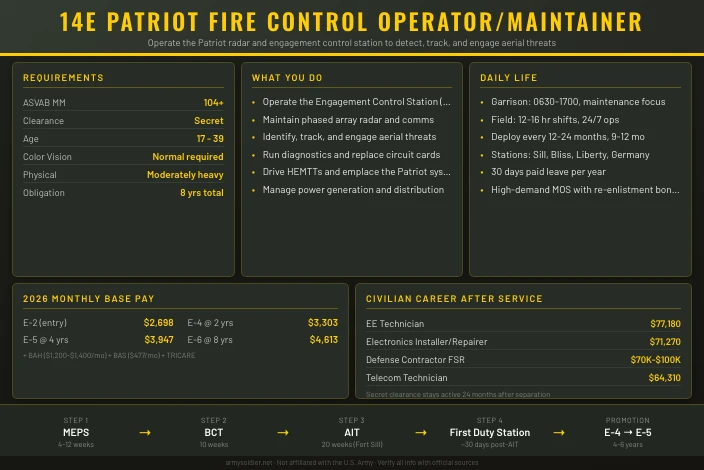
The 14E Patriot Fire Control Enhanced Operator/Maintainer operates and maintains the four major components of the Patriot Fire Control system: the Engagement Control Station (ECS), the phased array radar, the antennae mast group (AMG) for communications, and the electric power plant (EPP). You identify, track, and engage aerial threats using one of the world’s most advanced interceptor missile systems.
What You Do Day to Day
Your primary workstation is the Engagement Control Station, a climate-controlled shelter packed with computer consoles and tactical displays. During operations, you monitor radar feeds, classify air tracks, and coordinate engagement sequences with your crew. Between operations, maintenance eats most of your time.
A typical garrison day starts with equipment checks on the radar and power systems. You run diagnostic tests, replace faulty circuit cards, and verify that communication links between Patriot components are functioning. Power cable management is a constant task since the system runs on generators that need regular servicing.
Field days look different. You drive Heavy Expanded Mobility Tactical Trucks (HEMTTs) to move the fire control equipment, emplace the radar and ECS, and bring the system online. Tear-down and setup drills happen frequently because Patriot units practice “shoot and scoot” tactics to avoid counter-fire.
Specialized Roles and Identifiers
The 14-series covers the full Patriot weapon system and other air defense platforms. Your MOS fits into a broader team:
| Code | Title | Role |
|---|---|---|
| 14E | Patriot Fire Control Enhanced Operator/Maintainer | Operates ECS and maintains radar, comms, and power systems |
| 14T | Patriot Launching Station Enhanced Operator/Maintainer | Operates and maintains the missile launchers |
| 14G | Air Defense Battle Management System Operator | Manages airspace and coordinates between batteries |
| 14H | Air Defense Enhanced Early Warning System Operator | Provides early warning radar coverage |
| 14P | Air and Missile Defense Crewmember | Operates short-range systems like Avenger and C-RAM |
Additional Skill Identifiers (ASIs) become available as you gain experience. Senior 14E soldiers can earn ASIs related to Patriot system upgrades, including newer Post-Deployment Build configurations.
Mission Contribution
A Patriot battery can’t fight without its fire control section. The radar detects threats at ranges beyond 100 kilometers, and the ECS processes that data into firing solutions. You’re the crew that keeps that chain running. During air defense operations, a single mistake at the ECS console can mean a missed intercept or a friendly-fire incident. The stakes are real.
Your section also provides the communication backbone that links Patriot batteries to higher echelon air defense networks. That means your maintenance work on the AMG directly affects whether battalion and brigade headquarters can see the same air picture you see.
Equipment and Technology
The Patriot system is one of the most complex weapons in the Army inventory. You work with:
- AN/MPQ-65A radar that scans, tracks, and guides missiles simultaneously
- Engagement Control Station (ECS) with tactical workstations running specialized software
- OE-349 Antennae Mast Group for encrypted tactical communications
- EPP III electric power plant that generates power for the entire fire control section
- HEMTT trucks for transporting system components
- Fiber optic and RF communication links connecting battery components
The Army continues to upgrade Patriot with software and hardware improvements. Soldiers in this MOS get exposure to digital networking, radar theory, and electronic troubleshooting that goes far beyond what most enlisted jobs offer.
Salary and Benefits
Base Pay
Military pay depends on rank and time in service, not MOS. Every 14E earns the same base pay as any other soldier at the same grade and years of service. Here are the 2026 monthly base pay rates for typical 14E career milestones:
| Rank | Grade | Typical Time in Service | Monthly Base Pay |
|---|---|---|---|
| Private (PV2) | E-2 | Entry (after BCT) | $2,698 |
| Private First Class | E-3 | 1-2 years | $2,837 - $3,015 |
| Specialist | E-4 | 2-4 years | $3,303 - $3,659 |
| Sergeant | E-5 | 4-6 years | $3,947 - $4,109 |
| Staff Sergeant | E-6 | 8-10 years | $4,613 - $4,759 |
| Sergeant First Class | E-7 | 12+ years | $5,537+ |
These figures reflect the 2026 military pay scale, which includes a 3.8% raise effective January 1, 2026.
Allowances and Bonuses
On top of base pay, you receive:
- Basic Allowance for Subsistence (BAS): $476.95/month for enlisted soldiers
- Basic Allowance for Housing (BAH): Varies by duty station and dependency status. A single E-4 at Fort Sill receives roughly $1,200-$1,400/month. Soldiers with dependents get more.
- Enlistment bonus: The 14E MOS has historically offered bonuses up to $40,000 for multi-year contracts. Bonus amounts change quarterly, so check with your recruiter for current availability.
Benefits Package
TRICARE Prime covers all medical, dental, vision, and mental health care at zero cost for active duty soldiers. Your family members are also covered with no enrollment fee, no deductible, and no copays for in-network care.
The Post-9/11 GI Bill provides 36 months of full tuition at public schools (or up to $29,920.95/year at private schools), a monthly housing allowance, and a $1,000/year book stipend. You can transfer this benefit to a spouse or children after six years of service.
Tuition Assistance covers up to $4,500/year while you’re still serving, so you can start college classes during your enlistment.
You earn 30 days of paid leave per year (2.5 days per month), plus 11 federal holidays.
Retirement
The Blended Retirement System (BRS) combines a pension with TSP matching. The government automatically contributes 1% of your basic pay to your Thrift Savings Plan and matches up to 4% more if you contribute at least 5%. After 20 years, you receive a pension worth 40% of your highest 36 months of basic pay.
Qualifications and Eligibility
Basic Requirements
The 14E has higher technical requirements than many combat arms MOS. You need strong mechanical and electronics aptitude to qualify.
| Requirement | Details |
|---|---|
| ASVAB Line Score | MM (Mechanical Maintenance) of 104 |
| ASVAB Composite Formula | NO + AS + MC + EI |
| Security Clearance | Secret |
| Color Vision | Normal color vision required |
| Citizenship | U.S. citizen or permanent resident |
| Age | 17-39 (17 requires parental consent) |
| Education | High school diploma (AFQT 31+) or GED (AFQT 50+) |
| Physical Demand Rating | Moderately heavy |
| OPAT | Must pass; category varies by unit mission |
Enlistment Process
Selection Criteria
The 14E is not as competitive as some technical MOS like 17C (Cyber Operations), but the MM 104 score requirement filters out a significant portion of applicants. Strong math and mechanical reasoning scores will put you in a good position.
Prior experience with electronics, automotive repair, or computer systems can help you succeed in AIT, though none of it is required. What matters most is hitting that ASVAB threshold and passing the Secret clearance investigation.
New enlistees enter at E-1 (Private) through E-3 (Private First Class), depending on education credits, JROTC time, or referral bonuses. College credits can bump your entry rank to E-4 in some cases.
See our ASVAB study guide for strategies to hit these line scores, or take the PiCAT from home if you are a first-time tester.
Work Environment
Setting and Schedule
In garrison, you work in a motor pool or maintenance bay most days. The Patriot equipment stays in climate-controlled shelters or hardened pads, but you’ll spend plenty of time outdoors running power cables, checking antenna connections, and performing generator maintenance. Normal garrison hours run 0630-1700, Monday through Friday, though duty rosters for 24-hour operations change that.
Field training exercises are a regular part of the job. Expect 2-4 multi-week field rotations per year where you live out of tents or vehicles. During these exercises, you work 12-16 hour shifts operating the radar and ECS around the clock. Night operations are standard since the air defense mission never stops.
The Patriot system generates a lot of noise and heat. The EPP runs diesel generators, and the radar produces electromagnetic emissions that require safety standoff distances. You’ll follow strict radiation hazard (RADHAZ) procedures daily.
Chain of Command
A Patriot fire control section typically falls under a battery-level organization. Your immediate supervisor is a Staff Sergeant (SSG) or Sergeant (SGT) who serves as the fire control section chief. Above that, the battery commander (a Captain) and first sergeant manage the full battery.
Performance feedback comes through counseling sessions (monthly for junior soldiers, quarterly for NCOs) and the annual NCOER or OER evaluation system. Your section chief will rate you on technical proficiency, maintenance discipline, and tactical competence.
Teamwork and Autonomy
Fire control operations are team-driven. During engagements, the ECS crew works in tight coordination, with operators handling different console functions while the section chief manages the overall tactical picture. You won’t make engagement decisions alone, but your input on track classification and system status directly shapes the crew’s actions.
Maintenance tasks give you more independence. Once you’re trained on a subsystem, you’ll run diagnostic sequences and component swaps on your own. Senior specialists often mentor newer soldiers through complex fault-isolation procedures.
Retention
Air defense MOS soldiers have moderate retention rates. The technical skills transfer well to civilian jobs, which pulls some soldiers out after their first contract. The Army counters this with re-enlistment bonuses that frequently target 14E soldiers. Satisfaction tends to be high among those who enjoy the technical challenge, though the frequent field time and deployment rotations can wear on soldiers with families.
Training and Skill Development
Initial Training Pipeline
The 14E training pipeline is one of the longest for an enlisted combat arms MOS. You spend roughly 30 weeks total between BCT and AIT before reaching your first duty station.
| Phase | Location | Duration | Focus |
|---|---|---|---|
| Basic Combat Training (BCT) | Various (Fort Jackson, Fort Moore, Fort Sill) | 10 weeks | Soldier fundamentals: marksmanship, land navigation, drill, first aid, field craft |
| AIT Phase 1 | Fort Sill, OK (B Battery, 3-6 ADA) | ~7 weeks | Engagement Control Station operation and maintenance |
| AIT Phase 2 | Fort Sill, OK | ~7 weeks | Phased array radar operation and maintenance |
| AIT Phase 3 | Fort Sill, OK | ~6 weeks | Tactical employment, simulated air battles, field training exercise |
AIT at Fort Sill runs about 30 classes per year with roughly 16 students each. Every block of instruction starts in the classroom with theory, then moves to hands-on work with actual Patriot equipment. The final three-day field training exercise puts everything together: you emplace the system, run tactical scenarios, and execute warrior tasks under field conditions.
What You Learn in AIT
The 20-week AIT course covers a lot of ground:
- Radar theory and phased array operations including beam steering and target tracking
- ECS software for track management, engagement control, and system initialization
- Power generation and distribution for the EPP III systems
- Communication systems including the antennae mast group and fiber optic links
- HEMTT driving and equipment transport procedures
- Organizational-level maintenance including fault isolation and circuit card replacement
- Nuclear, biological, and chemical (NBC) operations specific to air defense
Advanced Training
After your first assignment, several training opportunities open up:
- Patriot Master Gunner course for senior NCOs who become the battery commander’s technical advisor
- Air Defense Artillery Senior Leaders Course at Fort Sill
- Battle Staff NCO course for soldiers moving into planning roles
- Warrant Officer Candidate School (WOCS) if you want to become a 140A (Command and Control Systems Integrator) or 140E (Patriot System Technician)
The Army also sends 14E soldiers to vendor training when major system upgrades roll out. Raytheon, the Patriot manufacturer, runs courses on new software builds and hardware modifications.
Everything starts with qualifying ASVAB scores — our study guide covers what to study first.
Career Progression and Advancement
Rank Progression
| Rank | Grade | Typical Time to Reach | Role |
|---|---|---|---|
| Private (PV1/PV2) | E-1/E-2 | Entry | Trainee, basic operator tasks |
| Private First Class | E-3 | 12 months | Certified operator, routine maintenance |
| Specialist | E-4 | 24 months | Full operator, leads maintenance tasks |
| Sergeant | E-5 | 4-6 years | Fire control section crew chief |
| Staff Sergeant | E-6 | 8-10 years | Fire control section chief |
| Sergeant First Class | E-7 | 14-18 years | Platoon sergeant or battery-level advisor |
| Master Sergeant | E-8 | 18-22 years | Operations NCO or senior advisor |
| Sergeant Major | E-9 | 22+ years | Battalion/brigade-level senior NCO |
Promotion to E-5 and above requires passing promotion boards, completing the appropriate NCOES (Noncommissioned Officer Education System) course, and earning sufficient promotion points. Technical certifications and college credits both add points.
Specialization Opportunities
As you advance, you can branch into:
- 14Z (Air Defense Artillery Senior Sergeant): The senior enlisted MOS for all ADA soldiers, typically at E-8 and above
- 140A Warrant Officer (Command and Control Systems Integrator): Technical expert managing air defense network integration
- 140E Warrant Officer (Patriot System Technician): Deep technical specialist on Patriot hardware and software
ASI codes become available through additional courses. These identifiers mark you as qualified on specific Patriot configurations or upgrades and open doors to specialized assignments.
Transfers and Reclassification
Moving to another MOS is possible but depends on the Army’s needs. The 14E is often listed as a “balanced” or “understrength” MOS, which can make it harder to reclassify out. Your branch manager at HRC (Human Resources Command) handles reassignment requests. Lateral transfers within the 14-series (say, from 14E to 14G) are easier than jumping to an unrelated field.
Performance Evaluations
The NCOER (NCO Evaluation Report) is the primary tool for NCO advancement. Raters assess you against standards in six areas: character, presence, intellect, leads, develops, and achieves. A strong NCOER with a “Most Qualified” rating from your senior rater is the single biggest factor in promotion at E-6 and above.
For junior enlisted (E-4 and below), promotion depends on a points-based system that weighs weapons qualification, fitness scores, awards, military education, and civilian education. Max out your promotion points early by completing correspondence courses and earning college credits while in your first assignment.
Physical Demands and Medical Evaluations
Daily Physical Demands
Official Army documents list the 14E at a “moderately heavy” physical demand rating. Patriot equipment includes heavy power cables, radar components, and generator parts. You’ll lift loads of 50-80 pounds regularly during emplacement and tear-down operations. HEMTT driving requires physical stamina during multi-hour road marches.
Field operations push the physical demands higher. Emplacing a Patriot battery means running cable between components, staking down equipment, and working in all weather conditions. Summer temperatures at Fort Bliss and Middle Eastern deployment locations can exceed 110 degrees Fahrenheit. Winter operations in Korea and Germany drop well below freezing.
The job also demands long periods of focused attention at the ECS console, which is mentally taxing more than physically. Eye strain and fatigue are real concerns during extended operations.
Army Fitness Test (AFT) Standards
Every soldier must pass the AFT regardless of MOS. The test has five events, each scored 0-100 points:
| Event | Abbreviation | Minimum (60 pts) | Maximum (100 pts) |
|---|---|---|---|
| 3 Repetition Maximum Deadlift | MDL | Varies by age/sex | Varies by age/sex |
| Hand Release Push-Up | HRP | Varies by age/sex | Varies by age/sex |
| Sprint-Drag-Carry | SDC | Varies by age/sex | Varies by age/sex |
| Plank | PLK | Varies by age/sex | Varies by age/sex |
| Two-Mile Run | 2MR | Varies by age/sex | Varies by age/sex |
You need at least 60 points per event and 300 total to pass the general standard (sex- and age-normed). Combat MOS soldiers need 350 total under the sex-neutral, age-normed combat specialty standard. The 14E falls under the air defense artillery branch, so check with your unit on which standard applies to your specific assignment.
Medical Standards
Normal color vision is mandatory for 14E soldiers. The radar and ECS displays use color-coded symbology to distinguish friendly, hostile, and unknown tracks. Color blindness is a disqualifying condition with no waiver available for this MOS.
Beyond initial entry, you’ll complete a Periodic Health Assessment (PHA) annually and a dental exam every 12 months. Soldiers working near the phased array radar must follow RADHAZ medical monitoring protocols, including baseline and periodic hearing and vision tests.
Deployment and Duty Stations
Where You’ll Be Stationed
Patriot batteries are stationed across the globe because the air and missile defense mission spans every geographic combatant command. Your assignment options include:
CONUS (Continental U.S.):
- Fort Sill, OK (also the AIT schoolhouse location)
- Fort Bliss, TX (largest concentration of air defense units)
- Fort Liberty, NC
- Fort Cavazos, TX
OCONUS (Outside Continental U.S.):
- Germany (Rhine Ordnance Barracks, Smith Barracks)
- South Korea (Camp Carroll, Osan, Suwon)
- Japan (Kadena, Kyogamisaki, Shariki)
- Turkey (Kurecik)
Assignments typically last 36-48 months for CONUS and 24-36 months for OCONUS. HRC schedules your next move based on Army needs, though you can submit preferences through the Assignment Satisfaction Key (ASK) system.
Deployment Patterns
Patriot units deploy regularly. The current global threat environment keeps air defense units in high demand across the Middle East, Europe, and the Pacific. Rotational deployments typically last 9-12 months, though some shorter rotations of 6 months exist for specific missions.
Between 2022 and 2025, the Army increased Patriot deployments to Europe in response to the conflict in Ukraine. This has accelerated the deployment tempo for 14E soldiers. Expect to deploy at least once during a standard 4-year enlistment, and possibly twice.
Short-notice deployments happen in this MOS more than most. When a new threat emerges or a combatant commander requests air defense coverage, Patriot batteries can be ordered to move within days.
Risk, Safety, and Legal Considerations
Job Hazards
The most immediate hazard is electromagnetic radiation from the phased array radar. The AN/MPQ-65A radar emits high-energy RF radiation that can cause tissue burns and eye damage at close range. Strict standoff distances and exclusion zones exist around the radar whenever it transmits.
Other hazards include:
- High-voltage electrical systems in the EPP and radar
- Heavy lifting injuries during emplacement and tear-down
- Hearing damage from generator and truck noise
- Heat casualties during field operations in hot climates
- Vehicle accidents during HEMTT road marches
In a combat zone, Patriot batteries are high-value targets. Enemy forces prioritize destroying air defense systems, which means your battery could face attacks from aircraft, missiles, drones, or ground forces.
Safety Protocols
The Army enforces detailed RADHAZ (Radiation Hazard) procedures for Patriot operations. Before the radar transmits, the crew establishes exclusion zones and posts guards. Personal dosimeters may be issued for extended operations.
Electrical safety training is a formal part of AIT and recurrent unit training. Lock-out/tag-out procedures apply to all maintenance on energized equipment. Hearing protection is mandatory near generators and during firing operations.
Security Clearance
The Secret clearance required for 14E involves a Tier 3 (T3) background investigation. Investigators check your criminal history, financial records, drug use, foreign contacts, and character references. The process typically takes 2-6 months.
Your enlistment contract obligates you to a total of 8 years of military service. The active duty portion (typically 3-6 years) is followed by time in the Individual Ready Reserve (IRR) to complete the 8-year obligation.
Impact on Family and Personal Life
Family Considerations
Deployment tempo hits 14E families harder than many other MOS. Frequent field training (2-4 weeks at a time, several times per year) plus 9-12 month deployments mean significant time away from home. Dual-military couples and single parents should plan carefully around childcare, especially during short-notice deployment scenarios.
Fort Bliss and Fort Sill both offer on-post housing, though wait lists can be long. Off-post BAH helps cover rent. Schools near major air defense installations generally rate well, and Fort Bliss in particular has a large military family community with established support programs.
Support Resources
Several programs help families handle the stress:
- Army Community Service (ACS) for relocation help, financial counseling, and employment assistance
- Family Readiness Groups (FRGs) at the battery and battalion level
- Military OneSource for confidential counseling and crisis support
- Child and Youth Services (CYS) for childcare and youth programs
- Exceptional Family Member Program (EFMP) for families with special needs
Relocation Reality
Plan on moving every 3-4 years. Most 14E soldiers cycle between CONUS and OCONUS assignments. Korea tours are usually unaccompanied (you go alone for 12 months), which is hardest on families. Germany and Japan assignments are typically accompanied, meaning your family moves with you.
Reserve and National Guard
Component Availability
The 14E MOS is available in both the Army Reserve and Army National Guard, but only in units equipped with the Patriot missile system. Several National Guard states maintain ADA brigades with Patriot battalions, including units in Florida, Texas, California, and Ohio. Some Army Reserve ADA units also carry 14E positions. Availability depends entirely on whether your state or region has a Patriot unit.
Drill Schedule and Training Commitment
Standard commitment is one weekend per month plus two weeks of Annual Training. Patriot fire control operators face heavier training demands than many other MOSs because the system is complex and certifications expire. Expect extra training days for Patriot system qualification, crew drills, and tactical exercises. Annual Training typically involves full system deployment at a major training center. Some units schedule additional weekends for operator certification tables.
Part-Time Pay
An E-4 with about three years of service earns roughly $422 per drill weekend in 2026, totaling about $5,064 over 12 weekends. Annual Training adds approximately $1,583. Extra training days are compensated at the same drill rate, which can push annual military income higher than typical Reserve/Guard MOSs. Active-duty E-4 base pay is $3,166 per month.
Benefits Differences
Reserve and Guard 14E soldiers get Tricare Reserve Select instead of free active-duty TRICARE. TRS costs $57.88 per month for member-only or $286.66 for member plus family in 2026.
Education benefits include:
- Federal Tuition Assistance: $4,500 per year for drilling members
- MGIB-SR: roughly $416 per month while enrolled
- Post-9/11 GI Bill: requires 90 or more days of federal activation; benefit percentage scales with active time
- State tuition waivers (Guard only): vary by state, some cover full tuition at state schools
Retirement follows the points-based system with pension payable at age 60. Extra training days earn additional retirement points, which helps Reserve/Guard Patriot soldiers accumulate points faster than MOSs with fewer training requirements.
Deployment and Mobilization
Patriot units deploy frequently. Reserve and Guard 14E soldiers face a moderate to high mobilization rate as Patriot batteries rotate through forward locations in the Middle East, Europe, and the Pacific. Mobilizations typically last 9 to 12 months. Some Patriot units have deployed multiple times in the past decade. This is one of the more deployment-heavy Reserve/Guard MOSs.
Civilian Career Integration
The 14E skill set transfers to defense industry and aerospace careers. Radar systems operation, missile system maintenance, and fire control technology experience are valued by defense contractors like Raytheon (Patriot’s manufacturer), Lockheed Martin, and Northrop Grumman. Electronics technician and systems operator roles in aviation and air traffic management also align well. USERRA protects your civilian position during mobilization, and your employer must hold your job until you return.
| Feature | Active Duty | Army Reserve | Army National Guard |
|---|---|---|---|
| Commitment | Full-time | One weekend/month + 2 weeks/year | One weekend/month + 2 weeks/year |
| Monthly Pay (E-4, ~3 yrs) | $3,166/month | ~$422/drill weekend | ~$422/drill weekend |
| Healthcare | TRICARE, $0 premiums | TRS, $57.88/month (member) | TRS, $57.88/month (member) |
| Education | TA + Post-9/11 GI Bill | Federal TA, MGIB-SR; Post-9/11 after activation | Federal TA, MGIB-SR, state tuition waivers |
| Deployment | Regular rotation every 1-2 years | Mobilization every 2-4 years | Mobilization every 2-4 years |
| Retirement | BRS pension at 20 years | Points-based, age 60 | Points-based, age 60 |
Post-Service Opportunities
Civilian Career Paths
No civilian job maps directly to operating a Patriot missile system. But the electronics, radar, and maintenance skills you build as a 14E transfer to several well-paying fields.
Defense contractors like Raytheon, Lockheed Martin, and Northrop Grumman actively recruit former Patriot soldiers for field service representative positions. These jobs involve maintaining and upgrading military systems for the same equipment you operated in uniform. Starting salaries for these roles typically range from $70,000 to $100,000, depending on experience and location.
Beyond defense contracting, your skills align with these BLS-tracked occupations:
| Civilian Job Title | Median Annual Salary (2024) | Job Outlook (2024-2034) |
|---|---|---|
| Electrical/Electronics Engineering Technician | $77,180 | +1% (slower than average) |
| Electrical/Electronics Installer and Repairer | $71,270 | Varies by specialty |
| Telecommunications Technician | $64,310 | -3% (declining) |
Transition Programs
Soldier for Life - Transition Assistance Program (SFL-TAP) provides resume writing, interview prep, and job search support starting 18 months before your separation date. The VA’s VetSuccess program offers career counseling and job placement.
Your Secret clearance remains active for up to 24 months after separation, which is a major asset for defense contractor jobs. Many employers will sponsor a clearance renewal.
The GI Bill covers degree programs in electrical engineering technology, computer networking, or electronics. Veterans with 14E experience often finish 2-year technician degrees in less time because military training satisfies some course requirements.
Is This a Good Job for You? The Right (and Wrong) Fit
Who Thrives as a 14E
This MOS works best for people who like solving technical problems with their hands. If you enjoyed tinkering with electronics, fixing cars, or building computers before enlisting, the maintenance side of 14E will feel natural. The operational side appeals to people who stay calm under pressure and can process information quickly on a screen.
You should be comfortable with:
- Math and electronics fundamentals since the ASVAB MM score of 104 tests exactly this
- Working outdoors in harsh conditions during field exercises and deployments
- Repetitive maintenance routines that keep the system ready to fight
- Long hours during field rotations with limited downtime
Who Should Look Elsewhere
This is not a desk job. If you prefer predictable hours, climate-controlled offices, and minimal physical labor, 14E will frustrate you. The field time is frequent and the deployments are real.
Soldiers who struggle with attention to detail tend to wash out. A missed maintenance step on the radar or a wrong parameter in the ECS software can take the entire system offline. The MOS demands precision.
If you’re colorblind, the MOS is off the table. There’s no waiver for the color vision requirement because the job depends on reading color-coded tactical displays.
Long-Term Fit
The 14E is a strong choice if you plan to serve 4-6 years and transition to defense contracting or electronics work. The Secret clearance and Patriot-specific experience create a hiring advantage that most enlisted MOS can’t match.
For a 20-year career, the path from 14E to warrant officer (140E) offers deep technical work without the administrative burden of senior enlisted ranks. Soldiers who prefer leadership over technical work can progress through the NCO ranks to 14Z (Air Defense Artillery Senior Sergeant) and compete for senior positions at battalion and brigade level.
More Information
Contact your local Army recruiter for current 14E bonus amounts, available ship dates, and ASVAB preparation resources. You can also call 1-888-550-ARMY (2769) or visit your nearest recruiting station.
- Prepare for the ASVAB with our study guide to make sure your line scores qualify
This site is not affiliated with the U.S. Army or any government agency. Verify all information with official Army sources before making enlistment or career decisions.
Explore more Army artillery and air defense careers such as 13B Cannon Crewmember and 13F Fire Support Specialist.