14T PATRIOT Launching Station Enhanced Operator/Maintainer
A ballistic missile launch is detected thousands of miles away. Within seconds, your crew gets the alert. You initialize the launcher, confirm the interceptor is armed, and wait for the engagement command. When it comes, a PATRIOT missile tears out of the canister at Mach 5 and destroys the threat before it reaches friendly forces. That is the 14T’s job: operating and maintaining the launching station for one of the most proven air defense systems on the planet.
Qualifying requires specific ASVAB line scores — our ASVAB study guide covers what to target and how to prepare.
Job Role and Responsibilities
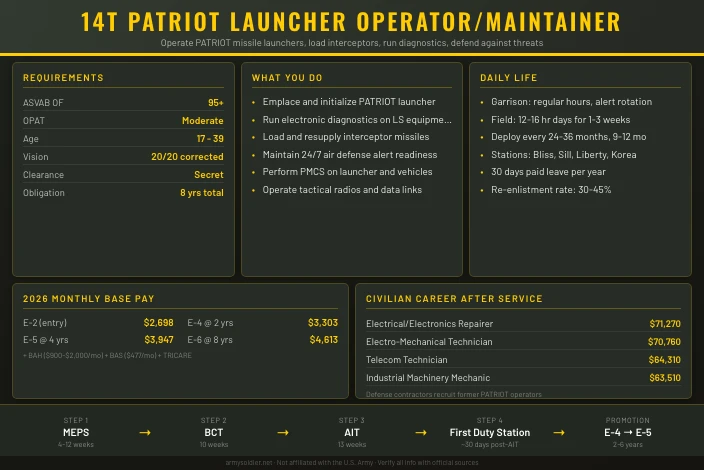
The 14T PATRIOT Launching Station Enhanced Operator/Maintainer operates and maintains the PATRIOT missile launching station. You emplace, initialize, and prepare the launcher for firing. You run electronic diagnostic checks on the system, handle interceptor missiles during resupply operations, and keep the launcher ready to engage enemy aircraft, cruise missiles, and ballistic missiles at all times.
Daily Tasks
Garrison days start with physical training, then shift to equipment maintenance. You run Preventive Maintenance Checks and Services (PMCS) on the launching station, inspect missile canisters, check hydraulic and electrical connections, and verify communications links between the launcher and the fire control system. Afternoons alternate between classroom training on system updates and hands-on drills.
Field training flips the routine. Your crew deploys the launcher to a tactical position, camouflages the site, and connects all cables and data links. Once the system is hot, you monitor it around the clock in shifts. When a simulated or real engagement order comes, you execute firing procedures within seconds. After the exercise, you march-order the equipment, convoy to a new position, and set up again.
During deployment, the pace stays high for weeks or months. PATRIOT batteries maintain 24/7 air defense coverage over critical assets. Your launcher must be ready to fire at any moment, which means constant monitoring, maintenance, and crew drills between engagements.
PATRIOT Weapon System
The PATRIOT (Phased Array Tracking Radar to Intercept of Target) system has four major components:
- Launching Station (LS) – holds up to four missile canisters and fires interceptors on command from the fire control system. This is the 14T’s primary equipment.
- Radar Set (AN/MPQ-65A) – tracks targets and guides missiles to intercept
- Engagement Control Station (ECS) – the command center where 14E operators manage engagements
- Antenna Mast Group (AMG) – provides communications between all system components
A typical PATRIOT battery has 6 to 8 launching stations spread across a tactical area. Each launcher operates semi-autonomously but receives firing commands from the ECS. Your crew is responsible for keeping your launcher functional and loaded so the battery can defend its coverage zone.
Specialized Roles and Identifiers
The 14T MOS progresses through four skill levels:
| Skill Level | MOSC | Role |
|---|---|---|
| Skill Level 1 | 14T1O | Operator: emplaces, initializes, and maintains the launching station; handles missile resupply |
| Skill Level 2 | 14T2O | Senior operator: supervises subordinates, provides technical guidance on maintenance |
| Skill Level 3 | 14T3O | Section supervisor: directs operations and organizational-level maintenance; manages tactical communications |
| Skill Level 4 | 14T4O | Master operator: certifies crews in air defense tables, develops maintenance programs, evaluates tactical procedures |
No ASIs or SQIs specific to 14T are currently published. Senior NCOs may qualify for broadening identifiers such as Master Fitness Trainer (ASI P5) or Battle Staff Operations (ASI 2S).
Mission Contribution
PATRIOT batteries are the Army’s primary defense against ballistic missiles, cruise missiles, and enemy aircraft. In recent conflicts, PATRIOT has intercepted dozens of incoming threats that would have killed soldiers and destroyed critical infrastructure. Your launcher is the weapon that actually fires. Without a crew keeping it loaded, maintained, and ready, the entire system is useless. The stakes do not get higher than shooting down an incoming ballistic missile headed for a populated area or a forward operating base.
Technology and Equipment
You work with some of the most advanced military hardware the Army fields. The launching station uses a hydraulic erection system, encrypted digital data links, and built-in test equipment for diagnostics. You operate specialized test sets to troubleshoot electrical and electronic faults at the organizational level.
Beyond the launcher, you handle PAC-2 GEM+ and PAC-3 MSE interceptor missiles during loading and resupply. Each missile canister weighs roughly 1,800 pounds and requires a forklift or crane for handling. You also operate military vehicles to tow and transport the launcher, and use tactical radios for crew communications.
Salary and Benefits
Financial Benefits
Military pay is set by rank and years of service. Most 14T soldiers enter as E-1 (Private) and promote to E-2 after completing Basic Combat Training.
| Rank | Pay Grade | Years of Service: 2 | Years of Service: 4 | Years of Service: 6 | Years of Service: 8 |
|---|---|---|---|---|---|
| Private (PV2) | E-2 | $2,698 | $2,698 | $2,698 | - |
| Specialist (SPC) | E-4 | $3,303 | $3,659 | $3,816 | $3,816 |
| Sergeant (SGT) | E-5 | $3,599 | $3,947 | $4,109 | $4,299 |
| Staff Sergeant (SSG) | E-6 | $3,743 | $4,069 | $4,236 | $4,613 |
Source: DFAS 2026 pay tables. Figures reflect the 2026 pay raise.
Tax-free allowances add significantly to your take-home pay. BAH (Basic Allowance for Housing) ranges from roughly $900 to $2,000+ per month for a single E-4, depending on your duty station. BAS (Basic Allowance for Subsistence) adds $477 per month for food. The Army periodically offers enlistment bonuses for 14T, with amounts up to $20,000 for a 6-year contract depending on qualification tier and recruiting needs. Bonus amounts change frequently, so confirm the current figure with your recruiter before signing.
Additional Benefits
TRICARE Prime covers you and your family at zero cost for active duty. That includes medical, dental, vision, prescriptions, mental health, and hospitalization. No premiums, no deductibles, no copays while you serve.
Education benefits include Tuition Assistance ($4,500 per year while serving) and the Post-9/11 GI Bill after separation. The GI Bill pays full in-state tuition at public schools for up to 36 months, plus a monthly housing allowance and $1,000 per year for books. You can transfer unused GI Bill benefits to your spouse or children after 6 years of service with a 4-year commitment.
The Blended Retirement System (BRS) combines a pension with TSP matching:
- Serve 20 years and receive 40% of your high-36 average basic pay as a pension
- The government contributes 1% automatically to your TSP and matches up to 4% more if you contribute 5%
- Continuation pay at 8-12 years of service provides a lump sum (typically 2.5x monthly basic pay for Army active component) in exchange for 3 more years
Work-Life Balance
You earn 30 days of paid leave per year. Garrison schedules typically run from 0600 PT to 1700 release, with occasional 24-hour CQ or staff duty shifts. Field exercises break that pattern with 12 to 16 hour days for 1 to 3 weeks at a stretch.
PATRIOT units maintain high readiness requirements, which can mean shorter notice for field deployments and more frequent certification exercises than some other MOSs. The trade-off is that garrison life between field rotations tends to be more predictable than combat arms jobs tied to maneuver units.
Qualifications and Eligibility
Basic Qualifications
You need a minimum score of 95 on the OF (Operators and Food) composite of the ASVAB. The OF line score combines four subtests: Verbal Expression (VE), Numerical Operations (NO), Auto and Shop Information (AS), and Mechanical Comprehension (MC). A 95 OF is moderate compared to technical MOSs but requires solid mechanical reasoning.
The OPAT (Occupational Physical Assessment Test) category is Moderate, which means you must pass the Moderate standard at MEPS before shipping to training. A Secret security clearance is required because PATRIOT operations involve classified engagement data and system capabilities.
| Requirement | Details |
|---|---|
| Age | 17-39 years old |
| Citizenship | U.S. citizen or permanent resident |
| Education | High school diploma or GED |
| AFQT (ASVAB) | Minimum 31 (diploma) or 50 (GED) |
| OF (Operators and Food) | Minimum 95 (VE + NO + AS + MC) |
| Security Clearance | Secret |
| OPAT Category | Moderate |
| Vision | Correctable to 20/20 |
| Color Vision | Must pass red/green color discrimination |
Application Process
Visit your local Army recruiting office and tell them you want 14T. The recruiter verifies your basic eligibility and schedules your MEPS appointment.
Selection Criteria and Competitiveness
The 14T is not the most competitive MOS. Air defense needs are growing as missile threats expand worldwide, so training slots are usually available. Higher ASVAB scores and a clean background give you more bargaining power for bonus packages and preferred ship dates.
No prior experience or certifications are required. Mechanical aptitude and comfort with electronics help in training, but the Army teaches everything from scratch.
Upon Accession into Service
You enter as E-1 (Private) and typically promote to E-2 after Basic Combat Training. Some soldiers arrive at their first unit as E-3 (PFC) with college credits or a referral bonus. The standard obligation is 8 years total: 3 to 6 years on active duty, with the remainder in the Individual Ready Reserve (IRR).
See our ASVAB study guide for strategies to hit these line scores, or take the PiCAT from home if you are a first-time tester.
Work Environment
Setting and Schedule
PATRIOT crews work in three distinct environments:
- Garrison – maintenance bays, motor pools, and battery operations centers. Regular duty hours with PT mornings and maintenance or training afternoons.
- Field training – tactical positions in remote areas where you emplace the launcher, maintain 24/7 air defense watch, and practice shoot-move-communicate cycles. Days run 12 to 16 hours.
- Deployment – forward positions protecting high-value assets. The schedule is driven by the threat. Alert status can mean sitting at the launcher for hours waiting for a missile warning that could come at any second.
Much of your work is outdoors. You emplace the launcher on open ground, run cables across terrain, and maintain equipment in heat, cold, rain, and dust. The launcher itself provides no crew shelter. When it rains, you get wet.
Leadership and Communication
Your chain of command runs through the battery (company-level unit). The launcher section chief (E-6) leads your crew. The platoon sergeant (E-7) manages multiple launcher sections. The battery commander (Captain) and First Sergeant own everything from training to discipline.
Tactical communication flows through encrypted data links between the launcher and the Engagement Control Station. Voice radio backs up digital links. Clear, fast communication is not optional. A delay in relaying a system fault or status change can leave a gap in air defense coverage.
Team Dynamics and Autonomy
A launcher crew is small, typically 3 to 4 soldiers. Every member has a defined role during emplacement, initialization, and resupply. The section chief directs operations, but each crew member must know the entire sequence well enough to step into any position.
Junior soldiers follow established procedures with little deviation. As you gain rank and experience, you earn more autonomy in diagnosing equipment problems, training subordinates, and making tactical decisions about launcher positioning and camouflage.
Job Satisfaction and Retention
Soldiers who stay in the 14T track talk about the satisfaction of protecting other service members and the intensity of live-fire exercises. The system works, and knowing you operate a weapon that has proven itself in combat adds weight to the job.
Common complaints center on repetitive maintenance cycles, long field exercises, and limited variety in daily tasks compared to other MOSs. Re-enlistment rates for air defense MOSs tend to fall between 30% and 45% after the first term. Bonuses and assignment incentives help close the gap.
Training and Skill Development
Initial Training
Training splits into two phases totaling about 23 weeks before you reach your first unit.
| Training Phase | Location | Duration | Focus |
|---|---|---|---|
| BCT | Fort Jackson, SC; Fort Moore, GA; Fort Leonard Wood, MO | 10 weeks | Basic soldier skills: marksmanship, land navigation, first aid, tactics, fitness |
| AIT | Fort Sill, OK (Fires Center of Excellence) | 13 weeks | PATRIOT launching station operations, electronic diagnostics, missile handling, maintenance procedures |
BCT is the same for every MOS. You learn to shoot, move, communicate, and survive as a soldier. Rifle qualification, hand grenade training, tactical movement, and the AFT are the major milestones.
AIT at Fort Sill puts you on actual PATRIOT equipment. The first weeks cover system theory: how the launcher communicates with the radar and fire control station, how interceptors guide to their targets, and how the electrical and hydraulic subsystems work. You learn the manual and automated procedures for emplacement, initialization, and march order.
The second half of AIT is hands-on. You run through emplacement drills until your crew can set up the launcher within tactical standards. You troubleshoot faults using built-in test equipment and specialized test sets. You practice missile resupply, loading canisters onto the launcher with forklifts and cranes. Safety procedures for handling live interceptors get repeated until they are automatic.
By graduation, you can operate the launcher through all modes, run basic diagnostics, perform organizational-level maintenance, and communicate with the fire control station over tactical data links.
Advanced Training
Your first year at your unit builds on AIT skills. You participate in crew certifications, section evaluations, and Air Defense Artillery Table exercises that test your crew’s ability to detect, track, and engage threats in realistic scenarios.
Strong performers can pursue additional training:
- Air Defense Master Gunner – advanced course for senior NCOs that produces the battery’s gunnery expert
- Warrior Leader Course – required for promotion to E-5; teaches leadership, counseling, and small-unit tactics
- Airborne School – open to soldiers in airborne-aligned air defense units
- Master Fitness Trainer (ASI P5) – certifies you to lead physical training programs
- Battle Staff Operations (ASI 2S) – for E-5 and above, covers operations center procedures
- Drill Sergeant School – a broadening assignment open to qualified NCOs
The Army also funds civilian education through Tuition Assistance. Many 14T soldiers earn college credits in electronics, engineering technology, or management during their enlistment.
Everything starts with qualifying ASVAB scores — our study guide covers what to study first.
Career Progression and Advancement
Career Path
Promotion to Specialist (E-4) comes around the 2-year mark if you meet time-in-service and time-in-grade requirements. Sergeant (E-5) requires a promotion board and competition. At E-5, your focus shifts from operating equipment to leading and training a crew.
| Rank | Pay Grade | Typical Years | Typical Role |
|---|---|---|---|
| Private (PV2) | E-2 | 0-1 | AIT graduate, launcher operator |
| Private First Class (PFC) | E-3 | 1-2 | Experienced operator, assists with maintenance |
| Specialist (SPC) | E-4 | 2-3 | Senior operator, leads resupply operations |
| Sergeant (SGT) | E-5 | 4-6 | Crew chief, trains and certifies junior soldiers |
| Staff Sergeant (SSG) | E-6 | 6-9 | Launcher section chief, tactical employment expert |
| Sergeant First Class (SFC) | E-7 | 9-12 | Platoon sergeant, battery operations |
| Master Sergeant (MSG) | E-8 | 12+ | Battery operations sergeant, battalion staff |
| Sergeant Major (SGM) | E-9 | 18+ | Senior enlisted advisor |
At E-6, NCOs compete for key positions as launcher section chiefs and platoon sergeants. Performance evaluations during these assignments carry the most weight for advancement to E-7 and beyond. Senior 14T soldiers may transition to the 14Z (Air Defense Artillery Senior Sergeant) designation at the E-8 and E-9 levels, which covers leadership across all ADA specialties.
Role Flexibility and Transfers
Lateral moves within CMF 14 are the easiest path. Common transitions include 14E (PATRIOT Fire Control Enhanced Operator), 14G (Air Defense Battle Management System Operator), or 14P (Air and Missile Defense Crewmember). Since you already understand the PATRIOT system, moving to 14E is a natural step that broadens your skill set.
Transferring outside CMF 14 requires completing the new MOS’s AIT and accepting a new service obligation. Soldiers with strong NCOERs and leadership recommendations get more options.
Performance Evaluation
NCOs receive annual NCOERs rated by their immediate supervisor and reviewed by their senior rater. The evaluation covers leadership, training results, technical competence, and character. A “Most Qualified” or equivalent top rating on your NCOER is the single biggest factor in getting promoted to E-6 and above.
What stands out: running a crew that passes every certification table on the first attempt, maintaining equipment readiness above 90%, mentoring soldiers who earn promotion, and volunteering for tough assignments. Those behaviors build the evaluations that drive careers.
Physical Demands and Medical Evaluations
Physical Requirements
The 14T carries a Moderate OPAT rating, but the actual physical demands are real. Launcher emplacement requires connecting heavy cables, manually leveling outriggers, and wrestling missile canisters during resupply. Individual canister assemblies weigh roughly 1,800 pounds and require mechanical assistance, but plenty of physical effort goes into positioning, securing, and connecting them.
Field exercises mean long hours on your feet, carrying equipment across uneven terrain, digging hasty fighting positions around the launcher, and stretching camouflage netting over a system that stands nearly 10 feet tall. Body armor and a weapon add weight to everything you do.
Every soldier takes the Army Fitness Test (AFT) at least once per year. The 14T falls under the general standard (not the combat specialty standard). Minimums for the 17-21 age group under the general standard:
| Event | General Minimum (60 pts) |
|---|---|
| 3-Rep Max Deadlift (MDL) | 140 lbs |
| Hand-Release Push-Up (HRP) | 10 reps |
| Sprint-Drag-Carry (SDC) | 2:36 |
| Plank (PLK) | 1:00 |
| Two-Mile Run (2MR) | 21:00 |
Each event scores 0 to 100. You need at least 60 per event and 300 total. The general standard is sex- and age-normed. Meeting the minimum keeps you in the Army. Scoring well above it puts you ahead of your peers for promotion and school slots.
Medical Evaluations
After entry, you complete an annual Periodic Health Assessment: weight, blood pressure, vision, hearing, dental, and a provider review. Deployable status requires a separate screening before each overseas rotation.
Hearing protection matters in the PATRIOT world. The launcher generates significant noise during missile firings, and proximity to generators and heavy vehicles adds cumulative exposure. Annual audiograms track your hearing health. Color vision must remain adequate throughout your career because equipment indicators and wiring use color-coded systems.
Deployment and Duty Stations
Deployment Details
PATRIOT batteries deploy on rotational cycles to provide air and missile defense coverage for combatant commanders. The target rotation is 9 to 12 months deployed for every 24 to 36 months at home station, but high demand for air defense has compressed that ratio in recent years. PATRIOT units have been among the most frequently deployed systems in the Army since the early 2000s.
Current and recent deployment regions include:
- Middle East – Kuwait, Qatar, Saudi Arabia, Jordan, Iraq
- Europe – Poland, Germany, Romania (NATO air defense rotations)
- Pacific – South Korea, Guam
- Global – wherever the combatant commander needs missile defense coverage
Deployed PATRIOT crews maintain around-the-clock alert status. Your launcher must be ready to fire within seconds of receiving an engagement order. Even in “low-threat” environments, crews run training engagements and maintain full operational readiness.
Location Flexibility
The Army assigns duty stations based on unit needs. You can list preferences, but there are no guarantees. Common installations for PATRIOT soldiers:
CONUS:
- Fort Bliss, TX (home to the 11th ADA Brigade and the 32nd Army Air and Missile Defense Command)
- Fort Sill, OK (Fires Center of Excellence, training base)
- Fort Liberty, NC
- Fort Stewart, GA
- Fort Campbell, KY
- Fort Carson, CO
OCONUS:
- South Korea (rotational air defense mission)
- Germany (NATO-aligned units)
- Wherever PATRIOT batteries deploy on 9-month rotations
Expect to PCS (move) every 2 to 4 years. Overseas accompanied tours run 2 to 3 years. Unaccompanied tours like Korea last about 1 year.
Risk, Safety, and Legal Considerations
Job Hazards
PATRIOT operations carry specific risks in both training and combat.
In garrison and field training:
- Crush and pinch injuries during emplacement from outriggers, cables, and launcher components
- Electrical shock from high-voltage systems inside the launching station
- Burns from hydraulic fluid leaks under pressure
- Vehicle accidents during convoy movements with heavy equipment
- Falls from the launcher platform during maintenance
In deployed environments:
- Counter-fire from enemy missiles, rockets, or artillery targeting your position
- IEDs during convoy movements between positions
- Small arms and drone attacks on air defense sites
- Exposure to extreme heat, dust, and austere living conditions
Safety Protocols
Every training event follows established safety procedures. Emplacement drills include checklists for grounding electrical systems, inspecting hydraulic lines, and verifying mechanical locks before crew members work near moving components. Ammunition handling during missile resupply follows strict load plans with designated safety observers.
Personal protective equipment includes hearing protection near the launcher and generators, gloves for cable handling, and body armor in tactical environments. After missile firings, crews inspect the launcher for blast damage and verify all systems before reloading.
Security and Legal Requirements
The Secret clearance required for 14T involves a background investigation that covers criminal history, financial records, and foreign contacts. The process starts at MEPS and can take several months to complete. An interim Secret clearance, granted by the Central Clearance Facility, allows you to begin training while the full investigation runs.
All soldiers serve under the Uniform Code of Military Justice (UCMJ). PATRIOT crews follow specific rules of engagement that govern when and how the system can fire. Air defense engagements happen fast, but every interceptor launch goes through an authorization chain. Accidental engagement of friendly or civilian aircraft is a constant training focus.
Impact on Family and Personal Life
Family Considerations
PATRIOT units deploy frequently and maintain high readiness standards at home station. Monthly field exercises typically run 3 to 7 days. Certification events and gunnery qualifications can extend to 2 to 3 weeks. Add a 9-month deployment every couple of years, and time away from family adds up fast.
Alert duty is another factor. Some PATRIOT units maintain real-world alert status even at CONUS installations, meaning you can be recalled to the battery at any hour. That unpredictability wears on families.
Support resources available at most installations:
- Family Readiness Groups (FRGs) – battery-level peer support for spouses and families
- Military OneSource – free counseling, financial planning, and relocation services
- Army Community Service (ACS) – employment help, crisis support, and transition assistance
- Exceptional Family Member Program (EFMP) – support for dependents with special medical or educational needs
Relocation and Flexibility
You will move. After AIT at Fort Sill, you go where the Army sends you. After that, PCS moves happen every 2 to 4 years. The Army covers moving costs, but each relocation disrupts your spouse’s job, your children’s schools, and your social network.
Fort Bliss is the largest concentration of PATRIOT units in CONUS and offers extended tour options that can reduce the number of PCS moves. Soldiers with strong performance records have slightly more influence over assignment preferences, but the Army’s needs always come first.
Reserve and National Guard
Component Availability
The 14T MOS is available in both the Army Reserve and Army National Guard, but only in units with Patriot missile systems. 14T soldiers work alongside 14E fire control operators in Patriot batteries. Several Guard states maintain Patriot battalions, and some Reserve ADA units carry 14T positions. Your options depend on whether a Patriot unit exists near you.
Drill Schedule and Training Commitment
Standard commitment is one weekend per month plus two weeks of Annual Training. Patriot launcher operators face extra training demands because system certifications and crew qualifications require regular hands-on practice. Annual Training typically involves full system deployment at a training center, including launcher setup, loading operations, and crew drills. Some units schedule additional weekends for certification tables, especially before deployment rotations.
Part-Time Pay
An E-4 with about three years of service earns roughly $422 per drill weekend in 2026. Over 12 weekends, that totals about $5,064. Annual Training adds approximately $1,583. Extra paid training days can push annual military income above the standard, especially before gunnery qualifications. Active-duty E-4 base pay is $3,166 per month.
Benefits Differences
Reserve and Guard 14T soldiers receive Tricare Reserve Select instead of free active-duty TRICARE. TRS costs $57.88 per month for member-only coverage or $286.66 for member plus family in 2026.
Education benefits include:
- Federal Tuition Assistance: $4,500 per year for drilling members
- MGIB-SR: roughly $416 per month while enrolled
- Post-9/11 GI Bill: requires 90 or more days of federal activation
- State tuition waivers (Guard only): vary by state, some cover full tuition at state schools
Retirement follows the points-based system. Pension draws at age 60, reducible by qualifying mobilizations down to age 50. TSP matching up to 5% applies under the Blended Retirement System.
Deployment and Mobilization
Patriot units deploy frequently. Reserve and Guard 14T soldiers face a moderate to high mobilization rate as Patriot batteries rotate through the Middle East, Europe, and the Pacific. Mobilizations typically last 9 to 12 months. This MOS carries one of the higher deployment tempos in the Reserve and Guard air defense community, similar to the 14E experience.
Civilian Career Integration
The 14T skill set translates to mechanical and electrical maintenance, missile and weapons systems work, and defense contracting. Companies that build and service Patriot and similar systems value hands-on launcher experience. Mechanical technician and heavy equipment maintenance roles in civilian industry are also a good fit. USERRA protects your civilian job during mobilization, and your employer must hold your position until you return.
| Feature | Active Duty | Army Reserve | Army National Guard |
|---|---|---|---|
| Commitment | Full-time | One weekend/month + 2 weeks/year | One weekend/month + 2 weeks/year |
| Monthly Pay (E-4, ~3 yrs) | $3,166/month | ~$422/drill weekend | ~$422/drill weekend |
| Healthcare | TRICARE, $0 premiums | TRS, $57.88/month (member) | TRS, $57.88/month (member) |
| Education | TA + Post-9/11 GI Bill | Federal TA, MGIB-SR; Post-9/11 after activation | Federal TA, MGIB-SR, state tuition waivers |
| Deployment | Regular rotation every 1-2 years | Mobilization every 2-4 years | Mobilization every 2-4 years |
| Retirement | BRS pension at 20 years | Points-based, age 60 | Points-based, age 60 |
Post-Service Opportunities
Transition to Civilian Life
The PATRIOT system has no civilian equivalent. Nobody hires you to launch interceptor missiles. But the technical skills you build transfer in meaningful ways.
You learn electronic troubleshooting, hydraulic system maintenance, and complex equipment diagnostics using sophisticated test equipment. You work with encrypted communications systems and digital data networks. You lead small teams responsible for multi-million-dollar equipment in high-pressure environments. Defense contractors, aerospace companies, and industrial manufacturers value all of that.
The Transition Assistance Program (TAP) provides resume building, interview coaching, and benefits counseling during your last year on active duty. The Post-9/11 GI Bill covers up to 36 months of tuition at public universities plus a housing allowance and book stipend.
Civilian Career Prospects
Here are common post-service career paths for former PATRIOT launching station operators:
| Civilian Job | Median Annual Salary (2024) | 10-Year Outlook |
|---|---|---|
| Electrical/Electronics Installers and Repairers | $71,270 | Little or no change |
| Electro-Mechanical Technician | $70,760 | +1% |
| Telecommunications Technician | $64,310 | -3% |
| Industrial Machinery Mechanic | $63,510 | +13% |
Defense contractors like Lockheed Martin (the PATRIOT system manufacturer), Raytheon, and Northrop Grumman actively recruit former PATRIOT soldiers for field service representative positions. These jobs pay well above the BLS medians listed above and often include overseas travel to support allied nations operating PATRIOT systems.
Is This a Good Job for You? The Right (and Wrong) Fit
Ideal Candidate Profile
The best 14T soldiers combine mechanical aptitude with patience and discipline.
Traits that predict success:
- Comfortable working with electronic and mechanical systems
- Calm under pressure, even when an alert sounds at 0300
- Detail-oriented enough to follow complex checklists without skipping steps
- Team player who takes accountability for their piece of the system
- Interested in missile systems, aerospace, or defense technology
If you want a job where what you do directly saves lives, and you can handle the repetitive maintenance that makes those moments possible, the 14T fits.
Potential Challenges
This MOS may not suit you if you:
- Want constant variety in your daily tasks
- Prefer working independently without structured procedures
- Dislike outdoor work in extreme weather with minimal shelter
- Cannot handle long stretches of waiting interrupted by sudden high-intensity action
- Need a predictable schedule with weekends reliably off
The maintenance-to-action ratio is lopsided. You spend far more time maintaining equipment and running drills than actually firing missiles. Soldiers who cannot find motivation in readiness work burn out quickly.
Career and Lifestyle Alignment
The 14T works best for soldiers who think in terms of systems. You get to operate a weapon that has knocked down real ballistic missiles in real combat. That means something. But day-to-day, this is a maintenance and readiness job with moments of intense action.
For a first enlistment, the 14T gives you a Secret clearance, technical skills in electronics and hydraulics, and experience with a weapons system that defense contractors compete to hire former operators for. Soldiers who plan ahead by using Tuition Assistance and the GI Bill come out positioned for strong careers in defense, aerospace, or industrial maintenance.
If you just want to push a button and watch missiles fly, reality will disappoint you. If you want to master a complex system, lead a crew, and know that your readiness could be the difference between life and death for thousands of people, the 14T delivers.
More Information
Talk to an Army recruiter about the 14T. Ask about current bonus amounts, training dates, and duty station options. If possible, request to speak with a soldier currently serving in a PATRIOT battery.
Take the MOS finder quiz at goarmy.com
Schedule an ASVAB at your nearest MEPS to check your OF line score
Visit Fort Sill’s ADA AIT page for details on the 14T training pipeline
Prepare for the ASVAB with our study guide to make sure your line scores qualify
This site is not affiliated with the U.S. Army or any government agency. Verify all information with official Army sources before making enlistment or career decisions.
Explore more Army artillery and air defense careers such as 13B Cannon Crewmember and 13F Fire Support Specialist.