15B Aircraft Powerplant Repairer
Every Army helicopter and fixed-wing aircraft runs on turbine engines. The 15B Aircraft Powerplant Repairer is the soldier who keeps those engines running. You tear down turboshaft and turboprop powerplants, diagnose failures, replace parts, and clear engines to fly. If the engine quits mid-flight, someone failed at your job. That weight follows you into the hangar every morning and keeps you precise.
Qualifying requires specific ASVAB line scores — our ASVAB study guide covers what to target and how to prepare.
Job Role and Responsibilities
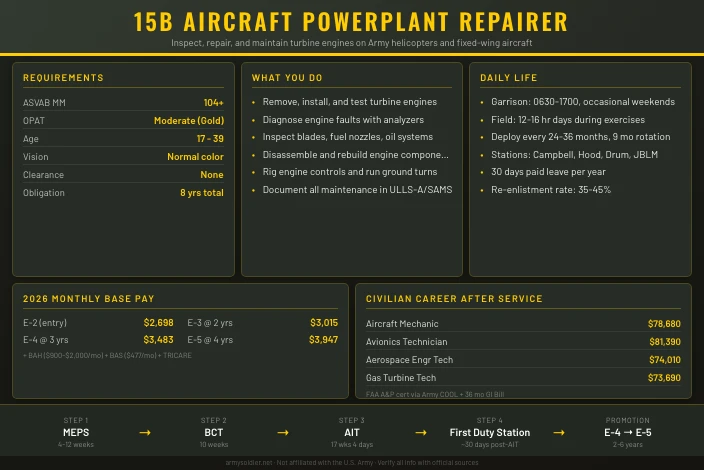
You inspect, troubleshoot, repair, and maintain aircraft turbine engines and their components. Your work covers engine removal and installation, diagnostic testing, component disassembly and reassembly, and fuel/oil system servicing. When an engine comes back from a mission with a fault, you find the problem and fix it before the aircraft flies again.
A garrison day usually starts at the maintenance board. Your section sergeant hands out the day’s tasks based on which aircraft are due for scheduled maintenance and which ones came back with write-ups. You grab the technical manual, a set of common and specialty tools, and head to the flight line or hangar.
Scheduled maintenance drives most of your time. Phase inspections on engines happen at set hour intervals. You pull cowlings, inspect turbine blades for erosion and cracks, check oil filters for metal contamination, test fuel nozzle spray patterns, and verify that engine mounts and vibration dampeners are within tolerance. Every finding goes into the Army’s maintenance tracking system.
Unscheduled work fills the gaps. A pilot reports a power loss on one engine during flight. You run a diagnostic with the engine analyzer, pull the compressor section, find a damaged blade, order the replacement, install it, and run a ground turn to verify the fix. Some jobs take a few hours. Others take days when parts are backordered or the root cause hides behind multiple symptoms.
Specific Roles
The 15B is the base MOS for aircraft powerplant maintenance. Specialization comes through Additional Skill Identifiers (ASIs) as you gain experience on specific engine platforms:
| Identifier | Description |
|---|---|
| MOS 15B | Aircraft Powerplant Repairer (all turbine engines) |
| ASI varies | Platform-specific identifiers assigned based on airframe/engine qualification |
The Army assigns 15B soldiers to work on T700 (Black Hawk, Apache), T55 (Chinook), and T53 (Huey/Kiowa) engine families depending on the unit’s aircraft. You specialize by gaining hands-on time with a specific engine family at your duty station.
Mission Contribution
Helicopters don’t fly without working engines. Medical evacuation, air assault, cargo resupply, reconnaissance, and special operations support all depend on powerplant reliability. A single engine failure grounds an aircraft for days or weeks. Multiply that across a fleet, and maintenance backlogs can cripple a brigade’s air operations. Your technical skill directly controls whether aviation units meet their mission timelines.
Technology and Equipment
You work with turboshaft engines rated from 1,400 to 4,800 shaft horsepower depending on the platform. The T700-GE-701D on the Black Hawk and Apache is the most common engine in the Army fleet. The T55-GA-714A powers the Chinook.
Daily tools include torque wrenches, borescopes for internal turbine inspections, engine analyzers and vibration diagnostic equipment, dial indicators, micrometers, and specialized fixtures for engine stand work. You use the Standard Army Maintenance System (SAMS) and Unit Level Logistics System-Aviation (ULLS-A) to track maintenance actions, order parts, and document faults.
Salary and Benefits
Financial Benefits
Military pay follows a standard scale based on rank and years of service. Most 15B soldiers enter at E-1 or E-2 and promote to E-4 within 2 to 3 years.
| Rank | Pay Grade | Years of Service | Monthly Base Pay (2026) |
|---|---|---|---|
| Private (PV2) | E-2 | < 2 | $2,698 |
| Private First Class (PFC) | E-3 | 2 | $3,015 |
| Specialist (SPC) | E-4 | 3 | $3,483 |
| Sergeant (SGT) | E-5 | 4 | $3,947 |
| Staff Sergeant (SSG) | E-6 | 8 | $4,613 |
Base pay is one piece. Basic Allowance for Housing (BAH) adds $900 to $2,000+ per month depending on duty station and dependency status. Basic Allowance for Sustenance (BAS) adds $476.95 per month for food. Enlistment bonuses for 15B change frequently – ask your recruiter about current offers before committing.
Additional Benefits
TRICARE provides full medical, dental, vision, and mental health coverage at zero cost for active-duty soldiers and their families. No premiums, no deductibles, no copays.
Tuition Assistance covers up to $4,500 per year for college courses while you serve. After separation, the Post-9/11 GI Bill pays full in-state tuition at public universities plus a monthly housing allowance and $1,000 annual book stipend for up to 36 months. The private school cap is $29,920.95 per academic year.
Retirement runs through the Blended Retirement System (BRS):
- Pension at 20 years: 40% of your high-36 average basic pay
- TSP matching: the government contributes up to 5% of your basic pay if you contribute at least 5%
- Continuation pay: a lump-sum bonus between years 8 and 12 for additional service commitment
Work-Life Balance
You earn 30 days of paid leave per year plus 11 federal holidays. Garrison schedules run roughly 0630 to 1700 most days. That schedule breaks down before major training exercises and during deployments, when 12- to 16-hour days become the norm until every engine on the flight line is mission-ready.
Qualifications and Eligibility
Basic Qualifications
The 15B requires a Mechanical Maintenance (MM) composite score of 104 on the ASVAB. The MM composite adds Numerical Operations, Auto and Shop Information, Mechanical Comprehension, and Electronics Information. That score sits in the moderate-to-competitive range for enlisted technical MOSs.
Normal color vision is required. Turbine engine maintenance involves color-coded wiring, fluid-level indicators, and safety markings. Red-green color deficiency is disqualifying without a waiver.
| Requirement | Details |
|---|---|
| Age | 17-39 (up to 42 with waiver) |
| Citizenship | U.S. citizen or permanent resident |
| Education | High school diploma or GED |
| AFQT (ASVAB) | Minimum 31 (diploma) or 50 (GED) |
| Mechanical Maintenance (MM) | Minimum 104 |
| OPAT Category | Moderate (Gold) |
| Vision | Normal color vision required |
| Security Clearance | None required |
Application Process
Start at a local Army recruiting station. Your recruiter reviews your qualifications, walks through the 15B MOS, and helps you choose between Active Duty, Reserve, or National Guard components.
MEPS (Military Entrance Processing Station) is the next step. You take the ASVAB if you haven’t already, complete a full medical exam, and go through background screening. If your MM score meets the 104 threshold and your medical results clear, your recruiter reserves a 15B training slot.
Selection Criteria and Competitiveness
The 15B is a steady-demand MOS. Army aviation units need powerplant mechanics across every installation that operates rotary-wing aircraft. Training slots open regularly throughout the year. Scoring above the 104 MM minimum helps if multiple recruits compete for the same ship date. Mechanical aptitude or prior experience working on engines strengthens your application but is not required.
Upon Accession into Service
Most recruits enter at E-1 (Private). Promotion to E-2 happens after Basic Combat Training. College credits, JROTC service, or referral bonuses can bump your entry grade to E-2 or E-3. The standard service obligation is 8 years total, split between active duty (typically 3 to 6 years) and the Individual Ready Reserve for the remainder.
See our ASVAB study guide for strategies to hit these line scores, or take the PiCAT from home if you are a first-time tester.
Work Environment
Setting and Schedule
Your work splits between the hangar and the flight line.
Flight line: Outdoors in whatever conditions the installation delivers. You perform pre-flight engine checks, post-flight inspections, and quick-turn maintenance between missions. Summer heat on a concrete ramp at Fort Hood radiates up from below while the sun hammers from above. Winter maintenance at Fort Drum means frozen fingers on cold metal tools.
Hangar: Larger engine removals, teardowns, and component replacements happen inside. Hangars have engine stands, overhead cranes, parts racks, and (at some installations) climate control. This is where you do detailed diagnostic work, reassemble engines after overhaul, and run test cells on rebuilt powerplants.
Garrison hours run 0630 to 1700 on most days with a lunch break. Expect occasional weekend duty when aircraft need to be ready for Monday flights. Field exercises and deployment push daily hours to 12 or more.
Leadership and Communication
Your chain of command runs through a section sergeant (E-5 or E-6), a platoon sergeant (E-7), and a maintenance officer (Warrant Officer or Captain). Technical guidance flows from the unit’s technical inspector, a senior NCO who signs off on completed engine work before an aircraft returns to flyable status.
Monthly counseling sessions give junior soldiers formal feedback. The aviation maintenance world tracks metrics closely – engine turn time, parts on order, fault completion rates – so performance shows up in numbers before it appears on a counseling form.
Team Dynamics and Autonomy
Engine work is rarely a solo job. Removing a T700 from a Black Hawk requires at least two soldiers coordinating with hoists, stands, and safety wires. You rely on your partner to hold, guide, and torque while you work.
Troubleshooting is the exception. When an engine has an intermittent fault, you follow the technical manual’s fault isolation procedure on your own, testing components and tracing systems. Your findings go to the section sergeant for review, but the initial diagnosis belongs to you.
Job Satisfaction and Retention
Soldiers who like solving mechanical puzzles and working with their hands tend to stay in the 15B field. Watching a helicopter lift off on an engine you rebuilt is a concrete payoff most desk jobs never provide. The main frustrations are parts shortages, long hours before field rotations, and the paperwork tied to every maintenance action.
First-term re-enlistment rates for CMF 15 aviation maintenance MOSs typically fall between 35% and 45%. Many who leave take their engine skills into civilian aviation jobs paying $70,000 or more within a few years.
Training and Skill Development
Initial Training
The 15B training pipeline has two phases: Basic Combat Training (BCT) and Advanced Individual Training (AIT).
| Phase | Location | Duration | Focus |
|---|---|---|---|
| BCT | Fort Jackson, SC; Fort Moore, GA; or Fort Leonard Wood, MO | 10 weeks | Soldiering basics: marksmanship, tactics, fitness, discipline |
| AIT | Fort Eustis, VA (Joint Base Langley-Eustis) | 17 weeks, 4 days | Turbine engine theory, disassembly, repair, diagnostics, and testing |
BCT turns you into a soldier. Rifle qualification, land navigation, first aid, squad movements, and physical conditioning. Every MOS goes through this phase.
AIT at the 128th Aviation Brigade turns you into a turbine engine mechanic. The course covers gas turbine theory, engine removal and installation, compressor and turbine section teardown, fuel control and governor adjustments, oil system servicing, and engine run procedures. You train on actual engines and test cells, not just classroom models.
The curriculum mixes classroom instruction with hands-on lab work. Written tests cover technical manual procedures and thermodynamic principles. Practical exams require you to perform specific maintenance tasks within time limits. A 5-day situational training exercise near the end of AIT puts your skills to the test under simulated field conditions.
Fail a block and you recycle through it. The Army does not graduate powerplant mechanics who cannot safely work on flight-critical systems.
Advanced Training
Training continues at your first duty station. You complete a series of task evaluations on the specific engine family your unit operates (T700, T55, or others) to earn full qualification.
From there, several paths open:
- Technical Inspector (TI): Senior 15B soldiers (E-6+) can qualify to sign off on all powerplant maintenance before an aircraft returns to service. This is the quality gate role in aviation maintenance.
- 160th SOAR (Night Stalkers): The Army’s special operations aviation regiment at Fort Campbell recruits experienced aviation mechanics. Selection is competitive, the tempo is high, and the engine platforms include variants not found in conventional units.
- Warrant Officer path: Strong 15B soldiers can apply for Warrant Officer Candidate School and become 151A Aviation Maintenance Technicians, managing unit-level maintenance programs.
- FAA A&P certification: The Army COOL program funds prep courses and exam fees for the FAA Airframe and Powerplant certificate. Your military turbine engine experience counts toward the FAA’s 30-month practical experience requirement, giving you a direct path to civilian certification while still serving.
Everything starts with qualifying ASVAB scores — our study guide covers what to study first.
Career Progression and Advancement
Career Path
Junior rank promotions are largely automatic based on time in service. E-5 and above require promotion board appearances, points, and strong evaluations.
| Rank | Pay Grade | Typical Years | Typical Role |
|---|---|---|---|
| Private (PV2) | E-2 | 0-1 | AIT graduate, basic engine tasks under supervision |
| Private First Class (PFC) | E-3 | 1-2 | Qualified mechanic, assigned to engine maintenance section |
| Specialist (SPC) | E-4 | 2-3 | Experienced mechanic, leads small engine tasks |
| Sergeant (SGT) | E-5 | 4-6 | Section leader, supervises junior powerplant mechanics |
| Staff Sergeant (SSG) | E-6 | 6-10 | Technical inspector, platoon sergeant |
| Sergeant First Class (SFC) | E-7 | 10-14 | Merges into 15K Aircraft Components Repair Supervisor |
| Master Sergeant (MSG) | E-8 | 14+ | Senior maintenance leadership, transitions to 15Z |
At E-7, the 15B merges into MOS 15K (Aircraft Components Repair Supervisor). The 15K oversees powerplant, powertrain, pneudraulics, structural, and avionics maintenance across a battalion. You manage scheduling, parts, personnel, and production timelines for all aviation repair shops. At E-8 and E-9, the career converges into 15Z (Aircraft Senior Sergeant), the top enlisted aviation maintenance leadership position.
Role Flexibility and Transfers
Lateral moves within CMF 15 are the most common path. The 15D (Aircraft Powertrain Repairer), 15H (Aircraft Pneudraulics Repairer), and 15F (Aircraft Electrician) share enough technical overlap that cross-training is realistic with additional schooling. Moves outside the aviation field require complete retraining and a new service commitment.
The Warrant Officer track is the biggest career leap for 15B soldiers. Becoming a 151A Aviation Maintenance Technician requires Warrant Officer Candidate School at Fort Novosel, Alabama, plus additional technical certification courses.
Performance Evaluation
NCOs receive annual NCOERs (NCO Evaluation Reports) rated by their immediate supervisor and senior rater. The reports measure technical competence, leadership, training of subordinates, and character. Consistent top-block ratings are what separate the E-6 who makes SFC from those who get passed over.
In aviation maintenance, what gets you noticed is concrete: low engine fault recurrence rates, clean maintenance documentation, catching problems during inspections that other mechanics missed, and keeping your section’s aircraft availability numbers high. Aviation commanders track readiness metrics daily. Mechanics who keep engines turning earn their reputations through output, not politics.
Physical Demands and Medical Evaluations
Physical Requirements
Turbine engines and their components are heavy. You regularly lift 40- to 70-pound parts, hold awkward positions inside engine bays, and work overhead with heavy tools. Removing a T700 engine from a Black Hawk involves hoisting roughly 500 pounds on a maintenance stand, guiding it out with hand pressure, and maneuvering it to a workbench. That requires both strength and careful coordination with your team.
The OPAT (Occupational Physical Assessment Test) category for 15B is Moderate (Gold), which requires:
- Standing Long Jump: 120 cm
- Seated Power Throw: 350 cm
- Strength Deadlift: 120 lbs
- Interval Aerobic Run: Stage 5 (shuttles)
Every soldier takes the Army Fitness Test (AFT) at least once per year. Minimum standards for the 17-21 age group:
| Event | Male Minimum | Female Minimum |
|---|---|---|
| 3-Rep Max Deadlift (MDL) | 140 lbs | 80 lbs |
| Hand-Release Push-Up (HRP) | 10 reps | 10 reps |
| Sprint-Drag-Carry (SDC) | 2:40 | 3:40 |
| Plank (PLK) | 2:00 | 2:00 |
| Two-Mile Run (2MR) | 15:54 | 18:54 |
Each event scores 0 to 100. You need at least 60 per event and 300 total to pass under the general standard. The 15B falls under the general standard, not the 350-point combat MOS standard.
Medical Evaluations
Annual physicals cover weight, blood pressure, vision, and hearing. Normal color vision must be confirmed on every periodic exam. Losing color discrimination means you cannot work on aircraft wiring or fluid-coded systems without a waiver, and waivers are not guaranteed.
Soldiers who qualify as crew members for maintenance test flights undergo more thorough flight physicals, including an EKG and audiogram.
Deployment and Duty Stations
Deployment Details
Wherever Army helicopters go, powerplant mechanics follow. Active-duty aviation units typically deploy on 9-month rotations every 24 to 36 months. Units in rapid-deployment divisions like the 101st Airborne (Air Assault) and 82nd Airborne may deploy with less notice.
Deployed 15B soldiers work in expeditionary maintenance hangars, portable engine test cells, and open-air repair points. The operational tempo increases sharply – engines accumulate flight hours faster in a combat zone, which compresses maintenance intervals. Expect 12- to 16-hour workdays during the first weeks of a deployment as the fleet adjusts to the new operational rhythm.
Location Flexibility
Duty station assignments come from Human Resources Command based on the needs of the Army. You can request a preferred installation through your assignment manager, but the Army fills vacancies where they exist. Aviation-heavy installations with frequent 15B billets include:
- Fort Campbell, KY (101st Airborne Division)
- Fort Hood, TX (1st Cavalry Division, III Corps aviation)
- Fort Drum, NY (10th Mountain Division)
- Joint Base Lewis-McChord, WA (I Corps aviation)
- Hunter Army Airfield, GA (3rd Infantry Division aviation)
- Fort Novosel, AL (Army aviation training center)
Overseas assignments to Germany, South Korea, Japan, and Italy are possible, depending on unit rotations and force structure changes.
Risk, Safety, and Legal Considerations
Job Hazards
Turbine engines operate at temperatures exceeding 1,000 degrees Fahrenheit and spin at tens of thousands of RPM. Working near running engines means exposure to extreme heat, loud noise, and high-velocity exhaust. Engine components contain hazardous materials including turbine oils, hydraulic fluid, and cleaning solvents.
Dropped components, pinch points on heavy fixtures, and foreign object debris (FOD) that can damage engines or injure personnel are daily risks. Aviation maintenance has a zero-tolerance FOD culture because a loose bolt or washer sucked into an intake can destroy a million-dollar engine.
Safety Protocols
The Army’s aviation safety program is one of the most structured in the military. Every maintenance action follows a technical manual procedure step by step. Two-person integrity rules apply to all flight-critical tasks – one person performs the work while another verifies each step.
Personal protective equipment (PPE) includes hearing protection (double protection near running engines), safety glasses, gloves rated for the task, and steel-toed boots. Engine test cells have blast barriers and emergency shutdown systems.
Safety stand-downs happen quarterly. Units review recent incidents across the Army and identify hazards specific to their maintenance operations.
Security and Legal Requirements
The 15B does not require a security clearance. Some specialized assignments (160th SOAR, for example) may require a Secret clearance, but that process happens after selection – not during initial enlistment.
Your legal obligations include your service contract (typically 3 to 6 years active, 8 years total), compliance with the Uniform Code of Military Justice (UCMJ), and accountability for government property. Every tool and part you use is tracked by serial number. Losing a tool on an aircraft requires a complete search before that bird flies.
Impact on Family and Personal Life
Family Considerations
The 15B schedule during garrison is predictable enough for a family routine. Most days end by 1700. Weekends are usually free unless your section pulls duty or an aircraft needs emergency work.
Deployments break that stability. Nine months away from home is hard on marriages, kids, and relationships. The Army provides resources to help: Army Community Service (ACS) offers family readiness groups, counseling, financial planning, and child care assistance. Chaplains and Military Family Life Consultants are available at every installation.
Single soldiers face a different set of trade-offs. The barracks life at an aviation installation is functional but basic. Most soldiers move off-post after making E-5 or getting married, at which point BAH covers most or all of the local rent.
Relocation and Flexibility
PCS (Permanent Change of Station) moves happen every 2 to 4 years for active-duty soldiers. The Army pays for the move and provides temporary housing allowances. You can request a specific installation during re-enlistment negotiations, though approval depends on the Army’s needs.
The Army Reserve and National Guard components offer more geographic stability. You drill one weekend per month and two weeks per year at your local aviation unit, keeping your civilian job and home base intact. The trade-off is slower promotion and less hands-on engine time compared to active duty.
Reserve and National Guard
The 15B MOS is available in both the Army Reserve and the Army National Guard. Guard units in particular have a strong aviation presence, with aviation battalions spread across many states. Both components offer full access to the 15B skill set. Skill-level ceilings in the Reserve and Guard are the same as active duty, so you can advance to senior NCO ranks and even warrant officer if you qualify.
The main practical difference is volume. Active-duty powerplant repairers work on engines daily, while Reserve and Guard soldiers get hands-on time during drill weekends, two-week annual training, and occasional mobilizations. If you want to keep your skills sharp without going full-time, you’ll need to put in extra effort outside drill to stay current on engine platforms.
Drill Schedule and Training Commitment
The baseline commitment is one weekend per month (typically Friday evening through Sunday) plus two weeks of annual training each year. For 15B soldiers, that schedule often expands. Engine-type certifications require renewal, and transitions to new engine platforms can add extra training days beyond the standard schedule. Aviation units in the Reserve and Guard frequently schedule additional maintenance exercises to stay mission-ready.
Expect some years where you do more than the minimum. Aviation is one of the more time-intensive components in the Reserve and Guard system because aircraft readiness standards don’t drop just because you’re part-time.
Part-Time Pay and Benefits
Drill pay at the E-4 level with about four years of time in service runs roughly $488 per drill weekend (four individual drill periods). Over 12 drill weekends a year, that’s approximately $5,856 in annual drill pay, not counting any annual training or mobilization time. An E-4 on active duty earns $3,659 per month in base pay, so the pay gap is real.
Healthcare works differently too. Reserve and Guard soldiers who aren’t on active orders use Tricare Reserve Select, which costs $57.88 per month for member-only coverage and $286.66 per month for family coverage. Active-duty soldiers get TRICARE Prime at no premium cost. For education, Reserve and Guard soldiers access the Montgomery GI Bill - Selected Reserve (Chapter 1606). After a qualifying mobilization, you may become eligible for the Post-9/11 GI Bill (Chapter 33). Guard members often receive state tuition waivers, which can cover a significant portion of college costs. Federal Tuition Assistance is available to both Reserve and Guard soldiers regardless of mobilization status.
Deployment and Mobilization
Aviation maintenance units have deployed regularly since 2001. Reserve and Guard 15B soldiers face moderate mobilization rates. You might go years without a deployment, then receive orders for a 9 to 12-month rotation to a combat zone or peacekeeping operation. Aviation units supporting rotary-wing assets are considered high value and have historically been pulled for both combat and training missions abroad.
When mobilized, your pay shifts to active-duty rates and your benefits upgrade to TRICARE Prime. Active-duty soldiers deploy on a more predictable rotation cycle, typically every 3 years or so depending on unit OPTEMPO. Reserve and Guard mobilizations are less frequent but less predictable.
Civilian Career Integration
The 15B MOS pairs extremely well with civilian aviation careers. The Federal Aviation Administration recognizes military training toward the Airframe and Powerplant (A&P) mechanic certificate. With your Army experience and some additional test preparation, you can earn the A&P certificate, which is the baseline credential for civilian aircraft maintenance work.
From there, paths include turbine engine specialist roles at commercial airlines, maintenance at MROs (Maintenance Repair Organizations), and contract positions with defense companies like Sikorsky, Boeing, and General Dynamics. The civilian demand for turbine-qualified mechanics is strong. The Reserve or Guard lets you keep building those skills and your military credential while holding a civilian aviation job at the same time.
USERRA (Uniformed Services Employment and Reemployment Rights Act) protects your civilian job when you mobilize. Your employer must hold your position and cannot penalize you for military service.
| Feature | Active Duty | Army Reserve | Army National Guard |
|---|---|---|---|
| Commitment | Full-time | One weekend/month, two weeks/year | One weekend/month, two weeks/year |
| Monthly Pay (E-4, ~4 yrs) | $3,659 | ~$488/drill weekend | ~$488/drill weekend |
| Healthcare | TRICARE Prime, $0 premiums | Tricare Reserve Select, $57.88/month | Tricare Reserve Select, $57.88/month |
| Education | Post-9/11 GI Bill | Federal TA, MGIB-SR | Federal TA, MGIB-SR, state tuition waivers |
| Deployment | Regular rotations | Mobilization-based | Mobilization-based, plus state activations |
| Retirement | 20-year pension, immediate | Points-based, age 60 | Points-based, age 60 |
Post-Service Opportunities
Transition to Civilian Life
The 15B is one of the most transferable military MOSs. Commercial airlines, helicopter operators, defense contractors, and maintenance repair organizations (MROs) all need turbine engine mechanics. Your military training gives you documented experience on engines that share core technology with civilian aircraft powerplants.
The FAA Airframe and Powerplant (A&P) certificate is the key credential for civilian aviation maintenance work. Military 15B experience counts toward the FAA’s 30-month practical experience requirement, and the Army COOL program funds exam preparation and testing fees. Getting your A&P before you separate puts you ahead of most civilian job applicants.
Programs like the Soldier for Life - Transition Assistance Program (SFL-TAP) provide resume workshops, job fairs with aviation employers, and connections to veteran hiring programs. Defense contractors like Lockheed Martin, Boeing, and Sikorsky actively recruit Army aviation mechanics.
| Civilian Job Title | Median Annual Salary (BLS, May 2024) | Job Outlook (2024-2034) |
|---|---|---|
| Aircraft Mechanic / Service Technician | $78,680 | +5% (faster than average) |
| Avionics Technician | $81,390 | +5% (faster than average) |
| Aerospace Engineering Technician | $74,010 | +3% (about average) |
| Gas Turbine Technician (Power Generation) | $73,690 | +4% |
About 13,100 openings for aircraft and avionics mechanics are projected each year through 2034. Growing air travel demand and an aging mechanic workforce create a favorable market for veterans with turbine engine experience.
Is This a Good Job for You? The Right (and Wrong) Fit
Ideal Candidate Profile
The 15B fits you if you like figuring out how machines work, then fixing them with your hands. Strong mechanical aptitude matters more than book smarts here. You need patience for detailed procedures, comfort working with heavy parts in tight spaces, and the discipline to follow a technical manual step by step even when you think you already know the answer.
People who did well in auto shop, worked on engines in their garage, or enjoyed physics and math classes tend to adapt quickly in AIT. Attention to detail is not optional – a missed torque spec or skipped inspection step can cause an engine failure in flight.
Potential Challenges
This job is not for someone who wants a predictable 9-to-5 schedule. Deployment cycles, field exercises, and late-night maintenance calls disrupt personal plans. The work is physically tiring, especially in hot or cold weather. Parts shortages can stall your progress on a repair for days, which frustrates soldiers who want to finish what they start.
The paperwork load surprises many new 15B soldiers. Every maintenance action requires documentation in the Army’s tracking system. You spend more time writing than you might expect for a hands-on mechanical job.
Career and Lifestyle Fit
If you plan to make aviation your long-term career – military or civilian – the 15B gives you a direct entry point. The skills transfer cleanly to FAA-certificated work, and the demand for turbine mechanics is strong in both sectors.
Soldiers who want combat-focused roles or hate repetitive procedures should look at other MOSs. The 15B is maintenance, not maneuver. Your fight is against mechanical failure, not an opposing force. For the right person, that’s exactly the point.
More Information
Your local Army recruiter can confirm current 15B availability, enlistment bonus status, and ship dates. Bring your ASVAB scores if you have them, or schedule a test at MEPS. The recruiting station is the fastest way to get answers specific to your situation.
- Prepare for the ASVAB with our study guide to make sure your line scores qualify
This site is not affiliated with the U.S. Army or any government agency. Verify all information with official Army sources before making enlistment or career decisions.
Explore more Army aviation careers such as 15T UH-60 Helicopter Repairer and 15U CH-47 Helicopter Repairer.