15D Aircraft Powertrain Repairer
Every Army helicopter that lifts off depends on a powertrain system working exactly right. Transmissions, gearboxes, rotor hubs, drive shafts – one loose bolt or misaligned gear and the aircraft stays grounded or worse. The 15D Aircraft Powertrain Repairer is the soldier who keeps those systems running. You’ll tear down transmissions, balance rotor assemblies, and test powertrain components on Black Hawks, Chinooks, and Apaches. This is hands-on mechanical work with real consequences, and the skills transfer directly to civilian aviation jobs paying $78,000 or more a year.
Qualifying requires specific ASVAB line scores — our ASVAB study guide covers what to target and how to prepare.
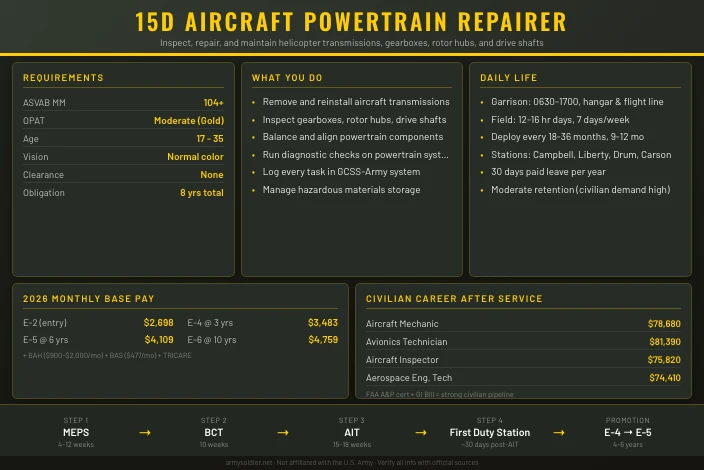
Job Role and Responsibilities
As a 15D Aircraft Powertrain Repairer, you inspect, test, repair, and maintain aircraft powertrain subsystems including transmissions, gearboxes, drive shafts, rotor hubs, and related components. You work from technical manuals, engineering drawings, and safety directives to keep Army rotary-wing aircraft mission-ready.
What You Do Day to Day
Most of your time goes into scheduled and unscheduled maintenance. Scheduled work follows a cycle: you pull powertrain components at set intervals, inspect them against wear limits, replace seals and bearings, and reinstall everything to spec. Unscheduled work happens when a crew chief writes up a vibration, a leak, or an abnormal reading during flight.
A typical garrison day starts with a maintenance formation around 0630. Your section leader assigns work orders, and you head to the hangar or flight line. You might spend the morning removing a main transmission from a UH-60, then the afternoon running diagnostic checks on a tail rotor gearbox. Documentation matters as much as the wrench work. Every task gets logged in the Army’s maintenance tracking system.
Field environments change the routine. During training exercises or deployments, you work out of maintenance tents or improvised shelters. The hours stretch to 12-16 per day, and you troubleshoot with fewer resources.
Specialized Roles
The 15D MOS has several skill levels and related identifiers within CMF 15 (Aviation):
| Identifier | Type | Description |
|---|---|---|
| 15D10 | MOS (Skill Level 1) | Entry-level powertrain repairer performing component-level maintenance |
| 15D20 | MOS (Skill Level 2) | Journeyman repairer with diagnostic and mentoring responsibilities |
| 15D30 | MOS (Skill Level 3) | Senior repairer supervising maintenance sections and evaluating operations |
| 15D40 | MOS (Skill Level 4) | Master-level maintainer managing shop operations and training programs |
Additional Skill Identifiers (ASIs) can expand your scope. Aviation maintenance soldiers may earn ASIs for specific airframes or component specialties as their career progresses.
How This Role Supports the Mission
Army aviation is a force multiplier. Helicopters move troops, evacuate casualties, deliver supplies, and provide fire support. None of that happens without functioning powertrains. When a Combat Aviation Brigade deploys, the 15D repairers keep the aircraft operational readiness rate high enough to fly the mission schedule. A grounded helicopter means a platoon doesn’t get resupplied or a casualty doesn’t get evacuated.
Equipment and Technology
You’ll work with precision measuring tools like micrometers, dial indicators, and torque wrenches calibrated to exact specifications. Vibration analysis equipment helps diagnose problems that aren’t visible to the eye. Hydraulic test stands simulate flight loads so you can verify a rebuilt component before it goes back on the aircraft.
The Army’s maintenance tracking software (ULLS-A/GCSS-Army) is where every work order, parts request, and inspection record lives. Technical manuals are increasingly digital, accessed on ruggedized tablets in the shop. Some units use borescopes and thermal imaging to inspect internal components without full disassembly.
Salary and Benefits
Military Pay
Base pay follows the same scale for all soldiers at a given rank and years of service. Here’s what a 15D can expect at key career milestones in 2026:
| Rank | Typical Time in Service | Monthly Base Pay | Annual Base Pay |
|---|---|---|---|
| E-1 Private (PV1) | Entry (BCT) | $2,407 | $28,884 |
| E-2 Private (PV2) | Less than 2 years | $2,698 | $32,376 |
| E-3 Private First Class (PFC) | 2 years | $3,015 | $36,180 |
| E-4 Specialist (SPC) | 3 years | $3,483 | $41,796 |
| E-5 Sergeant (SGT) | 6 years | $4,109 | $49,308 |
| E-6 Staff Sergeant (SSG) | 10 years | $4,759 | $57,108 |
Base pay is only part of the picture. Every enlisted soldier also receives:
- BAS (Basic Allowance for Subsistence): $476.95/month for food
- BAH (Basic Allowance for Housing): Varies by duty station and dependency status, ranging from roughly $900 to $2,000+ monthly for an E-4 at most CONUS installations
- TRICARE: Full medical, dental, and vision coverage at zero premium and zero copay for active duty soldiers. Family members are covered under TRICARE Prime with no enrollment fee.
Enlistment bonuses for aviation maintenance MOS codes change frequently. Check with your recruiter for current 15D bonus availability, as amounts vary by fiscal year and manning levels.
Retirement and Long-Term Benefits
The Blended Retirement System (BRS) combines a pension with TSP matching. The government automatically contributes 1% of your base pay to the Thrift Savings Plan after 60 days, then matches up to 4% more once you hit your third year of service. Contribute 5% of your pay to get the full match.
Serve 20 years and you earn a pension worth 40% of your highest 36 months of average base pay. Continuation pay between years 7 and 12 offers a lump sum (typically 2.5x monthly base pay for Army active component) in exchange for 3 more years of service.
Leave and Time Off
All soldiers earn 30 days of paid leave per year, accruing at 2.5 days per month. Federal holidays add 11 more days. Unused leave carries over up to 60 days.
Qualifications and Eligibility
Requirements at a Glance
| Requirement | Details |
|---|---|
| ASVAB Line Score | MM (Mechanical Maintenance) of 104 or higher |
| OPAT Category | Moderate (Gold) |
| Security Clearance | None required |
| Education | High school diploma or GED (AFQT minimum 31 with diploma, 50 with GED) |
| Age | 17-35 (waivers possible up to 39) |
| Citizenship | U.S. citizen or permanent resident |
| Color Vision | Normal color vision required |
| Physical | Must pass OPAT at Moderate (Gold) standard |
The MM (Mechanical Maintenance) composite is calculated from four ASVAB subtests: Numerical Operations (NO) + Auto & Shop Information (AS) + Mechanical Comprehension (MC) + Electronics Information (EI). A 104 is above average and reflects the technical demands of working on flight-critical components.
Enlistment Process
The path from recruiter’s office to first duty station follows a standard sequence:
Competitiveness
The 15D MOS is moderately competitive. Aviation maintenance soldiers are in steady demand because the Army operates thousands of rotary-wing aircraft. Having strong mechanical aptitude and a clean record helps. Prior experience with engines, transmissions, or automotive repair gives you a practical edge but isn’t required.
Entry rank is E-1 (PV1) for most enlistees, though college credits or referral programs can bump you to E-2 or E-3.
See our ASVAB study guide for strategies to hit these line scores, or take the PiCAT from home if you are a first-time tester.
Work Environment
Where You Work
Garrison life means climate-controlled hangars with proper lighting, tool cribs, and hydraulic lifts. Flight lines are outdoor work areas exposed to weather, jet exhaust, and engine noise. You’ll move between both depending on the maintenance task.
Field environments strip away the amenities. During training rotations at places like the National Training Center (Fort Irwin, CA) or the Joint Readiness Training Center (Fort Johnson, LA), you work from maintenance tents set up near the flight line. Dust, heat, cold, and limited parts supply are the norm.
Schedule and Tempo
Garrison hours typically run 0630 to 1700, Monday through Friday. Duty days stretch when aircraft have deadlined parts or when the unit is preparing for a field exercise. Some shops run shifts to maintain 24-hour repair capability during high-tempo periods.
Field exercises and deployments mean 12-16 hour days, 7 days a week. The pace depends on flight hours and how hard the aircraft are getting worked.
Chain of Command and Communication
Your immediate supervisor is your section sergeant, usually an E-5 or E-6. Above them sits the platoon sergeant and a maintenance officer (typically a warrant officer or lieutenant). Quality control inspectors check your work before an aircraft returns to flyable status. Technical guidance flows through technical inspectors (TIs) who have deep knowledge of specific airframe systems.
Performance feedback comes through monthly counseling sessions and formal evaluations (NCOERs) for NCOs, or developmental counseling for junior enlisted.
Teamwork and Autonomy
Powertrain work is collaborative. Removing a transmission from a helicopter takes a crew of 3-4 soldiers working in coordination. Bench work on individual components gives you more independence, but a technical inspector signs off on every critical task before the part goes back on the aircraft.
As you gain experience and rank, you earn more autonomy in diagnosing problems and directing work. By E-5, you’re assigning tasks to junior soldiers and making maintenance decisions that affect the flight schedule.
Retention
Aviation maintenance MOS codes have moderate retention rates. The skills are highly marketable in the civilian world, which pulls some soldiers toward early separation. Re-enlistment bonuses and the appeal of warrant officer paths help offset that. Soldiers who enjoy the work and the mission tend to stay. Those who want higher civilian pay often separate after their first enlistment.
Training and Skill Development
Initial Training Pipeline
| Phase | Location | Length | Focus |
|---|---|---|---|
| Basic Combat Training (BCT) | Fort Jackson, SC; Fort Moore, GA; Fort Leonard Wood, MO; or Fort Sill, OK | 10 weeks | Soldier fundamentals: marksmanship, land navigation, first aid, drill, physical fitness |
| Advanced Individual Training (AIT) | Fort Eustis, VA (128th Aviation Brigade) | 15-18 weeks | Aircraft powertrain systems: transmissions, gearboxes, rotor hubs, drive shafts, and test equipment |
BCT is the same for every soldier regardless of MOS. You learn to shoot, move, communicate, and function as part of a team under stress.
AIT is where 15D training gets specific. Classroom instruction covers powertrain theory, reading technical manuals, and understanding engineering tolerances. The bulk of AIT is hands-on: you work on actual aircraft components, learning to disassemble, inspect, repair, and reassemble transmission assemblies, rotor systems, and drive shafts. You’ll use precision measuring tools, vibration analysis gear, and hydraulic test equipment.
Training includes safety protocols for handling heavy components, working with flammable materials, and operating in and around aircraft. You’ll learn the documentation standards that the Army requires for every maintenance action.
After AIT
Your first duty station is where real learning accelerates. You’ll work under experienced 15D NCOs who teach the nuances that classroom training can’t cover. On-the-job training at your unit introduces you to the specific airframe your battalion flies.
Advanced Training Opportunities
- Aircraft-specific courses: Transition training for new airframes (UH-60M, CH-47F, AH-64E) as the Army fields upgraded models
- Technical Inspector (TI) certification: Qualifies you to sign off on maintenance tasks, a key credential for career advancement
- Aviation Safety courses: Risk management and accident investigation training available at the U.S. Army Combat Readiness Center
- Noncommissioned Officer Education System (NCOES): Basic Leader Course (BLC), Advanced Leader Course (ALC), and Senior Leader Course (SLC) are required for promotion to E-5, E-6, and E-7
- Warrant Officer path: Experienced 15D soldiers can apply to become 151A Aviation Maintenance Technicians, a warrant officer MOS that focuses on technical leadership
The Army Credentialing Assistance (CA) program and Army COOL fund civilian certifications while you serve, including FAA Airframe and Powerplant (A&P) licenses.
Everything starts with qualifying ASVAB scores — our study guide covers what to study first.
Career Progression and Advancement
Rank Progression
| Rank | Pay Grade | Typical Time in Service | Role |
|---|---|---|---|
| Private (PV1) | E-1 | Entry | Trainee in BCT |
| Private (PV2) | E-2 | 6 months | AIT student and initial duty assignment |
| Private First Class (PFC) | E-3 | 12 months | Entry-level powertrain repairer (15D10) |
| Specialist (SPC) | E-4 | 24 months | Journeyman repairer handling independent tasks |
| Sergeant (SGT) | E-5 | 4-6 years | Team leader directing 2-4 soldiers, requires BLC |
| Staff Sergeant (SSG) | E-6 | 8-10 years | Section leader overseeing a powertrain maintenance section, requires ALC |
| Sergeant First Class (SFC) | E-7 | 14-18 years | Platoon sergeant or maintenance production control NCOIC, requires SLC |
| Master Sergeant (MSG) | E-8 | 18-22 years | Senior maintenance manager at battalion or brigade level |
Promotion from E-1 to E-4 is largely automatic based on time in service and time in grade. From E-5 onward, promotion becomes competitive. Boards evaluate your NCOER ratings, military education, awards, and leadership potential. Promotion points come from civilian education, correspondence courses, physical fitness scores, and weapons qualification.
Specialization and Lateral Moves
Experienced 15D soldiers can pursue Additional Skill Identifiers (ASIs) for specific airframe systems. Lateral reclassification to other 15-series MOS codes is possible if you meet the ASVAB and physical requirements for the new MOS.
The warrant officer track is a major draw. After gaining experience as a 15D, you can apply for the 151A Aviation Maintenance Technician warrant officer MOS. Warrant officers serve as the Army’s technical experts, focusing on maintenance operations without the command responsibilities of commissioned officers. The path goes from Warrant Officer 1 (WO1) through Chief Warrant Officer 5 (CW5).
Performance Evaluation
The NCOER (NCO Evaluation Report) is the primary performance document for E-5 and above. It rates soldiers on six competencies: character, presence, intellect, leads, develops, and achieves. Junior enlisted receive developmental counseling from their supervisors.
Strong evaluations, consistent physical fitness scores, and completion of military education requirements are what separate soldiers who promote quickly from those who don’t.
Physical Demands and Medical Evaluations
On-the-Job Physical Demands
Powertrain components are heavy. Transmissions, gearboxes, and rotor assemblies can weigh well over 100 pounds. You’ll regularly handle 50-pound loads throughout the day and occasionally need to lift or maneuver components exceeding 100 pounds with the help of hoists and teammates.
The work requires:
- Extended periods of standing, kneeling, and crouching inside aircraft structures
- Gripping and turning tools in tight spaces for hours
- Climbing on and around helicopters to access upper powertrain components
- Carrying toolboxes and parts across flight lines and between maintenance areas
Army Fitness Test (AFT) Standards
The AFT replaced the ACFT on June 1, 2025. All soldiers take the same 5-event test. Standards apply across the force and are not MOS-specific.
| Event | Abbreviation | Minimum (60 pts) | Maximum (100 pts) |
|---|---|---|---|
| 3 Repetition Maximum Deadlift | MDL | Varies by age/sex | Varies by age/sex |
| Hand Release Push-Up | HRP | Varies by age/sex | Varies by age/sex |
| Sprint-Drag-Carry | SDC | Varies by age/sex | Varies by age/sex |
| Plank | PLK | Varies by age/sex | Varies by age/sex |
| Two-Mile Run | 2MR | Varies by age/sex | Varies by age/sex |
You need at least 60 points per event and 300 total to pass under the general standard (sex- and age-normed). The maximum score is 500. As an aviation maintenance soldier, the general 300-point standard applies rather than the 350-point combat MOS standard.
Medical Standards
The initial MEPS physical screens for conditions that would disqualify you. Normal color vision is mandatory for 15D because you need to identify color-coded wiring, fluid types, and safety markings. The Army conducts periodic health assessments (PHAs) annually. Aviation maintenance soldiers also receive hearing conservation program monitoring due to regular noise exposure from engines and flight lines.
Deployment and Duty Stations
Where 15D Soldiers Serve
Aviation units are stationed across the country and overseas. Major installations with aviation brigades include:
- Fort Campbell, KY – 101st Airborne Division (Air Assault)
- Fort Drum, NY – 10th Mountain Division (Combat Aviation Brigade)
- Fort Liberty, NC – 82nd Airborne Division (Combat Aviation Brigade)
- Fort Riley, KS – 1st Infantry Division
- Fort Carson, CO – 4th Infantry Division
- Joint Base Lewis-McChord, WA – I Corps
- Wheeler Army Airfield, HI – 25th Infantry Division
- Germany and South Korea – Rotational and permanently stationed aviation units
Duty station assignments depend on the needs of the Army, your rank, and available slots. Soldiers can submit preferences through the Assignment Satisfaction Key (ASK) system, but there’s no guarantee.
Deployment Patterns
Aviation maintenance soldiers deploy wherever Army helicopters go. Current rotations include the Middle East, Europe, the Pacific, and Africa. Deployments typically last 9-12 months, though some rotational deployments run shorter at 6 months.
Between deployments, expect 18-36 months of dwell time at your home station. Combat Training Center rotations at Fort Irwin and Fort Johnson happen between deployments and last about a month.
Risk, Safety, and Legal Considerations
Hazards
Working on aircraft powertrains involves real physical risks. Heavy components can fall or shift during removal and installation. Rotating parts, hydraulic pressure, and high-voltage electrical systems are part of the daily environment. Jet fuel, lubricants, solvents, and hydraulic fluids are constant exposure risks.
Noise exposure on the flight line is significant. Engine run-ups and ground taxi operations produce sustained noise levels that cause hearing damage without proper protection.
Safety Protocols
The Army’s aviation maintenance safety program is strict. Lockout/tagout procedures prevent accidental activation of systems during maintenance. Technical inspectors verify critical maintenance steps before an aircraft returns to service. Personal protective equipment (PPE) is mandatory: hearing protection, safety glasses, gloves, and steel-toed boots are the baseline.
Every maintenance task follows a technical manual procedure. Deviations require engineering approval. The two-person integrity (TPI) system ensures that safety-critical tasks get a second set of eyes.
Security and Legal Requirements
The 15D MOS does not require a security clearance. Your service contract typically includes a 3-6 year active duty commitment within an 8-year total military service obligation. The remaining years are served in the Individual Ready Reserve (IRR) unless you re-enlist.
Deployed soldiers operate under the Uniform Code of Military Justice (UCMJ) and applicable status of forces agreements (SOFAs) in the host country. In conflict zones, aviation maintenance soldiers work inside secured forward operating bases but remain subject to indirect fire and other theater-wide threats.
Impact on Family and Personal Life
Family Considerations
Military life demands flexibility from the whole family. Deployments of 9-12 months, training rotations, late nights before major exercises, and possible PCS moves every 2-3 years all affect spouses, children, and relationships.
The Army provides support systems to help:
- Army Community Service (ACS): Financial counseling, relocation assistance, employment help for spouses
- Family Readiness Groups (FRGs): Unit-level support networks that keep families informed during deployments
- Military OneSource: Free counseling, legal help, and referral services available 24/7
- Child Development Centers (CDCs): Subsidized childcare on most installations
- Exceptional Family Member Program (EFMP): Ensures assignment locations have the medical or educational services your family needs
Relocation and Stability
PCS moves happen every 2-3 years on average. Some soldiers stay at one installation longer if their unit has consistent manning. Overseas assignments to Germany or Korea typically last 2-3 years. Accompanied tours let you bring your family; unaccompanied tours (usually Korea) mean a year apart.
BAH adjusts to your new duty station’s cost of living, so your housing allowance changes with each move. On-post housing is available at most installations, which simplifies the relocation process.
Reserve and National Guard
The 15D MOS is available in both the Army Reserve and the Army National Guard. Aviation units in both components need powertrain repairers to maintain rotary-wing aircraft. Skill-level ceilings match active duty, and qualified soldiers can advance to senior NCO grades or pursue warrant officer candidacy through either component.
What differs most is the pace of hands-on work. Active-duty 15D soldiers maintain transmissions, gearboxes, and rotor systems as their primary daily job. Reserve and Guard soldiers do the same work but compressed into drill weekends and annual training. Staying sharp on powertrain systems requires active effort outside of scheduled drill time, especially when aircraft platforms change.
Drill Schedule and Training Commitment
The standard commitment is one weekend per month plus two weeks of annual training per year. For 15D soldiers, additional training days often come up. Certification maintenance on transmissions, gearboxes, and rotor systems requires periodic renewal. When the Army transitions to new aircraft or introduces updated rotor system components, Reserve and Guard soldiers may be called in for extra training beyond the base schedule.
Aviation units tend to schedule more maintenance exercises than infantry or support units because aircraft readiness is a harder requirement to fake. Expect the actual annual time commitment to exceed the minimum in most years.
Part-Time Pay and Benefits
An E-4 with roughly four years of service earns about $488 per drill weekend. That comes to approximately $5,856 per year across 12 drill weekends. Compare that to active-duty E-4 base pay of $3,659 per month and the part-time pay gap is significant. Annual training and mobilization periods pay at active-duty rates for the days served.
For healthcare, Reserve and Guard soldiers off active orders use Tricare Reserve Select. Member-only coverage costs $57.88 per month. Family coverage runs $286.66 per month. Active-duty soldiers pay nothing in premiums for TRICARE Prime. On the education side, Reserve and Guard soldiers can use the Montgomery GI Bill - Selected Reserve (Chapter 1606), Federal Tuition Assistance, and for Guard members, state tuition waivers that vary by state. A qualifying mobilization of 90 or more days can trigger eligibility for the Post-9/11 GI Bill (Chapter 33), which offers more generous benefits.
Deployment and Mobilization
Mobilization rates for aviation maintenance MOS soldiers in the Reserve and Guard are moderate. Aviation units have been called up regularly since 2001 for both combat and peacekeeping missions. A typical mobilization lasts 9 to 12 months, including pre-deployment training. You might serve for years without deploying, then receive orders on relatively short notice.
Active-duty soldiers deploy on predictable rotation cycles tied to their unit’s OPTEMPO. Reserve and Guard deployments depend more on Army readiness requirements and national security posture. When you do mobilize, pay upgrades to active-duty rates and healthcare shifts to TRICARE Prime for the duration.
Civilian Career Integration
Powertrain and drivetrain maintenance skills transfer directly to civilian aviation maintenance roles. With Army 15D experience and some additional study, you can qualify for the FAA Airframe and Powerplant (A&P) certificate. That credential opens doors to helicopter maintenance roles at commercial operators, emergency medical services aviation companies, and offshore oil support operators.
Defense contractors servicing Black Hawks, Chinooks, and Apache fleets also hire 15D-qualified mechanics at premium rates. The Reserve or Guard option lets you hold a civilian helicopter maintenance position while staying current on military aircraft systems, which strengthens both careers. USERRA protects your civilian job during any mobilization, requiring your employer to restore your position when you return.
| Feature | Active Duty | Army Reserve | Army National Guard |
|---|---|---|---|
| Commitment | Full-time | One weekend/month, two weeks/year | One weekend/month, two weeks/year |
| Monthly Pay (E-4, ~4 yrs) | $3,659 | ~$488/drill weekend | ~$488/drill weekend |
| Healthcare | TRICARE Prime, $0 premiums | Tricare Reserve Select, $57.88/month | Tricare Reserve Select, $57.88/month |
| Education | Post-9/11 GI Bill | Federal TA, MGIB-SR | Federal TA, MGIB-SR, state tuition waivers |
| Deployment | Regular rotations | Mobilization-based | Mobilization-based, plus state activations |
| Retirement | 20-year pension, immediate | Points-based, age 60 | Points-based, age 60 |
Post-Service Opportunities
Civilian Career Paths
The 15D MOS builds directly transferable skills. Aviation maintenance experience, combined with an FAA Airframe and Powerplant (A&P) certificate, opens doors across the civilian aviation industry. The Army COOL program and GI Bill can fund A&P certification and additional education while you serve or after separation.
The Veterans Employment Through Technology Education Courses (VET TEC) program and Transition Assistance Program (TAP) workshops help bridge the gap between military and civilian employment.
| Civilian Job Title | Median Annual Salary | Job Outlook (2024-2034) |
|---|---|---|
| Aircraft Mechanic / Service Technician | $78,680 | 5% growth (faster than average) |
| Avionics Technician | $81,390 | 5% growth |
| Aircraft Inspector (FAA/Civilian) | $75,820 | 4% growth |
| Aerospace Engineering Technician | $74,410 | 3% growth |
| Aviation Maintenance Supervisor | $90,000+ | Steady demand |
The BLS projects about 13,100 openings per year for aircraft mechanics and related technicians through 2034. Growing air travel demand and fleet complexity drive the need for qualified maintainers.
Education Benefits
The Post-9/11 GI Bill covers full in-state tuition at public universities and up to $29,920.95 per year at private schools, plus a monthly housing allowance tied to the E-5 with dependents BAH rate at your school’s ZIP code. You get 36 months of benefits total. A book stipend of $1,000 per year is included.
Tuition Assistance (TA) provides up to $4,500 per year while you’re still serving, covering $250 per semester hour.
Is This a Good Job for You? The Right (and Wrong) Fit
Who Thrives as a 15D
This MOS fits people who like solving mechanical puzzles. If you’re the person who takes things apart to understand how they work, you’ll enjoy powertrain maintenance. The best 15D soldiers share a few traits:
- Mechanical aptitude: You’re comfortable with tools and understand how gears, bearings, and shafts work together
- Attention to detail: Torque specs, safety wire patterns, and inspection criteria matter. A missed step can ground an aircraft or worse
- Physical toughness: You’ll work in heat, cold, and awkward positions while handling heavy parts
- Patience with paperwork: Documentation is half the job. If you hate logging your work, this will frustrate you
People who enjoy working with their hands, have a methodical approach to problem-solving, and want a skill that pays well after the Army tend to do well here.
Who Should Think Twice
This MOS is not a good fit if you:
- Prefer desk work or predictable schedules
- Dislike repetitive physical labor in uncomfortable positions
- Want a job with minimal deployments (aviation units deploy regularly)
- Have trouble with fine motor tasks or working in tight spaces
- Expect 9-to-5 hours without evening or weekend duty
Field maintenance conditions are harsh. You’ll work on cold flight lines in January and in hangar bays that hit 100+ degrees in summer. The work is rewarding, but it’s not easy.
Long-Term Fit
As a career path, 15D gives you options. Stay in and work toward warrant officer. Separate after one enlistment with an A&P certificate and start a civilian aviation career. Or use the GI Bill to study aerospace engineering or aviation management. The skills and discipline carry forward regardless of which direction you choose.
More Information
Talk to your local Army recruiter for the latest information on 15D availability, enlistment bonuses, and duty station options. You can also call 1-888-550-ARMY (2769) or visit your nearest recruiting station to discuss whether this MOS matches your goals.
- Prepare for the ASVAB with our study guide to make sure your line scores qualify
This site is not affiliated with the U.S. Army or any government agency. Verify all information with official Army sources before making enlistment or career decisions.
Explore more Army aviation careers such as 15T UH-60 Helicopter Repairer and 15U CH-47 Helicopter Repairer.