15E Unmanned Aircraft Systems Repairer
Every Army drone that flies a combat mission needs someone on the ground who can keep it in the air. As a 15E, you’re the mechanic behind the Army’s tactical unmanned aircraft. You troubleshoot avionics failures, swap out propulsion components, and get broken drones back on the flight line while operators wait. The Army is expanding its UAS fleet faster than almost any other weapons system, and every one of those aircraft needs a repairer who knows it inside out.
Qualifying requires specific ASVAB line scores — our ASVAB study guide covers what to target and how to prepare.
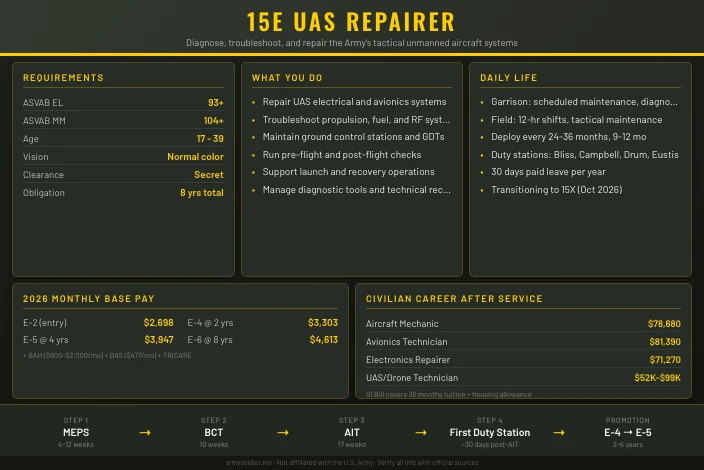
Job Role and Responsibilities
You diagnose, troubleshoot, and repair electrical, avionics, radio frequency, propulsion, fuel, optical payload, and weapons systems on the Army’s tactical unmanned aircraft. You also maintain ground control stations, ground data terminals, launch and recovery equipment, and all associated ground support gear.
Most of your day revolves around keeping aircraft mission-ready. In garrison, that means scheduled maintenance: inspecting airframes, running diagnostic tests on avionics, replacing worn components, and updating maintenance logs. When something breaks during flight operations, you shift to unscheduled repairs under time pressure. The operators need the aircraft back, and you’re the one who makes that happen.
Field environments change the pace. You set up maintenance areas in tactical positions, work under camouflage netting, and troubleshoot with limited tools and parts. During deployments, 12-hour shifts are common. You’re responsible for keeping every aircraft in your platoon flyable regardless of weather, dust, or the wear that combat operations put on the systems.
Specific Roles
The 15E falls under Career Management Field (CMF) 15, Aviation. Several related MOS codes exist in the UAS maintenance and operations community:
| Identifier | Type | Description |
|---|---|---|
| 15E | Primary MOS | Tactical UAS Repairer (Shadow RQ-7B and similar platforms) |
| 15W | Related MOS | UAS Operator (flies the aircraft you maintain) |
| 15M | Related MOS | MQ-1C Gray Eagle UAS Repairer (medium-altitude platform) |
| 15X | Successor MOS | TUAS Specialist (combined operator/repairer, effective Oct 2026) |
| 150U | Warrant Officer MOS | UAS Operations Technician |
Additional Skill Identifiers (ASIs) let you specialize after earning your MOS. The F8 (UAS Master Gunner), G3 (Air Cavalry Leaders Course), and U7 (UAS Instructor Operator) are all available to 15E soldiers who qualify.
Mission Contribution
Without functional aircraft, UAS operators have nothing to fly. Your work directly determines whether commanders get the real-time intelligence they need for troop movement, route clearance, and targeting decisions. A single maintenance failure can ground an aircraft during a mission window that doesn’t come back. The repairer’s job is to make sure that doesn’t happen.
Technology and Equipment
You work on the Shadow RQ-7B tactical UAS and its associated ground systems. That includes the One System Ground Control Station (OSGCS), portable Ground Data Terminals, electro-optical and infrared sensor payloads, the pneumatic launcher, and the arresting gear used for recovery. Your diagnostic toolkit includes multimeters, oscilloscopes, cable testers, and specialized aircraft test equipment. You also handle fuel systems, battery management, and RF communication links.
The Army is fielding new UAS platforms regularly. Soldiers who stay in this career field should expect to retrain on updated systems throughout their service.
Salary and Benefits
Financial Benefits
Military pay is based on rank and time in service. Most 15E soldiers enter at E-1 and reach E-4 within two years through automatic promotions.
| Rank | Time in Service | Monthly Base Pay (2026) |
|---|---|---|
| E-1 (PV1) | Entry | $2,407 |
| E-2 (PV2) | After BCT | $2,698 |
| E-3 (PFC) | ~1 year | $2,837 |
| E-4 (SPC) | ~2 years | $3,303 |
| E-5 (SGT) | ~4 years | $3,947 |
| E-6 (SSG) | ~8 years | $4,613 |
Base pay is only part of total compensation. BAH (Basic Allowance for Housing) adds $900 to $2,000+ per month depending on duty station and dependency status. BAS (Basic Allowance for Subsistence) adds $476.95 per month for food. The 15E has appeared on the Army’s enlistment bonus list. Bonus amounts change frequently based on demand, so ask your recruiter for current figures.
Additional Benefits
TRICARE covers active-duty soldiers and their families at zero cost. Doctor visits, hospital stays, dental, vision, prescriptions, and mental health care are all included with no enrollment fees or copays. Tuition Assistance pays up to $4,500 per year toward college courses while you serve.
The Post-9/11 GI Bill covers up to 36 months of tuition at public universities (full in-state rate) or up to $29,921 per year at private schools after you separate, plus a monthly housing allowance pegged to the E-5 BAH rate at your school’s ZIP code.
Retirement runs through the Blended Retirement System (BRS):
- Pension at 20 years: 40% of your highest 36-month average base pay
- TSP matching: the government puts up to 5% of your base pay into your Thrift Savings Plan
- Continuation pay between 8 and 12 years of service: a lump-sum bonus for extending your commitment
Work-Life Balance
You earn 30 days of paid leave per year, plus 11 federal holidays. In garrison, UAS maintenance units typically follow the same schedule as their parent aviation battalion. Field rotations and NTC/JRTC exercises break that routine. During deployments, expect extended shifts with limited time off.
Qualifications and Eligibility
Basic Qualifications
The 15E requires two ASVAB composite scores:
- Electronics (EL): 93 minimum
- Mechanical Maintenance (MM): 104 minimum
The EL composite combines General Science, Arithmetic Reasoning, Mathematics Knowledge, and Electronics Information. MM combines Numerical Operations, Auto and Shop Information, Mechanical Comprehension, and Electronics Information. A 104 MM is above average and requires solid mechanical and electronics aptitude.
| Requirement | Details |
|---|---|
| Age | 17-39 years old |
| Citizenship | U.S. citizen |
| Education | High school diploma or GED |
| AFQT (ASVAB) | Minimum 31 (diploma) or 50 (GED) |
| EL Line Score | Minimum 93 |
| MM Line Score | Minimum 104 |
| Security Clearance | Secret (required before training) |
| Physical Demands | Moderately heavy |
| PULHES Profile | 222221 |
| Vision | Normal color vision required |
| Class 4 Flight Physical | Required |
Application Process
Visit your local Army recruiting station and tell the recruiter you want 15E (or 15X if enlisting after October 2026). The recruiter checks your basic eligibility and schedules you for MEPS (Military Entrance Processing Station). At MEPS, you take the ASVAB, complete a physical exam including the Class 4 flight physical, and start a background investigation for your Secret clearance.
If your EL and MM scores qualify and you pass the medical screening, your recruiter reserves a training slot. The Secret clearance investigation can take a few weeks to several months. You ship to Basic Combat Training once it clears or an interim clearance is granted.
Plan on 4 to 12 weeks from first visit to shipping out. Medical waivers or clearance delays can push that further.
Selection Criteria and Competitiveness
The 15E is moderately competitive. The 104 MM requirement screens out soldiers who don’t have strong mechanical and electronics aptitude. The Secret clearance adds another filter. Prior experience with electronics, auto mechanics, or model aircraft helps but isn’t required.
With the Army expanding its drone fleet and the 15X merger creating demand for more multi-skilled UAS soldiers, training slots have grown over the past few years. Your biggest hurdle is the ASVAB score, not the slot availability.
Upon Accession into Service
You enter at E-1 (Private). After Basic, most soldiers promote to E-2. The standard service obligation is 8 years total, split between active duty (typically 3 to 6 years depending on your contract) and the Individual Ready Reserve for the remainder. Longer active-duty contracts may qualify for higher bonuses.
See our ASVAB study guide for strategies to hit these line scores, or take the PiCAT from home if you are a first-time tester.
Work Environment
Setting and Schedule
UAS repairers split their time between three main settings:
- Maintenance hangar or shop – climate-controlled space with workbenches, diagnostic equipment, and parts storage. This is where you do most scheduled maintenance and component repairs.
- Flight line – outdoors in whatever weather your duty station throws at you. You’re here for pre-flight and post-flight inspections, launch and recovery support, and field troubleshooting.
- Tactical assembly area – during field exercises and deployments, you set up maintenance operations under camo netting or in expandable shelters. Space is tight and conditions are rough.
Garrison schedules follow the unit’s flight calendar. When the platoon is flying, you’re on the line before and after every launch. Off-flight days go to scheduled maintenance, training, and admin tasks.
Leadership and Communication
You report to a UAS platoon sergeant (NCO) and work alongside operators daily. Your crew chief or section sergeant runs the maintenance team. Communication with the operator crew is constant because they report aircraft issues in flight that you need to diagnose on the ground.
Performance feedback comes through quarterly counseling sessions and annual NCOERs (for E-5 and above). Junior enlisted receive counseling packets from their direct supervisor.
Team Dynamics and Autonomy
Maintenance is team-oriented. Most repair tasks require at least two people for safety and efficiency. Senior repairers verify the work of junior soldiers through quality control inspections. That said, experienced 15E soldiers get real autonomy in diagnosing problems. When an aircraft comes back with an intermittent avionics fault, you’re the one who traces the wiring, runs the tests, and decides which component to replace.
Job Satisfaction and Retention
Soldiers who enjoy working with their hands on complex electronic and mechanical systems tend to stay. The direct connection between your work and mission success is tangible: you fix the aircraft, it flies, and the commander gets intelligence. The civilian job market for avionics and drone maintenance skills is strong, which gives 15E soldiers options at every re-enlistment window.
Retention challenges come from the deployment tempo and the physical demands of field maintenance. Working on aircraft in a desert or freezing rain gets old. But the technical skills you build are hard to replicate outside the military.
Training and Skill Development
Initial Training
Your training pipeline starts with Basic Combat Training and moves into AIT at Joint Base Langley-Eustis, Virginia.
| Phase | Location | Length | Focus |
|---|---|---|---|
| Basic Combat Training (BCT) | Fort Jackson, SC; Fort Moore, GA; or Fort Leonard Wood, MO | 10 weeks | Soldiering fundamentals: weapons qualification, land navigation, first aid, drill and ceremony |
| AIT (15E Course) | Joint Base Langley-Eustis, VA | 17 weeks | UAS electrical systems, avionics troubleshooting, propulsion and fuel systems, ground control station maintenance, launch/recovery equipment, RF systems, diagnostic tools, technical publications |
AIT is hands-on from early in the course. You start with electrical theory and aircraft systems fundamentals, then move into component-level troubleshooting and repair. By the final weeks, you’re performing full maintenance tasks on actual UAS equipment under instructor supervision. You graduate with your 15E MOS qualification.
Advanced Training
After your first duty station, several training paths open up:
- UAS Master Gunner Course (ASI F8) – advanced tactics, gunnery, and instructor qualification
- Air Cavalry Leaders Course (ASI G3) – reconnaissance tactics for aviation soldiers
- UAS Instructor Operator Course (ASI U7) – qualifies you to train other soldiers on UAS systems
- Airborne School – jump wings, available if assigned to an airborne unit
- Air Assault School – helicopter insertion qualification
- 15M Gray Eagle Transition – cross-train to maintain the Army’s medium-altitude MQ-1C platform
- Warrant Officer path (150U) – become a UAS Operations Technician after 5+ years of experience
The Army also supports FAA certifications through Army COOL (Credentialing Opportunities On-Line). Your maintenance experience can count toward the FAA Airframe and Powerplant (A&P) certificate, which is the gold standard for civilian aviation maintenance.
Everything starts with qualifying ASVAB scores — our study guide covers what to study first.
Career Progression and Advancement
Career Path
Promotions follow the Army’s standard time-in-grade and time-in-service requirements. Soldiers who earn ASIs and complete military education courses promote faster.
| Rank | Grade | Typical Timeline | Role |
|---|---|---|---|
| Private (PV1) | E-1 | Entry | Student, BCT |
| Private (PV2) | E-2 | 6 months | Student, AIT |
| Private First Class (PFC) | E-3 | 12 months TIS | Junior UAS repairer, crew member |
| Specialist (SPC) | E-4 | 24 months TIS | Qualified repairer, performs independent maintenance tasks |
| Sergeant (SGT) | E-5 | 3-5 years | Crew chief, team leader, supervises junior repairers |
| Staff Sergeant (SSG) | E-6 | 6-9 years | Section sergeant, manages maintenance operations |
| Sergeant First Class (SFC) | E-7 | 12-16 years | Platoon sergeant, technical advisor to commander |
| Master Sergeant (MSG) | E-8 | 18-20 years | Operations sergeant, branch manager, senior maintenance leader |
At E-5, you take on crew chief responsibilities and supervise a small team of repairers. By E-7, you’re advising the platoon leader on maintenance readiness and managing the training program for the entire section. The 150U Warrant Officer track is open to experienced NCOs who want to stay technical rather than move into broader leadership roles.
Role Flexibility and Transfers
Transferring within CMF 15 aviation maintenance is straightforward. Moving from 15E to 15M (Gray Eagle Repairer) requires a transition course but no new ASVAB qualification. The 15X merger will combine both skill sets, making lateral moves between operator and repairer functions automatic.
Transfers outside aviation require a new ASVAB qualification and a reclassification packet. Soldiers with Secret clearances and strong electronics backgrounds are competitive for signals (25 series) and intelligence (35 series) MOSs.
Performance Evaluation
The NCOER (Noncommissioned Officer Evaluation Report) drives career advancement for E-5 and above. Raters evaluate you on mission accomplishment, equipment readiness rates, technical competence, and leadership. Promotion boards weigh NCOER ratings, military education (Warrior Leader Course, Advanced Leader Course, Senior Leader Course), civilian education credits, and AFT scores.
Standing out means keeping your section’s aircraft operational readiness rate high, earning ASIs, completing military education ahead of your peers, and performing well on deployments.
Physical Demands and Medical Evaluations
Physical Requirements
The 15E carries a moderately heavy physical demands rating. You lift aircraft components, carry tools and parts across the flight line, and work in awkward positions underneath or inside the aircraft. In the field, add digging fighting positions, pulling security, and loading equipment onto trucks.
Daily physical demands depend on the task. Swapping a propulsion motor means lifting and positioning components that can weigh 30 to 50 pounds. Running wire harnesses through the airframe means crawling into tight spaces. Setting up the pneumatic launcher involves heavy equipment assembly. None of it compares to infantry, but this isn’t a desk job.
Army Fitness Test (AFT) Standards
The AFT has 5 events, each scored 0 to 100 points. Every soldier must score at least 60 per event with a 300-point minimum total. Scores are sex- and age-normed under the general standard.
| Event | What You Do |
|---|---|
| 3 Repetition Maximum Deadlift (MDL) | Deadlift maximum weight for 3 reps |
| Hand Release Push-Up (HRP) | Push-ups with full arm extension at the bottom |
| Sprint-Drag-Carry (SDC) | 250m shuttle with sprints, sled drags, and carries |
| Plank (PLK) | Hold a forearm plank for time |
| Two-Mile Run (2MR) | Run 2 miles as fast as possible |
The AFT replaced the ACFT on June 1, 2025. Maximum score is 500 points. The 300-point minimum applies to all soldiers regardless of MOS.
Medical Evaluations
The initial Class 4 flight physical is more thorough than a standard MEPS exam. It includes detailed vision testing (normal color vision is mandatory), hearing tests, cardiovascular screening, and a full medical history review. After that, you take a periodic health assessment every year and a full physical every 5 years. Vision changes that affect color perception can impact your MOS qualification.
Deployment and Duty Stations
Deployment Details
UAS repairers deploy wherever the Army sends UAS platoons. Every brigade combat team has a UAS element, and those elements deploy with the brigade. Rotations typically last 9 to 12 months, though shorter deployments to Europe and the Indo-Pacific region are becoming more common.
During deployments, you work in forward operating bases or tactical assembly areas. The pace is high: aircraft fly daily missions, which means daily maintenance. Expect 12-hour shifts on a crew rotation with limited downtime.
Duty Stations
The 15E has a wide duty station list because UAS platoons are embedded across the force.
CONUS:
- Fort Bliss, TX
- Fort Campbell, KY
- Fort Carson, CO
- Fort Cavazos, TX
- Fort Drum, NY
- Fort Huachuca, AZ
- Fort Liberty, NC
- Fort Moore, GA
- Fort Riley, KS
- Fort Stewart, GA
- Joint Base Langley-Eustis, VA
- Joint Base Lewis-McChord, WA
OCONUS:
- Fort Wainwright, AK
- USAG Bavaria, Germany
- USAG Hawaii
- USAG Humphreys, South Korea
- USAG Vicenza, Italy
You submit assignment preferences at AIT graduation, but the Army fills slots based on unit need first. Follow-on assignments depend on branch manager decisions at HRC and your re-enlistment options.
Risk, Safety, and Legal Considerations
Job Hazards
Working around aircraft carries inherent risks. Launch and recovery operations put you near a moving aircraft on the flight line. Propulsion systems, pneumatic launchers, and fuel systems all present mechanical hazards. Electrical troubleshooting means working with live circuits in some cases.
Field operations add the same environmental risks every deployed soldier faces: indirect fire, IED threats during convoys, and living in austere conditions for extended periods. You carry a weapon and pull security like every other soldier in a forward area.
Safety Protocols
Army aviation maintenance follows strict safety regulations. Technical inspections, tool accountability (every tool checked in and out to prevent foreign object debris), and two-person integrity on critical repairs all reduce risk. You wear hearing protection on the flight line, use personal protective equipment when handling fuel and hazardous materials, and follow lockout/tagout procedures on electrical systems.
Security and Legal Requirements
The Secret security clearance is mandatory. The background investigation covers your financial history, criminal record, drug use, and foreign contacts. Maintaining the clearance requires avoiding debt problems, drug use, and unauthorized foreign travel throughout your service.
Your enlistment contract is a legal obligation under the Uniform Code of Military Justice (UCMJ). Standard service obligation is 8 years total. During deployments, you follow the same rules of engagement and operational security requirements as every other soldier in the theater.
Impact on Family and Personal Life
Family Considerations
Deployment tempo for UAS units mirrors the rest of the combat arms. Plan on 9 to 12 months away from home every 2 to 3 years. Field training exercises and NTC/JRTC rotations add another 4 to 6 weeks per year away from family.
The Army provides support through Family Readiness Groups (FRGs), Military OneSource counseling, and on-post childcare. Spouses get access to employment assistance, education programs, and the full TRICARE benefit at no cost.
One advantage over some aviation jobs: you’re not flying in the aircraft. Your family isn’t worrying about a crash. But the PCS moves every 2 to 3 years and the deployment schedule still put strain on relationships.
Relocation and Flexibility
PCS (Permanent Change of Station) moves happen every 2 to 3 years. With the wide duty station list, you could land anywhere from Alaska to Italy. Joint domicile requests for dual-military couples get some consideration, but no guarantees.
Soldiers who want stability can try for assignments at Joint Base Langley-Eustis (the schoolhouse) or request back-to-back tours at the same installation. The Army doesn’t promise it, but career counselors can sometimes work it out.
Reserve and National Guard
The 15E MOS is available in both the Army Reserve and the Army National Guard. Guard UAS units have been expanding rapidly, driven by increased demand for unmanned systems in both combat and domestic operations. That growth means more available slots and more chances to stay active in the field part-time.
Skill-level ceilings are the same as active duty. You can advance to senior NCO ranks and pursue warrant officer candidacy in either component. The real challenge in Reserve and Guard 15E service is keeping pace with a fast-moving technology base when your hands-on time is limited to drill weekends and annual training.
Drill Schedule and Training Commitment
The standard baseline is one weekend per month and two weeks of annual training each year. For 15E soldiers, the actual commitment tends to run higher. UAS technology changes faster than almost any other platform in the Army inventory. New systems, new sensors, and new software updates mean extra training days and certification refreshes come up frequently. Guard and Reserve 15E soldiers often get called in for additional days when a unit transitions to a new UAS platform or when software upgrades require hands-on recertification.
If you take the part-time path in this MOS, budget time outside of drill to stay current on UAS systems independently. The technology moves too fast to rely only on scheduled training.
Part-Time Pay and Benefits
An E-4 with around four years of service earns approximately $488 per drill weekend (four drill periods). Across 12 drill weekends annually, that adds up to roughly $5,856 in drill pay, not counting annual training or any mobilization time. Active-duty E-4 base pay is $3,659 per month, so the part-time pay is a fraction of full-time compensation.
Healthcare off active orders means Tricare Reserve Select: $57.88 per month for member-only coverage and $286.66 per month for family coverage. Active-duty soldiers get TRICARE Prime at no cost. Education benefits include the Montgomery GI Bill - Selected Reserve (Chapter 1606), Federal Tuition Assistance, and state tuition waivers for Guard members. A qualifying mobilization of 90 or more days can open eligibility for the Post-9/11 GI Bill (Chapter 33), which has significantly higher annual benefits. Guard members with state tuition benefits can stack those on top of federal assistance in many states.
Deployment and Mobilization
UAS units are among the most frequently mobilized in the current Reserve and Guard force. Demand for unmanned systems in combat zones and intelligence-gathering missions has kept 15E soldiers in high demand for deployments. Mobilization rates are higher than many other aviation MOS specialties. A 9 to 12-month mobilization for a combat support mission is realistic in this MOS.
Active-duty 15E soldiers deploy on rotation cycles tied to their unit. Reserve and Guard soldiers deploy less frequently overall, but when the call comes for UAS units, it tends to come often. During mobilization, your pay shifts to active-duty rates and your healthcare upgrades to TRICARE Prime.
Civilian Career Integration
The civilian drone sector is growing fast. Commercial UAS maintenance, inspection, and integration work is in demand across agriculture, construction, infrastructure inspection, filmmaking, and defense contracting. Army 15E experience directly supports civilian UAS maintenance roles at companies like General Atomics, Shield AI, Skydio, and dozens of defense contractors operating UAS fleets.
You don’t need an FAA A&P certificate for UAS work (those rules apply to crewed aircraft), which simplifies the transition. Your Army training and hands-on system experience is often sufficient to qualify for contract positions. The Reserve or Guard lets you work in civilian UAS maintenance full-time while keeping your military UAS credential active, which strengthens your resume in a sector that values both commercial and military system experience. USERRA protects your civilian job during any mobilization period.
| Feature | Active Duty | Army Reserve | Army National Guard |
|---|---|---|---|
| Commitment | Full-time | One weekend/month, two weeks/year | One weekend/month, two weeks/year |
| Monthly Pay (E-4, ~4 yrs) | $3,659 | ~$488/drill weekend | ~$488/drill weekend |
| Healthcare | TRICARE Prime, $0 premiums | Tricare Reserve Select, $57.88/month | Tricare Reserve Select, $57.88/month |
| Education | Post-9/11 GI Bill | Federal TA, MGIB-SR | Federal TA, MGIB-SR, state tuition waivers |
| Deployment | Regular rotations | Mobilization-based | Mobilization-based, plus state activations |
| Retirement | 20-year pension, immediate | Points-based, age 60 | Points-based, age 60 |
Post-Service Opportunities
Transition to Civilian Life
The commercial drone industry and the defense contracting world both want people who can maintain unmanned aircraft. Your 15E experience gives you hands-on avionics, electrical, RF, and propulsion maintenance skills that civilian employers value. You leave the Army with a Secret clearance (or higher) that defense contractors pay a premium for.
The Soldier for Life program, Transition Assistance Program (TAP), and Hiring Our Heroes workshops help with resume building, interview prep, and job placement. Your GI Bill covers degree programs in aerospace engineering, avionics technology, electrical engineering, or aviation maintenance management.
Your military maintenance experience can count toward an FAA Airframe and Powerplant (A&P) certificate through the EASA/FAA military competence pathway. The A&P opens the door to any civilian aviation maintenance job.
| Civilian Job | Median Salary | Job Outlook (2024-2034) | Source |
|---|---|---|---|
| Aircraft Mechanic / Service Technician | $78,680 | +5% (faster than average) | BLS |
| Avionics Technician | $81,390 | +5% (faster than average) | BLS |
| Electrical/Electronics Equipment Repairer | $71,270 | Stable (replacement openings) | BLS |
| UAS/Drone Maintenance Technician | $52,000-$99,000 | High growth (industry estimates) | Industry data |
Defense contractors like General Atomics, L3Harris, Northrop Grumman, and Textron Systems recruit former military UAS maintainers. Government agencies including the CIA, DHS, and CBP also hire for their drone programs. Starting salaries in defense contracting often exceed $70,000 for technicians with deployment experience and an active clearance.
Is This a Good Job for You? The Right (and Wrong) Fit
Ideal Candidate Profile
You’re a good fit for 15E if you like taking things apart, figuring out why they broke, and putting them back together. The job rewards patience, attention to detail, and systematic troubleshooting. You need to be comfortable reading technical manuals and wiring diagrams, and you need steady hands for working on small electronic components.
Mechanical aptitude is the baseline. If you were the person in your friend group who fixed cars, built computers, or tinkered with electronics, you already have the right instincts. The Army will teach you the specific systems.
Potential Challenges
This is a maintenance job. You spend your days turning wrenches, tracing wires, and staring at diagnostic screens. If you want to fly the drone or be in a combat arms role, 15E will frustrate you. The new 15X MOS addresses this by combining operator and repairer duties, but the maintenance workload will still dominate for most soldiers.
Field conditions are rough. Working on aircraft in 110-degree heat at Fort Bliss or freezing wind at Fort Drum wears on you. Deployments mean long hours with high pressure to keep aircraft flyable. And the physical demands are real, even if they’re not infantry-level.
The other challenge is the pace of technology change. The Army is fielding new UAS platforms constantly. You retrain on new systems, learn new diagnostic procedures, and adapt to new maintenance standards throughout your career. That’s exciting for some people and exhausting for others.
Career and Lifestyle Alignment
For soldiers who want transferable technical skills, the 15E delivers. Avionics maintenance, electronics troubleshooting, and RF systems repair all translate directly to civilian careers that pay well. One enlistment gives you credentials that take civilian technicians years of trade school and apprenticeship to earn.
The long-term Army path is solid too. The Warrant Officer track (150U) keeps you technical without pushing you into administrative leadership. The 15X merger expands your skill set to include operations, which makes you more versatile and more promotable.
If you need a predictable 9-to-5 schedule, military life will challenge you no matter what MOS you pick. But compared to combat arms, the 15E offers more time in maintenance facilities and less time carrying a rucksack.
More Information
Talk to your local Army recruiter to check your ASVAB scores, ask about current enlistment bonuses, and reserve a 15E or 15X training slot. They can walk you through the timeline from MEPS to your first duty station and answer questions specific to your situation.
- Prepare for the ASVAB with our study guide to make sure your line scores qualify
This site is not affiliated with the U.S. Army or any government agency. Verify all information with official Army sources before making enlistment or career decisions.
Explore more Army aviation careers such as 15W UAS Operator and 15T UH-60 Helicopter Repairer.