15F Aircraft Electrician
Army helicopters don’t fly without power. Every light, sensor, warning system, and navigation display on a UH-60 Black Hawk or CH-47 Chinook runs through wiring that someone has to install, troubleshoot, and repair. That someone is the 15F Aircraft Electrician. You’ll spend your days tracing circuits, swapping components, and making sure $20 million aircraft have clean, reliable electrical systems before they leave the ground. If you want a hands-on technical job with real civilian career value, this MOS puts a multimeter in your hand on day one.
Qualifying requires specific ASVAB line scores — our ASVAB study guide covers what to target and how to prepare.
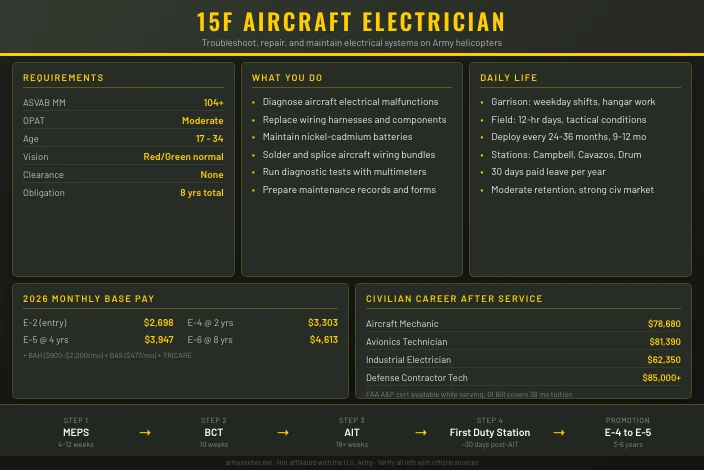
Job Role and Responsibilities
The 15F Aircraft Electrician supervises, inspects, troubleshoots, and performs maintenance on aircraft electrical systems at the aviation unit (AVUM), intermediate (AVIM), and depot levels. This MOS keeps Army rotary-wing aircraft mission-ready by maintaining every electrical circuit, instrument, and wiring harness on board.
What You Do Day to Day
Your mornings usually start with a maintenance schedule and a stack of work orders. A typical shift involves pulling panels off a helicopter, running diagnostic tests on electrical circuits, and tracking down the one bad wire causing an intermittent fault.
Specific daily tasks include:
- Diagnosing and troubleshooting electrical and electronic malfunctions using multimeters, oscilloscopes, and specialized test sets
- Removing, installing, and testing electrical components per the aircraft’s technical manuals
- Repairing and replacing aircraft instrument systems, lighting, and wiring harnesses
- Maintaining nickel-cadmium batteries and monitoring their charge cycles
- Soldering connections and performing wire splicing on aircraft wiring bundles
- Preparing maintenance records and requisitioning replacement parts through the Army supply system
Specialized Roles
As you gain experience, the Army breaks 15F responsibilities into skill levels:
| Skill Level | MOS Code | Ranks | Focus |
|---|---|---|---|
| Skill Level 1 | 15F10 | PV2 through SPC | Hands-on troubleshooting, component replacement, and maintenance documentation |
| Skill Level 2 | 15F20 | SGT | All Level 1 tasks plus technical guidance to junior soldiers and participation in maintenance test flights |
| Skill Level 3 | 15F30 | SSG | Supervising maintenance operations, quality control, trend analysis, and training subordinates |
How This Role Supports the Mission
Combat Aviation Brigades depend on aircraft availability rates. One grounded helicopter means one less medevac, one less resupply run, one less troop movement. Your job directly affects how many birds are on the flight line each morning.
When a UH-60 returns from a mission with a flickering caution panel or a dead radio, the crew chief writes it up. You get the work order. The aircraft doesn’t fly again until you sign off that every electrical system checks good.
Tools and Equipment
You’ll work with a mix of standard electrical tools and aviation-specific test equipment:
- Digital multimeters and oscilloscopes for circuit diagnosis
- Time Domain Reflectometers (TDRs) for locating cable faults
- Wire crimp tools, soldering stations, and heat shrink kits
- Aircraft-specific automated test equipment for Black Hawk and Chinook systems
- Technical manuals and interactive electronic technical manuals (IETMs) on ruggedized laptops
Most of this equipment has direct civilian equivalents. The troubleshooting logic you learn transfers straight to commercial aviation, defense contracting, and industrial electrical work.
Salary and Benefits
Base Pay
Army pay is the same across all MOS codes at the same rank and time in service. The table below shows 2026 monthly base pay for ranks a 15F will typically hold during a first enlistment and beyond.
| Pay Grade | Rank | Monthly Base Pay (under 2 yrs) | Monthly Base Pay (4 yrs) |
|---|---|---|---|
| E-1 | Private (PV1) | $2,407 | $2,407 |
| E-2 | Private (PV2) | $2,698 | $2,698 |
| E-3 | Private First Class (PFC) | $2,837 | $3,198 |
| E-4 | Specialist (SPC) | $3,142 | $3,659 |
| E-5 | Sergeant (SGT) | $3,343 | $3,947 |
| E-6 | Staff Sergeant (SSG) | $3,401 | $4,069 |
These figures don’t include allowances. Most soldiers also receive:
- Basic Allowance for Subsistence (BAS): $476.95/month for food
- Basic Allowance for Housing (BAH): Varies by duty station, rank, and dependency status. A single E-4 can expect roughly $900 to $2,000/month depending on location.
Healthcare and Education
TRICARE Prime covers all medical, dental, vision, and mental health care at zero cost to you while on active duty. Your family members are also covered with no enrollment fees or copays for in-network care.
Education benefits include Tuition Assistance ($4,500/year while serving) and the Post-9/11 GI Bill after separation. The GI Bill covers full in-state tuition at public schools, up to $29,920.95/year at private schools, a monthly housing allowance, and a $1,000/year book stipend for up to 36 months.
Leave and Work-Life Balance
You earn 30 days of paid leave per year, plus 11 federal holidays. Leave accrues at 2.5 days per month. Garrison work schedules in aviation maintenance typically run Monday through Friday with predictable hours, though field exercises and deployment cycles change that.
Retirement
The Blended Retirement System (BRS) combines a pension at 20 years (40% of your highest 36 months of basic pay) with Thrift Savings Plan matching. The government automatically contributes 1% of your basic pay to your TSP and matches up to 4% more if you contribute at least 5%.
Qualifications and Eligibility
Requirements at a Glance
| Requirement | Details |
|---|---|
| ASVAB Line Score | MM (Mechanical Maintenance) 104 or higher |
| OPAT Category | Moderate |
| Age | 17-34 (may vary with waivers) |
| Citizenship | U.S. citizen or permanent resident |
| Education | High school diploma or GED (AFQT 31 for diploma holders, 50 for GED) |
| Security Clearance | None required |
| PULHES | 222222 |
| Color Vision | Normal red/green color perception required |
| Physical Demands | Very heavy: occasional lifts over 100 lbs, frequent lifts of 50 lbs |
The MM composite tests your Numerical Operations, Auto and Shop Information, Mechanical Comprehension, and Electronics Information scores. A 104 is above average, so you’ll need solid mechanical reasoning and electronics knowledge to qualify.
Application Process
Selection Competitiveness
The 15F MOS is a mid-range technical specialty. It’s not as competitive as aviation operations (15P, 15Q) or UAS roles (15W), but the MM 104 requirement filters out candidates who struggle with mechanical and electronics aptitude. About 250 soldiers complete the 15F course each year. Having prior electrical experience or vocational coursework won’t help your ASVAB score directly, but it builds the foundation you’ll need in AIT.
Service Obligation
Most enlistees enter at E-1 (PV1) and owe an 8-year total military service obligation. Active duty terms typically run 3-6 years, with the remainder in the Individual Ready Reserve (IRR). Soldiers with college credits or certain qualifications may enter at E-2 or E-3.
See our ASVAB study guide for strategies to hit these line scores, or take the PiCAT from home if you are a first-time tester.
Work Environment
Setting and Schedule
Aviation maintenance happens in hangars, on flight lines, and sometimes in field conditions under canvas. In garrison at a permanent duty station, you’ll work in a heated and air-conditioned maintenance bay with overhead lighting and tool cribs. The standard shift is daytime, Monday through Friday.
Field rotations change everything. During training exercises at JRTC (Fort Johnson, LA) or NTC (Fort Irwin, CA), you’ll work 12-hour shifts under tactical conditions, often outdoors with portable lighting. Deployment schedules mirror the field: longer hours, austere conditions, and no weekends off.
Leadership and Chain of Command
You’ll report to your section sergeant (typically an E-6 15F30) who answers to the maintenance platoon leader and company commander. Performance feedback comes through the NCOER (NCO Evaluation Report) system for E-5 and above, and through counseling statements for junior enlisted.
Monthly counseling sessions are standard in most aviation units. Your supervisor tracks your technical proficiency, work ethic, and progress toward promotion requirements. Aviation maintenance units tend to have tighter supervision than many other branches because mistakes can be fatal.
Teamwork and Autonomy
Junior electricians (15F10) work under direct supervision at first. You’ll follow technical manual procedures step by step while your team leader watches. As you build confidence and demonstrate competence, you gain more independence on routine tasks.
By E-5, you’re leading a small team and making judgment calls on troubleshooting approaches. At E-6, you run the electrical section and decide how to prioritize work orders across multiple aircraft.
Retention and Satisfaction
Aviation maintenance MOS codes generally have moderate retention rates. Soldiers who enjoy hands-on technical work and can tolerate the field schedule tend to stay. Those who find the repetitive documentation tedious or dislike the physical demands often transition out after their first contract. The strong civilian job market for aircraft electricians gives soldiers a clear exit path, which affects reenlistment numbers.
Training and Skill Development
Initial Training Pipeline
| Phase | Location | Length | Focus |
|---|---|---|---|
| Basic Combat Training (BCT) | Fort Jackson, SC; Fort Moore, GA; or Fort Leonard Wood, MO | 10 weeks | Soldier skills: marksmanship, land navigation, first aid, drill and ceremony |
| Advanced Individual Training (AIT) | Fort Eustis, VA (Joint Base Langley-Eustis), 128th Aviation Brigade | 18 weeks, 4 days | Aircraft electrical systems, troubleshooting, wiring repair, battery maintenance, soldering, and test equipment operation |
BCT turns you into a soldier. You’ll learn to shoot, move, and communicate before you ever touch an aircraft. All MOS codes go through the same BCT curriculum.
AIT is where the real learning starts. The 15F course (602-15F10) at Fort Eustis combines classroom instruction on electrical theory with hands-on labs where you practice on actual UH-60 and CH-47 components. You’ll learn to read wiring diagrams, use test equipment, and trace faults through complex harnesses.
Beyond AIT
Once you reach your first duty station, learning continues through on-the-job training. Senior electricians mentor you on aircraft-specific systems that AIT couldn’t cover in depth. The Army also offers several paths for advanced development:
- Aircraft-specific qualification courses for platforms beyond UH-60 and CH-47 (e.g., AH-64 Apache electrical systems)
- Noncommissioned Officer Education System (NCOES) schools at each promotion gate: Basic Leader Course (BLC) before E-5, Advanced Leader Course (ALC) before E-6, Senior Leader Course (SLC) before E-7
- Functional courses in areas like quality control inspection, maintenance management, and safety
- Civilian certifications through Army Credentialing Assistance, including FAA Airframe and Powerplant (A&P) ratings and electronics technician certifications
The Army pays for most of these training opportunities. Soldiers who chase every available course build a resume that looks strong to both the Army promotion board and civilian employers.
Everything starts with qualifying ASVAB scores — our study guide covers what to study first.
Career Progression and Advancement
Rank Progression
| Pay Grade | Rank | Typical Time in Service | Key Responsibilities |
|---|---|---|---|
| E-1 to E-3 | PV1 through PFC | 0-2 years | Learning the job under supervision, performing basic maintenance tasks |
| E-4 | Specialist (SPC) | 2-3 years | Working independently on standard repairs, beginning to mentor newer soldiers |
| E-5 | Sergeant (SGT) | 3-6 years | Team leader, technical guidance, participation in maintenance test flights |
| E-6 | Staff Sergeant (SSG) | 6-10 years | Section supervisor, quality control, maintenance trend analysis, training program management |
| E-7 | Sergeant First Class (SFC) | 10-16 years | Platoon sergeant or maintenance operations NCOIC, senior technical advisor |
Promotion from E-4 to E-5 depends on your promotion points, which come from military education, awards, physical fitness scores, and your commander’s recommendation. Aviation MOS codes tend to have moderate promotion rates to E-5, with faster advancement for soldiers who complete BLC early and score well on the AFT.
Specialization Opportunities
The 15F MOS itself doesn’t branch into many sub-specialties, but you can pick up Additional Skill Identifiers (ASIs) that expand your qualifications:
- Aircraft-specific ASIs for platforms like the AH-64 Apache or newer rotary-wing systems
- Quality control inspector qualification, which puts you in a gatekeeping role for all maintenance work
- Maintenance test flight evaluator roles, where you ride along on test flights to verify your repairs in the air
Soldiers looking for a broader career change can also apply for reclassification into related MOS codes like 15N (Avionic Mechanic) or 15Y (AH-64D Armament/Electrical/Avionics Systems Repairer). Warrant officer tracks in the 150-series (aviation maintenance technicians) are available for senior NCOs who want to become the Army’s top technical experts without leaving the maintenance field.
Performance Evaluation
The NCOER is the Army’s formal evaluation tool for sergeants and above. Your rater (usually your platoon leader or section OIC) and senior rater (company commander) assess you against Army values, competencies, and your performance in specific duties. Strong NCOERs are the single biggest factor in getting promoted past E-5.
For junior enlisted (E-1 through E-4), monthly counseling and informal feedback from your supervisor shape your development. Your supervisor’s recommendation carries major weight at the E-5 promotion board.
Physical Demands and Medical Evaluations
What the Job Asks of Your Body
The OPAT category for 15F is Moderate, which means you need to pass the standing long jump, seated power throw, deadlift, and interval aerobic run at moderate thresholds during your entry process.
But the day-to-day physical demands are rated very heavy. That disconnect exists because the OPAT measures entry-level screening, not peak job requirements. On the job, you’ll occasionally lift components over 100 lbs and frequently handle loads around 50 lbs. You’ll also spend hours in awkward positions inside cramped aircraft bays, reaching overhead, kneeling on hard surfaces, and working with your arms extended.
A typical workday involves:
- Standing for long periods on concrete hangar floors
- Climbing in and out of helicopter cabins and cargo bays
- Pulling heavy wiring harnesses and electrical panels
- Carrying toolboxes and test equipment between aircraft on the flight line
- Working in extreme temperatures (hangars aren’t always climate-controlled, and the flight line never is)
Army Fitness Test (AFT) Standards
Every soldier must pass the AFT regardless of MOS. The 15F falls under the general standard (not the combat specialty standard). Here are the minimum requirements:
| Event | Minimum Score | Description |
|---|---|---|
| 3 Repetition Maximum Deadlift (MDL) | 60 points | Deadlift for max weight, 3 reps |
| Hand Release Push-Up (HRP) | 60 points | Push-ups with full arm extension at bottom |
| Sprint-Drag-Carry (SDC) | 60 points | 5x50m shuttle with sprint, sled drag, lateral shuffle, carry, and sprint |
| Plank (PLK) | 60 points | Hold plank position for time |
| Two-Mile Run (2MR) | 60 points | Timed 2-mile run |
You need at least 60 points per event and 300 total to pass. These minimums are sex- and age-normed. Scoring well above minimums strengthens your promotion packet.
Medical Standards
Beyond the initial MEPS physical, you’ll complete a Periodic Health Assessment (PHA) annually. Aviation maintenance personnel may also require additional hearing conservation screenings due to flight line noise exposure. Maintain your red/green color vision throughout your career; losing it can trigger a reclassification review.
Deployment and Duty Stations
Where You Could Be Stationed
15F Aircraft Electricians serve wherever the Army flies helicopters. That means Combat Aviation Brigades at major installations across the country and overseas.
Common CONUS (Continental U.S.) duty stations include:
- Fort Campbell, KY (101st Airborne Division)
- Fort Hood, TX (now Fort Cavazos; 1st Cavalry Division, III Corps)
- Fort Drum, NY (10th Mountain Division)
- Fort Bragg, NC (now Fort Liberty; XVIII Airborne Corps)
- Joint Base Lewis-McChord, WA (I Corps)
- Fort Carson, CO (4th Infantry Division)
- Hunter Army Airfield, GA (3rd Infantry Division aviation)
Overseas assignments include Germany (Europe rotations), South Korea (Camp Humphreys), and other forward-deployed locations.
Deployment Cycles
Aviation units deploy on a regular rotation, typically every 24-36 months for 9-12 month deployments. Current deployment tempos vary based on global requirements. Some rotations go to combat zones, while others support missions in Europe, the Pacific, or Africa.
You don’t get to pick your duty station, but the Army does take preferences into account through the Assignment Interactive Module (AIM) marketplace. First-term soldiers generally have less choice than those reenlisting, who can sometimes negotiate a duty station as part of their reenlistment package.
Risk, Safety, and Legal Considerations
Job Hazards
Working on aircraft electrical systems carries specific risks. High-voltage systems, rotating components near the flight line, and hazardous materials (solvents, sealants, battery acid) are part of the job.
The most common hazards include:
- Electrical shock from aircraft power systems
- Hearing damage from flight line operations
- Chemical exposure from cleaning solvents and battery maintenance
- Falls from maintenance stands and aircraft work platforms
- Repetitive strain injuries from prolonged awkward positions inside aircraft
Safety Protocols
Army aviation maintenance follows strict Technical Manual procedures for every task. You never freelance a repair. Lockout/tagout procedures protect you when working on powered systems. Personal protective equipment (PPE) requirements include:
- Hearing protection on the flight line (double protection in some areas)
- Safety glasses and chemical-resistant gloves for solvent work
- Fall protection harnesses when working at height
- Anti-static wrist straps when handling sensitive electronics
Security and Legal
The 15F MOS does not require a security clearance. Your enlistment contract commits you to an 8-year total military service obligation, with the active duty portion typically running 3-6 years.
If you deploy to a conflict zone, you follow the same rules of engagement and legal frameworks as every other soldier. Aviation maintenance personnel carry weapons during deployments and complete weapons qualification annually.
Impact on Family and Personal Life
What Your Family Should Expect
Garrison life for a 15F is relatively predictable compared to combat arms MOS codes. Standard duty hours, weekends off, and a permanent duty station give your family stability most of the year.
Field rotations and deployments disrupt that. You’ll spend 3-4 weeks at a time away from home during major training exercises, and 9-12 months during a full deployment. The frequency depends on your unit’s rotation cycle.
Family Support Programs
The Army provides support through several channels:
- Army Community Service (ACS): Financial planning, relocation help, family advocacy
- Military Family Life Counseling: Free, confidential counseling for soldiers and family members
- Child Development Centers: On-post childcare at subsidized rates
- Spouse employment programs: Job search assistance, career coaching, and portable career resources
- Family Readiness Groups (FRGs): Unit-level support networks that stay active during deployments
BAH rates for soldiers with dependents are higher than single rates, and TRICARE covers your entire family at no enrollment cost. These benefits offset some of the disruption that comes with military life.
PCS Moves
Expect to change duty stations every 2-4 years. The Army pays for your move (household goods shipment, travel allowance, temporary housing) through the Permanent Change of Station system. Families with school-age children often feel these moves the most. The Interstate Compact on Educational Opportunity for Military Children helps smooth school transitions across state lines.
Reserve and National Guard
The 15F MOS is available in both the Army Reserve and the Army National Guard. Aviation units in both components maintain aircraft that need qualified electricians, making 15F slots reasonably available across the country. Skill-level ceilings match active duty, so career progression to senior NCO or warrant officer is possible in either component.
The part-time track works well for soldiers who want to build civilian aviation credentials alongside their military service. Aircraft electrical experience transfers directly to civilian work, so Reserve or Guard service lets you grow both careers at the same time.
Drill Schedule and Training Commitment
One weekend per month and two weeks of annual training each year is the baseline. For 15F soldiers, that schedule can expand. Electrical system certifications require periodic renewal, and specific airframes use different wiring standards and system architectures. When a unit transitions to a new aircraft type or receives a major system upgrade, additional training days often follow. Wiring diagram training and avionics system updates may bring 15F soldiers in for extra sessions beyond the standard drill calendar.
Aviation units also tend to run more maintenance exercises than non-aviation units, which means the real annual time commitment often exceeds the minimum.
Part-Time Pay and Benefits
Drill pay at E-4 with about four years of service runs approximately $488 per drill weekend. Over 12 weekends per year, that’s roughly $5,856 in annual drill pay. Active-duty E-4 base pay is $3,659 per month, so the income difference is substantial if you leave active duty for the Reserve or Guard.
Off active orders, Reserve and Guard soldiers use Tricare Reserve Select for healthcare: $57.88 per month for individual coverage and $286.66 per month for family coverage. Active-duty soldiers pay nothing for TRICARE Prime. Education benefits for Reserve and Guard members include the Montgomery GI Bill - Selected Reserve (Chapter 1606) and Federal Tuition Assistance. Guard members often get state tuition waivers that can cover a large portion of in-state college costs. After a qualifying mobilization, you may earn eligibility for the Post-9/11 GI Bill (Chapter 33), which has higher annual benefits than the MGIB-SR.
Deployment and Mobilization
Reserve and Guard 15F soldiers face moderate mobilization rates. Aviation units deploy with their aircraft, and electrical specialists are essential to keeping those aircraft mission-ready in theater. Since 2001, aviation maintenance units have been called up for both combat operations and peacekeeping missions. A typical mobilization runs 9 to 12 months including pre-deployment preparation.
Active-duty electricians deploy on a more predictable schedule tied to unit rotation cycles. Reserve and Guard deployments are less frequent but less predictable. When mobilized, your pay moves to active-duty rates and your healthcare shifts to TRICARE Prime for the duration of the orders.
Civilian Career Integration
Aircraft electrical skills have strong civilian demand. With Army 15F experience, you can pursue FAA Airframe and Powerplant (A&P) certification, which is the standard credential for civilian aircraft maintenance roles. From there, paths include aircraft electrician positions at commercial airlines, avionics shops at regional airports, aerospace manufacturing quality control roles, and contract work supporting defense programs.
Major aviation employers like Delta, United, Boeing, Northrop Grumman, and L3Harris hire aircraft electricians with military backgrounds. The Reserve or Guard path lets you work in a civilian aviation electrical job full-time while maintaining your military electrical qualification. These two tracks reinforce each other. Employers in civilian aviation value current military experience, and military qualifications often satisfy portions of FAA certification requirements. USERRA protects your civilian aviation job if you are mobilized, requiring your employer to restore your position when you return.
| Feature | Active Duty | Army Reserve | Army National Guard |
|---|---|---|---|
| Commitment | Full-time | One weekend/month, two weeks/year | One weekend/month, two weeks/year |
| Monthly Pay (E-4, ~4 yrs) | $3,659 | ~$488/drill weekend | ~$488/drill weekend |
| Healthcare | TRICARE Prime, $0 premiums | Tricare Reserve Select, $57.88/month | Tricare Reserve Select, $57.88/month |
| Education | Post-9/11 GI Bill | Federal TA, MGIB-SR | Federal TA, MGIB-SR, state tuition waivers |
| Deployment | Regular rotations | Mobilization-based | Mobilization-based, plus state activations |
| Retirement | 20-year pension, immediate | Points-based, age 60 | Points-based, age 60 |
Post-Service Opportunities
How This MOS Translates to Civilian Work
The 15F gives you hands-on experience with aircraft electrical systems that civilian employers value. The troubleshooting skills, technical manual discipline, and safety culture you learn transfer directly to several industries.
While still serving, you can pursue an FAA Airframe and Powerplant (A&P) certificate through Army credentialing programs. The A&P is the gold standard for civilian aircraft maintenance jobs. Your military experience counts toward the experience requirements, and many soldiers finish their A&P testing before they separate.
Civilian Career Prospects
| Civilian Job Title | Median Annual Salary | Job Outlook (2024-2034) |
|---|---|---|
| Aircraft Mechanic / Service Technician | $78,680 | 5% growth (faster than average) |
| Avionics Technician | $81,390 | 5% growth (faster than average) |
| Industrial Electrician | $62,350 | 9% growth (much faster than average) |
Salaries vary by region and employer. Aviation maintenance jobs at major airlines and defense contractors (Lockheed Martin, Boeing, L3Harris) often pay above the median figures shown here. Overtime is common in civilian aviation maintenance and can push annual earnings well past six figures for experienced technicians.
Transition Programs
The Army’s Soldier for Life - Transition Assistance Program (SFL-TAP) starts 18 months before your separation date. You’ll attend workshops on resume writing, interview skills, and translating military experience into civilian language. The DOD SkillBridge program lets eligible soldiers do a civilian internship during their last 180 days of service while still receiving military pay and benefits.
Veterans can also use the GI Bill to pursue an associate’s or bachelor’s degree in aviation maintenance technology, electrical engineering technology, or a related field. This stacks on top of your hands-on experience and makes you competitive for supervisory roles.
Is This a Good Job for You? The Right (and Wrong) Fit
Who Thrives as a 15F
This job fits people who like solving puzzles with their hands. You need patience for methodical troubleshooting and comfort with detailed technical manuals. The best aircraft electricians share a few traits:
- Mechanical curiosity. You took things apart as a kid and wanted to know how they worked.
- Attention to detail. Missing a single wire connection can ground an aircraft or worse. You need to be the kind of person who double-checks their work without being told.
- Physical stamina. You’ll spend hours in uncomfortable positions. If you can’t tolerate kneeling, reaching overhead, and lifting heavy objects, this job will wear you down.
- Calm under pressure. When a helicopter is grounded and the commander needs it flying in two hours, you need to think clearly and work fast without cutting corners.
Who Should Look Elsewhere
The 15F is not a good fit if:
- You dislike repetitive documentation. Every repair requires detailed paperwork. Some soldiers spend as much time writing up maintenance forms as they do turning wrenches.
- You want regular office hours with no field time. Aviation units go to the field, and you go with them.
- You have red/green color vision deficiency. This is a hard disqualifier with no waiver.
- You prefer working alone. Aircraft maintenance is team work. You’ll always be coordinating with crew chiefs, other mechanics, and quality control inspectors.
Long-Term Fit
The 15F works well as both a career MOS and a stepping stone. Soldiers who stay in can progress to senior NCO positions and eventually the 15Z (Aircraft Senior Sergeant) supervisory track. Those who leave after one enlistment walk out with 4-6 years of aircraft electrical experience, potential FAA certifications, and a GI Bill that can fund additional education.
If you’re undecided between military career and civilian transition, the 15F keeps both doors open wider than most MOS codes.
More Information
Talk to your local Army recruiter to find out if 15F slots are available and whether you qualify based on your ASVAB scores. They can also tell you about current enlistment bonuses for this MOS, which change throughout the year based on the Army’s manning needs. Call 1-888-550-ARMY (2769) or visit your nearest recruiting station.
- Prepare for the ASVAB with our study guide to make sure your line scores qualify
This site is not affiliated with the U.S. Army or any government agency. Verify all information with official Army sources before making enlistment or career decisions.
Explore more Army aviation careers such as 15T UH-60 Helicopter Repairer and 15U CH-47 Helicopter Repairer.