15G Aircraft Structural Repairer
Army aircraft don’t just fly out of luck. Every rivet, panel, and structural weld has to meet strict tolerances before a pilot climbs in. The 15G Aircraft Structural Repairer is the soldier who keeps the airframe itself in spec. You patch battle damage, repair corrosion, replace skin sections, and certify the structure is safe to fly. If you want a hands-on technical trade with real consequences and a direct path to FAA certification, this MOS is worth a close look.
Qualifying requires specific ASVAB line scores — our ASVAB study guide covers what to target and how to prepare.
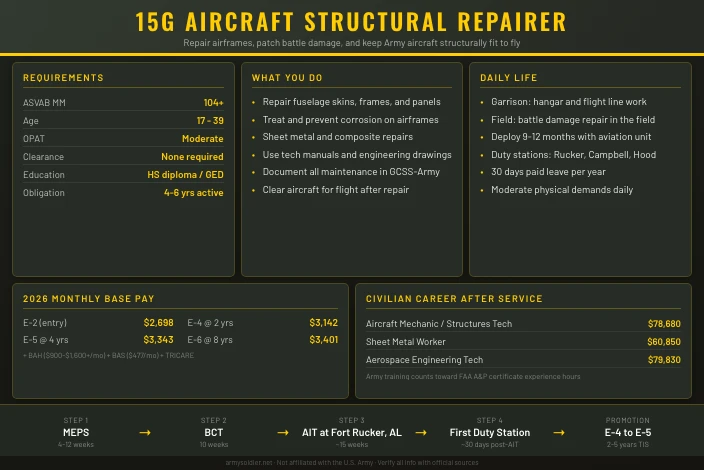
Job Role and Responsibilities
The 15G Aircraft Structural Repairer maintains the structural integrity of Army fixed-wing and rotary-wing aircraft. You inspect, repair, and replace airframe components including fuselage skins, frames, stringers, longerons, control surfaces, and access panels. Work is performed using technical manuals, engineering drawings, and aircraft maintenance data systems.
A garrison day usually starts with a scheduled inspection cycle. You open an aircraft maintenance order, review the task card, and work through the job step by step. That might mean removing a damaged belly panel, mapping corrosion with a depth gauge, cutting out the affected section, and bonding or riveting in a repair doubler. Every step is documented before the panel goes back on.
Field operations shift the pace. Aircraft take damage from rotor wash debris, rough landings, and hard use in austere environments. You assess damage quickly, determine whether it falls within allowable limits or requires a structural repair, and execute the fix with whatever materials you have on hand.
Specific Roles
The 15G is the base structural maintenance MOS. Soldiers build specialization through Additional Skill Identifiers (ASIs):
| Identifier | Description |
|---|---|
| ASI H8 | Advanced structural repair techniques |
| ASI R1 | Rotary-wing structural qualification |
Mission Contribution
Aviation units depend on structural repairers to keep aircraft in the fight. A single grounded aircraft cuts a unit’s mission capability. When a UH-60 takes a hard landing and cracks a main landing gear support fitting, the 15G is who makes the call on whether that airframe flies again today or goes back to depot.
Equipment
You work with sheet metal tools, rivet guns, pneumatic drills, bonding equipment, corrosion control compounds, and composite repair kits. Technical publications and maintenance management systems like GCSS-Army govern every task. On some platforms you’ll also work with fiberglass and honeycomb sandwich structure panels common in rotary-wing aircraft.
Salary and Benefits
Army pay is set by rank and time in service. The table below shows 2026 monthly base pay for the most common grades in this MOS.
| Rank | Grade | Monthly Base Pay (entry) |
|---|---|---|
| Private (PV2) | E-2 | $2,698 |
| Private First Class (PFC) | E-3 | $2,837 |
| Specialist (SPC) | E-4 | $3,142 |
| Sergeant (SGT) | E-5 | $3,343 |
| Staff Sergeant (SSG) | E-6 | $3,401 |
Source: DFAS 2026 military pay chart.
Base pay is only part of the picture. Most soldiers also receive:
- Basic Allowance for Housing (BAH): Varies by duty location, pay grade, and dependent status. A single E-4 at many CONUS installations receives $900-$1,600+ per month tax-free.
- Basic Allowance for Subsistence (BAS): $476.95/month (2026 rate) for all enlisted soldiers.
- TRICARE: Full medical, dental, and vision coverage for you and your family at no cost on active duty.
Additional Benefits
The Army’s Blended Retirement System (BRS) combines a pension with a Thrift Savings Plan (TSP) contribution. After 20 years of service, the pension pays 40% of your average high-36 basic pay monthly for life. The government also contributes up to 5% of basic pay to your TSP account starting in your third year.
Tuition Assistance covers up to $4,500 per year for college courses taken during service. After separation, the Post-9/11 GI Bill covers full in-state tuition at public schools plus a monthly housing allowance for up to 36 months.
Work-Life Balance
Active duty soldiers earn 30 days of paid leave per year. Aviation maintenance units work demanding schedules around deployment cycles and exercise rotations. In garrison, a standard duty day runs from morning formation through late afternoon, though extended maintenance periods can stretch hours significantly.
Qualifications and Eligibility
| Requirement | Details |
|---|---|
| ASVAB Score | MM: 104 (Mechanical Maintenance composite) |
| Citizenship | U.S. citizen or permanent resident alien |
| Age | 17-39 (waiver possible to 42) |
| Education | High school diploma or GED |
| Physical | OPAT: Moderate category |
| Security Clearance | None required at accession |
| Vision | Correctable to 20/20 |
| Color Vision | Required (some color perception standards apply for wiring and material identification) |
The MM (Mechanical Maintenance) composite draws from four ASVAB subtests: General Science (GS), Auto and Shop Information (AS), Mathematics Knowledge (MK), and Electronics Information (EI). Scoring 104 requires solid performance across all four.
Application Process
You’ll take the ASVAB at a Military Entrance Processing Station (MEPS). If you meet the line score requirement and pass the physical, you can contract for this MOS. The recruiter will confirm current seat availability and any bonus offerings tied to this specialty at the time you enlist.
Selection and Competitiveness
This is a technical MOS with a moderately high MM line score requirement. Candidates with mechanical aptitude or prior experience in bodywork, construction, or sheet metal fabrication tend to score well. The MOS is not a combat arms specialty, but aviation maintenance units do deploy regularly.
Service Obligation
Most enlistments for technical aviation MOSs carry a four-to-six year active duty obligation. Your contract will specify the exact term.
See our ASVAB study guide for strategies to hit these line scores, or take the PiCAT from home if you are a first-time tester.
Work Environment
Aircraft structural repair takes place in hangars, flight lines, maintenance bays, and field environments. You’ll work in all weather conditions when aircraft are deployed. Confined spaces are common when working inside fuselages or cargo bays.
Garrison maintenance follows a structured schedule tied to phase, periodic, and unscheduled inspections. The chain of command in an aviation maintenance company runs from the crew chief level through platoon sergeant and maintenance officer. NCOs provide direct technical supervision on most tasks.
Team Dynamics
Most structural repair work happens in small teams of two to four soldiers working a single aircraft. You’ll coordinate closely with other specialty MOS holders, including aircraft powerplant repairers (15B), pneudraulics repairers (15H), and electricians (15F), when a maintenance task overlaps multiple systems. Individual accountability is high because every repair you sign off goes into the aircraft’s permanent record.
Job Satisfaction
Aviation maintenance soldiers generally report high job satisfaction tied to the tangible nature of the work. When you fix an aircraft and it flies the next morning, the feedback loop is direct. Retention rates in CMF 15 tend to be solid, though tempo can be demanding at units with high operational commitments.
Training and Skill Development
| Phase | Location | Duration | Focus |
|---|---|---|---|
| Basic Combat Training (BCT) | Various installations | 10 weeks | Soldier skills, weapons, physical conditioning |
| Advanced Individual Training (AIT) | Fort Rucker, AL | ~15 weeks | Structural repair techniques, aircraft systems, technical manual use |
BCT and AIT are separate courses. BCT is conducted at one of several Army training installations. AIT for 15G is at Fort Rucker, Alabama, the home of Army aviation. The 2nd Battalion, 210th Aviation Regiment trains this MOS.
AIT covers aircraft identification and structural theory, reading engineering drawings, corrosion prevention and treatment, sheet metal repair, composite and fiberglass repair, and hands-on work on training airframes. You graduate with a working knowledge of structural repair across multiple Army aircraft platforms.
Advanced Training
After establishing yourself at your first duty station, opportunities open up for additional qualifications. Soldiers can attend:
- Hazardous Materials Handler course for working with corrosion compounds and bonding agents
- Composite Repair courses as aircraft with more composite structure enter the fleet
- Warrant Officer Candidate School (WOCS) for soldiers who want to pursue a 153A Aviation MOS officer track
- Noncommissioned Officer courses at each promotion point (PLDC, BNCOC, ANCOC)
The Army also supports college enrollment through on-post education centers. Many aviation maintenance soldiers pursue associate or bachelor’s degrees in aviation maintenance or aviation technology during off-duty hours.
Everything starts with qualifying ASVAB scores — our study guide covers what to study first.
Career Progression and Advancement
| Rank | Grade | Typical Time in Grade | Role |
|---|---|---|---|
| Private First Class | E-3 | First year | AIT graduate, learning procedures |
| Specialist (SPC) | E-4 | 1-2 years TIS | Crew member, completing tasks under supervision |
| Sergeant (SGT) | E-5 | 2-5 years TIS | Team leader, signing off tasks |
| Staff Sergeant (SSG) | E-6 | 5-8 years TIS | Section leader, quality control |
| Sergeant First Class (SFC) | E-7 | 8-14 years TIS | Platoon Sergeant, maintenance management |
| Master Sergeant (MSG) | E-8 | 14-20+ years TIS | Senior NCO, battalion-level maintenance |
Promotion to E-4 is semi-automatic within the first two years for most soldiers who meet basic standards. From E-5 onward, promotion is competitive and based on the Army’s centralized promotion board system, which evaluates NCOER scores, military education completion, and physical fitness.
Role Flexibility
Lateral transfers within CMF 15 are possible after soldiers complete initial service obligations. A 15G who wants to move to a more avionics-focused role can attend reclassification training for another 15-series MOS. Inter-branch reclassification is also available after meeting time-in-service thresholds.
Performance Evaluation
NCOs receive a Noncommissioned Officer Evaluation Report (NCOER) annually. Evaluation criteria include technical knowledge, leadership, physical fitness, and adherence to Army values. Strong NCOERs are the primary driver of competitive promotion.
Physical Demands and Medical Evaluations
The OPAT for MOS 15G falls in the Moderate category. You need to demonstrate the ability to lift, push, and maneuver within moderate physical demand standards before contracting for this MOS.
Daily physical demands include:
- Lifting and carrying aircraft components, tool boxes, and maintenance equipment (30-50 lbs regularly)
- Working overhead in confined fuselage spaces
- Kneeling and bending during extended maintenance tasks
- Operating pneumatic tools in sustained work cycles
The Army Fitness Test (AFT), effective June 1, 2025, has five events:
| Event | Abbreviation |
|---|---|
| 3 Repetition Maximum Deadlift | MDL |
| Hand Release Push-Up | HRP |
| Sprint-Drag-Carry | SDC |
| Plank | PLK |
| Two-Mile Run | 2MR |
Each event scores 0-100 points. The minimum passing score is 60 per event, with a 300 total minimum for the general standard. The AFT is sex- and age-normed for non-combat MOSs. There is no MOS-specific combat standard for 15G.
Medical Evaluations
Initial entry medical screening at MEPS screens for conditions that would disqualify service. Periodic occupational health evaluations include hearing conservation monitoring, because aviation maintenance environments involve high noise exposure from engines and pneumatic tools. Hearing protection is mandatory on the flight line.
Deployment and Duty Stations
Aviation maintenance units deploy with the aircraft they support. Combat aviation brigades (CABs) have deployed to Iraq, Afghanistan, Kuwait, and other locations. Typical deployment lengths run nine to twelve months on active duty.
Common 15G duty stations include Fort Rucker (Alabama), Fort Campbell (Kentucky), Fort Hood (Texas), Fort Bragg/Fort Liberty (North Carolina), Hunter Army Airfield (Georgia), and overseas locations in Korea, Germany, and Japan.
Assignment preferences can be submitted, but the Army fills positions based on unit needs. Soldiers with family considerations can request certain locations, and the Army works to accommodate when possible within mission requirements.
Risk, Safety, and Legal Considerations
Aircraft structural repair carries specific occupational hazards:
- Chemical exposure: Corrosion inhibitors, bonding agents, and epoxy compounds require proper PPE (respirators, gloves, safety glasses)
- Noise: Extended time on the flight line near running aircraft requires hearing protection
- Fall hazards: Working on aircraft platforms and inside fuselages at height requires fall protection awareness
- Tool accountability: FOD (foreign object debris) is a flight safety issue; tool kits are inventoried before and after every job
Safety is enforced through technical manual compliance, crew coordination, and Maintenance Safety Officer oversight. Every repair is inspected by a quality control NCO or officer before the aircraft is returned to flight status.
Security and Legal Requirements
No security clearance is required to enlist for this MOS, though access to certain systems and facilities may require a favorable background check. Soldiers sign a service contract outlining their obligations, including deployment and reassignment. UCMJ applies throughout service.
Impact on Family and Personal Life
Aviation maintenance units operate with deployment rotations that typically run nine to twelve months, followed by a reset period before the next cycle. Families based near major aviation installations have access to on-post housing, Family Readiness Groups (FRGs), and Military OneSource support services.
PCS (permanent change of station) moves occur on average every two to three years. Soldiers can submit assignment preferences through the Army’s assignment system, but approvals depend on available positions and unit requirements.
Relocation
Spouses and children PCS with the soldier. JFTR entitlements cover moving costs for household goods. Many aviation installations have strong school systems nearby and established military communities that ease transitions.
Reserve and National Guard
The 15G MOS is available in both the Army Reserve and the Army National Guard. Aviation battalions in both components require structural repairers to maintain airframe integrity on rotary-wing aircraft. Slot availability tracks closely with where aviation units are based, so access varies by state for Guard positions.
Skill-level ceilings are the same as active duty. Senior NCO advancement and warrant officer candidacy are both open paths in the Reserve and Guard. For 15G soldiers, the part-time track works particularly well because sheet metal and composite repair skills build directly toward high-demand civilian certifications.
Drill Schedule and Training Commitment
The standard commitment is one weekend per month and two weeks of annual training each year. For 15G soldiers, composite repair certifications and sheet metal proficiency require periodic practice and renewal. When aviation units receive new aircraft or updated structural repair standards, additional training days can be added to the schedule. Composite materials in newer Army aviation platforms evolve, and staying current means showing up for more than just the minimum drill days in some years.
Aviation units across the Reserve and Guard also tend to schedule additional maintenance exercises to meet aircraft readiness requirements, which often pull structural repairers in beyond the standard schedule.
Part-Time Pay and Benefits
At E-4 with roughly four years of service, drill pay runs approximately $488 per drill weekend. Over 12 drill weekends per year, that comes to about $5,856 in annual drill pay. Active-duty E-4 base pay is $3,659 per month, a significant gap. Annual training and mobilization periods pay at active-duty daily rates.
Off active orders, healthcare comes through Tricare Reserve Select at $57.88 per month for member-only coverage or $286.66 per month for family coverage. Active-duty soldiers pay nothing in premiums for TRICARE Prime. Education benefits available to Reserve and Guard 15G soldiers include the Montgomery GI Bill - Selected Reserve (Chapter 1606), Federal Tuition Assistance, and state tuition waivers for Guard members that vary by state. A qualifying mobilization can open access to the Post-9/11 GI Bill (Chapter 33), which is more valuable than the MGIB-SR for most education goals.
Deployment and Mobilization
Mobilization rates for aviation structural repairers in the Reserve and Guard are moderate. Aviation units deploy for combat and peacekeeping operations, and aircraft structural integrity requirements don’t pause in a deployed environment. Since 2001, aviation maintenance units have been called up regularly, and 15G soldiers go with their aircraft. A typical mobilization runs 9 to 12 months.
Active-duty soldiers deploy on predictable rotation cycles. Reserve and Guard mobilizations are less frequent but less predictable in timing. When mobilized, pay shifts to active-duty rates and healthcare upgrades to TRICARE Prime for the duration of the orders.
Civilian Career Integration
Sheet metal and composite repair skills from the 15G MOS transfer directly to some of the most in-demand civilian aviation maintenance roles. Composite repair technicians are sought after at airlines, MROs, aerospace manufacturers, and defense contractors. The demand for composite skills is growing as commercial aviation shifts toward carbon fiber and advanced materials on newer airframes.
With Army 15G experience, you can work toward FAA Airframe and Powerplant (A&P) certification, which covers airframe structural work. Sheet metal mechanics and composite repair specialists work at companies like Boeing, Spirit AeroSystems, Textron, and Bell Helicopter. Pay in civilian composite repair roles is competitive, and the military credential adds credibility with employers who service military contracts. The Reserve or Guard lets you work in civilian structural maintenance while keeping your military qualification active. USERRA protects your civilian job if you are mobilized, and your employer must restore your position when you return.
| Feature | Active Duty | Army Reserve | Army National Guard |
|---|---|---|---|
| Commitment | Full-time | One weekend/month, two weeks/year | One weekend/month, two weeks/year |
| Monthly Pay (E-4, ~4 yrs) | $3,659 | ~$488/drill weekend | ~$488/drill weekend |
| Healthcare | TRICARE Prime, $0 premiums | Tricare Reserve Select, $57.88/month | Tricare Reserve Select, $57.88/month |
| Education | Post-9/11 GI Bill | Federal TA, MGIB-SR | Federal TA, MGIB-SR, state tuition waivers |
| Deployment | Regular rotations | Mobilization-based | Mobilization-based, plus state activations |
| Retirement | 20-year pension, immediate | Points-based, age 60 | Points-based, age 60 |
Post-Service Opportunities
The civilian aviation maintenance industry has a significant hiring pipeline for veterans with Army structural repair backgrounds. The FAA’s Airframe and Powerplant (A&P) certificate is the primary credential, and Army training provides much of the required experience hours.
| Civilian Job Title | Median Annual Salary (BLS, May 2024) | Job Outlook (2024-2034) |
|---|---|---|
| Aircraft Mechanic / Structures Technician | $78,680 | +5% (faster than average) |
| Sheet Metal Worker | $60,850 | +2% |
| Aerospace Engineering Technician | $79,830 | +3% |
Source: Bureau of Labor Statistics Occupational Outlook Handbook.
Commercial aviation, helicopter operators, defense contractors, and aircraft MRO (maintenance, repair, and overhaul) facilities all hire veterans with hands-on structural experience. The GI Bill can fund an aviation maintenance technology degree or bridge course to accelerate A&P certification.
The Army’s Transition Assistance Program (TAP) provides pre-separation career counseling, resume writing, and employment workshops.
Is This a Good Job for You? The Right (and Wrong) Fit
This MOS fits people who like working with their hands on complex systems, take pride in precise technical work, and want a trade skill they can carry into a civilian career. If you scored well on the mechanical sections of the ASVAB and have ever fixed a car, worked sheet metal, or built something structural, you’ll find familiar logic in the work.
The wrong fit is someone who wants a desk job, dislikes physical labor, or expects aviation work to look like the movies. Structural repair is often dirty, loud, and happens in awkward positions inside tight spaces. The hours can be long during operational cycles.
Long-term, this MOS sets up well for someone who wants to work in commercial aviation as an A&P mechanic, in defense manufacturing, or in construction management. The mechanical discipline translates broadly.
More Information
Talk to an Army recruiter to find out if 15G seats are currently available and whether any enlistment incentives apply. Recruiters can pull current bonus schedules and advise on ASVAB preparation for the MM composite. You can find a local recruiter at goarmy.com or by calling 1-888-550-ARMY.
- Prepare for the ASVAB with our study guide to make sure your line scores qualify
This site is not affiliated with the U.S. Army or any government agency. Verify all information with official Army sources before making enlistment or career decisions.
Explore more Army aviation careers such as 15R AH-64 Attack Helicopter Repairer and 15H Aircraft Pneudraulics Repairer.