15H Aircraft Pneudraulics Repairer
Every time a helicopter lowers its landing gear or a pilot squeezes the brakes on touchdown, a pneudraulic system is doing the work. These systems combine hydraulic fluid pressure with compressed air to power landing gear, flight controls, brakes, rotor head components, and utility systems across Army rotary-wing aircraft. The 15H Aircraft Pneudraulics Repairer is the soldier who keeps them functional. It’s a niche specialty with a clear civilian career path, and the Army trains you from scratch.
Qualifying requires specific ASVAB line scores — our ASVAB study guide covers what to target and how to prepare.
Job Role and Responsibilities
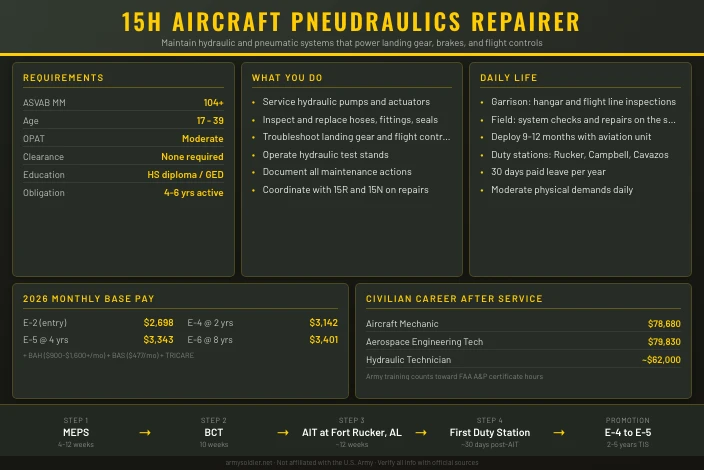
The 15H Aircraft Pneudraulics Repairer inspects, maintains, troubleshoots, and repairs the pneudraulic systems on Army aircraft. You service hydraulic pumps, actuators, reservoirs, servo valves, landing gear assemblies, and compressed-air accumulators. Work follows technical manual procedures and requires precise attention to pressure specifications and fluid cleanliness.
A typical garrison maintenance day starts with a phase or periodic inspection task. You drain and flush a hydraulic reservoir, inspect hoses and fittings for chafing or leaks, replace filter elements, and return the system to service after a functional test. Every squawk that comes back from the flight crew gets documented and investigated.
Troubleshooting is the most mentally demanding part of the job. When a pilot reports sluggish flight control response or landing gear that won’t retract, you isolate the fault using system schematics, pressure gauges, and test equipment. Pneudraulic systems have few obvious failure indicators, so systematic diagnosis matters.
Specific Roles
The base MOS is 15H. Soldiers gain additional qualifications through ASIs as they progress:
| Identifier | Description |
|---|---|
| ASI H4 | Hydraulic test stand operator |
| ASI R1 | Rotary-wing pneudraulic qualification |
Mission Contribution
Landing gear that won’t lock down or hydraulic flight controls that lose pressure mid-flight are mission-ending emergencies. The 15H ensures those systems never reach that point through disciplined preventive maintenance and fast, accurate troubleshooting when problems do occur. Aviation units at combat readiness rates depend directly on their pneudraulics repairers.
Equipment
You’ll work with hydraulic test stands, pressure gauges, torque wrenches, flushing equipment, contamination analysis kits, and aircraft-specific ground support equipment. The fluid systems on Army aircraft operate at pressures up to 3,000 psi, so procedure adherence isn’t optional.
Salary and Benefits
Monthly base pay is determined by rank and years of service. The 2026 figures below reflect current DFAS rates.
| Rank | Grade | Monthly Base Pay (entry) |
|---|---|---|
| Private (PV2) | E-2 | $2,698 |
| Private First Class (PFC) | E-3 | $2,837 |
| Specialist (SPC) | E-4 | $3,142 |
| Sergeant (SGT) | E-5 | $3,343 |
| Staff Sergeant (SSG) | E-6 | $3,401 |
Source: DFAS 2026 military pay chart.
Beyond base pay:
- BAH: Tax-free housing allowance that varies by duty location, grade, and dependency status. Ranges from roughly $900 to over $1,600 per month at most CONUS installations for an E-4.
- BAS: $476.95/month food allowance (2026 rate) for all enlisted soldiers.
- TRICARE: Full health, dental, and vision coverage for you and dependents at no cost on active duty.
Additional Benefits
The Blended Retirement System (BRS) pairs a 20-year pension at 40% of high-36 basic pay with automatic and matching government TSP contributions. The government contributes up to 5% of basic pay when you contribute 5% to your TSP, starting in your third year.
Army Tuition Assistance covers up to $4,500 per year for college. The Post-9/11 GI Bill provides full in-state tuition at public universities plus a housing allowance for up to 36 months after separation.
Work-Life Balance
Soldiers earn 30 days paid leave annually. Aviation maintenance schedules are driven by operational tempo. Garrison phases allow for reasonably predictable hours; pre-deployment and deployment periods can mean extended hours and weekend maintenance.
Qualifications and Eligibility
| Requirement | Details |
|---|---|
| ASVAB Score | MM: 104 (Mechanical Maintenance composite) |
| Citizenship | U.S. citizen or permanent resident alien |
| Age | 17-39 (waiver possible) |
| Education | High school diploma or GED |
| Physical | OPAT: Moderate category |
| Security Clearance | None required at accession |
| Color Vision | Required for fluid identification and wiring tasks |
The MM composite combines four subtests: General Science (GS), Auto and Shop Information (AS), Mathematics Knowledge (MK), and Electronics Information (EI). A score of 104 requires solid mechanical reasoning and basic math skills.
Application Process
The path starts with the ASVAB and a MEPS physical. If you meet the MM score and pass medical screening, your recruiter can contract you for this MOS. Ask your recruiter about current seat availability and any bonus eligibility.
Selection and Competitiveness
Candidates who have worked on cars, motorcycles, or mechanical equipment tend to pick up the hydraulic systems concepts faster. The MOS isn’t oversubscribed, so qualified applicants generally have a good shot at contracting for it.
Service Obligation
Technical aviation MOSs typically carry a four-to-six year active duty obligation. Your contract will define the exact term.
See our ASVAB study guide for strategies to hit these line scores, or take the PiCAT from home if you are a first-time tester.
Work Environment
Pneudraulics repairers work in hangars, on flight lines, and in field conditions during exercises and deployments. Hydraulic systems maintenance requires a clean environment, which means hangar work is preferred over open-air when possible.
The 1st Battalion, 210th Aviation Regiment at Fort Rucker trains this MOS. At operational units, you’ll work within an aviation maintenance company alongside other 15-series specialty holders.
Leadership and Communication
NCOs lead maintenance teams and are responsible for technical oversight of every job. Soldiers receive periodic counseling on performance, and NCOERs are the primary evaluation mechanism for E-5 and above. Aviation safety reporting is a required communication path, with any safety concern reportable up the chain without fear of reprisal.
Team Dynamics
Pneudraulic repairs often involve coordinating with the 15R (airframe repairer) when landing gear structural interfaces are involved, or with the 15N avionic mechanic when electrical signals drive hydraulic servo valves. Multi-specialty coordination is common on complex maintenance events.
Training and Skill Development
| Phase | Location | Duration | Focus |
|---|---|---|---|
| Basic Combat Training (BCT) | Various installations | 10 weeks | Soldier skills, weapons, fitness |
| Advanced Individual Training (AIT) | Fort Rucker, AL | ~12 weeks | Hydraulic/pneumatic systems, troubleshooting, aircraft-specific procedures |
AIT at Fort Rucker covers hydraulic theory, component identification, system schematics, leak detection, fluid cleanliness requirements, and hands-on maintenance tasks. Training includes work on actual aircraft systems and test stands.
Fort Rucker was redesignated from Fort Novosel back to Fort Rucker in July 2025 by the Secretary of the Army.
Advanced Training
Experienced 15H soldiers can pursue:
- Hydraulic Test Stand certification for advanced component testing
- Quality Assurance evaluator qualification for certifying other soldiers’ work
- Senior Leader Course (SLC) at promotion to SSG
- Warrant Officer Candidate School (WOCS) for soldiers targeting a technical warrant officer track
The Army’s Credentialing Assistance program and COOL (Credentialing Opportunities On-Line) identify civilian certifications relevant to this MOS that the Army will fund.
Everything starts with qualifying ASVAB scores — our study guide covers what to study first.
Career Progression and Advancement
| Rank | Grade | Typical Time in Service | Role |
|---|---|---|---|
| Private First Class (PFC) | E-3 | First year | Learning fundamentals at first unit |
| Specialist (SPC) | E-4 | 1-2 years | Crew member, working tasks independently |
| Sergeant (SGT) | E-5 | 2-5 years | Team leader, task sign-off authority |
| Staff Sergeant (SSG) | E-6 | 5-8 years | Section sergeant, quality control |
| Sergeant First Class (SFC) | E-7 | 8-14 years | Platoon sergeant, maintenance planning |
| Master Sergeant (MSG) | E-8 | 14-20+ years | Senior maintenance NCO |
Promotion to E-4 comes quickly for soldiers who meet basic standards. Competitive promotion to E-5 and above requires completing military education requirements, maintaining AFT passing scores, and building a strong NCOER record.
Specialization Opportunities
Advanced 15H soldiers can qualify as maintenance test flight observers on certain platforms, working directly with aviators during post-maintenance test flights to verify system performance. This is a high-responsibility qualification that opens career doors.
Performance Evaluation
NCOs are evaluated annually on a Noncommissioned Officer Evaluation Report (NCOER). Key rating areas include technical competence, leadership, personal responsibility, and training of subordinates.
Physical Demands and Medical Evaluations
The OPAT category for 15H is Moderate. Daily work demands include:
- Lifting hydraulic components, hose assemblies, and ground support equipment (20-50 lbs regularly)
- Working in confined areas under aircraft fuselages and within wheel wells
- Kneeling and bending during extended maintenance periods
- Carrying tool kits and test equipment across the flight line
The Army Fitness Test (AFT), effective June 1, 2025, has five events: 3-Rep Max Deadlift (MDL), Hand Release Push-Up (HRP), Sprint-Drag-Carry (SDC), Plank (PLK), and Two-Mile Run (2MR). Each scores 0-100. Minimum is 60 per event and 300 total for the general standard.
Medical Evaluations
Aviation maintenance soldiers undergo baseline hearing evaluations at accession and periodic monitoring throughout service. Hydraulic fluid exposure requires medical monitoring per occupational health standards. The Army’s medical readiness system tracks these requirements.
Deployment and Duty Stations
15H soldiers deploy with their aviation units. Combat aviation brigades operate globally, and deployment cycles for active duty units run roughly nine to twelve months, with reset periods in between.
Major 15H duty stations include Fort Rucker (Alabama), Fort Campbell (Kentucky), Fort Cavazos (Texas), Fort Liberty (North Carolina), Hunter Army Airfield (Georgia), and OCONUS locations in South Korea and Germany. Korea and Germany are popular OCONUS tours that provide overseas pay and allowances.
Risk, Safety, and Legal Considerations
Working with high-pressure hydraulic systems presents specific hazards:
- High-pressure injection injury: Hydraulic fluid under pressure can penetrate skin and cause serious tissue damage. Proper depressurization before opening any line is mandatory.
- Chemical hazard: Hydraulic fluids are toxic. PPE requirements include nitrile gloves, safety glasses, and proper ventilation.
- Slip/fall hazard: Hydraulic fluid spills create slick surfaces. Immediate cleanup is required.
Aviation safety regulations and Army maintenance technical manuals govern all procedures. Quality control NCOs inspect work before aircraft return to service, and DA Form 2404 documents all maintenance actions.
Security and Legal Requirements
No clearance is required at entry for this MOS. Standard UCMJ obligations apply throughout service. Soldiers working on classified aircraft modifications may require a favorable background investigation.
Impact on Family and Personal Life
Deployment cycles are predictable enough that families can plan around them, though schedules shift with unit missions. Fort Rucker, Fort Campbell, and Fort Cavazos all have well-established military family communities with on-post housing, childcare centers, and family support programs.
PCS moves occur roughly every two to three years. Moving costs are covered by the government up to weight allowances based on rank. Soldiers can request assignment preferences, and the Army balances them against unit manning needs.
Reserve and National Guard
The 15H MOS is available in both the Army Reserve and the Army National Guard. Guard aviation units in states with helicopter battalions maintain the largest number of part-time 15H slots. Reserve aviation support companies also carry hydraulics repairers on their rosters. Both components cap enlisted positions at the same skill levels as active duty, though promotion speed is slower due to fewer open slots.
Drill Schedule and Training Commitment
Reserve and Guard 15H soldiers follow the standard schedule of one weekend per month and two weeks of annual training. Hydraulic and pneumatic systems require hands-on proficiency, so drill weekends often include practical work on aircraft fluid systems, seals, and actuators. Some units schedule extra training days before annual readiness inspections or when a new aircraft variant enters the fleet. Expect 2 to 4 additional duty days per year beyond the minimum.
Part-Time Pay and Benefits
An E-4 with about four years of service earns roughly $488 per drill weekend in 2026. That adds up to about $5,856 per year from drill pay alone, plus extra pay during annual training. Active-duty E-4s earn $3,659 per month.
Reserve and Guard members can enroll in Tricare Reserve Select for $57.88 per month (member only) or $286.66 per month for a family plan. Active-duty soldiers pay nothing for TRICARE Prime. Both components offer Federal Tuition Assistance, and Guard members qualify for the Montgomery GI Bill-Selected Reserve (Chapter 1606). Guard soldiers in many states also receive state tuition waivers. Reserve and Guard retirement is points-based, with payments starting at age 60 rather than immediately after 20 years of service.
Deployment and Mobilization
Reserve and Guard 15H soldiers deploy with their aviation units when mobilized. Mobilization cycles vary, but Guard aviation units have historically deployed every 3 to 5 years for 9 to 12 month rotations. Hydraulics repairers are needed wherever Army helicopters fly, so demand stays consistent. Guard soldiers can also be called up by their state governor for domestic emergencies like hurricane response and wildfire support.
Civilian Career Integration
The 15H skill set maps directly to civilian hydraulic and pneumatic systems work. Aviation MROs (Maintenance Repair Organizations), helicopter operators, and aerospace manufacturers hire technicians with fluid power experience. Industrial hydraulics is another strong path, with positions at manufacturing plants, power companies, and oil and gas operations. The Uniformed Services Employment and Reemployment Rights Act (USERRA) protects your civilian job while you serve, requiring your employer to hold your position during drill weekends, annual training, and mobilizations.
| Feature | Active Duty | Army Reserve | Army National Guard |
|---|---|---|---|
| Commitment | Full-time | One weekend/month, two weeks/year | One weekend/month, two weeks/year |
| Monthly Pay (E-4, ~4 yrs) | $3,659 | ~$488/drill weekend | ~$488/drill weekend |
| Healthcare | TRICARE Prime, $0 premiums | Tricare Reserve Select, $57.88/month | Tricare Reserve Select, $57.88/month |
| Education | Post-9/11 GI Bill | Federal TA, MGIB-SR | Federal TA, MGIB-SR, state tuition waivers |
| Deployment | Regular rotations | Mobilization-based | Mobilization-based, plus state activations |
| Retirement | 20-year pension, immediate | Points-based, age 60 | Points-based, age 60 |
Post-Service Opportunities
The FAA Airframe and Powerplant (A&P) certificate is the primary civilian credential for aviation maintenance technicians. Army 15H training provides hands-on hydraulic systems experience that counts toward the required practical hours. Many veterans pursue A&P certification through an accelerated FAA-approved program after separation.
| Civilian Job Title | Median Annual Salary (BLS, May 2024) | Job Outlook (2024-2034) |
|---|---|---|
| Aircraft Mechanic & Service Technician | $78,680 | +5% |
| Aerospace Engineering Technician | $79,830 | +3% |
| Hydraulic Technician (industrial) | ~$55,000-$70,000 | Stable |
Source: Bureau of Labor Statistics Occupational Outlook Handbook.
Airlines, helicopter operators, defense contractors, and aerospace manufacturers all hire technicians with hydraulic systems backgrounds. The GI Bill can fund an aviation maintenance degree or A&P preparation program.
Is This a Good Job for You? The Right (and Wrong) Fit
This MOS fits people who like mechanical systems, are comfortable with detail-oriented procedural work, and want to build a marketable trade. The hydraulic systems knowledge you build here applies directly to commercial aviation, industrial manufacturing, and heavy equipment fields.
It doesn’t fit someone who wants variety day to day in a way that avoids repetition. Hydraulic maintenance is methodical. You follow procedures, you document everything, and you do it the same way every time because the consequences of shortcuts are aircraft accidents.
Career alignment is strong for anyone interested in commercial aviation maintenance, defense contracting, or heavy industry. The trade skills are real and portable.
More Information
Speak with an Army recruiter to check 15H seat availability and current bonus status. Recruiters can advise on ASVAB preparation strategies for the MM composite. Find a local recruiter at goarmy.com or call 1-888-550-ARMY.
- Prepare for the ASVAB with our study guide to make sure your line scores qualify
This site is not affiliated with the U.S. Army or any government agency. Verify all information with official Army sources before making enlistment or career decisions.
Explore more Army aviation careers such as 15G Aircraft Structural Repairer and 15R AH-64 Attack Helicopter Repairer.