15N Avionic Mechanic
Army helicopters fly because their engines work. They land safely because their avionics work. The 15N Avionic Mechanic is the person who makes sure navigation systems, communication radios, flight instruments, and electronic warfare gear all function the way they should. Without a working heads-up display or a reliable GPS, a Black Hawk pilot is flying blind. That responsibility falls on you.
This MOS puts you inside the guts of Army rotary-wing and fixed-wing aircraft. You’ll troubleshoot circuit boards, swap out flight computers, and test radar altimeters. The work is technical, the stakes are real, and the skills transfer directly to a civilian aviation career that pays well above the national median.
Qualifying requires specific ASVAB line scores — our ASVAB study guide covers what to target and how to prepare.
Job Role and Responsibilities
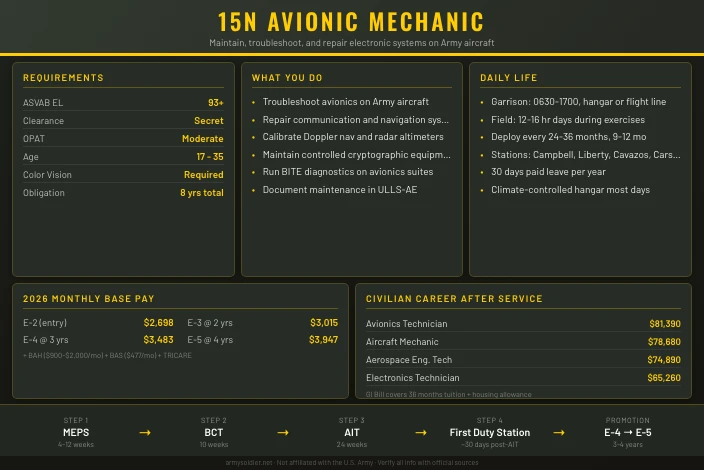
15N Avionic Mechanics maintain, troubleshoot, and repair the electronic systems on Army aircraft. That includes communication systems, navigation equipment, flight control computers, identification friend-or-foe (IFF) transponders, and controlled cryptographic items. Every flight depends on these systems working correctly.
What You Do Day to Day
Your daily work shifts between scheduled maintenance and break-fix troubleshooting. On a typical garrison day, you might spend the morning running diagnostics on an AH-64 Apache’s Target Acquisition Designation Sight, then switch to replacing a faulty radio in a UH-60 Black Hawk after lunch.
Specific tasks include:
- Running built-in test equipment (BITE) diagnostics on avionics suites
- Removing, repairing, and reinstalling communication and navigation components
- Calibrating Doppler navigation systems and radar altimeters
- Maintaining controlled cryptographic equipment used for secure communications
- Documenting all maintenance actions in the Unit Level Logistics System-Aviation Enhanced (ULLS-AE)
- Managing tool inventories and accounting for every piece of test equipment
Specialized Roles
The 15N is the primary MOS for avionic maintenance. Within the Army’s CMF 15 (Aviation) career field, related specializations include:
| Identifier | Type | Description |
|---|---|---|
| 15N | Primary MOS | Avionic Mechanic |
| 15N1O | Skill Level | E-1 through E-4 entry-level avionic mechanic |
| 15N2O | Skill Level | E-5 through E-6 senior avionic mechanic |
| 15N3O | Skill Level | E-7 supervisor-level avionic mechanic |
| 15N4O | Skill Level | E-8 master avionic mechanic |
Additional Skill Identifiers (ASIs) may be awarded for platform-specific training, such as work on the AH-64D/E Apache, CH-47F Chinook, or UH-60M Black Hawk avionics suites. Your unit and assignment determine which ASIs you earn.
Mission Contribution
Every aviation mission depends on functioning avionics. A helicopter can’t fly a medevac route without working navigation. A pilot can’t receive fire missions without operational radios. An attack helicopter can’t engage targets without calibrated sensors. You keep those systems running, which means you directly affect whether aircraft are mission-capable or sitting on the ground.
Technology and Equipment
You’ll work with oscilloscopes, multimeters, soldering stations, and specialized avionics test sets. The aircraft themselves carry GPS receivers, inertial navigation units, digital map displays, integrated helmet and display sighting systems, and encrypted communication gear. As the Army fields new platforms and upgrades older ones, 15N soldiers are among the first to train on the new hardware.
Salary and Benefits
Base Pay
Military pay follows rank and time in service. As a 15N, you enter at E-1 (Private) or E-2 (Private) depending on your contract. Here are the 2026 monthly base pay rates for typical 15N ranks:
| Rank | Grade | Typical Years of Service | Monthly Base Pay |
|---|---|---|---|
| Private (PV2) | E-2 | Under 2 | $2,698 |
| Private First Class (PFC) | E-3 | 2 | $3,015 |
| Specialist (SPC) | E-4 | 3-4 | $3,483 - $3,659 |
| Sergeant (SGT) | E-5 | 4-6 | $3,947 - $4,109 |
| Staff Sergeant (SSG) | E-6 | 8-10 | $4,613 - $4,759 |
Base pay is only part of your compensation. On top of these figures, you receive:
- Basic Allowance for Subsistence (BAS): $476.95/month for all enlisted soldiers
- Basic Allowance for Housing (BAH): Varies by duty station and dependency status. An E-4 without dependents receives roughly $900 to $2,000+ per month depending on location.
- TRICARE Prime: Zero-premium healthcare for you and your family, covering medical, dental, vision, mental health, and prescriptions
Benefits Beyond Pay
Education: The Post-9/11 GI Bill covers full in-state tuition at public schools (or up to $29,920.95/year at private institutions), plus a monthly housing allowance and $1,000/year book stipend for 36 months. Tuition Assistance provides up to $4,500/year while you’re still serving.
Retirement: The Blended Retirement System (BRS) gives you a pension worth 40% of your highest 36 months of basic pay after 20 years. The Army also contributes up to 5% of your basic pay into the Thrift Savings Plan (TSP), with matching that begins in your third year of service. You need to contribute at least 5% to get the full match.
Leave: 30 days of paid leave per year, plus 11 federal holidays. Leave accrues at 2.5 days per month.
Qualifications and Eligibility
Requirements at a Glance
| Requirement | Detail |
|---|---|
| ASVAB Line Score | EL (Electronics) 93 or higher |
| ASVAB Composite Formula | GS + AR + MK + EI |
| OPAT Category | Moderate |
| Security Clearance | Secret |
| U.S. Citizenship | Required |
| Age | 17-35 (waivers possible to 39) |
| Education | High school diploma or GED (AFQT 31 with diploma; 50 with GED) |
| Physical | Pass standard military entrance physical at MEPS |
| Color Vision | Required (must distinguish wire colors and electronic components) |
| Service Obligation | 8 years total (active + reserve/IRR combination) |
The EL 93 requirement is moderate compared to other technical MOS options. The Electronics composite tests general science, arithmetic reasoning, math knowledge, and electronics information. If you score well in math and science, you’ll likely clear this threshold.
Application Process
Competitiveness
The 15N is a steady-demand MOS rather than a high-competition one. Aviation units always need avionics maintainers. Meeting the EL 93 score is the main filter. Having prior electronics experience or relevant coursework can strengthen your position, but there’s no board or interview process. If you qualify and a slot is open, you’re in.
Enlistees enter at E-1 (PV1) unless they qualify for advanced rank through college credits, JROTC, or referral programs. A four-year active duty contract is standard, though six-year contracts are available and may come with a larger bonus.
See our ASVAB study guide for strategies to hit these line scores, or take the PiCAT from home if you are a first-time tester.
Work Environment
Setting and Schedule
Expect to spend most of your day in a maintenance hangar or on the flight line. Hangars are climate-controlled, which is a plus compared to field mechanics who work in the elements. During field exercises or deployments, you’ll work out of portable maintenance shelters or directly on the aircraft wherever it sits.
Garrison hours typically run from 0630 to 1700 (6:30 AM to 5:00 PM), Monday through Friday. But aviation maintenance doesn’t stop for the clock. If an aircraft needs to fly the next morning and has a broken radio, you stay until the radio works. Expect occasional nights and weekends, especially before large-scale training exercises.
Leadership and Communication
You work under a section NCOIC (noncommissioned officer in charge), typically an E-6 or E-7. Your chain of command runs from your team leader to the platoon sergeant to the company commander. Performance feedback comes through counseling sessions (monthly for junior soldiers) and the NCOER (Noncommissioned Officer Evaluation Report) system for NCOs.
Communication with pilots and crew chiefs is constant. They report discrepancies, and you diagnose and fix them. That back-and-forth requires clear documentation and precise technical language.
Team Dynamics
Avionics work balances teamwork with independent troubleshooting. You might collaborate with airframe mechanics to access a component buried behind a panel, but the actual diagnostic work is often you and a wiring diagram. Senior mechanics get more autonomy in deciding repair approaches, while junior soldiers follow established technical manuals closely.
Retention
Aviation maintenance MOS positions generally have moderate retention rates. The Secret clearance, technical skills, and FAA-adjacent experience make civilian offers attractive, which pulls some soldiers out after their first contract. The Army counters with re-enlistment bonuses and career progression opportunities. Soldiers who enjoy the work and the mission tend to stay.
Training and Skill Development
Initial Training Pipeline
| Phase | Location | Length | Focus |
|---|---|---|---|
| Basic Combat Training (BCT) | Fort Jackson, SC; Fort Moore, GA; or Fort Leonard Wood, MO | 10 weeks | Soldiering fundamentals: marksmanship, first aid, drill, land navigation, field tactics |
| Advanced Individual Training (AIT) | Fort Eustis, VA (128th Aviation Brigade) | 24 weeks | Avionics theory, hands-on troubleshooting, wiring repair, component replacement, test equipment operation |
BCT is the same for every soldier regardless of MOS. You learn to shoot, move, and communicate.
AIT at Fort Eustis is where the real technical education begins. The 24-week course covers electrical theory, schematic reading, soldering techniques, connector repair, and hands-on maintenance of actual aircraft avionics systems. You’ll learn to use oscilloscopes, multimeters, and specialized avionics test sets. The program builds from fundamentals to platform-specific systems.
Training is run by the 1st Battalion, 210th Aviation Regiment under the 128th Aviation Brigade. Class sizes are small enough for individual attention on the test equipment. You graduate with a solid foundation in avionics troubleshooting.
Advanced Training Opportunities
After your first assignment, several training paths open up:
- Platform-specific courses: Detailed training on the avionics suites of the AH-64 Apache, UH-60 Black Hawk, CH-47 Chinook, or other airframes
- Advanced Leader Course (ALC): Required for promotion to E-6, combines leadership instruction with advanced technical training
- Senior Leader Course (SLC): Required for E-7, focuses on supervisory and management skills for maintenance operations
- Warrant Officer path: Experienced 15N soldiers can apply for Warrant Officer Candidate School (WOCS) and become 151A Aviation Maintenance Technicians
- Army COOL certifications: The Army’s Credentialing Opportunities On-Line program funds civilian certifications like the Avionics Electronics Technician certificate and FAA Airframe rating
The first few years shape your entire career. Your initial duty station assignment determines which aircraft platform you specialize in. A soldier sent to an Apache battalion develops different expertise than one assigned to a Black Hawk unit. Both paths are valuable, and cross-training happens during later assignments.
Everything starts with qualifying ASVAB scores — our study guide covers what to study first.
Career Progression and Advancement
Rank Progression
| Rank | Grade | Typical Time to Reach | Role |
|---|---|---|---|
| Private (PV1) | E-1 | Entry | Learner; performs tasks under direct supervision |
| Private (PV2) | E-2 | 6 months | Performs basic maintenance tasks |
| Private First Class (PFC) | E-3 | 12 months | Works with moderate supervision |
| Specialist (SPC) | E-4 | 24 months | Journeyman mechanic; works independently on most tasks |
| Sergeant (SGT) | E-5 | 3-4 years | Team leader; supervises 2-4 soldiers; quality control inspector |
| Staff Sergeant (SSG) | E-6 | 6-8 years | Section NCOIC; manages maintenance sections |
| Sergeant First Class (SFC) | E-7 | 12-15 years | Platoon sergeant; senior technical advisor |
| Master Sergeant (MSG) | E-8 | 18-20 years | Senior maintenance manager at battalion/brigade level |
Promotion to E-5 and above is semi-centralized, meaning you compete against other 15N soldiers Army-wide. Promotion points come from military education, civilian education, awards, and physical fitness scores. Aviation MOS positions tend to promote at a steady rate because the skill set is always in demand.
Specialization Opportunities
As you gain experience, you can branch into related roles:
- Quality control inspector: Oversee maintenance standards for your section or company
- Technical inspector (TI): Perform final inspections on completed maintenance actions before aircraft are cleared for flight
- Instructor: Teach at the 128th Aviation Brigade or serve as a unit-level trainer
- 160th SOAR: The 160th Special Operations Aviation Regiment at Fort Campbell recruits experienced aviation maintainers for special operations support
Role Flexibility
Transferring between aviation MOS positions is possible but not automatic. A 15N who wants to become a 15T (UH-60 Helicopter Repairer) would need to attend a reclassification course. Within avionics, moving between aircraft platforms is more straightforward since the diagnostic fundamentals are the same.
Performance Evaluation
The NCOER (for E-5 and above) evaluates soldiers on competence, character, and commitment. Your rater and senior rater assess your technical proficiency, leadership, and contribution to the unit’s mission. Strong evaluations are the single biggest factor in promotion board results.
For junior enlisted (E-1 through E-4), monthly counseling sessions with your supervisor track your progress. These counselings feed into the overall performance picture that determines whether you’re recommended for promotion.
Physical Demands and Medical Evaluations
Daily Physical Reality
Avionics work is less physically brutal than airframe maintenance, but it’s not a desk job. You’ll spend hours standing, kneeling, or crouching inside aircraft cabins and access panels. Reaching overhead to route wiring or leaning into tight spaces to access avionics bays is standard.
Lifting requirements are moderate. Most avionics components weigh under 50 pounds, but some radar units and power supplies are heavier. You’ll also carry toolboxes and test equipment to and from the flight line.
Fine motor skills matter more than raw strength in this MOS. Soldering connections, crimping wires, and handling small connectors require steady hands and good vision.
Army Fitness Test (AFT) Standards
The Army Fitness Test (AFT) took effect in June 2025. All soldiers must pass the same test, which is not MOS-specific. The 15N falls under the general fitness standard, not the combat specialty standard.
| Event | Minimum (60 pts each) | Maximum (100 pts each) |
|---|---|---|
| 3 Repetition Maximum Deadlift (MDL) | Varies by age/sex | Varies by age/sex |
| Hand Release Push-Up (HRP) | Varies by age/sex | Varies by age/sex |
| Sprint-Drag-Carry (SDC) | Varies by age/sex | Varies by age/sex |
| Plank (PLK) | Varies by age/sex | Varies by age/sex |
| Two-Mile Run (2MR) | Varies by age/sex | Varies by age/sex |
The general standard requires a minimum of 60 points per event and a total of at least 300 points (out of 500 maximum). Scoring is sex- and age-normed. A score of 465 or above exempts you from body fat measurements.
Medical Standards
You must pass the initial MEPS physical, which screens for conditions that would prevent military service. Color vision is required for this MOS since you need to distinguish wire colors and LED indicators during troubleshooting.
After entering service, you’ll complete a Periodic Health Assessment (PHA) annually. Hearing conservation is particularly relevant for avionics mechanics who work around running aircraft. The Army provides double hearing protection (foam plugs plus over-ear muffs) for flight line operations.
Deployment and Duty Stations
Where You Could Be Stationed
15N soldiers serve wherever the Army operates aircraft. That covers a wide range of installations:
CONUS (Continental United States):
- Fort Campbell, KY (101st Airborne, 160th SOAR)
- Fort Liberty, NC (82nd Airborne)
- Fort Cavazos, TX
- Fort Carson, CO
- Fort Drum, NY
- Joint Base Lewis-McChord, WA
- Fort Riley, KS
- Fort Bliss, TX
OCONUS (Outside Continental United States):
- Katterbach/Wiesbaden, Germany
- Camp Humphreys, South Korea
- Wheeler Army Airfield, Hawaii
- Fort Wainwright, AK
Deployment Patterns
Aviation units deploy regularly. Rotational deployments to the Middle East, Europe, and the Pacific typically last 9-12 months, with dwell time of 24-36 months between deployments. Some units deploy in shorter rotations of 3-6 months for specific missions.
During deployments, your work tempo increases. Aircraft fly more, which means more maintenance. You might work 12-16 hour days for extended periods. The upside is that deployment pay includes tax-free income, family separation allowance, and potentially hazardous duty pay.
Location Preferences
You can list preferred duty stations on your assignment preference worksheet, but the Army assigns you based on unit needs. Aviation MOS soldiers have an advantage here: aviation units exist at many installations, which gives the assignment system more flexibility. Your first duty station is generally needs-of-the-Army, but subsequent assignments give you more input.
Risk, Safety, and Legal Considerations
Job Hazards
Working around aircraft carries inherent risks. Rotor blades, engine intakes, and hot exhaust are constant dangers on the flight line. Avionics-specific hazards include:
- Electrical shock from high-voltage systems (some avionics components carry lethal voltage)
- Exposure to hazardous materials like solder flux, cleaning solvents, and conformal coatings
- Hearing damage from prolonged exposure to aircraft engine noise
- Repetitive strain from detailed hand work in awkward positions
Safety Protocols
The Army’s aviation safety culture is strict. Mandatory safety briefings, personal protective equipment (PPE), and lock-out/tag-out procedures for electrical systems are non-negotiable. You’ll wear hearing protection, safety glasses, and anti-static wrist straps as standard practice.
Every maintenance action follows a technical manual (TM) procedure. Deviation from the TM is a serious offense because shortcuts in aviation maintenance can cause crashes.
Security Clearance
The Secret clearance is required because you’ll handle controlled cryptographic items (CCI) and work with encrypted communication systems. The clearance process includes a background investigation covering your criminal history, financial records, and personal references. Initial processing takes 1-4 months in most cases.
Maintaining your clearance means avoiding debt problems, criminal activity, and unauthorized disclosure of classified information. Losing your clearance means losing your MOS.
Legal Obligations
Your enlistment contract obligates you to 8 total years of military service, split between active duty and the Individual Ready Reserve (IRR). The active portion is typically 3-6 years depending on your contract. During your active time, you’re subject to the Uniform Code of Military Justice (UCMJ) 24 hours a day.
Impact on Family and Personal Life
Family Considerations
Military life is hard on families. Deployments of 9-12 months, field training exercises that take you away for 2-4 weeks at a time, and unpredictable work hours all put strain on relationships. Single soldiers have more flexibility, but anyone with a spouse or children needs to plan around the Army’s schedule.
The Army provides family support through several programs:
- Army Community Service (ACS): Financial counseling, relocation assistance, and family readiness groups
- Child Development Centers (CDC): On-post childcare at subsidized rates
- Military OneSource: Free counseling, legal assistance, and financial planning
- Exceptional Family Member Program (EFMP): Ensures families with special needs members are assigned to installations with appropriate support
Relocation
Expect to move every 2-4 years. Permanent Change of Station (PCS) moves are funded by the Army, including household goods shipping, travel pay, and temporary lodging allowance. Frequent moves make it harder for spouses to build careers, though remote work has eased that pressure.
On-post housing is available at most installations, or you can live off-post using your BAH. Housing quality varies by installation. Newer posts like Fort Liberty and Fort Cavazos have recently renovated family housing.
Reserve and National Guard
The 15N Avionic Mechanic MOS is available in both the Army Reserve and the Army National Guard. Guard helicopter and fixed-wing units across the country need avionics technicians to maintain navigation, communication, and flight instrument systems. Reserve aviation support units also carry 15N positions. Avionics work requires current technical knowledge, so part-time soldiers need to stay sharp on rapidly changing cockpit systems.
Drill Schedule and Training Commitment
The standard commitment is one weekend per month and two weeks of annual training. Avionics systems receive frequent software updates, and new cockpit displays or communication suites may require extra training days beyond the baseline schedule. Some Guard aviation units schedule additional maintenance training days before deployment readiness exercises. Plan for 2 to 5 extra duty days per year depending on your unit’s aircraft and upgrade cycle.
Part-Time Pay and Benefits
An E-4 with about four years of service earns roughly $488 per drill weekend in 2026, totaling about $5,856 per year from weekend drills. Annual training adds roughly two weeks of active-duty pay on top. Active-duty E-4s earn $3,659 per month.
Healthcare coverage through Tricare Reserve Select costs $57.88 per month for the member or $286.66 for a family plan. Active-duty soldiers receive TRICARE Prime at no cost. Education benefits include Federal Tuition Assistance and the Montgomery GI Bill-Selected Reserve (Chapter 1606) for both components. Guard soldiers in many states get state tuition waivers that can cover most or all of public university costs. Retirement follows a points-based system, with payments beginning at age 60.
Deployment and Mobilization
Guard and Reserve aviation units deploy on mobilization cycles that run roughly every 3 to 5 years for 9 to 12 months. Avionics mechanics are needed wherever helicopters operate, so 15N soldiers deploy with their aviation battalions for combat, peacekeeping, and training missions overseas. Guard members can also be activated by their state governor for domestic missions like disaster response.
Civilian Career Integration
Avionics is one of the strongest civilian career bridges in Army aviation. Airlines, helicopter operators, defense contractors, and avionics repair shops all hire technicians with military avionics training. FCC licensing and FAA certifications are attainable through Army COOL funding. The civilian avionics technician field pays well and continues to grow as aircraft systems become more electronic. USERRA protects your civilian position during military service, and many avionics employers actively recruit Guard and Reserve soldiers because their military training keeps technical skills current.
| Feature | Active Duty | Army Reserve | Army National Guard |
|---|---|---|---|
| Commitment | Full-time | One weekend/month, two weeks/year | One weekend/month, two weeks/year |
| Monthly Pay (E-4, ~4 yrs) | $3,659 | ~$488/drill weekend | ~$488/drill weekend |
| Healthcare | TRICARE Prime, $0 premiums | Tricare Reserve Select, $57.88/month | Tricare Reserve Select, $57.88/month |
| Education | Post-9/11 GI Bill | Federal TA, MGIB-SR | Federal TA, MGIB-SR, state tuition waivers |
| Deployment | Regular rotations | Mobilization-based | Mobilization-based, plus state activations |
| Retirement | 20-year pension, immediate | Points-based, age 60 | Points-based, age 60 |
Post-Service Opportunities
Civilian Career Translation
The 15N MOS translates directly to civilian aviation careers. You leave the Army with hands-on experience troubleshooting electronic systems on aircraft, which is exactly what commercial aviation employers need. Several paths are available:
- FAA Airframe rating: Your military training may count toward the experience requirement for this certification
- Avionics Electronics Technician certification: Available through industry organizations; Army COOL funds the exam
- FCC General Radiotelephone Operator License: Relevant for communication system work
Defense contractors like Lockheed Martin, Boeing, Raytheon, and Northrop Grumman hire former 15N soldiers for avionics maintenance and field service positions. The Partnership for Youth Success (PaYS) program guarantees job interviews with participating military-friendly employers.
Civilian Salary and Outlook
| Career | Median Annual Salary | Job Outlook (2024-2034) |
|---|---|---|
| Avionics Technician | $81,390 | 5% growth (faster than average) |
| Aircraft Mechanic / Service Technician | $78,680 | 5% growth (faster than average) |
| Aerospace Engineering Technician | $74,890 | 4% growth (about average) |
| Electronics Technician (general) | $65,260 | 2% growth (slower than average) |
Salary data is from the Bureau of Labor Statistics (May 2024 estimates). About 13,100 openings for aircraft and avionics mechanics are projected each year through 2034.
Transition Support
The Army’s Soldier for Life - Transition Assistance Program (SFL-TAP) begins 12-18 months before your separation date. It includes resume workshops, job fairs, and connections to veterans’ hiring programs. The GI Bill covers further education if you want to earn an associate’s or bachelor’s degree in avionics technology or aerospace engineering.
If you decide the Army isn’t for you, the process for separation depends on your contract status. Completing your active duty obligation results in an honorable discharge. Early separation is possible through hardship, medical, or voluntary separation programs, but it’s not guaranteed.
Is This a Good Job for You? The Right (and Wrong) Fit
Who Thrives as a 15N
This MOS suits people who like solving puzzles with a multimeter in hand. The ideal 15N has:
- Patience for systematic troubleshooting. Avionics problems don’t always announce themselves. You follow a logical process, test one system at a time, and trace faults through wiring diagrams.
- Comfort with math and science. The EL 93 ASVAB score requires decent ability in arithmetic, general science, math, and electronics. If those subjects came naturally in school, you’ll do fine in AIT.
- Attention to detail. One loose wire or incorrect solder joint can ground an aircraft. This isn’t a job where “close enough” works.
- Interest in technology. Army avionics systems are complex and always being upgraded. You need to actually enjoy learning how electronic systems work.
Who Should Think Twice
This MOS is a poor fit if you:
- Want a physically active outdoor job. Most of your time is spent in a maintenance hangar working on electronics. If you joined the Army to kick doors or drive tanks, you’ll be bored.
- Struggle with structured technical procedures. Every repair follows a specific technical manual. Improvisation is not rewarded in aviation maintenance.
- Dislike sedentary detail work. Sitting at a workbench for hours tracing circuit paths requires a different kind of stamina than running a patrol route.
- Can’t handle the clearance requirements. Financial problems or a criminal history will block your Secret clearance, which blocks this MOS.
Long-Term Fit
If your goal is a stable, well-paying civilian career after the Army, the 15N is one of the strongest MOS options available. Avionics technicians earn above-average salaries, and the field is growing. Soldiers who do one contract and leave with certifications are competitive in the civilian job market immediately.
For those who want a full military career, the path from E-1 to E-7 or E-8 is well-defined. The warrant officer route (151A) offers another layer of technical leadership without the command responsibilities of the commissioned officer track. Either way, the skills you build in this MOS have value for decades.
More Information
Talk to your local Army recruiter to get current enlistment bonus figures, ship dates, and available contract options for the 15N Avionic Mechanic MOS. They can also help you understand how your ASVAB scores map to the Electronics composite and whether you qualify today.
- Prepare for the ASVAB with our study guide to make sure your line scores qualify
This site is not affiliated with the U.S. Army or any government agency. Verify all information with official Army sources before making enlistment or career decisions.
Explore more Army aviation careers such as 15T UH-60 Helicopter Repairer and 15U CH-47 Helicopter Repairer.