15P Aviation Operations Specialist
Every aircraft that takes off from an Army airfield does so because someone coordinated the flight plan, confirmed weather, tracked the crew, and stood ready to initiate a rescue if the aircraft didn’t come back. That’s the 15P Aviation Operations Specialist. You run the operations center, manage flight schedules, maintain records, and keep the commander informed of where every aircraft and crew is at all times. If you prefer the brains of aviation over the wrench work, this MOS puts you at the center of it.
Qualifying requires specific ASVAB line scores — our ASVAB study guide covers what to target and how to prepare.
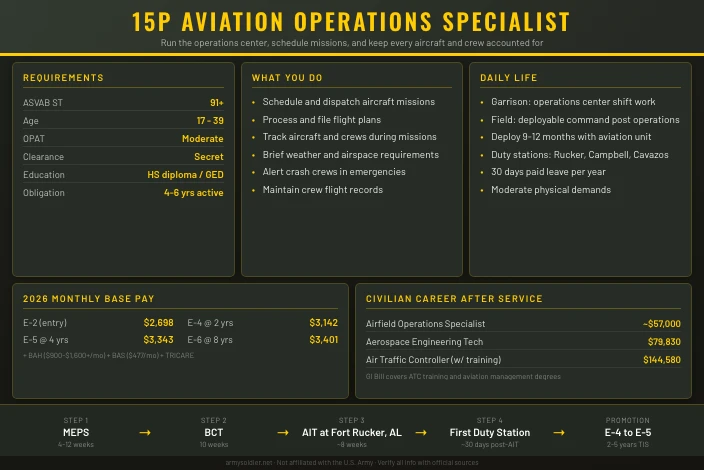
Job Role and Responsibilities
The 15P Aviation Operations Specialist plans, coordinates, and monitors tactical aircraft missions. You maintain flight schedules, process flight plans, manage crew flight records, brief weather and airspace requirements, and alert crash crews in emergencies. You are the link between aviators, ground units, and higher headquarters.
A garrison day in an aviation operations section starts before the first aircraft launches. You pull weather data, check NOTAMs (Notices to Air Missions), build the flight schedule, and brief it during the morning operations meeting. Once missions are airborne, you track them on boards or digital systems and maintain radio contact with aircraft on the operations frequency.
When something goes wrong, the operations specialist is the first call. An overdue aircraft triggers an immediate accountability check and, if necessary, the search-and-rescue alert. Knowing the procedures and executing them calmly under pressure is part of the job.
Specific Roles
The 15P MOS has no formal sub-specializations at entry. Soldiers build qualifications through experience and Additional Skill Identifiers over time:
| Identifier | Description |
|---|---|
| ASI F5 | Aviation Operations Senior Supervisor |
| Senior Operations NCO | Battalion and brigade-level operations management |
Mission Contribution
Tactical aviation missions don’t run themselves. The 15P coordinates with airspace management, weather sections, fuel handlers, maintenance, and ground units to ensure each flight executes as planned. In combat, flight operations centers run 24 hours and directly support attack, reconnaissance, and medevac missions.
Equipment and Systems
You’ll use Army Aviation Mission Support System (AAMS), digital flight-following systems, tactical radio equipment, and standard office tools. Aviation operations sections maintain substantial documentation, so administrative accuracy is as important as situational awareness.
Salary and Benefits
Monthly base pay is set by rank and years of service. The 2026 figures below come from the DFAS pay schedule.
| Rank | Grade | Monthly Base Pay (entry) |
|---|---|---|
| Private (PV2) | E-2 | $2,698 |
| Private First Class (PFC) | E-3 | $2,837 |
| Specialist (SPC) | E-4 | $3,142 |
| Sergeant (SGT) | E-5 | $3,343 |
| Staff Sergeant (SSG) | E-6 | $3,401 |
Source: DFAS 2026 military pay chart.
Additional compensation for most active duty soldiers:
- BAH: Tax-free housing allowance based on duty location, pay grade, and dependent status. A single E-4 at many CONUS installations receives $900-$1,600+ per month.
- BAS: $476.95/month food allowance (2026 rate).
- TRICARE: Full health, dental, and vision coverage for you and dependents on active duty.
Additional Benefits
The Blended Retirement System (BRS) combines a 20-year pension at 40% of high-36 basic pay with government TSP matching up to 5% of basic pay. Tuition Assistance funds up to $4,500 per year for college courses taken while serving. The Post-9/11 GI Bill covers in-state tuition at public schools plus a monthly housing allowance for up to 36 months after leaving service.
Work-Life Balance
Soldiers earn 30 days paid leave per year. Operations sections often work shift schedules, especially at deployed locations. The upside is a more predictable rotation compared to some field-intensive MOSs. Garrison hours are generally structured around the flying schedule.
Qualifications and Eligibility
| Requirement | Details |
|---|---|
| ASVAB Score | ST: 91 (Skilled Technical composite) |
| Citizenship | U.S. citizen or permanent resident alien |
| Age | 17-39 (waiver possible) |
| Education | High school diploma or GED |
| Physical | OPAT: Moderate category |
| Security Clearance | Secret (required; initiated at accession) |
The ST (Skilled Technical) composite combines four subtests: General Science (GS), Verbal Expression (VE), Mathematics Knowledge (MK), and Mechanical Comprehension (MC). A score of 91 is achievable with solid reading, general science, and math preparation.
Application Process
Take the ASVAB, pass the MEPS physical, and meet the ST score requirement. Your recruiter will initiate the security clearance investigation as part of the enlistment process. Clearance processing typically takes several weeks to a few months.
Selection and Competitiveness
This MOS attracts candidates with strong verbal and organizational skills. Prior experience in scheduling, dispatching, customer service, or office administration translates directly. The 15P is competitive but not extremely difficult to contract for compared to high-demand combat or cyber MOSs.
Service Obligation
Most aviation-related MOSs carry a four-to-six year active duty obligation.
See our ASVAB study guide for strategies to hit these line scores, or take the PiCAT from home if you are a first-time tester.
Work Environment
Aviation operations centers run in garrison operations buildings and deployable command post shelters. Work is primarily indoor, though you’ll regularly move between the operations center and the flight line. Deployed environments may involve tents, hardened facilities, or expeditionary shelters depending on the mission.
The 1st Battalion, 13th Aviation Regiment at Fort Rucker (Alabama) trains this MOS. Operational units assign 15P soldiers to battalion and brigade aviation operations sections, where they work under Aviation Operations Officer (15A) and senior NCO supervision.
Leadership and Communication
Operations specialists communicate constantly, with flight crews, higher headquarters, weather sections, fuel teams, and ground units. Clear radio discipline and professional communication under pressure are core skills. Senior NCOs mentor junior specialists through all aspects of the operations role.
Job Satisfaction
15P soldiers who enjoy the coordination challenge and want to stay connected to the aviation mission without being mechanics typically report high satisfaction. The work has direct, visible impact every time a successful mission launches and returns.
Training and Skill Development
| Phase | Location | Duration | Focus |
|---|---|---|---|
| Basic Combat Training (BCT) | Various installations | 10 weeks | Soldier skills, fitness, weapons |
| Advanced Individual Training (AIT) | Fort Rucker, AL | ~8 weeks | Flight planning, operations systems, crew records, emergency procedures |
AIT covers aviation operations center procedures, AAMS system use, flight following methods, airspace coordination, weather integration, and crew resource management concepts. The course is classroom-intensive with applied exercises using simulated operations environments.
Advanced Training
As soldiers progress, they can pursue:
- Aviation Mission Planner certification for specific aircraft types
- Aviation Safety Officer courses for senior NCOs
- Senior Leader Course (SLC) at promotion to SSG
- Interagency coordination training at battalion and brigade operations assignments
The Army’s COOL program identifies civilian credentials in aviation operations and transportation management that align with this MOS.
Everything starts with qualifying ASVAB scores — our study guide covers what to study first.
Career Progression and Advancement
| Rank | Grade | Typical Time in Service | Role |
|---|---|---|---|
| Private First Class (PFC) | E-3 | First year | Learning operations procedures |
| Specialist (SPC) | E-4 | 1-2 years | Junior operations specialist |
| Sergeant (SGT) | E-5 | 2-5 years | Operations team leader |
| Staff Sergeant (SSG) | E-6 | 5-8 years | Senior operations specialist, shift NCOIC |
| Sergeant First Class (SFC) | E-7 | 8-14 years | Aviation operations section chief |
| Master Sergeant (MSG) | E-8 | 14-20+ years | Brigade-level aviation operations SGM |
Promotion through E-4 is largely time-based in the first two years. Competitive promotions from E-5 upward require completing required military education, passing the AFT, and building a strong NCOER record.
Specialization Opportunities
Senior 15P NCOs often branch into aviation liaison roles, working directly with joint force headquarters or special operations units. Experienced specialists are also well-positioned for warrant officer programs in aviation operations.
Performance Evaluation
NCOs are evaluated annually on NCOERs. Key competencies rated include tactical and technical proficiency, leadership, and communication skills.
Physical Demands and Medical Evaluations
The OPAT category for 15P is Moderate. The work is primarily cognitive and administrative rather than heavy physical labor. Day-to-day demands include:
- Sitting and standing for extended periods during shift work
- Carrying equipment and personal gear during field exercises and deployments
- Maintaining physical fitness standards for the AFT
The Army Fitness Test (AFT) has five events: 3-Rep Max Deadlift (MDL), Hand Release Push-Up (HRP), Sprint-Drag-Carry (SDC), Plank (PLK), and Two-Mile Run (2MR). Each event scores 0-100, with a minimum of 60 per event and 300 total for the general standard. The AFT is sex- and age-normed.
Medical Evaluations
No aviation-specific medical standards beyond standard Army entry screening apply for this MOS. Periodic Army medical readiness screening continues throughout service.
Deployment and Duty Stations
Aviation operations specialists deploy with their aviation units. Combat aviation brigades operate across CENTCOM, INDOPACOM, and EUCOM theaters. Deployment lengths for active duty units typically run nine to twelve months.
Duty stations include Fort Rucker (Alabama), Fort Campbell (Kentucky), Fort Cavazos (Texas), Fort Liberty (North Carolina), Hunter Army Airfield (Georgia), and OCONUS locations in South Korea and Germany.
Risk, Safety, and Legal Considerations
Aviation operations specialists work in a safety-critical environment. Errors in flight scheduling, weather data, or airspace coordination can contribute to aviation accidents. Strict standard operating procedures govern every function in the operations center.
The Secret clearance creates additional legal obligations. Soldiers must report foreign contacts, financial changes, and other circumstances that could affect clearance status. Unauthorized disclosure of classified information is a federal crime.
Security Requirements
Maintaining your Secret clearance requires responsible personal conduct throughout service. Periodic reinvestigations occur every 10 years for Secret clearances. Financial responsibility, sobriety, and discretion in social media use are practical requirements.
Impact on Family and Personal Life
Aviation operations sections work shift schedules that can include nights and weekends in garrison, though rotations are generally predictable. Deployment cycles follow unit rotation plans. Fort Rucker, Fort Campbell, and Fort Cavazos all have established military communities with on-post housing and family support resources.
PCS moves happen roughly every two to three years. Government-funded household goods moves cover relocation costs. Assignment preference requests are processed through the Army’s assignment system.
Reserve and National Guard
The 15P Aviation Operations Specialist MOS is available in both the Army Reserve and the Army National Guard. Every Reserve and Guard aviation unit needs operations specialists to manage flight schedules, track aircraft status, and run the tactical operations center. This makes 15P one of the more widely available aviation MOS across part-time components. Positions exist at the company and battalion level in both components.
Drill Schedule and Training Commitment
Reserve and Guard 15P soldiers follow the standard one weekend per month and two weeks of annual training. Operations work during drill weekends typically involves maintaining flight records, updating status boards, and running operations center procedures. Major exercises or pre-deployment training may add a few extra duty days per year. The workload is manageable compared to hands-on maintenance MOS, since operations tasks fit naturally into the drill weekend format.
Part-Time Pay and Benefits
An E-4 with about four years of service earns roughly $488 per drill weekend in 2026. Over 12 weekends, that comes to about $5,856 per year before annual training pay. Active-duty E-4s earn $3,659 per month.
Tricare Reserve Select costs $57.88 per month for individual coverage or $286.66 for a family plan. Active-duty soldiers pay nothing for TRICARE Prime. Federal Tuition Assistance is available for both Reserve and Guard soldiers. The Montgomery GI Bill-Selected Reserve (Chapter 1606) provides education funding, and Guard members in many states qualify for state tuition waivers at public colleges. Reserve and Guard retirement uses a points-based system with payments starting at age 60.
Deployment and Mobilization
Reserve and Guard 15P soldiers mobilize with their aviation units. Deployment cycles run roughly every 3 to 5 years for 9 to 12 months. Operations specialists are needed at every deployed aviation headquarters, so demand is consistent. Guard members may also be activated for state missions like hurricane response, where aviation operations coordination is needed for helicopter support.
Civilian Career Integration
Aviation operations experience translates well to civilian jobs in flight dispatching, airport operations management, and aviation scheduling. Airlines, charter companies, and fixed-base operators (FBOs) hire people who understand flight planning, weather coordination, and operations center procedures. The FAA Aircraft Dispatcher certification is an attainable next step that opens doors to airline dispatch positions. USERRA protects your civilian job during military service, and many aviation employers value the organizational and scheduling skills that 15P soldiers bring from their military background.
| Feature | Active Duty | Army Reserve | Army National Guard |
|---|---|---|---|
| Commitment | Full-time | One weekend/month, two weeks/year | One weekend/month, two weeks/year |
| Monthly Pay (E-4, ~4 yrs) | $3,659 | ~$488/drill weekend | ~$488/drill weekend |
| Healthcare | TRICARE Prime, $0 premiums | Tricare Reserve Select, $57.88/month | Tricare Reserve Select, $57.88/month |
| Education | Post-9/11 GI Bill | Federal TA, MGIB-SR | Federal TA, MGIB-SR, state tuition waivers |
| Deployment | Regular rotations | Mobilization-based | Mobilization-based, plus state activations |
| Retirement | 20-year pension, immediate | Points-based, age 60 | Points-based, age 60 |
Post-Service Opportunities
Aviation operations experience translates directly to civilian flight operations and dispatch roles. Airlines, charter operators, fixed-base operators (FBOs), and aviation management companies all hire people with operations center backgrounds.
| Civilian Job Title | Median Annual Salary (BLS, May 2024) | Job Outlook (2024-2034) |
|---|---|---|
| Airfield Operations Specialist | ~$57,000 | Stable |
| Aerospace Engineering Tech | $79,830 | +3% |
| Air Traffic Controller (with further training) | $144,580 | +2% |
Source: Bureau of Labor Statistics.
The GI Bill can fund FAA certification programs, aviation management degrees, or air traffic control training. The Army’s COOL program identifies nationally recognized credentials in aviation management that are directly supported by 15P experience.
Is This a Good Job for You? The Right (and Wrong) Fit
This MOS fits candidates who are organized, calm under pressure, and want to be involved in the aviation mission without becoming a mechanic or pilot. Strong verbal skills, attention to detail, and the ability to juggle multiple tasks simultaneously are practical requirements.
The wrong fit is someone who wants physical variety, wants to be outside working with their hands, or dislikes administrative processes. Operations center work is detail-intensive. Missing a notation in a crew record or getting a radio frequency wrong has real consequences.
Long-term, 15P opens doors to airline and charter operations, aviation management, and federal aviation jobs. The clearance experience is a bonus for defense contractor and government agency careers.
More Information
Talk with an Army recruiter to confirm current 15P seat availability and whether a clearance-related enlistment incentive applies. You can find a local recruiter at goarmy.com or by calling 1-888-550-ARMY.
- Prepare for the ASVAB with our study guide to make sure your line scores qualify
This site is not affiliated with the U.S. Army or any government agency. Verify all information with official Army sources before making enlistment or career decisions.
Explore more Army aviation careers such as 15G Aircraft Structural Repairer and 15Y AH-64D Armament/Electrical/Avionics Repairer.