15Q Air Traffic Control Operator
Every Army helicopter and fixed-wing aircraft that takes off, lands, or moves through controlled airspace depends on a 15Q to keep it safe. You talk pilots through approaches in zero visibility, separate aircraft on crowded tactical airfields, and make split-second calls when two birds are heading for the same runway. Mess it up and people die. Get it right and nobody even notices you’re there.
Qualifying requires specific ASVAB line scores — our ASVAB study guide covers what to target and how to prepare.
Job Role and Responsibilities
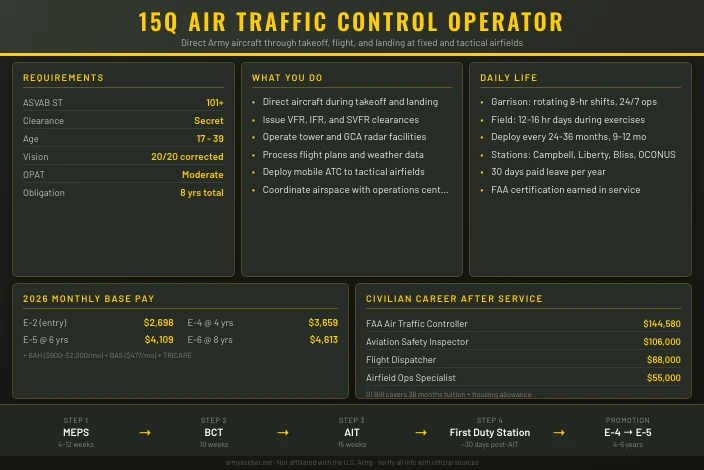
As a 15Q Air Traffic Control Operator, you direct Army aircraft during takeoff, in-flight operations, and landing at both fixed airfields and tactical field sites. You issue clearances, track aircraft on radar, manage flight plans, and coordinate airspace to prevent collisions and keep missions running on time.
Most of your shift is spent in a control tower or radar facility talking to pilots over radio. You process flight plans, issue VFR and IFR clearances, relay weather updates, and sequence aircraft for approach and departure. When visibility drops, you guide pilots through instrument approaches using ground-controlled approach (GCA) radar.
Tactical operations are different. You deploy with mobile air traffic control equipment to set up temporary airfields, forward arming and refueling points (FARPs), and landing zones. That means assembling portable towers, calibrating navigation aids, and running ATC out of a vehicle or tent. The environment shifts fast, from a well-equipped airfield in Germany to a dirt strip in a training area.
Specialized Roles
| Code | Role |
|---|---|
| 15Q10 | Entry-level ATC operator: tower, GCA radar, and airspace information center operations |
| 15Q20 | Shift leader/team leader: trains personnel, supervises tower or radar shifts |
| 15Q30 | Facility chief/tactical team leader: runs ATC facilities, writes letters of agreement |
| 15Q40 | Senior platoon sergeant: manages high-density facilities, serves as A2C2 liaison |
| ASI F7 | Pathfinder-qualified: establishes and controls landing zones, drop zones, and pickup zones |
Your role in the bigger picture: without ATC, aviation operations fall apart. Every medevac flight, resupply mission, and air assault depends on someone sequencing aircraft safely. You’re the link between the operations center and the pilots in the air. During large-scale exercises or real-world operations, a single tower might handle dozens of rotary-wing and fixed-wing aircraft within a few hours.
Equipment and Technology
You work with radar scopes, tower communication systems, flight data processing equipment, and the Enhanced Tower Simulator (ETOS), the Army’s most advanced ATC training system. Tactical units use mobile ATC shelters that fit on trucks. In fixed facilities, you use the same types of approach radar and communication equipment found at civilian airports.
All voice communications get recorded for review. You track weather instruments, maintain navigation aids, and update flight information publications. The gear is highly technical, but the training covers it step by step.
Salary and Benefits
Financial Benefits
Military pay is based on rank and years of service. Most 15Q soldiers start at E-2 or E-3 after AIT, depending on time in training and any college credits.
| Rank | Pay Grade | Years of Service | Monthly Base Pay |
|---|---|---|---|
| Private (PV2) | E-2 | Under 2 | $2,698 |
| Private First Class (PFC) | E-3 | 2 | $3,015 |
| Specialist (SPC) | E-4 | 4 | $3,659 |
| Sergeant (SGT) | E-5 | 6 | $4,109 |
| Staff Sergeant (SSG) | E-6 | 8 | $4,613 |
Base pay is just the start. BAH (Basic Allowance for Housing) adds $900 to $2,000+ per month depending on your duty station and dependency status. BAS (Basic Allowance for Subsistence) adds $476.95 monthly for food. TRICARE covers your medical, dental, vision, and prescriptions at zero cost while on active duty.
Enlistment bonuses for 15Q vary by fiscal year. Check with your recruiter for current amounts, since aviation MOSs sometimes qualify for targeted incentives.
Additional Benefits
TRICARE Prime covers you and your family with no enrollment fees, no deductibles, and no copays for in-network care. The annual catastrophic cap for family members is $1,000.
Education benefits start on day one. Tuition Assistance pays up to $4,500 per year for college courses while you serve. After separating, the Post-9/11 GI Bill covers up to 36 months of tuition at a public university (full in-state rate) plus a monthly housing allowance and a $1,000 annual book stipend. Private school tuition is capped at $29,920.95 per academic year.
Retirement uses the Blended Retirement System (BRS). Serve 20 years and you get a pension worth 40% of your highest 36 months of base pay. The government also matches up to 5% of your Thrift Savings Plan (TSP) contributions starting in your third year.
Work-Life Balance
You earn 30 days of paid leave per year. In garrison, ATC operators typically work rotating shifts since the tower operates around the clock. Most facilities run 8-hour shifts with occasional 12-hour rotations during high-tempo periods.
Field exercises and deployments throw predictability out the window. You might run ATC 12 to 16 hours a day for weeks straight during major training events. Between exercises, the pace is more manageable.
Qualifications and Eligibility
Basic Qualifications
You need a minimum Skilled Technical (ST) score of 101 on the ASVAB. The ST composite combines General Science, Verbal Expression, Math Knowledge, and Mechanical Comprehension. This is a moderately competitive score that filters out roughly half of test takers.
A Secret security clearance is required before you start AIT. The investigation covers your financial history, criminal record, foreign contacts, and personal conduct. Most applicants clear this in 2 to 4 months. Drug use, significant debt, or foreign ties can slow or block the process.
The OPAT physical demand category for 15Q is Moderate, which means you need to pass these minimums before shipping to basic training:
| Requirement | Details |
|---|---|
| Age | 17-39 (waivers possible up to 42) |
| Citizenship | U.S. citizen or permanent resident |
| Education | High school diploma or GED |
| AFQT (ASVAB) | Minimum 31 (diploma) or 50 (GED) |
| Skilled Technical (ST) | Minimum 101 |
| Security Clearance | Secret (required before AIT) |
| OPAT Category | Moderate |
| Vision | Correctable to 20/20; normal color vision |
| Hearing | Meet audiometric standards; ATC requires clear communication |
| Speech | No significant speech impediments |
Application Process
Start at a recruiting station. Your recruiter checks your scores, medical history, and background. If everything lines up, you go to MEPS (Military Entrance Processing Station) for the ASVAB (if you haven’t taken it), a full physical, and a background screening. MEPS usually takes one day.
Once your scores qualify for 15Q and your medical clears, the recruiter books an AIT training slot. The whole process from first visit to ship date takes 4 to 12 weeks, though security clearance delays can stretch that.
Selection Criteria and Competitiveness
The 15Q is moderately competitive. The Army needs air traffic controllers at installations worldwide, so slots open regularly. That said, the ST 101 and Secret clearance requirements thin the applicant pool. Higher ASVAB scores give you more room to negotiate bonuses and ship dates. Prior experience with aviation, radios, or technical equipment helps but isn’t required.
Upon Accession into Service
You enter at E-1 (Private) and promote to E-2 after Basic Combat Training. The standard obligation is 8 years total: typically 3 to 6 years active duty (depending on your contract and any bonus) plus the remainder in the Individual Ready Reserve.
See our ASVAB study guide for strategies to hit these line scores, or take the PiCAT from home if you are a first-time tester.
Work Environment
Setting and Schedule
Your primary workspace is a control tower or radar facility. Fixed-base towers at major Army airfields look and feel similar to civilian airport towers: climate-controlled, elevated, with a 360-degree view of the runway and taxiways. GCA radar facilities are darker rooms where you watch scopes and talk pilots through approaches.
Tactical settings are less comfortable. Mobile ATC equipment deploys on trucks to austere airfields, field training sites, and temporary operating locations. You might control aircraft from the back of a vehicle or a portable shelter. Weather, bugs, dust, and noise are constant.
Shift work is standard. Most ATC facilities operate 16 to 24 hours daily, with 8-hour rotating shifts. Night shifts, weekends, and holidays are part of the deal.
Leadership and Communication
Your chain of command runs through the facility chief (usually an E-6 or E-7) up to the company commander. On shift, the shift leader manages operations. Communication is constant: with pilots, with the operations center, and with other controllers on position.
Performance feedback comes through annual NCOERs and regular shift evaluations. ATC is one of the few Army jobs where your supervisor can listen to recordings of your work, so mistakes and good calls both get reviewed.
Team Dynamics and Autonomy
You work alongside other controllers, but when you’re on position, you own the airspace. Decisions about aircraft separation, sequencing, and emergency handling are yours to make in real time. Nobody else can make those calls for you while you’re working a frequency.
Off-position, the job is more collaborative. You brief incoming shifts, coordinate with operations staff, and maintain facility records as a team. Training is continuous: everyone in the facility practices emergency procedures, reviews regulations, and stays certified.
Job Satisfaction and Retention
ATC operators who enjoy the work tend to stay. The technical challenge, the direct responsibility, and the clean civilian career path keep retention reasonable. Soldiers who struggle with shift work, high-pressure decision-making, or the isolation of tower duty leave for other MOSs or civilian jobs.
The FAA actively recruits military controllers, and that pipeline influences a lot of career decisions. Some soldiers stay in long enough to retire. Others do one or two enlistments, earn their FAA certification, and move to civilian ATC.
Training and Skill Development
Initial Training
Training splits into two phases: Basic Combat Training (BCT) and Advanced Individual Training (AIT).
| Training Phase | Location | Duration | Focus |
|---|---|---|---|
| BCT | Fort Jackson, SC; Fort Moore, GA; Fort Leonard Wood, MO | 10 weeks | Soldier basics: marksmanship, tactics, fitness, discipline |
| AIT | Fort Novosel, AL (1st Battalion, 13th Aviation Regiment) | 15 weeks | Air traffic control: tower procedures, radar operations, flight plan processing, FAA regulations |
BCT teaches you to be a soldier. Every MOS does this phase. Rifle marksmanship, land navigation, squad tactics, and physical fitness fill the days.
AIT at Fort Novosel is where you become a controller. The 1st Battalion, 13th Aviation Regiment runs the 15Q course alongside the 15P (Aviation Operations Specialist) program. Training covers tower operations, GCA radar procedures, airspace information center duties, flight plan processing, weather interpretation, and FAA/DoD regulation compliance.
You train on the Enhanced Tower Simulator (ETOS), the Army’s most advanced ATC simulator. It replicates full tower environments with realistic aircraft traffic, weather conditions, and emergency scenarios. Classroom instruction covers radio phraseology, aircraft recognition, separation standards, and instrument approach procedures.
After passing the course, you receive your MOS qualification and report to your first duty station within about 30 days.
Advanced Training
Once at your unit, you start facility-specific training to earn ratings for your particular tower or radar. This takes several months and involves supervised live traffic control until you’re certified to work independently.
Career development paths after your initial rating:
- GCA Radar Rating if your initial certification was tower (and vice versa)
- Pathfinder School at Fort Moore, GA, for the F7 ASI qualification
- Air Assault School and Airborne School for soldiers in aviation units
- Warrior Leader Course and Advanced Leader Course for NCO promotion
Strong performers can apply for Warrant Officer Candidate School to become a 150A (Air Traffic and Airspace Management Technician). That track requires E-5 or above, at least 5 years in the MOS, a tower or radar rating, and 2 years of ATC leadership experience.
Everything starts with qualifying ASVAB scores — our study guide covers what to study first.
Career Progression and Advancement
Career Path
Promotion to E-4 (Specialist) is semi-automatic after about 2 years if you meet the requirements. E-5 (Sergeant) requires a promotion board and enough promotion points, which typically happens at 4 to 6 years. At E-5, you shift from working a position to leading shifts and training junior controllers.
| Rank | Pay Grade | Typical Years | Typical Role |
|---|---|---|---|
| Private (PV2) | E-2 | 0-1 | AIT graduate, entry-level controller |
| Specialist (SPC) | E-4 | 2-3 | Certified controller, independent operations |
| Sergeant (SGT) | E-5 | 4-6 | Shift leader, trainer, quality control evaluator |
| Staff Sergeant (SSG) | E-6 | 6-9 | Facility chief, tactical team leader |
| Sergeant First Class (SFC) | E-7 | 9-12 | Senior ATC manager, A2C2 liaison |
| Master Sergeant (MSG) | E-8 | 12+ | Senior aviation operations leadership |
The warrant officer pathway through 150A is the biggest draw for career-minded 15Q soldiers. Warrant officers serve as the Army’s top technical experts in air traffic and airspace management, progressing from WO1 through CW5 with significantly higher pay and specialized assignments.
Role Flexibility and Transfers
Transferring to another MOS is possible but requires leadership approval and an open slot. Common lateral moves include 15P (Aviation Operations Specialist), 25U (Signal Support Systems Specialist), or other aviation MOSs. Staying within CMF 15 (Aviation) is easier than crossing into a different career field.
Any MOS change means completing that job’s training and extending your service commitment.
Performance Evaluation
NCOs receive annual NCOERs rated by their supervisor and senior rater. For ATC operators, performance is unusually measurable: your facility records, error rates, and training progression all create a clear picture. Strong NCOERs are the single biggest factor in promotion to E-6 and above.
What sets you apart: earning multiple ratings (tower and radar), completing advanced schools, mentoring junior controllers, and maintaining zero operational errors. The ATC community is small enough that reputation matters.
Physical Demands and Medical Evaluations
Physical Requirements
Air traffic control isn’t a physically grueling MOS compared to Infantry or Combat Engineers, but it has specific medical standards that other jobs don’t. Your eyes, ears, and speech must meet aviation-grade criteria. Color vision matters because you identify aircraft lights and runway markers by color. Clear hearing is mandatory since you spend entire shifts communicating over radio.
The physical work comes during tactical deployments. Setting up mobile ATC equipment means lifting heavy cases, assembling antenna masts, and working outdoors in any weather. Garrison tower duty is mostly seated work in a controlled environment.
Every soldier takes the Army Fitness Test (AFT) once a year. Minimum standards for ages 17-21:
| Event | Male Minimum | Female Minimum |
|---|---|---|
| 3-Rep Max Deadlift (MDL) | 140 lbs | 80 lbs |
| Hand-Release Push-Up (HRP) | 10 reps | 10 reps |
| Sprint-Drag-Carry (SDC) | 2:40 | 3:40 |
| Plank (PLK) | 2:00 | 2:00 |
| Two-Mile Run (2MR) | 15:54 | 18:54 |
Each event is scored 0 to 100, and you need at least 60 per event with a 300 total. These are the general standards; they apply to all soldiers regardless of MOS.
Medical Evaluations
Annual physicals cover weight, blood pressure, vision, and hearing. ATC operators get additional flight-related medical screening. Any degradation in vision, hearing, or speech can affect your ability to hold your controller rating.
Before deployment, a separate medical clearance checks that you’re fit for the environment. Mental health screening has become standard before and after deployments for all soldiers.
Deployment and Duty Stations
Deployment Details
15Q soldiers deploy wherever the Army flies. That means supporting aviation operations in the Middle East, Europe, the Pacific, and Africa. Deployment lengths typically run 9 to 12 months, with the standard rotation aiming for 2 years home between each deployment.
Tactical ATC teams deploy with combat aviation brigades and set up mobile airfields in forward areas. You might run a tower at a well-established base one deployment and operate mobile radar at a remote outpost the next. Shorter rotational deployments to places like South Korea, Germany, or Poland are also common.
Location Flexibility
The Army assigns duty stations based on need. You can submit preferences, but aviation-specific installations get priority.
Common CONUS duty stations:
- Fort Campbell, KY
- Fort Liberty, NC
- Fort Bliss, TX
- Fort Cavazos, TX (formerly Fort Hood)
- Fort Drum, NY
- Fort Carson, CO
- Fort Riley, KS
- Fort Stewart, GA
- Fort Novosel, AL
- Joint Base Lewis-McChord, WA
Common OCONUS duty stations:
- Germany (multiple USAG locations)
- South Korea (Camp Humphreys, Yongsan-Casey)
- Hawaii (Wheeler Army Airfield)
- Fort Wainwright, AK
Expect to move every 2 to 4 years. The Army pays for each PCS (permanent change of station) move.
Risk, Safety, and Legal Considerations
Job Hazards
ATC carries different risks than combat arms MOSs. The primary hazard is stress. Controlling live aircraft with lives at stake creates constant pressure, and mistakes can be catastrophic. Fatigue from shift work compounds this.
Tactical deployments add physical risks: enemy fire at forward airfields, vehicle accidents during convoy movements, and environmental hazards at austere locations. Equipment setup requires working at heights on antenna masts and in all weather conditions.
Safety Protocols
ATC facilities follow strict FAA and Army safety procedures. All communications are recorded and reviewed. Controllers work set shift lengths with mandatory rest periods to prevent fatigue-related errors. Facility chiefs monitor workload and pull controllers off position when stress or fatigue becomes a factor.
In tactical settings, you follow unit force protection measures: body armor, weapons qualification, convoy procedures, and perimeter security. Emergency procedures for aircraft incidents are rehearsed regularly.
Security and Legal Requirements
The Secret clearance required for 15Q must stay active throughout your career. Any significant changes in your finances, criminal record, or foreign contacts can trigger a review. Clearance reinvestigations happen periodically.
All soldiers follow the Uniform Code of Military Justice (UCMJ). ATC operators have additional professional obligations under FAA regulations and Army aviation directives. Violations of ATC procedures can result in decertification, which effectively ends your ability to work in the MOS.
Impact on Family and Personal Life
Family Considerations
Shift work is the biggest day-to-day challenge. Your schedule rotates between days, evenings, and nights. Holidays, weekends, and family events will sometimes fall on your shift. That’s harder on families than a standard 9-to-5 job.
Deployments separate you for 9 to 12 months. Frequent PCS moves disrupt your spouse’s career and your kids’ schooling. These challenges are common across the Army, not unique to 15Q.
Support resources at most installations:
- Family Readiness Groups (FRGs) for peer support
- Military OneSource for free counseling and family services
- Spousal employment assistance at each new duty station
- Exceptional Family Member Program (EFMP) for families with special needs
- Child Development Centers for subsidized childcare
Relocation and Flexibility
You move where the Army needs you. Aviation installations are spread across the country and overseas, so your options are broader than some MOSs that concentrate at a few posts. Larger installations like Fort Campbell and Fort Liberty tend to offer 3 to 4 year tours.
Joint-domicile requests (keeping military couples stationed together) are possible but not guaranteed. The Army tries to accommodate preferences, but mission needs come first.
Reserve and National Guard
The 15Q Air Traffic Control Operator MOS is available in both the Army Reserve and the Army National Guard. Guard and Reserve aviation brigades operate tactical ATC facilities, including mobile tower and radar approach control units. ATC is a perishable skill, meaning controllers must maintain currency to stay qualified. This creates a higher training commitment than most part-time aviation MOS.
Drill Schedule and Training Commitment
ATC requires active currency to maintain proficiency. Reserve and Guard 15Q soldiers follow the standard one weekend per month and two weeks of annual training, but most units schedule extra training days for tower and radar time. Annual evaluations, proficiency checks, and recertification exercises add 4 to 8 additional duty days per year. Some Guard ATC units operate during large-scale exercises where controllers log live traffic hours. Maintaining ATC currency as a part-time soldier takes more effort than most MOS, but it keeps your skills sharp for both military and civilian ATC work.
Part-Time Pay and Benefits
An E-4 with about four years of service earns roughly $488 per drill weekend in 2026, totaling about $5,856 per year from weekend drills. The extra training days required for ATC currency add more paid duty days on top. Active-duty E-4s earn $3,659 per month.
Tricare Reserve Select costs $57.88 per month for individual coverage or $286.66 for a family plan. Active-duty TRICARE Prime has no premiums. Federal Tuition Assistance and the Montgomery GI Bill-Selected Reserve (Chapter 1606) cover education costs. Guard soldiers in many states qualify for state tuition waivers. Retirement uses a points-based system with payments beginning at age 60.
Deployment and Mobilization
ATC operators are in demand for every deployment that involves airfield operations. Reserve and Guard ATC units have deployed for combat operations, peacekeeping missions, and training exercises overseas. Mobilization cycles run roughly every 3 to 5 years for 9 to 12 months. ATC skills are always needed, so 15Q soldiers face consistent mobilization demand. Guard members may also be activated for state emergencies that require temporary airfield operations.
Civilian Career Integration
The 15Q MOS is one of the most transferable jobs in the entire military. The FAA considers military controllers “experienced” and runs a dedicated hiring track for veterans with ATC ratings. FAA controller positions pay between $80,000 and $130,000 or more depending on facility complexity. Military tower and radar time counts toward FAA certification requirements, and veterans can bypass the age cap that applies to other FAA applicants.
USERRA protects your civilian job during military service. Many 15Q soldiers work as civilian FAA controllers while drilling with their Guard or Reserve unit, effectively building ATC hours in both settings. This dual-status arrangement is common and well-supported because the FAA recognizes the value of military ATC training.
| Feature | Active Duty | Army Reserve | Army National Guard |
|---|---|---|---|
| Commitment | Full-time | One weekend/month, two weeks/year | One weekend/month, two weeks/year |
| Monthly Pay (E-4, ~4 yrs) | $3,659 | ~$488/drill weekend | ~$488/drill weekend |
| Healthcare | TRICARE Prime, $0 premiums | Tricare Reserve Select, $57.88/month | Tricare Reserve Select, $57.88/month |
| Education | Post-9/11 GI Bill | Federal TA, MGIB-SR | Federal TA, MGIB-SR, state tuition waivers |
| Deployment | Regular rotations | Mobilization-based | Mobilization-based, plus state activations |
| Retirement | 20-year pension, immediate | Points-based, age 60 | Points-based, age 60 |
Post-Service Opportunities
Transition to Civilian Life
Military ATC experience translates directly to one of the highest-paying civilian careers available without a college degree. The FAA considers military controllers “experienced” and offers a year-round hiring track specifically for veterans with ATC ratings. You bypass the age limit that applies to other FAA applicants, and your military tower or radar time counts toward certification.
The Transition Assistance Program (TAP) helps with resumes, interviews, and benefits counseling during your last 12 months. The Post-9/11 GI Bill covers additional education if you want to pursue aviation management, engineering, or another field.
Civilian Career Prospects
| Civilian Job | Median Annual Salary | Job Outlook (10-Year) |
|---|---|---|
| Air Traffic Controller (FAA) | $144,580 | +1% (about 2,200 openings/year) |
| Airfield Operations Specialist | $55,000 | Stable |
| Aviation Safety Inspector | $106,000 | +4% |
| Flight Dispatcher | $68,000 | +6% |
The FAA is actively hiring. The agency plans to bring on at least 2,200 new controllers per year through 2028 to replace retirees and fill shortages. Military veterans with ratings have a significant advantage over candidates coming straight from the FAA Academy. Top-step FAA controllers earn over $186,000 annually at high-traffic facilities.
Post-Service Policies
An honorable discharge gives you access to VA healthcare, disability compensation (if applicable), and education benefits. If you’re eyeing FAA work, start the application process 6 to 12 months before your separation date. The hiring pipeline has multiple steps, and starting early keeps you from sitting at home waiting for a class date.
Is This a Good Job for You?
Ideal Candidate Profile
The best air traffic controllers stay sharp under pressure and don’t freeze when two aircraft are on a collision course.
Traits that predict success:
- Ability to track multiple things at once without losing focus
- Calm decision-making when the stakes are high
- Strong spatial awareness and mental math
- Comfort with direct, precise communication (no filler, no hesitation)
- Discipline to follow procedures exactly, every time
If you played sports that require split-second reads, excelled at video games that demand multitasking, or naturally organize chaos in your head, this MOS fits your wiring.
Potential Challenges
This job is a poor fit if you:
- Struggle under sustained pressure or time constraints
- Have difficulty with shift work or irregular sleep schedules
- Need creative freedom (ATC is 100% procedural and rule-bound)
- Have vision, hearing, or speech issues that could affect your medical qualification
The stress is real. Controlling live aircraft with people on board creates a type of pressure that some people handle well and others don’t. There’s no way to know for sure until you’re doing it. Burnout is a factor, and the shift schedule wears on some people more than the actual work.
Career and Lifestyle Alignment
This MOS makes the most sense if you want a high-paying civilian career after the Army. FAA controllers earn six figures, and military experience is the fastest path to get there. You don’t need a college degree to make $144,000 a year controlling traffic at a busy terminal facility.
The trade-off: you’ll work shifts, deploy, and move for the duration of your service. The Army invests heavily in your training, and in return, you owe several years of active duty. But when you leave, you walk out with skills that have immediate civilian market value. Few MOSs offer that kind of direct one-to-one career transfer.
If you’re not interested in ATC as a long-term career, this MOS still builds discipline, technical expertise, and leadership skills that transfer to other fields. The Secret clearance alone opens doors in defense contracting and government work.
More Information
Talk to an Army recruiter about the 15Q. Ask about current enlistment bonuses, training dates, and whether your ASVAB scores qualify. If possible, ask to speak with a current 15Q soldier to hear what tower and radar duty are really like.
Take the MOS Finder quiz at goarmy.com
Schedule an ASVAB at your nearest MEPS to see where your scores land
Talk to military families in your area for an honest picture of Army life
Prepare for the ASVAB with our study guide to make sure your line scores qualify
This site is not affiliated with the U.S. Army or any government agency. Verify all information with official Army sources before making enlistment or career decisions.
Explore more Army aviation careers to find other aviation MOS options.