15R AH-64 Attack Helicopter Repairer
The AH-64 Apache is the most lethal attack helicopter in the U.S. military. It hunts tanks, suppresses air defenses, and escorts ground forces through the most dangerous terrain on Earth. None of that happens without the 15R AH-64 Attack Helicopter Repairer keeping the aircraft ready to fly. You work on the engines, rotor systems, hydraulics, airframe structures, and every mechanical system that keeps an Apache in the fight. If you want a hands-on technical career with real operational consequences, this MOS puts you at the center of it.
Qualifying requires specific ASVAB line scores — our ASVAB study guide covers what to target and how to prepare.
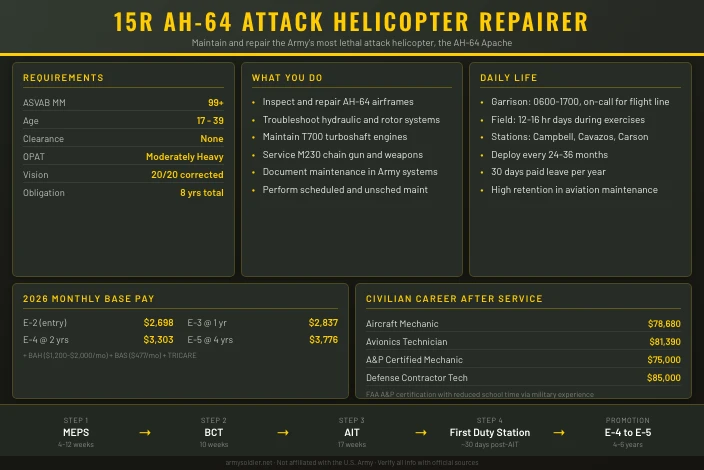
Job Role and Responsibilities
The 15R AH-64 Attack Helicopter Repairer inspects, troubleshoots, repairs, and maintains AH-64 Apache attack helicopters. You service airframe structures, turboshaft engines, rotor systems, hydraulic systems, fuel systems, and flight controls. When an Apache goes down for maintenance, you diagnose the fault, fix it, and clear the aircraft to fly.
A garrison day typically starts with a scheduled phase or periodic inspection. You open panels, check fluid levels, inspect rotor blade leading edges for erosion, and work through the technical manual checklist line by line. Every finding goes into the maintenance management system before you move to the next task.
Unscheduled maintenance is a constant. A pilot returns from a training mission and writes up a hydraulic pressure fluctuation. You pull the maintenance records, start troubleshooting at the most likely cause, and work outward from there. That process might take two hours or two days depending on what you find.
Specific Roles
The 15R is the base MOS for AH-64 maintenance. Soldiers accumulate specialized qualifications through Additional Skill Identifiers (ASIs):
| Identifier | Description |
|---|---|
| ASI B6 | AH-64A Apache maintenance |
| ASI B8 | AH-64D Longbow maintenance |
At senior grades, 15R soldiers can move into the 15K Aircraft Components Repair Supervisor MOS, which oversees component-level repair across an aviation unit. The career ultimately merges into 15Z Aircraft Senior Sergeant at E-8 and above, a leadership role that manages all aviation maintenance at battalion level.
Mission Contribution
Attack helicopters exist to destroy targets that ground forces can’t reach or engage safely. The Apache carries Hellfire missiles, a 30mm chain gun, and Hydra 70 rockets. Its Target Acquisition Designation Sight and FLIR systems let it find and engage targets at night and in bad weather. When a ground unit calls for fire support, the 15R is the reason the Apache can answer that call. A grounded Apache is a capability the brigade doesn’t have, so every maintenance decision carries operational weight.
Technology and Equipment
You work on General Electric T700-GE-701C/D turboshaft engines, composite main and tail rotor blades, hydraulic actuators, and the aircraft’s 1553B data bus systems. The M230 chain gun requires its own maintenance checks. You use borescopes for internal engine inspections, vibration analyzers to balance rotor systems, and specialized hydraulic test stands. All maintenance is documented in the Army’s maintenance management systems and executed to the standards in the technical manual library.
Salary and Benefits
Pay starts the day you enter the Army, not when you finish training. A new 15R arrives at their first unit as a Specialist (SPC) at E-4 after AIT.
Base Pay
| Rank | Time in Service | Monthly Base Pay |
|---|---|---|
| Private (PV2) E-2 | Entry | $2,698 |
| Private First Class (PFC) E-3 | 1 year | $2,837 |
| Specialist (SPC) E-4 | 2 years | $3,303 |
| Sergeant (SGT) E-5 | 4-6 years | $3,776 |
| Staff Sergeant (SSG) E-6 | 6-10 years | $4,236 |
Pay figures are 2026 DFAS rates reflecting the 3.8% across-the-board raise effective January 2026.
Additional Allowances
Base pay is only part of the picture. Two allowances add significant income on top of it:
- Basic Allowance for Subsistence (BAS): $476.95 per month, flat rate for all enlisted soldiers
- Basic Allowance for Housing (BAH): Varies by duty location and dependency status. An E-4 without dependents at Fort Campbell, Kentucky draws roughly $1,200-$1,500 per month. An E-4 with dependents at many CONUS installations draws $1,500-$2,000 per month. Use the DoD BAH Rate Lookup for your specific installation.
Neither allowance is taxable, which makes the effective compensation significantly higher than the base pay figures suggest.
Additional Benefits
Healthcare: Active-duty soldiers receive TRICARE Prime at no cost. Zero premiums, zero deductibles, and zero copays for in-network care. Dental and vision coverage are included. Family members enroll under the same plan with a $1,000 annual out-of-pocket cap for in-network care.
Education: Tuition Assistance (TA) covers up to $4,500 per year for college courses taken while on active duty. After separation, the Post-9/11 GI Bill pays full in-state tuition at public schools, a monthly housing allowance based on the school’s ZIP code, and up to $1,000 per year in book stipends. Private school tuition is capped at $29,920.95 per academic year for the 2025-2026 school year.
Retirement: Soldiers who joined after January 2018 fall under the Blended Retirement System (BRS). BRS combines a 20-year pension at 40% of high-36 average basic pay with a Thrift Savings Plan (TSP) that includes government matching up to 5% of basic pay. Soldiers who contribute at least 5% of their paycheck receive the maximum match.
Work-Life Balance
Active-duty soldiers earn 30 days of paid leave per year, accruing at 2.5 days per month. Federal holidays add 11 more days. Garrison schedules generally follow normal duty hours Monday through Friday, though aviation units have periodic duty rotations and on-call requirements that extend beyond the standard day. Field exercises and pre-deployment training cycles compress that balance temporarily.
Qualifications and Eligibility
Requirements Table
| Requirement | Standard |
|---|---|
| ASVAB Line Score | MM: 99 (Mechanical Maintenance) |
| AFQT Minimum | 31 (high school diploma); 50 (GED) |
| Age | 17-34 at enlistment |
| Citizenship | U.S. citizen or permanent resident |
| Education | High school diploma or GED |
| Security Clearance | None required at entry |
| OPAT Category | Moderately Heavy (MH) |
| Medical | PULHES 222211 |
| Gender | Open to all |
The MM (Mechanical Maintenance) composite is calculated as: NO + AS + MC + EI. Strong scores on the Auto and Shop Information (AS) and Mechanical Comprehension (MC) subtests are the biggest drivers. If you’ve worked on engines, vehicles, or heavy equipment before enlisting, those sections will feel familiar.
Application Process
The path to 15R follows the standard Army enlistment process:
The full process from first recruiter visit to shipping date typically takes two to four months, depending on MEPS scheduling and how quickly waivers clear if needed.
Selection Criteria
15R is open to anyone who meets the MM:99 threshold and the medical standards. The MOS is not a special operations pipeline with a selection board or competitive interview. If you meet the scores and pass MEPS, you can request 15R. Your recruiter’s office can tell you whether slots are available in your current enlistment cycle.
Service Obligation
The standard active-duty service obligation for 15R is three years, though many contracts include additional time tied to training length or bonuses. Soldiers entering under the Army’s nine-year active-duty option train at a reduced pace but receive enhanced benefits. Confirm your specific obligation in your contract before signing.
See our ASVAB study guide for strategies to hit these line scores, or take the PiCAT from home if you are a first-time tester.
Work Environment
Setting and Schedule
15R work happens in aircraft hangars, on flight lines, and in the field. Garrison maintenance is primarily hangar work during normal duty hours, Monday through Friday. The environment is industrial: concrete floors, large overhead doors, the smell of hydraulic fluid and jet fuel, and the constant noise of other aircraft running nearby.
Field exercises shift the environment completely. You set up maintenance at a forward arming and refueling point (FARP) or in a tactical assembly area, working with reduced tools, less shelter, and more time pressure. Deployed maintenance can mean working on austere forward operating bases where part shortages and environmental conditions add complexity to every job.
Leadership and Communication
Aviation maintenance runs through a rigid chain of command. The quality control officer or warrant officer signs off on critical maintenance actions. The master gunner and crew chiefs report issues, and the maintenance officer tracks aircraft readiness against mission requirements. As a junior 15R, you receive task-specific oversight on complex jobs. As you gain experience, you run your own inspections and troubleshoot independently before looping in leadership.
Performance feedback comes through the Non-Commissioned Officer Evaluation Report (NCOER) at E-5 and above, and through counseling statements at junior grades. Aviation maintenance is one of the more documentation-intensive career fields in the Army, so written records and attention to detail follow you from the start.
Team Dynamics
Aviation maintenance is a team sport. You rarely complete a significant job alone. Rotor system changes, engine replacements, and major structural repairs require multiple mechanics working in coordination. You’ll rely on your team to catch errors and back up your work, especially on flight-critical components where a missed step can have consequences in the air.
At the same time, individual accountability is constant. Your name goes in the logbook when you sign off a maintenance action. That personal accountability shapes how careful and thorough experienced 15R soldiers are, and it’s the standard you’re expected to reach quickly.
Job Satisfaction
Aviation maintenance is among the higher-retention specialties in the Army. Soldiers who stay in 15R typically cite the technical challenge, the Apache specifically (it’s the Army’s most capable attack helicopter), and the direct applicability to civilian aviation careers. The job is demanding, the hours in the field are long, and the pressure of flight safety is real. But soldiers who value precision technical work and don’t mind getting dirty tend to find genuine satisfaction in it.
Training and Skill Development
Initial Training Pipeline
| Phase | Location | Duration | Focus |
|---|---|---|---|
| Basic Combat Training (BCT) | Various installations | 10 weeks | Soldier fundamentals, fitness, weapons, tactics |
| Advanced Individual Training (AIT) | Fort Eustis, Virginia | 17 weeks | AH-64 systems, maintenance procedures, technical manuals |
BCT is the same for all Army recruits regardless of MOS. You’ll qualify on the M16/M4, run field exercises, and build basic soldier skills. Aviation maintenance MOSs don’t have a special BCT track.
AIT at Fort Eustis focuses exclusively on the AH-64. The curriculum covers:
- Aircraft systems familiarization (airframe, engine, drivetrain)
- Hydraulic system inspection and repair
- Rotor system maintenance and tracking
- Engine troubleshooting using technical manuals
- Maintenance record keeping and documentation
- Ground safety and FOD (Foreign Object Damage) prevention
The training is classroom and hands-on combined. You work on actual aircraft components and training airframes, not just diagrams. By the end of AIT, you can conduct scheduled inspections and assist on complex maintenance tasks under supervision.
Advanced Training
After arriving at your first unit, you continue building skills through on-the-job training and formal qualification courses:
- New Equipment Training (NET): When the Army introduces upgraded Apache variants or new systems, affected mechanics attend formal new equipment training.
- Warrant Officer Candidate School (WOCS): High-performing enlisted 15R soldiers can apply for the 153A Rotary Wing Aviator or 151A Aviation Maintenance Technician warrant officer programs. These paths require a service commitment but open significantly higher pay and leadership positions.
- Flight school bridge programs: Some aviation maintenance veterans use military experience to qualify for FAA Airframe and Powerplant (A&P) certification with reduced civilian school time.
- Battle Staff NCO Course: Available at senior NCO grades for soldiers moving into operations and planning roles.
Everything starts with qualifying ASVAB scores — our study guide covers what to study first.
Career Progression and Advancement
Rank Progression
| Rank | Grade | Typical Time in Service | Primary Focus |
|---|---|---|---|
| Private First Class | E-3 | 0-1 year | Learning, BCT/AIT |
| Specialist | E-4 | 1-3 years | Building task proficiency |
| Sergeant | E-5 | 3-6 years | Team leader, independent maintenance |
| Staff Sergeant | E-6 | 6-10 years | Section sergeant, quality control |
| Sergeant First Class | E-7 | 10-15 years | Platoon sergeant, maintenance management |
| Master Sergeant / 1SG | E-8 | 15-20 years | Senior advisor, first sergeant |
| Sergeant Major | E-9 | 20+ years | CSM or SGM at battalion or higher |
Promotion to E-5 and above is merit-based and competitive. The Army uses a points system that weights time in grade, military education, physical fitness scores, and awards. Aviation maintenance MOSs tend to promote faster than combat arms MOSs at junior grades because the technical skill set is harder to replace.
Role Flexibility
15R soldiers who want to branch out have options. The most common lateral move is into 15H (Aircraft Pneudraulics Repairer) or transitioning to 15Z (Aircraft Senior Sergeant) as a master-level maintenance leader. Applying for a Voluntary Transfer Incentive Program (VTIP) slot allows a move to a different MOS if the Army needs skills elsewhere, though aviation maintenance soldiers are generally kept in the career field.
Performance Evaluation
Junior soldiers (E-4 and below) receive monthly counseling from their squad leader and quarterly counseling from their platoon sergeant. The focus is on task completion, attitude, and growth.
At E-5, the formal NCOER system takes over. Your rater and senior rater evaluate you on character, presence, intellect, leads, and achieves.
Aviation maintenance performance is measured in concrete terms: aircraft readiness rates, maintenance documentation accuracy, and safety record. Units that keep their Apache fleet above the required readiness threshold reflect well on the maintenance team.
Physical Demands and Medical Evaluations
Physical Requirements
The 15R is rated Moderately Heavy on the OPAT (Occupational Physical Assessment Test). The daily physical demands reflect the work:
- Lifting and carrying components weighing 50-80+ pounds (rotor blade assemblies, engine modules)
- Working in confined areas such as engine bays and tail booms
- Extended periods standing, kneeling, or lying on concrete
- Working overhead to reach internal components
- Wearing hearing protection continuously on the flight line
You are not in a combat arms role, but the physical demands are real. Soldiers who keep themselves fit find the job less punishing and recover faster from physically demanding days.
Army Fitness Test (AFT)
The Army Fitness Test replaced the ACFT on June 1, 2025. All soldiers, regardless of MOS, must pass the AFT. The 15R is not designated as a combat specialty MOS for AFT purposes, so the general standard applies.
| Event | Abbreviation | Minimum Score |
|---|---|---|
| 3 Repetition Maximum Deadlift | MDL | 60 points |
| Hand Release Push-Up | HRP | 60 points |
| Sprint-Drag-Carry | SDC | 60 points |
| Plank | PLK | 60 points |
| Two-Mile Run | 2MR | 60 points |
| Total minimum | 300 points |
Scores are sex- and age-normed. The maximum score is 500 points (100 per event). AFT is administered twice per year.
Medical Evaluations
The Army conducts periodic health assessments throughout your career. Aviation-adjacent soldiers who work around aircraft noise must receive annual hearing evaluations and, where necessary, audiological monitoring. The PULHES 222211 standard required for 15R means no significant vision, hearing, or physical limitations at entry, though corrective lenses are permitted for vision. Medical waivers are possible for some conditions; a recruiter can advise based on your specific situation.
Deployment and Duty Stations
Typical Duty Stations
AH-64 Apache units are concentrated at a specific set of installations:
CONUS:
- Fort Campbell, Kentucky (101st Airborne Division)
- Fort Cavazos, Texas (1st Cavalry Division)
- Fort Wainwright, Alaska (11th Airborne Division)
- Fort Drum, New York (10th Mountain Division)
- Hunter Army Airfield, Georgia (3rd Infantry Division aviation)
- Fort Riley, Kansas
- Joint Base Lewis-McChord, Washington
OCONUS:
- Katterbach Army Airfield, Germany
- Camp Humphreys and Seoul, South Korea
- Wheeler Army Airfield, Hawaii
Assignment preferences are submitted through the assignment system, but the Army fills requirements based on unit needs. First-assignment soldiers receive orders based on where the Army needs 15R skills at that time.
Deployment Details
Apache units deploy regularly in support of theater security operations, combat operations, and rotational training missions. Deployment cycles vary by unit and current operational requirements. Combat deployments have historically run six to twelve months. Rotational deployments to Europe or South Korea typically run nine months. Aviation support soldiers generally deploy with their assigned unit, though individual augmentation fills also pull soldiers for shorter missions.
The 101st Airborne at Fort Campbell has historically maintained one of the most active Apache deployment schedules of any division. Soldiers who want operational experience should consider Fort Campbell assignments.
Risk, Safety, and Legal Considerations
Job Hazards
Aviation maintenance carries specific risks that ground maintenance does not:
- Rotor wash and prop wash: Deadly if you’re not clear of the rotor arc during run-up
- Foreign Object Damage (FOD): Dropped tools or debris ingested by an engine can destroy it and potentially cause a crash
- Fuel and hydraulic fluid exposure: Both are flammable and exposure to hydraulic fluid carries long-term health concerns
- Electrical hazards: High-voltage systems on the aircraft require lockout/tagout discipline
- Noise-induced hearing loss: Sustained exposure to turbine engine and rotor noise requires consistent hearing protection
The Army takes aviation maintenance safety extremely seriously because the consequences of errors are immediate and severe.
Safety Protocols
Every maintenance action on a flight-critical system requires a technical manual reference and a quality control (QC) inspection before the aircraft is cleared. Shops use two-person verification on critical torque values and safety-wiring. FOD walks before engine start are mandatory. Proper personal protective equipment is required and enforced. The Army aviation safety program maintains detailed records of maintenance-related incidents, and soldiers are trained to report hazards without fear of reprisal.
Security and Legal Requirements
15R does not require a security clearance at entry. If you later move into roles that require access to classified systems or plans, you’ll go through the standard background investigation. Your service contract is a binding legal obligation. Going AWOL or failing to meet standards can result in administrative separation or court martial depending on severity. Soldiers who want to leave the Army before their obligation ends must go through an official separation process.
Impact on Family and Personal Life
Family Considerations
The Army provides a strong family support infrastructure. On-installation housing, or BAH to live off-post, gives families flexibility. Family Readiness Groups (FRGs) connect spouses and dependents within the unit. Military OneSource offers free counseling, financial planning, and relocation assistance. TRICARE covers the entire family at no cost to the soldier.
That said, aviation units operate with a tempo that affects family life. Field exercises, gunnery qualifications, and deployment workups generate irregular duty hours. Deployments mean extended separations. Families who do well in this environment tend to build strong local networks and treat each duty station as a chapter rather than a disruption.
Relocation
Soldiers receive Permanent Change of Station (PCS) orders roughly every two to three years. The Army covers moving costs through the Defense Personal Property Program, and soldiers receive a Dislocation Allowance (DLA) payment to offset relocation expenses. Families with school-age children or spouses in specialized careers sometimes find frequent moves the hardest part of Army life. The MyArmyBenefits counselor at your installation can walk through options including remote work resources for spouses.
Reserve and National Guard
The 15R MOS is primarily a National Guard position. Guard units in states including Utah, South Carolina, and Idaho operate Apache attack helicopter battalions that maintain 15R billets. Army Reserve availability is limited because the Reserve component has fewer attack aviation units than the Guard.
If you want to serve part-time as a 15R, the Guard is your best path. Research which states have active Apache units before committing to a specific Guard recruiter, since not every state Guard has an attack aviation battalion.
Drill Schedule and Training Commitment
Guard 15R soldiers follow the standard one-weekend-per-month and two-weeks-Annual-Training schedule. Apache maintenance is technically demanding, and keeping skills current on a part-time schedule takes effort. Drill weekends for Guard aviation maintenance units involve real work in the maintenance bay - phase maintenance, component replacements, and system checks on assigned aircraft.
Apache-specific certifications and annual technical proficiency checks add training days beyond normal drill. When the Army pushes system upgrades or software changes to the Apache fleet, Guard 15R soldiers need additional qualification training. Budget for three to six extra training days per year. Unit Training Officers schedule these in advance so soldiers can coordinate with civilian employers. All additional training days are compensated.
Part-Time Pay and Benefits
An E-4 with about four years of service earns roughly $488 per drill weekend. Over 12 drill weekends per year, that comes to approximately $5,856 in annual drill pay, plus Annual Training pay for two weeks. Active duty E-4 monthly base pay at the same experience level is $3,659.
Healthcare for Guard soldiers is available through Tricare Reserve Select: $57.88 per month for member-only coverage or $286.66 per month for family coverage in 2026. Active duty soldiers get TRICARE Prime at no cost. Many Guard soldiers carry employer-sponsored health insurance from their civilian jobs and use Tricare Reserve Select as supplemental or gap coverage.
Education benefits include Federal Tuition Assistance and the Montgomery GI Bill-Selected Reserve (Chapter 1606). Guard members often qualify for state tuition waivers at public universities - the value varies by state but can be substantial. After a qualifying mobilization of 90 or more consecutive days, Guard soldiers may earn Post-9/11 GI Bill (Chapter 33) eligibility.
Retirement follows the points-based formula. After 20 qualifying years (at least 50 retirement points per year), you become eligible for retirement pay starting at age 60. That minimum age drops by three months for every 90 days of qualifying active service, down to a floor of 50.
Deployment and Mobilization
Guard Apache units have been mobilized for overseas deployments in support of contingency operations. Mobilization cycles for Guard aviation units tend to run every three to five years, though this depends heavily on national security demand at the time. Typical deployment length is nine to twelve months including pre-deployment training and post-deployment reset.
Active duty Apache units deploy more frequently on set rotation cycles. Guard Apache soldiers experience lower deployment frequency overall, but when mobilizations happen they are real combat deployments, not just training events.
During mobilization, Guard soldiers receive full active duty pay and TRICARE Prime at no cost.
Civilian Career Integration
Apache experience is a narrow specialty but one with direct civilian demand. Boeing is the Apache prime contractor and employs maintenance technicians and field service representatives who support Apache fleets at military installations worldwide. Defense contractors running maintenance programs at Guard and active duty bases hire 15R veterans specifically because of their system knowledge.
Rotary-wing maintenance repair organizations (MROs) that service military and law enforcement helicopters recruit from the Guard. FAA Airframe and Powerplant (A&P) certification builds on Army training and opens broader civilian aviation maintenance doors beyond just the Apache program.
Boeing and other Apache program contractors sometimes actively recruit from the Guard units they support, creating a direct pipeline from part-time Guard service to full-time civilian contractor work. This is one of the more concrete civilian-military career integration opportunities in Army aviation.
USERRA protects your civilian job during any mobilization period.
| Feature | Active Duty | Army Reserve | Army National Guard |
|---|---|---|---|
| Commitment | Full-time | One weekend/month, two weeks/year | One weekend/month, two weeks/year |
| Monthly Pay (E-4, ~4 yrs) | $3,659 | ~$488/drill weekend | ~$488/drill weekend |
| Healthcare | TRICARE Prime, $0 premiums | Tricare Reserve Select, $57.88/month | Tricare Reserve Select, $57.88/month |
| Education | Post-9/11 GI Bill | Federal TA, MGIB-SR | Federal TA, MGIB-SR, state tuition waivers |
| Deployment | Regular rotations | Mobilization-based | Mobilization-based, plus state activations |
| Retirement | 20-year pension, immediate | Points-based, age 60 | Points-based, age 60 |
Post-Service Opportunities
Civilian Career Transition
The 15R MOS builds directly applicable skills for the civilian aviation maintenance industry. FAA Airframe and Powerplant (A&P) certification is the key credential. Many veterans qualify for accelerated A&P certification paths based on their military maintenance experience. The FAA allows military training to substitute for a portion of the civilian experience requirement, and several programs help veterans bridge the gap in weeks rather than years.
Airlines, helicopter operators, defense contractors, and government agencies actively recruit veterans with AH-64 experience. Boeing, Lockheed Martin, L3Harris, and SAIC all have large Apache sustainment and modernization programs that value soldiers who have maintained the platform in operational settings.
Civilian Career Prospects
| Civilian Job Title | Median Annual Salary | Job Outlook (2024-2034) |
|---|---|---|
| Aircraft Mechanic and Service Technician | $78,680 | +5% (faster than average) |
| Avionics Technician | $81,390 | +5% |
| Aerospace Quality Control Inspector | $65,000-$85,000 | +3-5% |
| Defense Contractor Aviation Maintenance | $85,000-$115,000 | Steady demand |
Salary data from the Bureau of Labor Statistics (May 2024). Defense contractor compensation varies by company and clearance level.
Education Benefits
The Post-9/11 GI Bill covers 36 months of education benefits. At a public in-state university, that means full tuition and fees plus a monthly housing allowance. Veterans pursuing an A&P license through an FAA-approved school can use GI Bill benefits to cover program costs. The book stipend adds up to $1,000 per academic year. Tuition Assistance is also available for courses taken while still on active duty.
Is This a Good Job for You? The Right (and Wrong) Fit
Ideal Candidate Profile
The best candidates for 15R are people who like working with mechanical systems and don’t mind learning from a thick technical manual. You should be comfortable working in a team, taking direction precisely, and doing repetitive inspection tasks without cutting corners. The Apache is a complex aircraft, and the learning curve is steep even after AIT.
Strong candidates typically have some prior exposure to mechanical work: cars, motorcycles, engines, construction equipment. That background doesn’t substitute for the Army’s training, but it helps you absorb technical concepts faster. Detail orientation and patience matter more than physical strength, though the job requires both.
Potential Challenges
If you prefer a predictable nine-to-five schedule, aviation maintenance will test your patience. Flight schedules drive maintenance schedules, and aircraft don’t always break during business hours. Extended field exercises compress your personal time. Deployments happen, and they separate you from family and normal life for months.
The stakes are also real. An error in maintenance documentation or a missed inspection step can contribute to a crash. That weight is something experienced 15R soldiers carry as motivation to stay precise. If that kind of accountability feels oppressive rather than motivating, this MOS may not suit you.
Who Stays and Who Leaves
15R is a strong fit if your post-service goal is a civilian aviation maintenance career. The skills transfer directly, the credentials accelerate your A&P certification path, and the demand for A&P mechanics is growing. If your goal is something unrelated to aviation – healthcare, business, law enforcement – the MOS still gives you structured discipline and a security clearance pathway, but the technical training won’t directly support that career transition.
Soldiers who thrive in this role tend to stay for a full career or transition to well-paying civilian jobs after their first or second contract. The ones who struggle are usually those who expected more tactical fieldwork and less wrenching, or who underestimated how documentation-intensive military aviation maintenance is.
More Information
Talk to an Army recruiter to find out whether 15R slots are available for your enlistment cycle and whether your ASVAB scores qualify. Recruiters can walk you through current bonus programs, duty station options, and how to structure your contract to maximize your benefits. You can also contact a recruiter online at goarmy.com or call 1-888-550-ARMY.
- Prepare for the ASVAB with our study guide to make sure your line scores qualify
This site is not affiliated with the U.S. Army or any government agency. Verify all information with official Army sources before making enlistment or career decisions.
Explore more Army aviation careers such as the 15T UH-60 Helicopter Repairer and the 15U CH-47 Helicopter Repairer.