15T UH-60 Helicopter Repairer
Every Black Hawk that lifts off depends on the soldier who fixed it. The 15T UH-60 Helicopter Repairer keeps the Army’s most versatile helicopter flying – from medevac runs and troop insertions to search-and-rescue and VIP transport. You diagnose problems, replace parts, run inspections, and sign off that the aircraft is safe before anyone climbs aboard. If you want a hands-on mechanical job with real consequences, this is it.
Qualifying requires specific ASVAB line scores — our ASVAB study guide covers what to target and how to prepare.
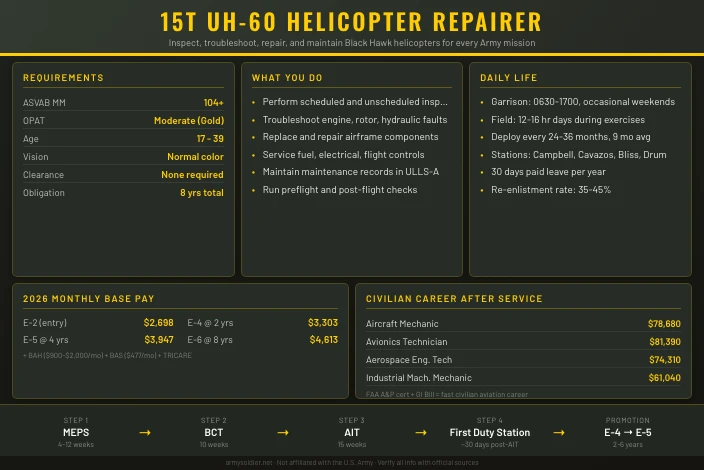
Job Role and Responsibilities
You inspect, troubleshoot, repair, and maintain UH-60 Black Hawk helicopters. Your work covers airframe structures, engines, rotor systems, hydraulics, fuel systems, and flight controls. When a bird goes down for maintenance, you figure out what broke, fix it, and clear it to fly.
A typical garrison day starts with a scheduled inspection. You pull panels, check fluid levels, look for cracks or corrosion, and run through the technical manual checklist line by line. After the inspection, you log findings in the Unit Level Logistics System-Aviation (ULLS-A) and start whatever repairs the aircraft needs.
Unscheduled maintenance fills the gaps. A pilot reports a vibration during flight. You troubleshoot the rotor system, trace the problem to a worn damper bearing, pull the old one, install the replacement, and run a ground check. That process might take four hours or four days depending on parts availability and what else you find.
Specific Roles
The 15T is the base MOS for UH-60 maintenance. As you gain experience, the Army adds specialization through Additional Skill Identifiers (ASIs):
| Identifier | Description |
|---|---|
| ASI B4 | UH-60A/L maintenance |
| ASI B7 | UH-60M maintenance |
Senior 15T soldiers can transition into broader aviation maintenance roles. The 15H (Aircraft Pneudraulics Repairer) and 15K (Aircraft Components Repair Supervisor) open up at higher skill levels. At E-8 and above, the career merges into 15Z (Aircraft Senior Sergeant), a leadership MOS that oversees all aviation maintenance within a battalion.
Mission Contribution
Black Hawks fly more missions than any other Army helicopter. Medical evacuation, air assault, command and control, cargo resupply, special operations support – the 15T keeps all of it running. A single maintenance failure can ground an aircraft for days, so your work directly affects whether units can move, fight, and get casualties to hospitals.
Technology and Equipment
You work with turboshaft engines (T700-GE-701C/D), composite rotor blades, digital flight control systems, hydraulic servos, integrated vehicle health monitoring systems, and the technical manual library that documents every nut and bolt on the airframe. Specialized tools include torque wrenches calibrated to specific tolerances, vibration analysis equipment, borescopes for internal engine inspections, and ground support equipment like the Black Hawk maintenance stands and portable hydraulic test benches.
Salary and Benefits
Financial Benefits
Military pay is based on rank and time in service. Most 15T soldiers enter at E-1 or E-2 and promote to E-4 within their first enlistment.
| Rank | Pay Grade | Years of Service: 2 | Years of Service: 4 | Years of Service: 6 | Years of Service: 8 |
|---|---|---|---|---|---|
| Private (PV2) | E-2 | $2,698 | $2,698 | $2,698 | - |
| Specialist (SPC) | E-4 | $3,303 | $3,659 | $3,816 | $3,816 |
| Sergeant (SGT) | E-5 | $3,599 | $3,947 | $4,109 | $4,299 |
| Staff Sergeant (SSG) | E-6 | $3,743 | $4,069 | $4,236 | $4,613 |
Source: DFAS 2026 pay tables. Figures reflect the 2026 pay raise.
Housing and food allowances add to that base pay. BAH (Basic Allowance for Housing) depends on your duty station and whether you have dependents. A single E-4 receives roughly $900 to $2,000+ per month depending on location. BAS adds $477 monthly for food. Enlistment bonuses for 15T change frequently – ask your recruiter about current offers before signing.
Additional Benefits
TRICARE covers you and your family at zero cost for active-duty members. That includes doctor visits, prescriptions, dental, vision, mental health, and hospitalization. While serving, Tuition Assistance pays up to $4,500 per year toward college courses. After separation, the Post-9/11 GI Bill covers up to 36 months of tuition at public universities (full in-state rate) plus a monthly housing allowance and $1,000 annual book stipend.
Retirement follows the Blended Retirement System (BRS):
- Pension at 20 years: 40% of your high-36 average basic pay
- TSP matching: the government contributes up to 5% of your basic pay
- Continuation pay: a lump-sum bonus between years 8 and 12 in exchange for additional service
Work-Life Balance
You earn 30 days of paid leave per year. Garrison schedules are generally predictable – early morning to late afternoon with occasional weekend duty. Field maintenance and deployments break that pattern. When aircraft need to fly for a training exercise or real-world mission, you work until the fleet is ready regardless of the clock.
Qualifications and Eligibility
Basic Qualifications
The 15T requires a Mechanical Maintenance (MM) composite score of 104 on the ASVAB. The MM composite combines Numerical Operations, Auto and Shop Information, Mechanical Comprehension, and Electronics Information. That score sits in the moderate-to-competitive range for enlisted MOSs.
You also need normal color vision. Aviation maintenance involves color-coded wiring, fluid identification, and safety markings. Red-green color blindness is disqualifying without a waiver.
| Requirement | Details |
|---|---|
| Age | 17-39 (up to 42 with waiver) |
| Citizenship | U.S. citizen or permanent resident |
| Education | High school diploma or GED |
| AFQT (ASVAB) | Minimum 31 (diploma) or 50 (GED) |
| Mechanical Maintenance (MM) | Minimum 104 |
| OPAT Category | Moderate (Gold) |
| Vision | Normal color vision required |
| Security Clearance | None required |
Application Process
Visit your local Army recruiting station. Your recruiter reviews your qualifications, explains the 15T, and helps you decide between Active Duty, Reserve, or National Guard.
MEPS (Military Entrance Processing Station) comes next. You take the ASVAB if you haven’t already, complete a full medical exam, and go through a background review. If your MM score hits 104 and your medical results check out, your recruiter reserves a 15T training slot.
Selection Criteria and Competitiveness
The 15T is a high-demand MOS. The Army needs Black Hawk mechanics at every aviation unit worldwide, so slots open regularly. Scoring well above the 104 MM minimum helps if multiple recruits are competing for the same ship date. Prior automotive or mechanical experience strengthens your application but is not required.
Upon Accession into Service
Most recruits enter at E-1 (Private). You promote to E-2 after Basic Combat Training. College credits or referral bonuses can bump your entry grade to E-2 or E-3. The standard service obligation is 8 years total – typically 3 to 6 years active duty with the remainder in the Individual Ready Reserve.
See our ASVAB study guide for strategies to hit these line scores, or take the PiCAT from home if you are a first-time tester.
Work Environment
Setting and Schedule
Your workspace splits between the flight line and the hangar.
Flight line: You work outdoors in whatever the weather gives you. Summer heat on a concrete ramp in Texas. Freezing rain at Fort Drum in January. You perform preflight and postflight inspections here, along with quick-turn maintenance between missions.
Hangar: Larger inspections and component replacements happen inside. The hangar has overhead cranes, jacks, maintenance stands, and parts storage. It is climate-controlled at some installations and an open-air shed at others.
Garrison hours are typically 0630 to 1700 with a lunch break. Expect occasional nights and weekends when aircraft need to be ready for early-morning flights. Field exercises and deployments stretch those hours to 12-16 per day.
Leadership and Communication
You work under a platoon sergeant (E-7) and a maintenance officer (usually a Warrant Officer or Captain). Day-to-day tasking comes from your section sergeant. Technical guidance often comes from the unit’s technical inspector (TI), a senior 15T or 15Z who signs off on critical maintenance.
Performance feedback flows through counseling sessions (monthly for junior soldiers) and annual evaluations. The aviation maintenance world values precision and documentation, so your leadership notices when your paperwork is clean and your maintenance faults are caught early.
Team Dynamics and Autonomy
Most maintenance tasks are two-person jobs at minimum. You hold panels while your partner removes bolts. You read the technical manual while someone else torques a fitting. The buddy system is baked into aviation safety culture.
That said, troubleshooting is often individual. When a system malfunctions, you follow the fault isolation procedures in the manual, test components, and trace wiring. Your section sergeant reviews your findings, but the initial detective work is yours.
Job Satisfaction and Retention
Aviation mechanics who enjoy problem-solving and hands-on work tend to stay. The satisfaction of watching a helicopter you fixed take off and complete its mission is hard to match in other MOSs. The biggest complaints are parts shortages, long hours before major exercises, and the paperwork burden that comes with every maintenance action.
Re-enlistment rates for aviation maintenance MOSs hover around 35% to 45% for first-term soldiers. Those who leave often do so for higher-paying civilian aviation jobs – which speaks to the value of the training itself.
Training and Skill Development
Initial Training
Training has two phases: Basic Combat Training (BCT) and Advanced Individual Training (AIT).
| Phase | Location | Duration | Focus |
|---|---|---|---|
| BCT | Fort Jackson, SC; Fort Moore, GA; Fort Leonard Wood, MO | 10 weeks | Soldiering basics: marksmanship, tactics, fitness, discipline |
| AIT | Fort Eustis, VA (Joint Base Langley-Eustis) | 15 weeks | UH-60 maintenance: airframe, engines, rotor systems, hydraulics |
BCT makes you a soldier. Rifle qualification, land navigation, squad movements, and physical conditioning. Every MOS goes through this phase.
AIT turns you into a helicopter mechanic. At the 128th Aviation Brigade in Fort Eustis, Virginia, you study the UH-60 platform inside and out. The curriculum covers engine theory and disassembly, rotor head and blade maintenance, hydraulic systems, fuel systems, electrical troubleshooting, and airframe structural repair on fiberglass, aluminum, and steel components. You practice on actual aircraft and trainer rigs, not just classroom models.
The course mixes classroom instruction with hands-on lab work. Written tests cover technical manual procedures and system theory. Practical exams require you to perform specific maintenance tasks within time limits. Fail a block of instruction and you recycle through it – the Army does not graduate mechanics who cannot do the work.
Advanced Training
After AIT, your training continues at your first unit. You complete a progression of task evaluations to earn full qualification on the UH-60 model at your installation (A/L or M variant).
Several advanced paths open up from there:
- Aircraft Crewmember (Crew Chief): Some 15T soldiers earn the additional duty of flying as the crew chief on Black Hawk missions. This requires a separate flight physical, crew chief course, and ongoing flight hours.
- Technical Inspector (TI): Senior 15T soldiers (E-6+) can qualify as technical inspectors who sign off on all maintenance before an aircraft returns to service.
- 160th SOAR (Night Stalkers): The Army’s special operations aviation unit at Fort Campbell recruits experienced 15T soldiers. The assessment and selection process is demanding, and the operational tempo is intense.
- Warrant Officer path: Strong 15T soldiers can apply for Warrant Officer Candidate School and become 151A (Aviation Maintenance Technicians), managing maintenance programs at the unit level.
The Army pays for FAA Airframe and Powerplant (A&P) certification prep through the Army COOL program. Your military maintenance experience counts toward the FAA’s 30-month practical experience requirement.
Everything starts with qualifying ASVAB scores — our study guide covers what to study first.
Career Progression and Advancement
Career Path
Promotion through the junior ranks is mostly automatic if you meet time-in-service requirements and stay out of trouble. E-5 and above require board appearances, points, and strong evaluations.
| Rank | Pay Grade | Typical Years | Typical Role |
|---|---|---|---|
| Private (PV2) | E-2 | 0-1 | AIT graduate, basic maintenance tasks |
| Private First Class (PFC) | E-3 | 1-2 | Qualified mechanic, assigned to maintenance section |
| Specialist (SPC) | E-4 | 2-3 | Experienced mechanic, may lead small tasks |
| Sergeant (SGT) | E-5 | 4-6 | Section leader, supervises junior mechanics |
| Staff Sergeant (SSG) | E-6 | 6-10 | Platoon sergeant, technical inspector |
| Sergeant First Class (SFC) | E-7 | 10-14 | Production control, maintenance operations manager |
| Master Sergeant (MSG) | E-8 | 14+ | Senior maintenance leadership, transitions to 15Z |
At E-6, you’re managing maintenance teams and quality control. At E-7, you run production control – the nerve center that tracks every aircraft’s maintenance status and schedules the work. E-8 and E-9 positions merge into the 15Z (Aircraft Senior Sergeant) MOS, where you oversee all aviation maintenance for a battalion.
Role Flexibility and Transfers
Lateral moves within CMF 15 are the easiest path. The 15U (CH-47 Chinook Repairer) and 15R (AH-64 Apache Repairer) share enough overlap that cross-training is straightforward with additional AIT. Moves outside the aviation maintenance field require retraining and a new service commitment.
The Warrant Officer track is the biggest growth move for 15T soldiers. The 151A (Aviation Maintenance Technician) manages unit-level maintenance programs and requires Warrant Officer Candidate School plus a technical certification course.
Performance Evaluation
NCOs receive annual NCOERs (NCO Evaluation Reports) rated by their supervisor and senior rater. Evaluations measure leadership, technical proficiency, training effectiveness, and character. Consistent “most qualified” ratings separate the soldiers who make E-7 from those who don’t.
What actually gets you noticed: clean maintenance records, catching problems other mechanics miss, training your section to high standards, and keeping aircraft availability rates up. Aviation commanders track readiness numbers closely. The mechanics who keep birds flying earn reputations fast.
Physical Demands and Medical Evaluations
Physical Requirements
This job is physically demanding in ways that don’t always show up on a fitness test. You lift 40- to 60-pound components regularly. You climb on and under the aircraft in awkward positions. You hold heavy tools overhead while removing parts in tight spaces. Summer heat on the flight line and winter cold in the hangar compound the effort.
The OPAT (Occupational Physical Assessment Test) category for 15T is Moderate (Gold), which requires:
- Standing Long Jump: 120 cm
- Seated Power Throw: 350 cm
- Strength Deadlift: 120 lbs
- Interval Aerobic Run: Stage 5 (shuttles)
Every soldier takes the Army Fitness Test (AFT) at least once per year. Minimum standards for the 17-21 age group:
| Event | Male Minimum | Female Minimum |
|---|---|---|
| 3-Rep Max Deadlift (MDL) | 140 lbs | 80 lbs |
| Hand-Release Push-Up (HRP) | 10 reps | 10 reps |
| Sprint-Drag-Carry (SDC) | 2:40 | 3:40 |
| Plank (PLK) | 2:00 | 2:00 |
| Two-Mile Run (2MR) | 15:54 | 18:54 |
Each event is scored 0 to 100. You need at least 60 per event and 300 total to pass. The general standard applies to 15T – combat MOS roles require 350.
Medical Evaluations
Annual physicals check weight, blood pressure, vision, and hearing. Aviation maintenance requires normal color vision on every periodic exam. If you lose color discrimination, you cannot work on aircraft wiring or fluid systems without a waiver.
Flight physicals apply only to crew chief-qualified 15T soldiers who fly regularly. Those exams are more thorough and include an EKG and audiogram.
Deployment and Duty Stations
Deployment Details
Black Hawks deploy wherever the Army goes. Active-duty aviation units typically rotate on a 9-month deployment cycle every 24 to 36 months. Units in rapid-deployment divisions (82nd Airborne, 101st Airborne) may deploy with shorter notice.
Deployment locations depend on global demand. Common recent destinations include the Middle East (Kuwait, Iraq, Syria), Europe (Poland, Romania, Germany), and the Pacific (South Korea). Domestic deployments happen for disaster relief and border support operations.
During deployment, you maintain aircraft in austere conditions – open-air maintenance areas, limited parts supply, sand and dust contamination, and high operational tempo. Twelve-hour shifts are standard. Sixteen-hour days happen when mission requirements spike.
Location Flexibility
The Army assigns duty stations based on unit needs. You can submit preferences, but the branch manager at Human Resources Command makes the final call. Expect to move every 2 to 4 years.
Common CONUS duty stations for 15T:
- Fort Campbell, KY (101st Airborne, 160th SOAR)
- Fort Cavazos, TX (1st Cavalry Division aviation)
- Fort Bliss, TX (1st Armored Division aviation)
- Fort Drum, NY (10th Mountain Division aviation)
- Hunter Army Airfield, GA (3rd Infantry Division aviation)
- Joint Base Lewis-McChord, WA
OCONUS:
- Germany (multiple installations)
- South Korea (Camp Humphreys)
- Alaska (Fort Wainwright)
- Hawaii (Wheeler Army Airfield)
Risk, Safety, and Legal Considerations
Job Hazards
Working around helicopters carries real risk. Main rotor blades spin at head height. Tail rotors are nearly invisible when turning. Engine exhaust reaches temperatures that cause burns on contact.
Common hazards:
- Rotor blade strikes during ground runs
- Hearing damage from engine and rotor noise
- Chemical exposure to hydraulic fluid, fuel, lubricants, and solvents
- Falls from maintenance stands and aircraft surfaces
- Musculoskeletal injuries from lifting heavy components
- Heat stress on summer flight lines
Safety Protocols
Aviation maintenance follows strict safety procedures documented in Army Regulation 385-10 and unit standing operating procedures. Double hearing protection (plugs plus muffs) is required near running aircraft. Ground guides direct all helicopter movements. Lockout/tagout procedures prevent systems from activating during maintenance. Every maintenance action requires documentation and a quality control check before the aircraft returns to service.
Security and Legal Requirements
The 15T does not require a security clearance for initial entry. Soldiers assigned to special operations aviation (160th SOAR) or classified programs may need a Secret clearance later in their career.
All soldiers follow the Uniform Code of Military Justice (UCMJ). Aviation mechanics carry an additional legal responsibility: if you sign off that an aircraft is safe to fly and it crashes due to a maintenance error you should have caught, the investigation will trace back to your signature. That accountability is taken seriously at every level.
Impact on Family and Personal Life
Family Considerations
Military life means moves, deployments, and unpredictable hours. Your family adjusts to a new installation every few years, and deployments separate you for 9 months at a stretch.
Support available at most installations:
- Family Readiness Groups (FRGs) – peer support organized through your unit
- Military OneSource – free counseling, financial planning, and relocation help
- Spousal employment assistance – job search support at each new duty station
- Exceptional Family Member Program (EFMP) – coordinated care for family members with special needs
- On-post childcare – CDC (Child Development Centers) at most installations, though waitlists are common
Relocation and Flexibility
PCS (Permanent Change of Station) moves happen every 2 to 4 years. The Army covers moving expenses, but each relocation disrupts your spouse’s employment, your kids’ schools, and your social network. Larger aviation installations tend to offer 3-year tours. Overseas tours run 2 to 3 years with or without dependents depending on the location.
You can request specific installations, and the Army sometimes grants them. Having a high-demand MOS like 15T gives you slightly better odds since Black Hawk units exist at most major posts.
Reserve and National Guard
The 15T MOS is one of the most available Army specialties in both the Army Reserve and Army National Guard. The UH-60 Black Hawk is the Army’s most widely used helicopter, and Guard medevac and assault helicopter units operate in nearly every state. If you want to stay connected to aviation without a full-time commitment, this MOS gives you strong options.
Drill Schedule and Training Commitment
Standard reserve commitment is one weekend per month and two weeks of Annual Training each summer. For 15T soldiers, that baseline is only part of the picture.
Black Hawk mechanics need to stay current on airframe-specific certifications. Expect additional training days for variant-specific qualifications, especially if your unit flies the UH-60M (the newest Black Hawk variant) or the HH-60M medevac configuration. The medevac HH-60M has different systems and equipment than the assault UH-60M, so soldiers switching between variants need variant-specific training. Guard aviation units may schedule additional weekend drills or short training periods to meet aircraft readiness requirements.
Annual Training often takes place at Army aviation training centers or alongside active duty units. For 15T soldiers, AT frequently involves real maintenance work on unit aircraft, not just classroom time.
Part-Time Pay and Benefits
An E-4 with about four years of service earns roughly $488 for a drill weekend (four drill periods). Over a year of 12 drill weekends, that works out to about $5,856. Add two weeks of Annual Training at daily active duty rates, and total annual pay is closer to $7,000 to $8,000 depending on rank.
Health coverage is separate from active duty. Reserve and Guard soldiers not on orders can enroll in Tricare Reserve Select. Individual coverage runs $57.88 per month. Family coverage is $286.66 per month. That is a real benefit compared to buying private health insurance, but it is not the same as active duty TRICARE Prime at no cost.
Education benefits are strong. Federal Tuition Assistance pays up to $4,500 per year toward college courses. Guard members also qualify for state tuition waivers in most states, which can cover full in-state tuition on top of federal TA. After activation on qualifying orders, you may earn Post-9/11 GI Bill (Chapter 33) benefits. The base reserve option is the Montgomery GI Bill-Selected Reserve (Chapter 1606).
Retirement uses a points-based system. You need 20 qualifying years (at least 50 retirement points per year). Benefits are not paid until age 60, though that threshold drops three months for every 90 days of active service during a contingency operation, with a minimum eligible age of 50.
Deployment and Mobilization
Black Hawk units are among the most frequently mobilized Guard aviation assets. Medevac units see especially consistent deployment rotations because Army medicine relies on the HH-60M for evacuation missions. Guard assault helicopter companies have deployed to Afghanistan, Iraq, and in support of SOUTHCOM and AFRICOM missions.
Expect mobilization cycles roughly every three to five years for a Guard aviation unit, though actual frequency depends on your unit and national demand. Mobilizations are typically 9 to 12 months, including pre-deployment training. When mobilized to active duty status, you receive full active duty pay, TRICARE Prime, and your civilian job is protected under USERRA.
Civilian Career Integration
The 15T MOS pairs directly with civilian helicopter maintenance careers. The Army’s UH-60 is built by Sikorsky, and the commercial S-70 family shares significant components and systems. EMS and air ambulance companies operating Sikorsky aircraft actively recruit 15T veterans. Law enforcement aviation units, offshore oil and gas helicopter operators, and commercial helicopter charter companies all hire mechanics with Black Hawk experience.
Many 15T soldiers pursue FAA Airframe and Powerplant (A&P) certification to formalize their military training for civilian employers. The experience hours from military service can count toward A&P certification requirements. With an A&P license, the career market opens significantly.
USERRA protects your civilian job when you are called to active duty. Your employer must restore your position with the same pay, seniority, and benefits when you return.
| Feature | Active Duty | Army Reserve | Army National Guard |
|---|---|---|---|
| Commitment | Full-time | One weekend/month, two weeks/year | One weekend/month, two weeks/year |
| Monthly Pay (E-4, ~4 yrs) | $3,659 | ~$488/drill weekend | ~$488/drill weekend |
| Healthcare | TRICARE Prime, $0 premiums | Tricare Reserve Select, $57.88/month | Tricare Reserve Select, $57.88/month |
| Education | Post-9/11 GI Bill | Federal TA, MGIB-SR | Federal TA, MGIB-SR, state tuition waivers |
| Deployment | Regular rotations | Mobilization-based | Mobilization-based, plus state activations |
| Retirement | 20-year pension, immediate | Points-based, age 60 | Points-based, age 60 |
Post-Service Opportunities
Transition to Civilian Life
Your 15T training translates directly to the civilian aviation industry. The Army teaches you airframe and powerplant fundamentals on a platform that civilian employers recognize. Many veterans use their military maintenance hours to qualify for an FAA Airframe and Powerplant (A&P) certificate, the standard credential for civilian aircraft mechanics.
The Transition Assistance Program (TAP) provides resume help, interview coaching, and benefits counseling during your last year on active duty. The GI Bill covers schooling if you want to pursue an aviation maintenance technology degree or expand into avionics.
Civilian Career Prospects
| Civilian Job | Median Annual Salary (2024) | 10-Year Outlook |
|---|---|---|
| Aircraft Mechanic / Service Technician | $78,680 | +5% |
| Avionics Technician | $81,390 | +5% |
| Aerospace Engineering Technician | $74,310 | +4% |
| Industrial Machinery Mechanic | $61,040 | +14% |
Black Hawk mechanics are in demand at defense contractors (Sikorsky/Lockheed Martin, Boeing, L3Harris), helicopter EMS operators, offshore oil and gas aviation companies, and commercial airlines. Sikorsky actively recruits former 15T soldiers to work on civilian and military Black Hawk variants worldwide.
Starting civilian salaries for A&P-certified mechanics with military UH-60 experience typically range from $55,000 to $75,000, with experienced mechanics at major employers earning well over $90,000.
Post-Service Policies
An honorable discharge gives you access to VA healthcare, disability compensation, survivor benefits, and education benefits. You can separate after your service obligation ends or re-enlist for another term. Career counselors at your installation help you plan the transition well before your ETS date.
Is This a Good Job for You? The Right (and Wrong) Fit
Ideal Candidate Profile
The best 15T soldiers are mechanically minded people who like solving problems with their hands.
Traits that predict success:
- Comfortable reading and following detailed technical manuals
- Patient enough to trace a fault through multiple systems
- Physically able to work in cramped, hot, or cold conditions for hours
- Background in automotive repair, shop class, or mechanical hobbies
- Detail-oriented – a missed safety wire can kill someone
You do not need prior aviation experience. AIT teaches everything from scratch. What matters more is whether you can follow precise procedures, stay focused during repetitive tasks, and accept that your mistakes have consequences measured in lives.
Potential Challenges
This MOS is a poor fit if you:
- Cannot handle repetitive, detail-oriented work for extended periods
- Dislike working outdoors in extreme weather
- Struggle with technical reading (the manuals are dense)
- Want a 9-to-5 schedule with no surprises
- Have chronic back or shoulder problems (the lifting and awkward positions will aggravate them)
The hours can be long, especially before major exercises or deployments. Parts shortages mean you sometimes cannot finish a repair for days. And the paperwork load – maintenance forms, logbook entries, inspection records – is heavier than most people expect from a wrench-turning job.
Career and Lifestyle Alignment
If you want to build a career in aviation maintenance, the 15T is one of the fastest entries in the industry. You graduate AIT with real turbine engine experience that civilian A&P schools spend two years teaching. The GI Bill pays for additional schooling afterward, and employers value military maintenance discipline.
The trade-off is standard military life. You move every few years. Deployments take you away from home for months. The pay starts low compared to civilian mechanics, though total compensation (housing, healthcare, retirement) closes that gap.
For someone who wants hands-on mechanical work, transferable skills, and a clear path to a civilian aviation career, the 15T delivers on all three.
More Information
Talk to an Army recruiter about the 15T. Ask about current enlistment bonuses, training dates, and whether your ASVAB scores qualify. If you can, request to speak with a 15T soldier at your nearest aviation unit for a firsthand account of the job.
Take the MOS Finder quiz at goarmy.com
Schedule an ASVAB at your nearest MEPS to see where your scores land
Check the Army COOL site for FAA A&P certification details
Prepare for the ASVAB with our study guide to make sure your line scores qualify
This site is not affiliated with the U.S. Army or any government agency. Verify all information with official Army sources before making enlistment or career decisions.
Explore more Army aviation careers such as the 15U CH-47 Chinook Helicopter Repairer and 15Q Air Traffic Control Operator.