15U CH-47 Helicopter Repairer
The CH-47 Chinook is the Army’s heavy-lift workhorse. It hauls howitzers into mountain positions, sling-loads supplies to remote outposts, and evacuates dozens of troops in a single sortie. Somebody has to keep those twin rotors spinning. That somebody is the 15U CH-47 Helicopter Repairer. You tear down engines, troubleshoot hydraulic leaks, replace flight-critical components, and sign off that a 50,000-pound aircraft is safe to fly. If turning wrenches on one of the biggest helicopters in the U.S. military sounds like your kind of work, keep reading.
Qualifying requires specific ASVAB line scores — our ASVAB study guide covers what to target and how to prepare.
Job Role and Responsibilities
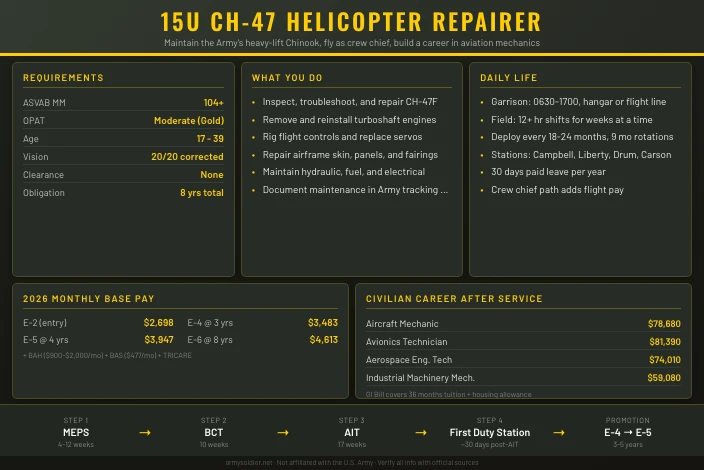
A 15U CH-47 Helicopter Repairer performs scheduled and unscheduled maintenance on the CH-47F Chinook helicopter. You inspect, troubleshoot, repair, and replace components across the airframe, powerplant, drivetrain, and flight control systems. Your sign-off means the aircraft is airworthy, and lives depend on getting it right.
What You Do Daily
Garrison days start early. Physical training at 0630, then the maintenance hangar by 0800. You pull open technical manuals on a ruggedized tablet, check the aircraft’s fault log, and start working through the maintenance schedule. One morning it might be a phase inspection that has you removing cowlings, checking torque on rotor head bolts, and measuring wear on transmission gears. The next day you could be tracking down an intermittent hydraulic leak that only shows up under pressure.
Most of your hands-on work falls into a few categories:
- Engine and drivetrain – removing, inspecting, and reinstalling the T55-GA-714A turboshaft engines, the combining transmission, and forward/aft transmissions
- Flight controls – rigging cyclic, collective, and directional controls; replacing servos, actuators, and mixing units
- Airframe and structures – patching aluminum skin, replacing honeycomb panels, fixing fiberglass fairings, and inspecting the cargo ramp and hook systems
- Fuel and hydraulic systems – bleeding lines, swapping pumps, and checking filters
- Electrical systems – tracing wiring harnesses, replacing generators, and testing caution/advisory panels
Field maintenance is different. You work out of a maintenance tent or off the back of an M1083 truck with a limited tool set. Turnaround pressure is higher because the aircraft is needed for the next mission. Twelve-hour shifts are common during exercises and deployments.
Specialized Roles and Identifiers
The 15U has a straightforward MOS structure, but several additional qualifications open new doors.
| Identifier | Description |
|---|---|
| MOS 15U | CH-47 Helicopter Repairer (primary enlisted MOS) |
| ASI B3 | CH-47F Flight Engineer/Crew Chief qualification |
| ASI P5 | Master Gunner (Aviation) |
| MOS 15Z | Senior Aviation Mechanic (E-8 and above, merges all 15-series repairer MOSs) |
| SQI 5 | Instructor qualification |
| SQI 8 | Equal Opportunity Advisor |
Earning the B3 identifier as a crew chief/flight engineer is one of the most common goals. You fly on the aircraft, manage the cabin during missions, operate the hoist, and direct sling-load hookups from the cargo door. Flight pay comes with it.
Mission Contribution
The Chinook is the only Army helicopter that can carry an entire infantry platoon, an artillery piece with its crew and ammunition, or 26,000 pounds of external cargo. When a forward operating base needs resupply and the roads are mined, the CH-47 flies it in. When an engineer unit needs a bulldozer placed on a ridgeline, the Chinook lifts it there.
None of that happens if the aircraft is down for maintenance. A grounded Chinook means delayed operations, rerouted convoys, and troops waiting without supplies. Your wrench time directly affects the combat power of every unit that depends on heavy lift.
Technology and Equipment
You work with both analog hand tools and modern diagnostic platforms.
- Interactive Electronic Technical Manuals (IETMs) – tablet-based maintenance procedures with diagrams, parts lookups, and fault isolation trees
- Vibration analysis equipment – used during track and balance procedures to reduce rotor vibration after component changes
- Portable hydraulic test stands – for checking pump output, relief valve settings, and actuator travel
- Bore scopes and thermal imagers – for engine inspections without full disassembly
- Standard aircraft toolkits – torque wrenches, safety wire pliers, flare nut wrenches, Dzus fastener tools, and rivet guns
Salary and Benefits
Financial Benefits
Military pay is based on rank and years of service. Most 15U soldiers enter at E-2 (PV2) after completing Basic Combat Training. Promotions through E-4 come quickly if you stay out of trouble and complete required training.
| Rank | Pay Grade | Years of Service: 2 | Years of Service: 4 | Years of Service: 6 | Years of Service: 8 |
|---|---|---|---|---|---|
| Private (PV2) | E-2 | $2,698 | $2,698 | $2,698 | - |
| Private First Class (PFC) | E-3 | $3,015 | $3,198 | $3,198 | $3,198 |
| Specialist (SPC) | E-4 | $3,303 | $3,659 | $3,816 | $3,816 |
| Sergeant (SGT) | E-5 | $3,599 | $3,947 | $4,109 | $4,299 |
| Staff Sergeant (SSG) | E-6 | $3,743 | $4,069 | $4,236 | $4,613 |
Source: DFAS 2026 pay tables. Figures reflect the 2026 pay raise.
Base pay is only part of total compensation. BAH (Basic Allowance for Housing) ranges from roughly $900 to $2,000+ per month depending on your duty station and whether you have dependents. BAS adds about $477 monthly for food. 15U soldiers who earn crew chief status and fly regularly receive monthly flight pay ranging from $150 to $250 depending on rank.
Enlistment bonuses for the 15U change frequently based on Army manning needs. Check with your recruiter for the current offer before signing your contract.
Additional Benefits
TRICARE covers you and your dependents at zero cost for medical, dental, vision, prescriptions, and mental health care while on active duty. There are no premiums, deductibles, or copays.
Tuition Assistance pays up to $4,500 per year for college courses while you serve. After separation, the Post-9/11 GI Bill covers up to 36 months of tuition at a public university plus a monthly housing allowance pegged to the E-5 BAH rate at your school’s zip code.
The Blended Retirement System (BRS) starts building your nest egg early:
- The government automatically contributes 1% of your base pay to the Thrift Savings Plan (TSP) starting after 60 days
- It matches dollar-for-dollar on the first 3% you contribute and 50 cents on the next 2%, for a total government match of up to 5%
- Serve 20 years and collect a pension worth 40% of your high-36 average base pay
Work-Life Balance
You earn 30 days of paid leave per year plus 11 federal holidays. Garrison hours are typically 0630 to 1700 on weekdays. Field duty rotations happen 2 to 4 times per year and run 2 to 4 weeks each, with long days and no weekends off. NTC and JRTC rotations are the most demanding, with 14 to 16 hour days for about a month.
Qualifications and Eligibility
Basic Qualifications
You need to be a U.S. citizen or permanent resident, age 17 to 39, with a high school diploma or GED. High school graduates need at least a 31 on the AFQT. GED holders need a 50. The 15U requires one ASVAB composite score:
- Mechanical Maintenance (MM): 104 minimum
The MM composite adds your Numerical Operations (NO), Auto and Shop Information (AS), Mechanical Comprehension (MC), and Electronics Information (EI) scores together. It tests your ability to understand how machines work, read diagrams, and solve mechanical problems. A 104 is above average and takes real study for most test-takers.
The 15U falls in the Moderate physical demand category on the OPAT. You must pass four events at the Gold standard: Standing Long Jump (120 cm / 3.9 feet), Seated Power Throw (350 cm / 11.5 feet), Strength Deadlift (120 lbs), and Interval Aerobic Run (36 shuttles).
| Requirement | Details |
|---|---|
| Age | 17-39 years old |
| Citizenship | U.S. citizen or permanent resident |
| Education | High school diploma or GED |
| AFQT (ASVAB) | Minimum 31 (diploma) or 50 (GED) |
| MM Score | Minimum 104 |
| OPAT Category | Moderate |
| Vision | Correctable to 20/20 |
| Color Vision | Must distinguish red and green |
| Security Clearance | None required at entry |
| Moral Standards | No disqualifying criminal history or drug use |
Application Process
Walk into your local Army recruiting station and tell them you want to be a 15U. The recruiter will confirm your basic eligibility and schedule you for MEPS (Military Entrance Processing Station).
At MEPS, you take the ASVAB (if you have not already), go through a complete medical exam, and take the OPAT. If your MM score hits 104 and you pass the medical screening, the guidance counselor at MEPS will check for available 15U training slots. You pick your ship date and swear in. The whole process from first recruiter visit to shipping out takes 4 to 12 weeks depending on training seat availability and any medical follow-ups.
Selection Criteria and Competitiveness
The 15U is moderately competitive. The Army maintains Chinook units at installations worldwide, so slots open regularly. But the MM 104 requirement filters out a chunk of applicants. If your practice ASVAB scores are close, focus on the Auto and Shop, Mechanical Comprehension, and Electronics Information subtests before retaking.
No prior certifications or experience are needed. Familiarity with hand tools, engines, or automotive repair is helpful but not required.
Upon Accession into Service
Most recruits enter as E-1 (PV1) or E-2 (PV2) depending on education credits or the Delayed Entry Program. After completing AIT, expect to be E-2 or E-3. The standard service obligation is 8 years total: typically 3 to 6 years active duty with the remainder in the Individual Ready Reserve (IRR).
See our ASVAB study guide for strategies to hit these line scores, or take the PiCAT from home if you are a first-time tester.
Work Environment
Setting and Schedule
Expect to split time between a maintenance hangar, the flight line, and the field. Hangars have overhead cranes, power tools, and climate control. The flight line is open-air work on a concrete pad in whatever weather your duty station throws at you. Fort Drum in January means turning wrenches at -10 degrees. Fort Bliss in August means doing it at 110.
Garrison hours are 0630 to 1700 most weekdays. Flight schedules drive your overtime. If aircraft are flying night missions, maintenance shifts to evenings. Field exercises and deployments flip you to 12-hour shifts or longer.
Leadership and Communication
Your chain of command runs from your team leader (E-5 or E-6) to the platoon sergeant (E-7), maintenance officer (usually a CW2 or CW3), and up to the company commander. Daily communication happens through maintenance meetings, production control boards, and aircraft status reports. If a part is on backorder or a repair is going to take longer than expected, you report it up the chain immediately.
Performance feedback comes through NCOERs (Noncommissioned Officer Evaluation Reports) for E-5 and above or informal counseling packets for junior soldiers. Formal counseling happens monthly or quarterly depending on your unit’s standard.
Team Dynamics and Autonomy
You work on a maintenance team of 3 to 5 soldiers, usually led by an E-5 or E-6. Junior 15Us handle task-level work under supervision: removing and replacing components, performing inspections, and documenting maintenance actions. As you gain experience and rank, you get more autonomy. An E-5 might own an entire phase inspection from start to finish, deciding the work sequence and assigning tasks.
Crew chiefs operate with even more independence. On a mission, you are the maintenance authority on the aircraft. The pilots fly it; you keep it running and manage everything in the cabin.
Job Satisfaction and Retention
Aviation maintenance has solid retention compared to many Army MOSs. The skills transfer directly to civilian aviation jobs, which makes soldiers feel their time is well spent. Re-enlistment bonuses for 15U vary by year. The biggest frustration soldiers report is parts availability. Waiting weeks for a back-ordered component while your aircraft sits in a red X status gets old. Working conditions in the field can be rough, but most 15Us take pride in keeping the Army’s biggest helicopter flying.
Training and Skill Development
Initial Training
Training follows the standard two-phase path: Basic Combat Training (BCT) followed by Advanced Individual Training (AIT).
| Phase | Location | Length | Focus |
|---|---|---|---|
| BCT | Fort Jackson, SC; Fort Moore, GA; or Fort Sill, OK | 10 weeks | Soldier skills: weapons, land nav, first aid, drill, physical fitness |
| AIT | Fort Eustis, VA (Joint Base Langley-Eustis) | 17 weeks | CH-47 airframe, engine, drivetrain, hydraulics, electrical, and flight control systems |
BCT turns you into a soldier. You learn to shoot the M4, throw grenades, navigate with a map and compass, and work as a fire team. Physical training is daily and intense.
AIT at Fort Eustis is where you become a Chinook mechanic. The first weeks cover general aviation maintenance concepts: safety procedures, tool control, aircraft forms and records, and ground handling. Then you move to CH-47-specific systems. You get hands-on time with actual aircraft and components in training hangars. Instructors walk you through engine removal and installation, rotor head maintenance, hydraulic system troubleshooting, and electrical fault isolation.
By graduation, you can perform scheduled inspections, replace major components, and document your work in the Army’s maintenance tracking systems.
Advanced Training
Once you reach your first duty station, training accelerates through on-the-job experience and formal schools.
- Crew Chief/Flight Engineer Course – the most common next step. You learn to fly as a crew member, operate the rescue hoist, direct sling-load operations, and manage the cabin during troop and cargo missions. Passing earns you the B3 ASI and flight status.
- Aircraft Maintenance Senior Sergeant Course – prepares E-6 and E-7 soldiers for production control and quality assurance roles
- Master Gunner Course – teaches you to train and certify aerial gunnery programs for your unit
- Noncommissioned Officer Education System (NCOES) – Basic Leader Course (BLC) for E-4 promotable, Advanced Leader Course (ALC) for E-5, and Senior Leader Course (SLC) for E-6, all required for promotion
The Army also funds FAA Airframe and Powerplant (A&P) certification preparation through the Army Credentialing Assistance Program. This is the ticket to civilian aviation careers, and getting it while still in uniform saves you thousands in tuition and testing fees.
Everything starts with qualifying ASVAB scores — our study guide covers what to study first.
Career Progression and Advancement
Career Path
Promotion through the enlisted ranks follows a predictable timeline, though competition gets steeper as you move up.
| Rank | Grade | Typical Time to Reach | Key Milestone |
|---|---|---|---|
| Private (PV1) | E-1 | Entry | Ship to BCT |
| Private (PV2) | E-2 | 6 months | Automatic promotion |
| Private First Class (PFC) | E-3 | 12 months | Automatic promotion |
| Specialist (SPC) | E-4 | 24 months | Semi-automatic (waiverable) |
| Sergeant (SGT) | E-5 | 3-5 years | Board appearance, BLC, promotion points |
| Staff Sergeant (SSG) | E-6 | 6-9 years | ALC, demonstrated leadership |
| Sergeant First Class (SFC) | E-7 | 12-16 years | SLC, broadening assignments |
| Master Sergeant (MSG) | E-8 | 18-22 years | Senior maintenance manager, MOS becomes 15Z |
| Sergeant Major (SGM) | E-9 | 22+ years | Battalion or brigade-level senior enlisted advisor |
At E-8, your MOS consolidates into 15Z (Senior Aviation Mechanic). You manage maintenance programs across all airframe types, not just the Chinook.
Role Flexibility and Transfers
If the Chinook is not your long-term fit, lateral reclassification to another 15-series MOS (15T Black Hawk, 15R Apache, 15Y Apache avionics) is possible through a DA Form 4187 packet. Approval depends on your unit’s needs and available slots in the new MOS.
Soldiers with strong GT scores can also apply for Warrant Officer programs. MOS 151A (Aviation Maintenance Technician) is a natural progression for experienced 15U NCOs who want to stay technical without moving into command roles. Warrant Officers serve as the Army’s top technical experts in aviation maintenance.
Performance Evaluation
The Army uses the NCOER system for E-5 and above. Your rater (usually your platoon leader or section leader) and senior rater (company commander) evaluate you annually on competence, character, and presence. Promotion boards weigh these evaluations heavily.
Below E-5, counseling packets and developmental assessments track your progress. Points for promotion to E-5 and E-6 come from weapons qualification, physical fitness, awards, military education, and civilian education. Strong 15Us invest in college courses and professional certifications to stack their points early.
Physical Demands and Medical Evaluations
Physical Requirements
Chinook maintenance is physical. You lift transmission components weighing 40 to 80 pounds. You climb onto the aircraft’s upper deck using maintenance stands, squeeze into tight compartments around the aft pylon, and hold awkward positions while torquing bolts overhead. Summer heat inside a closed hangar or on a hot flight line adds to the strain.
Daily physical demands include:
- Lifting and carrying parts, toolboxes, and equipment up to 50 pounds regularly
- Climbing ladders and maintenance stands to reach the upper fuselage and rotor systems
- Kneeling, crouching, and lying on concrete or dirt to access underside components
- Standing for extended periods during phase inspections
- Pulling safety wire and operating hand tools for hours at a stretch
The Army Fitness Test (AFT) applies to all soldiers. It has five events, each scored 0 to 100 points.
| Event | Minimum (60 pts) | Maximum (100 pts) |
|---|---|---|
| 3 Repetition Maximum Deadlift (MDL) | Varies by age/sex | Varies by age/sex |
| Hand Release Push-Up (HRP) | Varies by age/sex | Varies by age/sex |
| Sprint-Drag-Carry (SDC) | Varies by age/sex | Varies by age/sex |
| Plank (PLK) | Varies by age/sex | Varies by age/sex |
| Two-Mile Run (2MR) | Varies by age/sex | Varies by age/sex |
The general passing standard is 300 total points with a minimum of 60 per event. Scores are sex- and age-normed. Every soldier takes the AFT regardless of MOS.
Medical Evaluations
You complete a full physical at MEPS before shipping to training. After that, Periodic Health Assessments (PHAs) happen annually. Soldiers on flight status as crew chiefs get a more thorough flight physical every year, including hearing tests, vision screening, and cardiovascular checks. Hearing protection matters in this MOS. Chinook engines and rotors produce sustained noise levels above 100 decibels, and long-term hearing loss is a documented occupational hazard.
Deployment and Duty Stations
Deployment Details
CH-47 units deploy regularly. The Chinook is in demand everywhere the Army operates because nothing else carries that much weight that far. Deployment rotations typically follow a 9-month deployed, 18 to 24 months home station cycle. During deployment, you maintain aircraft in austere conditions: desert heat, high altitude, sand and dust that destroy engines faster than normal.
Combat Aviation Brigades (CABs) rotate through the Middle East, Europe, and the Pacific on a regular basis. Some 15Us also deploy with Special Operations Aviation units (160th SOAR) that fly the MH-47, the special operations variant of the Chinook.
Location Flexibility
Your duty station depends on which Chinook unit has an open slot when you graduate AIT.
CONUS installations:
- Fort Campbell, KY (101st Airborne)
- Fort Liberty, NC (82nd Airborne)
- Fort Drum, NY (10th Mountain)
- Fort Carson, CO (4th Infantry Division)
- Fort Riley, KS (1st Infantry Division)
- Fort Cavazos, TX
- Fort Bliss, TX
- Joint Base Lewis-McChord, WA
OCONUS installations:
- USAG Ansbach, Germany
- USAG Wiesbaden, Germany
- USAG Humphreys, South Korea
- USAG Hawaii (Wheeler Army Airfield)
- Fort Wainwright, AK
You can request a preferred location after AIT, but the Army fills slots based on unit needs first. Once at your first duty station, you can submit a preference for future assignments through the Assignment Interactive Module (AIM) marketplace.
Risk, Safety, and Legal Considerations
Job Hazards
Working on helicopters carries real risk. You handle flammable fuels, hydraulic fluid under high pressure, and heavy components suspended by hoists and cranes. Rotor blades create a lethal hazard zone around the aircraft when engines are running. Engine exhaust temperatures exceed 1,000 degrees at the tailpipe.
Specific hazards include:
- Noise exposure from engines and auxiliary power units (above 100 dB)
- Chemical exposure to JP-8 fuel, hydraulic fluid, solvents, and corrosion-preventive compounds
- Fall risk from maintenance stands, the aircraft’s upper deck, or cargo ramp
- Crush and pinch hazards from moving flight controls, rotor components, and heavy transmission parts
Safety Protocols
The Army takes aviation safety seriously. Every maintenance action follows a technical manual procedure. Tool control programs require you to account for every tool before and after each job. Foreign Object Debris (FOD) prevention is drilled into you from day one of AIT.
Personal protective equipment (PPE) includes hearing protection (double protection near running engines), safety glasses, gloves, steel-toed boots, and reflective belts on the flight line at night. Fall protection harnesses are required for any work above 6 feet.
Security and Legal Requirements
The 15U does not require a security clearance at entry. If you later move into units with classified missions (like the 160th SOAR), you may need a Secret or Top Secret clearance. That process includes a background investigation, financial review, and interviews with references.
Your legal obligations include your full service contract (typically 3 to 6 years active duty plus IRR time totaling 8 years) and compliance with the Uniform Code of Military Justice (UCMJ). Deployments to conflict zones are directed by your chain of command and are not optional.
Impact on Family and Personal Life
Family Considerations
Military life is hard on families. Deployments mean 9 months away from spouses and kids. Field exercises add another 60 to 90 days per year away from home. The irregular hours during flight weeks or maintenance surges mean missed dinners and cancelled plans.
The Army offsets this with family support programs:
- Army Community Service (ACS) – counseling, financial planning, and relocation help at every installation
- Family Readiness Groups (FRGs) – unit-level support networks that connect families during deployments
- Military OneSource – free 24/7 counseling, legal assistance, and childcare referrals
- TRICARE – full medical and dental coverage for dependents at no cost
- On-post housing or BAH – either a house on post or a monthly allowance to live off post
Relocation and Flexibility
Expect to PCS (Permanent Change of Station) every 2 to 4 years. Each move means a new installation, new schools for kids, and a new community. The Army covers moving costs and provides temporary lodging allowances. Soldiers with working spouses find the frequent moves difficult since the spouse has to restart their career at each new location.
Single soldiers have more flexibility. Barracks life at most installations is basic but functional, and you save money since BAH and BAS are not paid to single soldiers living in the barracks.
Reserve and National Guard
The 15U MOS is available in both the Army Reserve and Army National Guard, but positions are fewer than for Black Hawk mechanics. The CH-47 Chinook fleet is smaller than the UH-60 fleet, so Guard Chinook units exist in select states including Pennsylvania, Texas, and Colorado. If there is a Chinook unit near you, it is worth considering. If not, your options are more limited compared to 15T.
Drill Schedule and Training Commitment
The standard reserve commitment is one weekend per month and two weeks of Annual Training per year. For 15U soldiers, that baseline gets extended by Chinook-specific requirements.
The CH-47F is a complex, high-maintenance aircraft. Reserve and Guard 15U soldiers need annual proficiency checks on CH-47F systems. Training days beyond the standard drill calendar are common when new software updates roll out or when unit readiness standards require extra aircraft hours. Guard aviation units sometimes schedule additional weekend drills to maintain airworthiness on their Chinook fleet.
Annual Training for Chinook units often means working alongside active duty heavy-lift aviation battalions. Expect real maintenance work on aircraft, not classroom exercises.
Part-Time Pay and Benefits
An E-4 with about four years of service earns roughly $488 per drill weekend. Over 12 drill weekends, that is around $5,856 per year before Annual Training pay. Add two weeks of AT at daily active duty rates and total annual reserve income is typically $7,000 to $8,000 depending on rank.
Health coverage outside of orders runs through Tricare Reserve Select. Individual coverage is $57.88 per month. Family coverage is $286.66 per month. It costs more than active duty TRICARE Prime, but it is far cheaper than most private health insurance plans.
Education benefits include Federal Tuition Assistance, which pays up to $4,500 per year. Guard members get access to state tuition waivers in most states. After activation on qualifying orders, Post-9/11 GI Bill (Chapter 33) benefits may become available. The base reserve education option is the Montgomery GI Bill-Selected Reserve (Chapter 1606).
Retirement is points-based. You need 20 qualifying years with at least 50 retirement points per year. Pay is not issued until age 60, with the age reduced three months for every 90 days of qualifying active service (minimum age 50).
Deployment and Mobilization
Guard Chinook units have deployed regularly for heavy-lift missions, humanitarian operations, and combat support. The CH-47 is the Army’s primary heavy-lift platform, and demand for it is consistent. Mobilization cycles vary by unit and national need, but Chinook units should expect deployment rotations roughly every three to five years.
Deployments typically run 9 to 12 months including pre-deployment training. While on orders, you receive full active duty pay and TRICARE Prime. USERRA protects your civilian job throughout the deployment.
Civilian Career Integration
The CH-47 is manufactured and supported by Boeing. Boeing’s defense contractor network actively recruits veterans with Chinook maintenance experience for roles supporting active Army Chinook programs. Civilian heavy-lift helicopter operators, including those doing firefighting, logging, and construction work, also hire from this pool.
Direct civilian equivalents are fewer than for Black Hawk mechanics because the Chinook does not have a large commercial variant. That said, the technical depth of 15U training transfers well. Pursuing an FAA Airframe and Powerplant (A&P) certification expands your civilian options beyond Chinook-specific roles. A&P certification, combined with hands-on CH-47 experience, makes you competitive for maintenance roles on a wide range of rotary-wing aircraft.
USERRA protects your civilian employment during any active duty mobilization. Your employer must reinstate you to the same position with the same seniority and pay when you return.
| Feature | Active Duty | Army Reserve | Army National Guard |
|---|---|---|---|
| Commitment | Full-time | One weekend/month, two weeks/year | One weekend/month, two weeks/year |
| Monthly Pay (E-4, ~4 yrs) | $3,659 | ~$488/drill weekend | ~$488/drill weekend |
| Healthcare | TRICARE Prime, $0 premiums | Tricare Reserve Select, $57.88/month | Tricare Reserve Select, $57.88/month |
| Education | Post-9/11 GI Bill | Federal TA, MGIB-SR | Federal TA, MGIB-SR, state tuition waivers |
| Deployment | Regular rotations | Mobilization-based | Mobilization-based, plus state activations |
| Retirement | 20-year pension, immediate | Points-based, age 60 | Points-based, age 60 |
Post-Service Opportunities
Transition to Civilian Life
The 15U sets you up for a strong civilian career in aviation maintenance. Your hands-on experience with turbine engines, rotor systems, hydraulics, and avionics translates directly to commercial and defense contractor positions. The biggest step is getting your FAA Airframe and Powerplant (A&P) certificate, which the Army helps you pursue through credentialing programs.
Transition programs include:
- Soldier for Life – Transition Assistance Program (SFL-TAP) – resume workshops, job fairs, and career counseling starting 18 months before separation
- SkillBridge – up to 6 months of civilian work experience with an approved employer while still receiving military pay and benefits
- Army COOL (Credentialing Opportunities On-Line) – funds civilian certifications like the FAA A&P, OSHA safety certs, and ASE automotive certifications
- Post-9/11 GI Bill – 36 months of tuition coverage plus housing allowance for college or trade school
Civilian Career Prospects
Aviation maintenance skills are in demand. The commercial aviation industry faces a technician shortage, and military-trained mechanics fill that gap.
| Civilian Job Title | Median Annual Salary | Job Outlook (2024-2034) |
|---|---|---|
| Aircraft Mechanic / Service Technician | $78,680 | 5% growth (faster than average) |
| Avionics Technician | $81,390 | 5% growth |
| Aerospace Engineering Technician | $74,010 | 4% growth |
| Industrial Machinery Mechanic | $59,080 | 16% growth |
About 13,100 openings for aircraft and avionics mechanics are projected each year over the next decade. Defense contractors like Boeing, Lockheed Martin, and L3Harris actively recruit former military helicopter mechanics. Starting salaries for A&P-certified technicians at major airlines often exceed $80,000 with overtime.
Is This a Good Job for You? The Right (and Wrong) Fit
Ideal Candidate Profile
The best 15Us share a few traits. You like taking things apart and putting them back together. You are comfortable with grease under your fingernails and sweat on your back. Patience matters because troubleshooting a fault that does not show up on the ground but appears at 5,000 feet takes methodical thinking.
Good fits tend to have:
- Mechanical aptitude and spatial reasoning
- Comfort with physical labor in uncomfortable conditions
- Attention to detail (one missed safety wire can ground an aircraft)
- Willingness to learn complex systems through technical manuals, not guessing
- Team orientation with the ability to work independently on assigned tasks
Potential Challenges
This MOS is not for everyone. The physical demands wear on your body over time, especially your knees, back, and shoulders. Deployments are frequent and long. You may spend holidays in a maintenance tent instead of at home.
Other factors to consider:
- Cold, heat, rain, and wind do not stop the maintenance schedule
- Parts shortages can stall your work for weeks, which is frustrating when you take pride in turning aircraft
- Promotion to E-5 and beyond requires civilian education and military schooling on top of your daily job
- The 104 MM ASVAB score is a real barrier for some applicants
Career and Lifestyle Alignment
If you want a desk job, this is not it. If you want to work with your hands, earn a skill that pays well on the civilian side, and be part of something larger than yourself, the 15U is a solid pick. Soldiers who plan to do one enlistment and get out leave with an FAA-trackable skill set and GI Bill benefits. Soldiers who stay in can build a 20-year career that ends with a pension, TSP savings, and the experience to walk into a six-figure civilian maintenance job.
The single biggest advantage of the 15U over a civilian aviation mechanic apprenticeship: the Army pays you to learn. No student loans. No unpaid internships. You earn a salary from day one of training.
More Information
Talk to your local Army recruiter to find out whether the 15U is available, what bonuses are on the table right now, and when the next training slot opens. Bring your ASVAB scores if you already have them. If your MM score is close to 104 but not there yet, ask about retesting options.
- Prepare for the ASVAB with our study guide to make sure your line scores qualify
This site is not affiliated with the U.S. Army or any government agency. Verify all information with official Army sources before making enlistment or career decisions.
Explore more Army aviation careers to find other MOS options in the aviation field.