15Y AH-64D Armament/Electrical/Avionics Systems Repairer
The AH-64 Apache carries Hellfire missiles, a 30mm chain gun, and a targeting system that can acquire and engage multiple targets simultaneously at night in bad weather. None of that works without the 15Y. This MOS owns the weapons systems, electrical distribution, and avionics suite on the most lethal attack helicopter in the U.S. military. The line scores required are among the highest in CMF 15, and the training is one of the longest in the aviation career field. If your ASVAB scores support it and you want to work on weapons and electronics at the highest technical level, this is the right MOS.
Qualifying requires specific ASVAB line scores — our ASVAB study guide covers what to target and how to prepare.
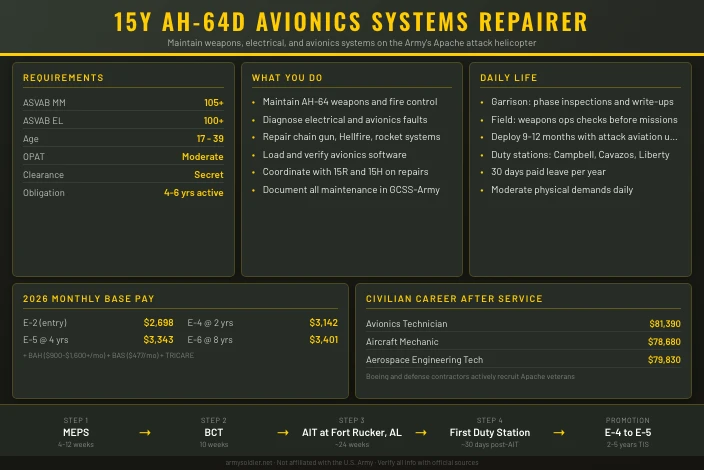
Job Role and Responsibilities
The 15Y AH-64D Armament/Electrical/Avionics Systems Repairer diagnoses, troubleshoots, and repairs the weapons systems, electrical systems, and avionics components of the AH-64 Apache attack helicopter. You maintain the M230 chain gun, Hellfire missile launchers, Hydra rocket pods, fire control radar, targeting sensors, and the entire aircraft electrical distribution system.
A garrison maintenance day covers both scheduled and unscheduled work. Scheduled work follows the aircraft maintenance order: you’re either in a phase inspection, a periodic maintenance cycle, or a calendar-based component replacement. Unscheduled work comes from pilot write-ups. A targeting system that returns a bit error during a mission gets a maintenance code, and you start from there with schematics and diagnostics.
Apache weapons and avionics systems are deeply integrated. A fault in the weapons management computer affects targeting and fire control simultaneously. You learn to read electrical schematics quickly, use specialized test equipment, and isolate faults to the line-replaceable unit (LRU) level before swapping components.
Specific Roles
The 15Y base MOS focuses on the AH-64 platform. Soldiers build qualifications through Additional Skill Identifiers:
| Identifier | Description |
|---|---|
| ASI B8 | AH-64D Longbow avionics qualification |
| ASI E9 | AH-64E Apache Guardian systems qualification |
| ASI H8 | Advanced electronic systems repair |
Mission Contribution
Attack aviation provides direct fires for ground forces, suppresses enemy air defenses, conducts reconnaissance, and supports special operations. When the Apache’s weapons or sensors go down, it flies as an expensive observation platform. The 15Y gets it back to full capability. Units measure combat readiness by aircraft availability, and availability depends on technicians like you doing your job right.
Equipment
You work with aircraft technical publications, digital fault isolation manuals, specialized Apache ground support equipment, avionics test sets, electrical test benches, and software-based maintenance tools. The AH-64E uses an open systems architecture with significant software content, so familiarity with digital fault codes and software load procedures is increasingly part of the job.
Salary and Benefits
Base pay is determined by rank and time in service. The 2026 rates below come from the current DFAS pay schedule.
| Rank | Grade | Monthly Base Pay (entry) |
|---|---|---|
| Private (PV2) | E-2 | $2,698 |
| Private First Class (PFC) | E-3 | $2,837 |
| Specialist (SPC) | E-4 | $3,142 |
| Sergeant (SGT) | E-5 | $3,343 |
| Staff Sergeant (SSG) | E-6 | $3,401 |
Source: DFAS 2026 military pay chart.
Most soldiers also receive:
- BAH: Tax-free housing allowance based on duty location, grade, and dependency status. An E-4 at most CONUS installations receives roughly $900-$1,600+ per month.
- BAS: $476.95/month (2026) for all enlisted soldiers.
- TRICARE: Full health, dental, and vision coverage for you and dependents at no charge on active duty.
Additional Benefits
The Blended Retirement System (BRS) pairs a 20-year pension at 40% of your high-36 basic pay with TSP matching. The government contributes up to 5% of basic pay when you contribute 5%, starting in year three. Army Tuition Assistance covers up to $4,500 per year for college courses. The Post-9/11 GI Bill provides in-state tuition at public universities plus a monthly housing allowance for up to 36 months after separation.
Work-Life Balance
Thirty days paid leave per year. Aviation maintenance units carry demanding operational tempos, particularly at active combat aviation brigades. Garrison schedules are structured around inspection cycles, but extended maintenance periods can mean long days.
Qualifications and Eligibility
| Requirement | Details |
|---|---|
| ASVAB Score | MM: 105 AND EL: 100 (both required) |
| Citizenship | U.S. citizen or permanent resident alien |
| Age | 17-39 (waiver possible) |
| Education | High school diploma or GED |
| Physical | OPAT: Moderate category |
| Security Clearance | Secret (required; initiated at accession) |
| Color Vision | Required (wire identification and targeting sensor work) |
The dual line score requirement sets this MOS apart from most of CMF 15. MM 105 tests mechanical and physical science knowledge. EL 100 tests electronics and math. You need both. Candidates who have studied basic electronics, physics, or have mechanical backgrounds tend to find the ASVAB preparation more manageable.
Application Process
The ASVAB and MEPS physical are the first steps. Your recruiter will confirm both line scores meet the threshold before processing the contract. The Secret clearance investigation runs concurrently with the enlistment process.
Selection and Competitiveness
15Y is one of the more demanding technical enlistments in Army aviation because of the dual line score requirement. Candidates who prepare thoroughly for both the mechanical and electronics sections of the ASVAB have the best outcomes. The MOS has strong demand, so qualified applicants generally receive offers.
Service Obligation
Technical aviation MOSs typically require a four-to-six year active duty commitment.
See our ASVAB study guide for strategies to hit these line scores, or take the PiCAT from home if you are a first-time tester.
Work Environment
15Y soldiers work on the Apache flight line, in maintenance hangars, and in field environments during exercises and deployments. The Apache is a complex aircraft, and maintenance requires close coordination between the 15Y and the 15R (airframe repairer), 15H (pneudraulics repairer), and 15F (electrician) when a fault crosses system boundaries.
Training for this MOS takes place at Fort Rucker, Alabama under the 1st Battalion, 210th Aviation Regiment. At operational units, 15Y soldiers are assigned to Apache attack or reconnaissance battalions in combat aviation brigades.
Team Dynamics
Apache maintenance crews work in small specialist teams. The 15Y and 15R often work the same aircraft simultaneously, with clear task delineation: structure and power train to the 15R, weapons and avionics to the 15Y. Coordination is constant, especially during complex maintenance events involving both systems.
Job Satisfaction
Soldiers who work on the Apache tend to develop strong professional identity around the platform. The aircraft is high-profile, technically demanding, and genuinely important to Army combat operations. Retention in 15Y tends to be stronger than less specialized MOSs.
Training and Skill Development
| Phase | Location | Duration | Focus |
|---|---|---|---|
| Basic Combat Training (BCT) | Various installations | 10 weeks | Soldier skills, weapons, fitness |
| Advanced Individual Training (AIT) | Fort Rucker, AL | ~24 weeks | AH-64 weapons systems, electrical systems, avionics, fault isolation |
AIT is one of the longer courses in CMF 15. The curriculum begins with electrical theory and systems fundamentals before moving to Apache-specific weapons management, fire control systems, and avionics. Students work on simulator hardware and actual aircraft components before moving to hands-on aircraft maintenance.
The academic structure blends classroom instruction with hangar bay practical exercises. You graduate with specific AH-64 qualification that translates to an immediate mission-ready role at your first unit.
Advanced Training
After establishing proficiency at the first duty station, soldiers can pursue:
- AH-64E (Apache Guardian) qualification as the Army upgrades from earlier Apache variants
- Quality Assurance evaluator certification for certifying other soldiers’ work
- Maintenance Test Flight Observer qualification for working alongside aviators during test flights
- Senior Leader Course (SLC) at promotion to SSG
- Warrant Officer Candidate School (WOCS) for soldiers targeting a 151A Aviation Maintenance Technician warrant officer path
The Army’s COOL program and Credentialing Assistance program identify civilian avionics and electronics certifications that align with 15Y experience.
Everything starts with qualifying ASVAB scores — our study guide covers what to study first.
Career Progression and Advancement
| Rank | Grade | Typical Time in Service | Role |
|---|---|---|---|
| Private First Class (PFC) | E-3 | First year | AIT graduate, learning unit procedures |
| Specialist (SPC) | E-4 | 1-2 years | Working under supervision on Apache systems |
| Sergeant (SGT) | E-5 | 2-5 years | Team leader, task sign-off authority |
| Staff Sergeant (SSG) | E-6 | 5-8 years | Section leader, quality control |
| Sergeant First Class (SFC) | E-7 | 8-14 years | Platoon sergeant, maintenance management |
| Master Sergeant (MSG) | E-8 | 14-20+ years | Senior NCO, battalion-level maintenance |
Promotion to E-4 is semi-automatic in the first two years for soldiers who meet standards. Competitive promotions above E-4 require completing military education requirements, maintaining passing AFT scores, and building a strong NCOER record.
Specialization Opportunities
Experienced 15Y NCOs are in demand at the Army Aviation and Missile Command (AMCOM), depot-level maintenance facilities, and foreign military sales teams that support allied Apache operators. These assignments open at the mid-career NCO level.
Performance Evaluation
NCOs receive annual NCOERs evaluating technical proficiency, leadership, physical fitness, and adherence to Army standards. Strong technical performance and willingness to take on additional duties accelerate promotion.
Physical Demands and Medical Evaluations
The OPAT category for 15Y is Moderate. Daily physical demands include:
- Climbing on and around the Apache airframe to access weapons and avionics bays
- Carrying test equipment and toolboxes across the flight line
- Working in confined avionics bays and weapons stations in cramped positions
- Sustained use of hand tools during maintenance cycles
The Army Fitness Test (AFT), effective June 1, 2025, has five events: 3-Rep Max Deadlift (MDL), Hand Release Push-Up (HRP), Sprint-Drag-Carry (SDC), Plank (PLK), and Two-Mile Run (2MR). Minimum passing score is 60 per event, 300 total, sex- and age-normed for the general standard.
Medical Evaluations
Aviation maintenance soldiers undergo baseline hearing evaluations and periodic monitoring throughout service. Flight line noise levels require mandatory hearing protection. Color vision is required for this MOS due to wire color coding in electrical systems and targeting sensor calibration work.
Deployment and Duty Stations
Attack aviation units deploy to support combat and theater security operations globally. AH-64 units have operated in Iraq, Afghanistan, Syria, and numerous theater security cooperation assignments. Deployment cycles for active duty units typically run nine to twelve months.
Major 15Y duty stations include Fort Rucker (Alabama), Fort Campbell (Kentucky), Fort Cavazos (Texas), Fort Liberty (North Carolina), and OCONUS positions in South Korea and Germany. Apache units are present at most major Army aviation installations.
Risk, Safety, and Legal Considerations
Apache weapons systems carry live ordnance, which creates specific safety obligations:
- Weapons safety: Apache armament systems require strict ground safety procedures. The 30mm gun and missile launchers are only armed following specific authorization steps.
- Electrical hazards: High-voltage aircraft electrical systems require proper lockout/tagout procedures during maintenance.
- Chemical hazards: Battery systems and some hydraulic fluids require PPE.
All weapons maintenance follows Army Regulation 750-10 and applicable technical manuals. Quality control NCOs inspect all weapons work before aircraft are cleared to arm.
Security Requirements
The Secret clearance for this MOS carries specific obligations around protecting classified Apache system capabilities, sensor specifications, and weapons system performance data. Unauthorized disclosure of that information is a federal crime with serious consequences.
Impact on Family and Personal Life
Apache units carry high operational tempos. Fort Campbell and Fort Cavazos are the primary homes of attack aviation brigades and have well-established military family support infrastructure. On-post housing, childcare, school systems, and Family Readiness Groups are available at all major installations.
PCS moves occur every two to three years on average. The Army covers household goods moving costs up to rank-based weight allowances.
Reserve and National Guard
The 15Y MOS is tied almost entirely to the Apache attack helicopter. Active duty units operate most of the Army’s Apache fleet, but the National Guard also flies Apaches in several states. Army Reserve 15Y positions are very limited. If you want a Guard 15Y slot, check which states have Apache battalions before you sign.
Drill Schedule and Training Commitment
Standard reserve commitment is one weekend per month and two weeks of Annual Training per year. For 15Y soldiers, technical certification requirements add to that baseline.
Apache weapons and avionics systems are complex. Annual technical proficiency checks must be maintained on Apache-specific systems including the Target Acquisition and Designation Sight (TADS), the Modernized Target Acquisition and Designation Sight (M-TADS/PNVS), and Longbow radar systems. When Boeing or the Army pushes software updates to weapons systems or avionics, soldiers need extra training days to recertify on the new configurations.
Guard Apache units often schedule additional weekend drills or short training periods to maintain aircraft readiness standards. The AH-64 is a demanding aircraft to maintain, and Guard units cannot let proficiency lapse between drill weekends.
Part-Time Pay and Benefits
An E-4 with about four years of service earns roughly $488 per drill weekend. Over 12 drill weekends per year, that totals about $5,856. Add two weeks of Annual Training at daily active duty rates and total annual reserve income typically runs $7,000 to $8,000.
Health coverage outside of orders runs through Tricare Reserve Select. Individual coverage is $57.88 per month. Family coverage is $286.66 per month. Compare that to active duty TRICARE Prime, which has no premiums.
Federal Tuition Assistance is available to both Reserve and Guard soldiers, paying up to $4,500 per year. Guard members qualify for state tuition waivers in most states. After activation on qualifying orders, Post-9/11 GI Bill (Chapter 33) benefits may become available. The base reserve education option is the Montgomery GI Bill-Selected Reserve (Chapter 1606).
The reserve retirement system is points-based. You need 20 qualifying years with at least 50 retirement points per year. Pay does not start until age 60, reduced three months for every 90 days of qualifying active service during contingency operations (minimum age 50).
Deployment and Mobilization
Guard Apache battalions deploy on 3 to 5 year cycles for overseas missions. Apache attack aviation supports ground force commanders, so demand for the aircraft and its maintainers follows operational requirements. Mobilizations typically run 9 to 12 months including pre-deployment training and post-deployment reset.
During mobilization to full-time orders, you receive active duty pay, TRICARE Prime at no cost, and USERRA civilian job protection. The Guard also activates Apache units for state missions such as disaster response, though those activations are rare and shorter.
Civilian Career Integration
Apache avionics and weapons systems expertise has direct civilian value in the defense industry. Boeing’s Apache sustainment programs rely on veterans who understand the aircraft’s specific systems. Defense contractors supporting Army aviation include L3Harris, BAE Systems, and Raytheon, all of which hire 15Y veterans for maintenance and technical support roles.
These contractor positions often require a security clearance. Most 15Y soldiers already hold a Secret clearance from active duty service. A clearance plus Apache avionics experience is a strong combination for defense industry hiring managers.
Commercial avionics technician roles are also an option. The skills involved in Apache avionics, including digital systems, sensor integration, and precision electronics, apply to civilian avionics maintenance. FAA Airframe and Powerplant (A&P) certification formalizes your military training for civilian employers outside the defense sector.
USERRA protects your civilian job during any mobilization to active orders. Your employer must reinstate you to the same position with the same seniority and pay when you return.
| Feature | Active Duty | Army Reserve | Army National Guard |
|---|---|---|---|
| Commitment | Full-time | One weekend/month, two weeks/year | One weekend/month, two weeks/year |
| Monthly Pay (E-4, ~4 yrs) | $3,659 | ~$488/drill weekend | ~$488/drill weekend |
| Healthcare | TRICARE Prime, $0 premiums | Tricare Reserve Select, $57.88/month | Tricare Reserve Select, $57.88/month |
| Education | Post-9/11 GI Bill | Federal TA, MGIB-SR | Federal TA, MGIB-SR, state tuition waivers |
| Deployment | Regular rotations | Mobilization-based | Mobilization-based, plus state activations |
| Retirement | 20-year pension, immediate | Points-based, age 60 | Points-based, age 60 |
Post-Service Opportunities
Apache avionics and weapons systems experience is directly marketable to defense contractors who support Army aviation programs, Boeing’s Apache sustainment operations, and commercial avionics employers.
| Civilian Job Title | Median Annual Salary (BLS, May 2024) | Job Outlook (2024-2034) |
|---|---|---|
| Avionics Technician | $81,390 | +5% |
| Aircraft Mechanic & Service Tech | $78,680 | +5% |
| Aerospace Engineering Tech | $79,830 | +3% |
Source: Bureau of Labor Statistics Occupational Outlook Handbook.
Defense contractors including Boeing, Lockheed Martin, and L3Harris actively recruit Army 15Y veterans for Apache sustainment positions. The GI Bill can fund an avionics degree or FAA Airframe and Powerplant certificate program.
Is This a Good Job for You? The Right (and Wrong) Fit
This MOS fits candidates who scored well on the electronics and mechanical sections of the ASVAB, like working with complex integrated systems, and want deep platform expertise rather than broad general knowledge. The dual line score requirement naturally selects for people with strong technical aptitude.
The wrong fit is someone who wants variety across many aircraft types early in their career, or someone who prefers simple, predictable maintenance tasks. Apache systems are complex and interconnected. Troubleshooting requires patience and systematic thinking.
Long-term, 15Y is one of the strongest aviation MOSs for transitioning into civilian defense contracting or commercial avionics. The specific Apache knowledge has direct market value with contractors, airlines, and helicopter operators worldwide.
More Information
Talk with an Army recruiter to confirm 15Y seat availability and whether any enlistment bonus applies. Your recruiter can also advise on ASVAB preparation resources for both the MM and EL composites. Find a local recruiter at goarmy.com or call 1-888-550-ARMY.
- Prepare for the ASVAB with our study guide to make sure your line scores qualify
This site is not affiliated with the U.S. Army or any government agency. Verify all information with official Army sources before making enlistment or career decisions.
Explore more Army aviation careers such as 15R AH-64 Attack Helicopter Repairer and 15P Aviation Operations Specialist.