74D CBRN Specialist
Few Army jobs carry the weight of the 74D. CBRN Specialists are the soldiers standing between their unit and some of the most dangerous threats on earth: nerve agents, biological weapons, radiological contamination, and nuclear fallout. If a chemical attack happens, you’re the one who detects it, identifies it, and leads the decontamination. That combination of high stakes and specialized knowledge makes this one of the more demanding MOSs in the Army.
Qualifying requires specific ASVAB line scores — our ASVAB study guide covers what to target and how to prepare.
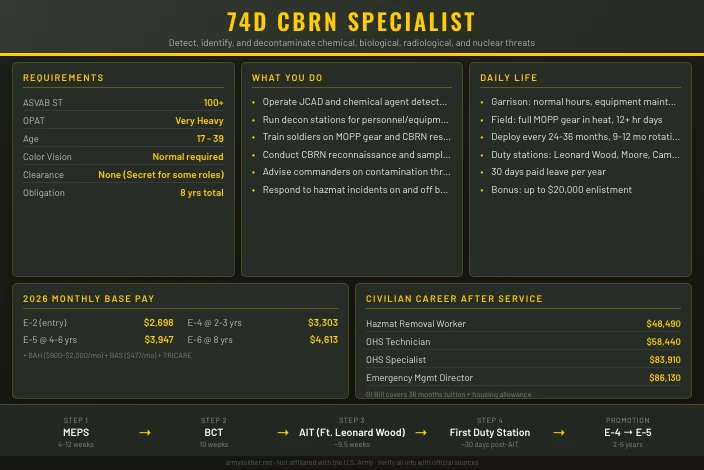
Job Role and Responsibilities
CBRN Specialists detect, identify, and neutralize chemical, biological, radiological, and nuclear threats. They operate specialized detection equipment, conduct decontamination operations on personnel and equipment, advise commanders on CBRN risk, and train soldiers across the unit on protective measures and response procedures.
A garrison day might include calibrating detection equipment, running a CBRN awareness class for a company, or rehearsing mass decontamination drills with the platoon. During field exercises, CBRN teams set up detection perimeters, sample suspected contaminated areas, and execute decon lanes that process hundreds of soldiers through proper decontamination procedures.
In a deployed environment, the job shifts fast. You’re attached to maneuver units, moving forward when there’s a suspected threat, operating in full Mission Oriented Protective Posture (MOPP) gear in heat that can reach dangerous levels. You document incidents, transmit contamination reports up the chain, and help commanders make real-time decisions about routes, positions, and protective measures.
Specialized Roles
The Army assigns skill levels to the 74D as soldiers gain rank and experience:
| Identifier | Skill Level | Rank Range | Duties |
|---|---|---|---|
| 74D10 | Level 1 | E-1 to E-4 | Operate detection equipment, conduct decon, execute CBRN defense tasks |
| 74D20 | Level 2 | E-5 | Lead CBRN teams, supervise detection and decon operations |
| 74D30 | Level 3 | E-6 | Manage CBRN section, advise company commanders, train subordinates |
| 74D40 | Level 4 | E-7 | Senior CBRN NCO, battalion-level advisor, staff planning |
| 74D50 | Level 5 | E-8 to E-9 | Senior enlisted CBRN leader, brigade and above |
Additional Skill Identifiers (ASIs) open doors to advanced roles. Soldiers can pursue ASIs in nuclear disablement operations, or qualify for Special Qualification Identifiers (SQIs) like Airborne (P) or Ranger (V) to serve with elite units.
How This Role Supports the Mission
No commander can make a sound tactical decision in a contaminated environment without reliable CBRN information. The 74D is the subject matter expert who gives commanders that information. When a unit moves through a potentially contaminated area, the CBRN team goes first. When soldiers need decontamination, the 74D runs the station. When a hazmat incident happens on or off base, CBRN Specialists are among the first responders.
Technology and Equipment
The equipment list is long and specialized. Detection gear includes the Joint Chemical Agent Detector (JCAD), M8A1 automatic chemical alarm, AN/VDR-2 radiac meter, and the Chemical Agent Monitor (CAM). For biological threats, the Biological Integrated Detection System (BIDS) is a key platform.
Decontamination equipment includes the M17 Lightweight Decontamination System, the M12A1 Power Driven Decontamination Apparatus, and standard MOPP gear (protective suit, mask, gloves, overboots). You maintain all of this equipment and train soldiers on proper use before they ever need it in a real-world situation.
Salary and Benefits
Financial Benefits
Base pay follows rank and time in service. Most 74D soldiers enter the Army at E-1 and reach E-4 within the first few years.
| Pay Grade | Rank | Typical Time in Service | 2026 Monthly Base Pay |
|---|---|---|---|
| E-2 | Private (PV2) | Entry (post-BCT) | $2,698 |
| E-4 | Specialist (SPC) | 2-3 years | $3,303 |
| E-5 | Sergeant (SGT) | 4-6 years | $3,947 |
| E-6 | Staff Sergeant (SSG) | 8 years | $4,613 |
The 74D qualifies for an enlistment bonus of up to $20,000, though exact amounts vary by contract length and Army needs at the time you enlist. Ask your recruiter for the current rate.
Base pay does not tell the whole story. BAH (Basic Allowance for Housing) adds $900 to $2,000+ per month tax-free, depending on your duty station and whether you have dependents. BAS (Basic Allowance for Subsistence) adds $476.95 per month for food.
Additional Benefits
TRICARE covers you and your dependents at no cost. Zero enrollment fees, zero deductibles, and zero copays for active-duty members. Medical, dental, vision, mental health, and prescriptions are all included.
Tuition Assistance (TA) pays up to $4,500 per year for college courses while you serve. After separation, the Post-9/11 GI Bill covers up to 36 months of in-state tuition at public universities, up to $29,920.95 per year at private schools, plus a monthly housing allowance and a $1,000 annual book stipend.
Retirement works through the Blended Retirement System (BRS). Serve 20 years and you earn a pension worth 40% of your highest 36 months of base pay. The government matches up to 5% of your Thrift Savings Plan (TSP) contributions starting in your third year of service.
Work-Life Balance
You earn 30 days of paid leave per year. In garrison, CBRN sections typically work Monday through Friday with normal duty hours. Field exercises and deployments break that pattern, but the pace in garrison is manageable compared to combat arms MOSs.
Qualifications and Eligibility
Basic Qualifications
The minimum ASVAB requirement is 100 on the Skilled Technical (ST) composite. The ST composite measures general science, verbal expression, mathematics knowledge, and mechanical comprehension. This is a moderately high bar that filters for soldiers who can handle technical training.
| Requirement | Details |
|---|---|
| Age | 17-39 (up to 42 with waiver) |
| Citizenship | U.S. citizen or permanent resident |
| Education | High school diploma or GED |
| AFQT | Minimum 31 (diploma) or 50 (GED) |
| Skilled Technical (ST) | Minimum 100 |
| Physical Profile (PULHES) | 122221 or better |
| Color Vision | Normal color vision required |
| OPAT Category | Very Heavy |
| Security Clearance | None required for initial award; Secret required for some leadership assignments |
| Other | Must complete Chemical Defense Training Facility (CDTF) exposure |
Application Process
Start with your local Army recruiter. They verify your ASVAB scores, confirm your OPAT results, and run an initial background check. If you score at least 100 on the ST composite and meet the physical requirements, the recruiter coordinates a training date at MEPS.
At MEPS, you complete or confirm your ASVAB scores, get a full medical exam, and finalize your contract. The 74D enlistment bonus is locked in at contracting. From first recruiter contact to ship date, expect 4 to 12 weeks depending on medical clearance and available training slots.
Selection Criteria and Competitiveness
The 74D is not an ultra-competitive MOS, but the ST 100 requirement and the Very Heavy OPAT category filter out a significant portion of recruits. Soldiers who bring prior chemistry, biology, or emergency response experience stand out. Any prior hazmat certification or FEMA training is worth mentioning, though the Army starts your training from scratch regardless.
Upon Accession into Service
Most recruits enter at E-1 (Private) and promote to E-2 after completing BCT. College credits or JROTC participation can push your starting grade to E-2 or E-3. The standard enlistment obligation is 8 years total active, split between Active Duty and the Individual Ready Reserve.
See our ASVAB study guide for strategies to hit these line scores, or take the PiCAT from home if you are a first-time tester.
Work Environment
Setting and Schedule
CBRN work spans two very different environments. In garrison, you work in a CBRN shop attached to a battalion or brigade. Most days follow normal duty hours, with time spent on equipment maintenance, training development, and unit education. You spend less time in the field than infantry or engineers, but CBRN sections do participate in exercises and readiness events regularly.
On deployment or in the field, the job becomes physically demanding. Full MOPP gear triples your heat load. Missions in a hot environment wearing a protective suit and mask for hours are mentally and physically exhausting. The physical demands category reflects that reality.
Leadership and Communication
Your direct chain of command runs through the CBRN section NCOIC, then to the battalion or brigade S9 (CBRN staff officer). Communication with higher headquarters is constant during threat response. You transmit contamination reports, update threat overlays, and brief commanders in real time.
Feedback in the 74D follows the standard Army counseling cycle: initial counseling when you arrive at a unit, monthly counseling for junior enlisted, and a formal evaluation (NCOER) once you reach E-5.
Team Dynamics and Autonomy
Junior 74D soldiers (E-1 through E-4) work under close supervision during detection and decon operations. The stakes are high enough that a senior NCO reviews every critical task. As you build experience and rank, you take the lead. An E-5 runs a team independently. An E-6 manages the entire CBRN section and advises the commander without someone looking over their shoulder.
Small CBRN teams attached to forward units often operate with significant autonomy. A two- or three-person team might be the only CBRN presence for a battalion-size element. In that position, your judgment matters.
Job Satisfaction and Retention
CBRN Specialists tend to re-enlist at moderate rates. The specialized skills, the unique training at Fort Leonard Wood (including the Chemical Defense Training Facility), and the ability to serve with elite units like the Rangers or Special Forces are strong draws. The job also offers a clear path into civilian emergency response and hazmat careers.
The common complaints: CBRN sections are often undermanned, which means one or two soldiers carry the workload for the entire section. Some duty stations have limited CBRN mission activity in garrison, which can make the work feel like equipment maintenance and classroom instruction between deployments.
Training and Skill Development
Initial Training
Training runs in two consecutive phases.
| Training Phase | Location | Duration | Focus |
|---|---|---|---|
| BCT | Fort Jackson, SC; Fort Moore, GA; Fort Leonard Wood, MO | 10 weeks | Soldier fundamentals: marksmanship, land navigation, tactics, fitness |
| AIT | Fort Leonard Wood, MO (USACBRNS) | ~9.5 weeks | CBRN detection, decontamination, reconnaissance, HAZMAT response, PPE operations |
AIT at the U.S. Army Chemical, Biological, Radiological and Nuclear School (USACBRNS) is not a classroom-only experience. You train on actual detection equipment, run through decontamination stations, and complete the Chemical Defense Training Facility – a controlled exposure to toxic agents while wearing protective gear. That last requirement is mandatory for MOS qualification and is one of the few places in the Army where you train with real chemical agents under tightly controlled conditions.
The AIT curriculum covers detection and monitoring, identification and sampling, reconnaissance fundamentals, company-level CBRN defense, HAZMAT response at the Awareness and Operations levels, mass decontamination operations, and PPE procedures. You graduate HAZMAT certified.
After AIT, expect to arrive at your first duty station within about 30 days.
Advanced Training
The Army sends you to leader development courses as you promote. The Warrior Leader Course (E-5), Advanced Leader Course (E-6), and Senior Leader Course (E-7) all include MOS-specific CBRN instruction layered on top of the general NCO leadership curriculum.
Beyond the standard NCO courses, 74D soldiers can pursue specialized training:
- Nuclear Disablement Team (NDT): advanced training for soldiers who may be tasked to disable nuclear devices
- Technical Escort qualification: for soldiers assigned to Technical Escort Battalions that transport or destroy chemical materials
- Airborne training at Fort Moore, GA; opens assignments with airborne units
- Ranger Assessment and Selection Program: for soldiers seeking assignment with the 75th Ranger Regiment
- CBRN Reconnaissance course: advanced recon techniques for 74D specialists
Army COOL and the Army Credentialing Assistance program help you earn civilian credentials while serving, including HAZWOPER certifications and emergency response credentials that carry direct value in the civilian job market.
Everything starts with qualifying ASVAB scores — our study guide covers what to study first.
Career Progression and Advancement
Career Path
Promotion through E-4 happens on a predictable timeline. The NCO ranks require promotion boards, points, and available slots.
| Rank | Pay Grade | Typical Time in Service | Role |
|---|---|---|---|
| Private (PV2) | E-2 | 0-1 years | Entry-level CBRN specialist, learns detection and decon tasks |
| Private First Class (PFC) | E-3 | 1-2 years | CBRN specialist, increasing independent task execution |
| Specialist (SPC) | E-4 | 2-3 years | Fully qualified 74D, team member on detection and decon operations |
| Sergeant (SGT) | E-5 | 4-6 years | CBRN team leader, supervises 2-4 soldiers |
| Staff Sergeant (SSG) | E-6 | 6-10 years | CBRN section NCOIC, primary advisor to company commanders |
| Sergeant First Class (SFC) | E-7 | 10-14 years | Senior CBRN NCO, battalion-level advisor and trainer |
| Master Sergeant (MSG) | E-8 | 14-18 years | Brigade CBRN NCO, staff planning and technical oversight |
| Sergeant Major (SGM) | E-9 | 18+ years | Senior CBRN advisor at division level and above |
Role Flexibility and Transfers
The 74D can pursue a number of high-value special duty assignments: Drill Sergeant, Recruiter, Training with Industry (TWI), or assignments to the 75th Ranger Regiment, 3rd Infantry Regiment (The Old Guard), or Special Mission Units. Each of these broadens your experience and strengthens your promotion file.
If you want to move to a different MOS, reclassification is possible after your initial service obligation. Common lateral moves go toward 89D (Explosive Ordnance Disposal), 68W (Combat Medic), or intelligence MOSs. Any change requires new AIT and a fresh service obligation.
Performance Evaluation
At E-5 and above, you receive an annual NCOER. Your rater evaluates leadership, technical knowledge, and overall contribution to the unit. Senior rater comments carry significant weight for promotion board consideration.
What top-performing 74Ds look like: zero equipment readiness failures, clean performance on CBRN evaluations and inspections, civilian certifications earned on their own time, mentoring junior soldiers, and volunteering for the assignments no one else wants.
Physical Demands and Medical Evaluations
Physical Requirements
The 74D carries a Very Heavy physical demands rating and a PULHES physical profile of 122221. Normal color vision is required to read detection equipment readouts accurately. This is not a desk MOS. Field operations in full MOPP gear are physically brutal, and the Army’s OPAT entrance standards reflect that.
Every soldier takes the Army Fitness Test (AFT) at least once per year. The AFT replaced the ACFT effective June 1, 2025. It has five events, each scored 0 to 100 points. The minimum to pass is 60 points per event, 300 points total.
| Event | Description | Minimum to Pass (Ages 17-21) |
|---|---|---|
| 3-Rep Max Deadlift (MDL) | Maximum weight for 3 repetitions | Male: 140 lbs / Female: 80 lbs |
| Hand-Release Push-Up (HRP) | Full arm extension at bottom of each rep | Male: 10 reps / Female: 10 reps |
| Sprint-Drag-Carry (SDC) | Five 50-meter shuttles with varied loads | Male: 2:40 / Female: 3:40 |
| Plank (PLK) | Front leaning rest, elbows down | Male: 2:00 / Female: 2:00 |
| Two-Mile Run (2MR) | Timed two-mile run | Male: 15:54 / Female: 18:54 |
The AFT is sex- and age-normed. Maximum total score is 500. Higher scores contribute to promotion points at E-5 and above.
Medical Evaluations
You complete an annual Periodic Health Assessment (PHA) covering weight, blood pressure, vision, hearing, and general health. Before deployments, a more thorough medical clearance screens for anything that might limit your ability to operate in austere conditions.
The CDTF exposure during AIT requires a medical screening beforehand. Soldiers with respiratory conditions or certain other medical issues may be disqualified from the exposure requirement, which effectively disqualifies them from the MOS.
Deployment and Duty Stations
Deployment Details
CBRN Specialists deploy with the units they support. Active-duty rotation patterns typically run 9 to 12 months deployed followed by 24 to 36 months at home station. The Army’s current operational tempo in the Middle East and Europe keeps CBRN units busy.
Deployed CBRN teams conduct threat assessments ahead of unit movements, respond to hazmat incidents, support route clearance operations when chemical contamination is suspected, and maintain the unit’s CBRN readiness throughout the deployment.
Location Flexibility
CBRN units exist at every major installation. The Chemical Corps is headquartered at Fort Leonard Wood, which is also the training base. Other major assignments include:
CONUS duty stations:
- Fort Leonard Wood, MO (Chemical Corps headquarters and school)
- Fort Moore, GA
- Fort Campbell, KY
- Fort Liberty, NC
- Fort Carson, CO
- Fort Cavazos, TX
- Fort Drum, NY
- Joint Base Lewis-McChord, WA
OCONUS assignments:
- Germany (multiple installations)
- South Korea (Camp Humphreys)
- Hawaii (Schofield Barracks)
- Alaska (Fort Wainwright)
- Kuwait and other Middle East locations on rotation
You submit a preference list during the assignment process, but the Army fills positions based on unit needs. Early career, you go where the Army sends you. More assignment choices open up as you gain rank and experience.
Risk, Safety, and Legal Considerations
Job Hazards
This MOS carries genuine physical risk. Training at the Chemical Defense Training Facility involves exposure to toxic agents, even under controlled conditions. Deployed operations may involve real chemical or radiological contamination. Equipment failures, mask seal breaks, or procedural errors in a contaminated environment can have serious consequences.
Heat injury is an everyday training risk. Operating in full MOPP gear in warm weather generates extreme body heat. Heat exhaustion and heat stroke are real threats during field exercises and deployment operations.
Safety Protocols
The Army invests heavily in CBRN safety procedures. The CDTF has a strict medical screening and monitoring process. Field operations follow detailed MOPP guidance, buddy checks, and mask fit procedures. Decontamination stations are designed with redundant checks to ensure thorough decon before soldiers remove protective gear.
Every CBRN operation has a documented safety plan. Soldiers rehearse emergency procedures and mask confidence drills regularly so that protective equipment becomes second nature.
Security and Legal Requirements
Initial award of the 74D MOS does not require a security clearance. Soldiers who move into leadership positions, staff assignments, or special duty roles may need a Secret clearance. The investigation process takes 2 to 6 months and includes a background check, references interview, credit review, and criminal history review.
All soldiers serve under the Uniform Code of Military Justice (UCMJ). CBRN Specialists who handle controlled chemical materials are subject to additional accountability requirements. Mishandling or unauthorized disclosure related to CBRN materials carries serious legal consequences.
Impact on Family and Personal Life
Family Considerations
The 74D has a more predictable garrison schedule than combat arms MOSs. Most weeks run Monday through Friday with normal hours. That said, field exercises and deployments disrupt any routine. The emotional weight of the job, preparing for some of the worst possible threat scenarios, is something soldiers carry home.
The Army offers substantial family support:
- Family Readiness Groups (FRGs) for peer support within the unit
- Military OneSource for free counseling and family services (up to 12 sessions per issue)
- Spousal employment assistance and MyCAA scholarships
- Exceptional Family Member Program (EFMP) for families with special needs members
Relocation and Flexibility
Plan to move every 2 to 4 years. PCS moves are funded by the Army, but each relocation disrupts your family’s routine. The upside: CBRN billets exist at dozens of installations, giving you more assignment options than many specialized MOSs.
Soldiers at senior grades (E-7 and above) have more influence over their assignment preferences and can sometimes stay at the same installation for back-to-back tours.
Reserve and National Guard
Component Availability
The 74D MOS is available in both the Army Reserve and Army National Guard. Dedicated CBRN companies exist in both components, and many units across the Army carry a CBRN NCO slot in their headquarters staff. This means 74D positions are spread widely across both components and across many states. The Guard also fields Weapons of Mass Destruction Civil Support Teams (CSTs), which are 22-person full-time teams in every state and territory that respond to CBRN incidents. Some 74D soldiers serve on CSTs in an Active Guard/Reserve (AGR) full-time capacity.
Drill Schedule and Training Commitment
Standard commitment is one weekend per month plus two weeks of Annual Training. 74D soldiers may need extra training days for CBRN survey and decontamination equipment certifications, HAZMAT qualifications, and WMD response exercises. Annual Training often involves CBRN lane training, live agent qualification (at select installations), or support to a training center’s CBRN exercise program. Guard CBRN soldiers on CSTs operate full-time and follow a different schedule than standard drilling soldiers.
Part-Time Pay
An E-4 with about three years of service earns roughly $422 per drill weekend in 2026. Over 12 weekends, that totals about $5,064. Annual Training adds approximately $1,583, for an annual total near $6,647. AGR soldiers on Civil Support Teams earn full-time active-duty equivalent pay. Active-duty E-4 monthly base pay is $3,166.
Benefits Differences
Reserve and Guard 74D soldiers receive Tricare Reserve Select instead of free active-duty TRICARE. TRS costs $57.88 per month for member-only or $286.66 for member plus family in 2026. AGR soldiers on CSTs receive TRICARE at no cost, similar to active duty.
Education benefits include:
- Federal Tuition Assistance: $4,500 per year for drilling members
- MGIB-SR: roughly $416 per month while enrolled
- Post-9/11 GI Bill: requires 90 or more days of federal activation
- State tuition waivers (Guard only): vary by state, some cover full tuition at state schools
Retirement uses the points-based system for traditional drilling soldiers. AGR soldiers earn active-duty-style retirement. Standard Reserve/Guard pension draws at age 60, reducible by qualifying mobilizations down to age 50.
Deployment and Mobilization
Reserve and Guard CBRN units mobilize at a moderate rate. 74D soldiers deploy to provide CBRN defense support, chemical survey, and decontamination capability in theater. Mobilizations typically last 9 to 12 months. Guard CBRN units, especially CSTs, also respond to domestic CBRN incidents and natural disasters under state authority. This dual federal/state mission means Guard 74D soldiers may be activated by the governor for homeland defense missions in addition to federal mobilizations.
Civilian Career Integration
The 74D skill set transfers well to HAZMAT technician, environmental health and safety, emergency management, and industrial safety careers. Many Reserve and Guard 74D soldiers work in fire department HAZMAT teams, environmental safety agencies, or industrial safety management during the week. The CBRN survey, detection, and decontamination training you receive is directly applicable to civilian HAZMAT response. USERRA protects your civilian job during mobilization and state activations.
| Feature | Active Duty | Army Reserve | Army National Guard |
|---|---|---|---|
| Commitment | Full-time | One weekend/month + 2 weeks/year | One weekend/month + 2 weeks/year (or full-time on CST) |
| Monthly Pay (E-4, ~3 yrs) | $3,166/month | ~$422/drill weekend | ~$422/drill weekend (AGR: full-time pay) |
| Healthcare | TRICARE, $0 premiums | TRS, $57.88/month (member) | TRS, $57.88/month (AGR: TRICARE, $0) |
| Education | TA + Post-9/11 GI Bill | Federal TA, MGIB-SR; Post-9/11 after activation | Federal TA, MGIB-SR, state tuition waivers |
| Deployment | Regular rotation | Mobilization every 4-6 years | Mobilization + state CBRN responses |
| Retirement | BRS pension at 20 years | Points-based, age 60 | Points-based, age 60 (AGR: active-style) |
Post-Service Opportunities
Transition to Civilian Life
CBRN Specialists leave the Army with technical skills that translate directly to civilian emergency response, environmental safety, and hazmat careers. Your HAZMAT certification earned in AIT meets federal training requirements for civilian hazmat roles. Your detection and decontamination experience is directly applicable to industrial accident response, nuclear facility work, and government emergency management.
The Transition Assistance Program (TAP) provides resume help, interview coaching, and benefits counseling during your last year on active duty. Army COOL credentials earned while serving give you a competitive head start in civilian hiring.
The Post-9/11 GI Bill covers up to 36 months of tuition for degrees in chemistry, environmental science, emergency management, or public health, any of which multiply your earning potential after separation.
Civilian Career Prospects
| Civilian Job | Median Annual Salary (May 2024) | 10-Year Outlook |
|---|---|---|
| Hazardous Materials Removal Worker | $48,490 | +1% |
| Occupational Health & Safety Technician | $58,440 | +12% |
| Emergency Management Director | $86,130 | +3% |
| Occupational Health & Safety Specialist | $83,910 | +12% |
Entry-level hazmat removal positions are accessible immediately after separation. With a degree or additional certifications, occupational health and safety roles offer significantly higher pay. Federal agencies including FEMA, the EPA, and the DoD hire former CBRN Specialists regularly because they already understand detection protocols and contamination response.
Post-Service Policies
An honorable discharge unlocks VA healthcare, education benefits, home loan guarantees, and disability compensation if applicable. Talk to your career counselor 12 to 18 months before your ETS date to plan your transition. CBRN skills are genuinely marketable, and lining up certifications or a degree program before you separate makes a real difference in your starting salary.
Is This a Good Job for You?
Ideal Candidate Profile
The 74D fits soldiers who want a technical specialty with real-world stakes and a clear path to civilian careers in safety and emergency response.
Traits that predict success:
- Comfortable working with technical equipment and detailed procedures
- Disciplined enough to follow safety protocols exactly, every time
- Physically capable of meeting the Very Heavy OPAT standard
- Interested in chemistry, biology, environmental science, or emergency response
- Able to stay calm when operating in protective gear under pressure
Prior science coursework or civilian emergency response experience is a genuine advantage here. A background in chemistry or biology helps you absorb the AIT curriculum faster. But the Army trains you from scratch, so no prior experience is required.
Potential Challenges
This MOS may not be the right fit if:
- You want a primarily indoor desk job
- You struggle in high heat or confined, gear-heavy environments
- Meticulous safety protocols feel restrictive rather than protective
- You want a job where mistakes have low consequences
The work carries genuine physical and psychological weight. You train for scenarios (mass casualty CBRN events) that most people never want to think about. Some soldiers find that meaningful; others find it draining.
CBRN sections are also frequently understaffed. A single qualified 74D may end up responsible for an entire battalion’s CBRN readiness. That workload is manageable with good time management, but it is a real factor.
Who Should Enlist as a 74D
The 74D is a strong choice for soldiers who want technical depth, a path to high-paying civilian safety roles, and the option to work with elite units like the Rangers or Special Forces. The garrison schedule is more predictable than combat arms. The civilian demand for hazmat and emergency management professionals is real and growing.
If you want a physically demanding specialty with serious civilian market value and do not mind being the subject matter expert that every commander turns to in a crisis, this MOS delivers.
More Information
Talk to an Army recruiter about the 74D CBRN Specialist MOS. Bring your ASVAB scores and ask about current enlistment bonus amounts, available training dates, and which duty stations have openings. If you have prior science, emergency response, or HAZMAT experience, mention it. That background can affect your starting rank options and assignment choices.
- Prepare for the ASVAB with our study guide to make sure your line scores qualify
This site is not affiliated with the U.S. Army or any government agency. Verify all information with official Army sources before making enlistment or career decisions.
Explore more Army CBRN careers to find other Chemical Corps MOS options.