56M Religious Affairs Specialist
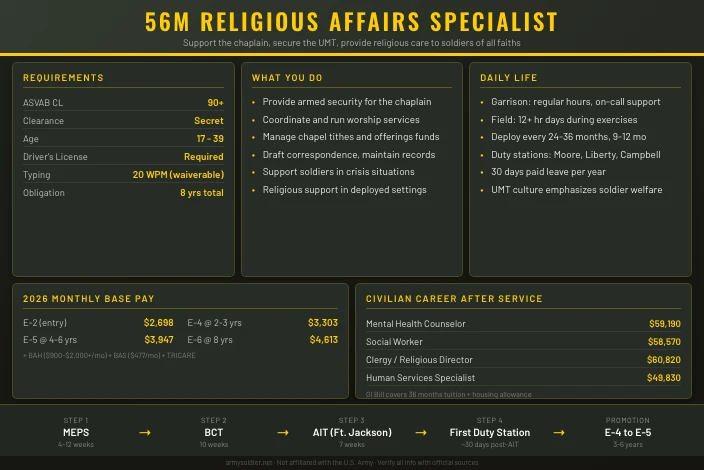
Every chaplain needs a partner who can handle the logistics, security, and administrative work that makes religious support possible. That partner is the 56M Religious Affairs Specialist. You coordinate worship services, manage religious program funds, provide armed security for the chaplain, and make sure soldiers of every faith tradition have access to pastoral care whether they’re at a garrison post or a forward operating base. If you want a military career built around service to others and a meaningful civilian transition into counseling or ministry, this MOS is worth a hard look.
Qualifying requires specific ASVAB line scores — our ASVAB study guide covers what to target and how to prepare.
Job Role and Responsibilities
Religious Affairs Specialists are the operational backbone of the Unit Ministry Team (UMT). You work directly with the chaplain to plan and execute religious support programs, manage administrative functions, safeguard chapel tithes and offerings funds, and provide security for the chaplain in tactical environments. You support soldiers of all faith backgrounds while operating in garrison and deployed settings.
Day-to-day work shifts depending on your assignment. In garrison, you might coordinate a memorial service in the morning, process administrative paperwork for religious education programs in the afternoon, and field a soldier’s request for a clergy visit before the day ends. You track the unit’s spiritual readiness data, manage correspondence for the chaplain, and keep the ministry team’s equipment and vehicles maintained.
In a deployed environment, the stakes go up. You move with the unit, maintain armed security for the chaplain (who cannot bear arms under the Geneva Conventions), set up field services in improvised locations, and respond when soldiers are in crisis. The chaplain leads the spiritual ministry. You make sure everything around that ministry runs.
Specialized Roles
The Army identifies skill levels by a numeric code appended to the MOS:
| MOS Code | Skill Level | Typical Assignment | Primary Duties |
|---|---|---|---|
| 56M10 | Level 1 | E-1 to E-4 | Battalion UMT support, religious program administration |
| 56M20 | Level 2 | E-5 | Senior battalion UMT, supervises Level 1 soldiers |
| 56M30 | Level 3 | E-6 | Brigade-level religious support operations |
| 56M40 | Level 4 | E-7 | Division/Corps/Theater religious operations planning |
| 56M50 | Level 5 | E-8 to E-9 | Strategic-level religious affairs, develops Army-wide policy |
Additional Skill Identifiers and Special Qualification Identifiers can expand your role. Airborne-qualified Religious Affairs Specialists (SQI P) support airborne units. Others earn ASIs tied to specific functional areas within the Chaplain Corps.
How This Role Supports the Mission
Army regulations prohibit chaplains from bearing arms. That creates a specific tactical problem: how does the Army protect clergy in a combat zone? The answer is the Religious Affairs Specialist. You carry a weapon, provide security, and ensure the chaplain can move through the operational environment to reach soldiers who need pastoral care. Beyond the tactical role, you track religious needs across the unit, coordinate with community religious leaders during stability operations, and help commanders understand the religious factors that affect their area of operations.
Technology and Equipment
You use standard Army office software for correspondence, scheduling, and fund management. The Defense Travel System handles travel arrangements. You maintain vehicles assigned to the UMT, operate Army communications equipment in the field, and manage the physical security of chapel funds under Army finance regulations. In deployed environments, you work with the unit’s tactical command systems to coordinate movement and maintain contact with higher headquarters.
Salary and Benefits
Financial Benefits
Pay is based on rank and time in service. Most 56M soldiers enter as E-1 or E-2 and reach E-4 within two to three years.
| Pay Grade | Rank | Typical Time in Service | 2026 Monthly Base Pay |
|---|---|---|---|
| E-2 | Private (PV2) | Entry (post-BCT) | $2,698 |
| E-4 | Specialist (SPC) | 2-3 years | $3,303 |
| E-5 | Sergeant (SGT) | 4-6 years | $3,947 |
| E-6 | Staff Sergeant (SSG) | 8 years | $4,613 |
| E-7 | Sergeant First Class (SFC) | 10-14 years | $5,268 |
Base pay is one part of total compensation. Basic Allowance for Housing (BAH) adds roughly $900 to $2,000 or more per month depending on your duty station and dependent status. Basic Allowance for Subsistence (BAS) adds $477 per month for food. Both allowances are tax-free.
The 56M does not currently carry a standard enlistment bonus. Bonus availability changes frequently, so confirm current offers with your recruiter.
Additional Benefits
TRICARE covers you and your family at no cost while you’re on active duty. That includes medical, dental, vision, mental health services, and prescriptions with no enrollment fees, deductibles, or copays.
Tuition Assistance pays up to $4,500 per year toward college classes while you serve. The Post-9/11 GI Bill covers up to 36 months of tuition at public universities (full in-state rate) or up to $29,921 per year at private schools, plus a monthly housing allowance and $1,000 annual book stipend after you separate.
Work-Life Balance
You earn 30 days of paid leave per year. Religious Affairs Specialists assigned to garrison posts typically follow regular duty hours Monday through Friday. Field exercises and deployments disrupt that schedule, but UMT work is generally less physically demanding than combat arms assignments on a day-to-day basis.
The Blended Retirement System (BRS) provides a pension worth 40% of your average highest 36 months of base pay after 20 years of service. The government also matches up to 5% of your Thrift Savings Plan contributions starting in your third year.
Qualifications and Eligibility
Basic Qualifications
The minimum ASVAB line score for 56M is a Clerical (CL) composite of 90. The CL composite draws from Verbal Expression, Arithmetic Reasoning, and Mathematics Knowledge. Strong reading and writing skills matter most for this MOS because you draft correspondence, manage records, and communicate with soldiers in emotional distress.
| Requirement | Details |
|---|---|
| Age | 17-39 (up to 42 with waiver) |
| Citizenship | U.S. citizen |
| Education | High school diploma or GED |
| AFQT | Minimum 31 (diploma) or 50 (GED) |
| Clerical (CL) | Minimum 90 |
| Security Clearance | Secret required |
| Physical Demands | Moderate |
| PULHES | 222221 |
| Typing/Keyboarding | Credit for 1 year or 2 courses in keyboarding (waiverable at 20 WPM) |
| Driver’s License | Valid state driver’s license required |
| Moral Character | High moral character standard; no disqualifying criminal history |
Application Process
Start with your Army recruiter. They’ll verify your ASVAB scores, check your initial eligibility, and start the process for your Secret clearance investigation. MEPS handles your medical exam, final ASVAB testing if needed, and your initial background screening.
The security investigation is the longest part of the process. Expect two to six months for a Secret clearance, depending on your background. The investigation includes a credit check, criminal history review, and interviews with references.
From your first recruiter visit to your ship date, expect six to sixteen weeks, with background or medical delays pushing that toward the longer end.
Selection Criteria and Competitiveness
The 56M is not an oversubscribed MOS. The Chaplain Corps is a relatively small career field, and the Army needs Religious Affairs Specialists at units across all components. A CL score of 90 is moderate, so recruits with strong verbal and administrative skills are competitive. Experience in ministry, counseling, social work, or community service makes a strong impression during the process.
Upon Accession into Service
Most recruits enter at E-1 and promote to E-2 after completing Basic Combat Training. College credits or JROTC participation can raise your starting rank to E-2 or E-3. The standard service obligation is 8 years total, split between your active contract and Reserve or Individual Ready Reserve time.
See our ASVAB study guide for strategies to hit these line scores, or take the PiCAT from home if you are a first-time tester.
Work Environment
Setting and Schedule
In garrison, a UMT office operates much like a small administrative and pastoral care center. You manage schedules, handle correspondence, coordinate with other installation services, and support the chaplain’s counseling and worship programs. Standard duty hours apply, but pastoral crises don’t follow a schedule, and you may respond outside normal hours.
Deployed environments are different. You move with the unit, set up field services wherever the mission takes you, and maintain a heightened security posture. Days run long and unpredictably, and your role expands to include force protection duties.
Leadership and Communication
Your chain of command runs through the Chaplain Corps structure:
| Role | Typical Rank | Function |
|---|---|---|
| Unit Chaplain | O-3 (CPT) or O-4 (MAJ) | Your direct functional leader; leads spiritual ministry |
| UMT NCOIC | E-7 or E-8 | Technical oversight and professional development |
| Brigade Chaplain | O-4 (MAJ) | Supervises all UMTs in the brigade |
| Division Chaplain | O-5 (LTC) or O-6 (COL) | Sets religious support policy for the division |
Communication is constant in this job. You brief commanders on religious needs assessments, coordinate with other installation offices, and interact with soldiers who may be in emotional or spiritual distress. Patience, discretion, and clear writing are as important as tactical skills.
Team Dynamics and Autonomy
At the E-1 through E-4 level, you work under close supervision. The chaplain leads and you support. As you advance and move to brigade or division-level assignments, you take on more independent responsibility: managing junior soldiers, coordinating complex multi-faith programs, and developing religious support plans that integrate with the unit’s operational planning.
Deployed UMTs sometimes operate as a two-person team in a remote location with limited oversight from higher headquarters. That degree of autonomy requires judgment, professionalism, and strong communication with your chain of command.
Job Satisfaction and Retention
Religious Affairs Specialists who stay in the field past their first enlistment tend to value the direct impact on soldier welfare. You work with people during the hardest moments of their lives. That’s meaningful work, and many soldiers cite it as the primary reason they re-enlist.
The challenges are real too. High operational tempo, frequent deployments, and the emotional weight of pastoral support work affect retention over time. The Army provides behavioral health resources for UMT members, and using them is encouraged given the nature of the role.
Training and Skill Development
Initial Training
Training breaks into two phases: Basic Combat Training and Advanced Individual Training.
| Training Phase | Location | Duration | Focus |
|---|---|---|---|
| BCT | Fort Jackson, SC; Fort Moore, GA; Fort Leonard Wood, MO | 10 weeks | Soldier fundamentals: marksmanship, tactics, fitness, discipline |
| AIT (56M) | Chaplain School, Fort Jackson, SC | 7 weeks | Religious support operations, UMT administration, multi-faith ministry, fund management, tactical operations |
BCT turns you into a soldier before AIT turns you into a Religious Affairs Specialist. The 7-week AIT at the U.S. Army Institute for Religious Leadership at Fort Jackson covers religious support doctrine, Army chaplain roles and restrictions, English grammar and Army correspondence standards, preparing and managing chapel tithes and offerings funds, and the interaction skills needed to support soldiers across a pluralistic, multi-faith environment. The course runs approximately 16 times per year.
After AIT graduation, you report to your first duty station within about 30 days.
Advanced Training
On-the-job experience in your first unit fills gaps that the classroom can’t. Real pastoral crises, actual fund management, and live security responsibilities in a deployed environment develop skills that AIT only introduces.
As you promote, the Army sends you through the standard NCO Education System: Warrior Leader Course (WLC) at E-5, Advanced Leader Course (ALC) at E-6, and Senior Leader Course (SLC) at E-7. The Chaplain Corps supplements these with MOS-specific professional development through the Religious Leadership career management field.
The Army COOL program supports credentials that align with 56M skills, including the Human Services Board Certified Practitioner (HS-BCP). This credential recognizes your experience supporting human welfare and translates directly to civilian human services and counseling fields.
Everything starts with qualifying ASVAB scores — our study guide covers what to study first.
Career Progression and Advancement
Career Path
Promotion through E-4 is mostly automatic if you meet standards. From E-5 forward, it gets competitive.
| Rank | Pay Grade | Typical Time in Service | Role |
|---|---|---|---|
| Private (PV2) | E-2 | 0-1 years | Entry-level UMT support |
| Private First Class (PFC) | E-3 | 1-2 years | UMT assistant, increasing responsibilities |
| Specialist (SPC) | E-4 | 2-3 years | Experienced UMT soldier, independent tasks |
| Sergeant (SGT) | E-5 | 4-6 years | Senior UMT NCO at battalion level |
| Staff Sergeant (SSG) | E-6 | 6-10 years | Brigade-level religious support NCOIC |
| Sergeant First Class (SFC) | E-7 | 10-14 years | Division or Corps UMT senior NCO |
| Master Sergeant (MSG) | E-8 | 14-18 years | Theater-level religious affairs leader |
| Sergeant Major (SGM) | E-9 | 18+ years | Strategic-level policy and operations |
The most significant career jump is from E-4 to E-5, which requires passing a promotion board and accumulating promotion points through military education, awards, and fitness scores. Strong NCO Evaluation Reports (NCOERs) drive advancement from E-6 onward.
Role Flexibility and Transfers
The 56M is a single-MOS career field with no sub-specialties within the enlisted ranks. Soldiers who want to expand their scope can pursue warrant officer or officer paths in the Chaplain Corps, though the chaplain officer track requires a graduate theology degree and ecclesiastical endorsement.
Reclassification to another MOS is possible. Administrative and human services MOSs like 42A (Human Resources Specialist) or 25U (Signal Support Specialist) draw on skills developed in the 56M role. Any change requires new AIT and a fresh service obligation.
Performance Evaluation
Enlisted soldiers at E-5 and above receive an annual NCOER. Your rater and senior rater assess leadership, competence, and overall performance. For Religious Affairs Specialists, performance indicators include the quality of religious support programs you manage, your accuracy with fund accountability, your professional development of junior soldiers, and your contribution during deployments or significant training events.
Top performers earn early promotion consideration by seeking out additional duties, completing college coursework, and volunteering for challenging assignments.
Physical Demands and Medical Evaluations
Physical Requirements
The 56M carries a Moderate physical demands rating with a PULHES profile of 222221. You won’t haul the same loads as a combat engineer or infantryman every day, but you still operate in field environments, wear body armor, carry a weapon, and maintain the fitness to support the chaplain in any operational setting.
All soldiers take the Army Fitness Test (AFT) at least once per year. The AFT has five events, each scored from 0 to 100 points. You need 60 points per event and 300 total to pass the general standard.
| Event | Description | Minimum Passing Score (General Standard) |
|---|---|---|
| 3-Rep Max Deadlift (MDL) | Maximum weight for 3 repetitions | 60 points (sex- and age-normed) |
| Hand-Release Push-Up (HRP) | Full arm extension at bottom of each rep | 60 points (sex- and age-normed) |
| Sprint-Drag-Carry (SDC) | Five 50-meter shuttles with varied loads | 60 points (sex- and age-normed) |
| Plank (PLK) | Front leaning rest, elbows on ground | 60 points (sex- and age-normed) |
| Two-Mile Run (2MR) | Timed two-mile run | 60 points (sex- and age-normed) |
The maximum total score is 500. Scoring above the minimum helps with promotion points at competitive grades.
Medical Evaluations
You complete an annual Periodic Health Assessment covering weight, blood pressure, vision, hearing, and general health screening. Pre-deployment medical clearance is more thorough. The Secret clearance requires periodic reinvestigation, which includes a review of any mental health treatment or substance history.
Religious Affairs Specialists should be aware that secondary trauma from sustained exposure to soldier crisis is an occupational reality. The Army provides mental health resources, and seeking them out when needed is both encouraged and appropriate.
Deployment and Duty Stations
Deployment Details
Religious Affairs Specialists deploy with their assigned units. The general rotation for active-duty units is 9 to 12 months deployed followed by 24 to 36 months at home station. That tempo varies based on the Army’s operational requirements and your unit’s readiness cycle.
Deployed UMTs provide religious support in austere conditions. You might conduct a memorial ceremony in the morning, provide crisis support to a soldier in the afternoon, and conduct a security patrol with the chaplain in the evening. Domestic mobilizations for national emergencies or disaster response also occur.
Location Flexibility
Religious Affairs Specialists serve at nearly every installation where Army units are stationed. Every battalion-level unit has a UMT position, which means you can find 56M billets across a wide range of duty stations.
Common CONUS duty stations:
- Fort Moore, GA
- Fort Liberty, NC
- Fort Campbell, KY
- Fort Cavazos, TX
- Fort Carson, CO
- Fort Drum, NY
- Fort Stewart, GA
- Joint Base Lewis-McChord, WA
- Fort Wainwright, AK
OCONUS assignments:
- Germany (Grafenwoehr, Wiesbaden, Stuttgart)
- South Korea (Camp Humphreys)
- Hawaii (Schofield Barracks)
- Kuwait and other Middle East locations
You can submit a preference list during the assignment process, but the Army fills its needs first. Larger posts have more UMT billets and generally offer longer tour lengths.
Risk, Safety, and Legal Considerations
Job Hazards
The primary occupational risk for this MOS comes from the deployed environment. You operate in combat zones providing security for the chaplain, which means exposure to the same hazards as other forward-deployed soldiers: indirect fire, vehicle-borne threats, and the physical toll of austere living conditions.
Secondary trauma from sustained pastoral support work is a real but underrecognized hazard. Regular exposure to grief, loss, and soldier crisis takes a cumulative psychological toll that varies by individual.
In garrison, risks are minimal. Standard Army safety protocols cover physical training injuries and vehicle accidents.
Safety Protocols
Force protection procedures govern UMT movement in deployed environments. The chaplain cannot be armed, so your job is to maintain situational awareness and security discipline at all times when moving outside the wire. Chapel tithes and offerings funds require strict dual-control financial procedures, secured storage, and audit trails.
The Army provides mental health support resources, and Religious Affairs Specialists are encouraged to use them given the nature of the work.
Security and Legal Requirements
A Secret security clearance is required. The clearance process is covered in the Qualifications section above. The investigation components include:
- Criminal history review
- Credit and financial records check
- Foreign contacts disclosure
- Personal interviews with references
- Periodic reinvestigation every 10 years
Any deception during the investigation is an immediate disqualifier.
All soldiers are subject to the Uniform Code of Military Justice (UCMJ). Religious Affairs Specialists also bear responsibility for the proper handling of chapel funds. Mismanagement, even through carelessness rather than intent, can result in financial liability and adverse action.
The chaplain’s communications with soldiers are protected by privileged communication doctrine. You work in close proximity to those conversations but have no authority to disclose what you observe or overhear.
Impact on Family and Personal Life
Family Considerations
The 56M is not a combat arms MOS, but it’s not a garrison-only job either. Deployments happen. Nine to 12 months away from family is hard regardless of what you do when you’re there.
The Army provides a range of family support resources:
- Family Readiness Groups (FRGs) for peer support during deployments
- Military OneSource for free counseling and family services
- Army Community Service (ACS) for financial counseling, employment assistance, and relocation support
- Exceptional Family Member Program (EFMP) for families with special needs members
The nature of the UMT mission means your unit cares about family resilience. Chaplain Corps culture tends to emphasize welfare support, which extends to UMT families. Your chaplain is often the person other soldiers go to for marriage counseling, which means your own family has ready access to pastoral care most soldiers have to request through channels.
Relocation and Flexibility
Expect to move every two to four years. PCS moves are Army-funded, but each relocation affects your spouse’s career and your children’s schooling. The broad distribution of UMT billets across installations gives you more duty station options than many specialized MOSs, which helps with managing family preferences during the assignment process.
BAH at common duty stations ranges from roughly $1,200 to $2,400 per month depending on rank, location, and dependent status. Posts in higher cost-of-living areas pay more, but local expenses offset the increase. Spouses with portable careers or remote-work options handle the frequent moves better than those in location-dependent fields.
The Army’s School Liaison Officer program at each installation helps children transition between school systems during PCS moves. Childcare is available through on-post CDC (Child Development Centers), though waitlists at high-demand installations can run several months.
Reserve and National Guard
The 56M Religious Affairs Specialist is available in both the Army Reserve and Army National Guard. Every chaplain in the Reserve components needs a 56M assistant, so positions exist in unit ministry teams (UMTs) across most states and Reserve units. Billets are spread widely but thinly, with typically one 56M per battalion-level unit.
Drill Schedule and Training Commitment
Standard commitment is one weekend per month (Battle Assembly) plus two weeks of Annual Training per year. Drill weekends for 56M soldiers include coordinating religious services, managing religious supply inventories, supporting chaplain counseling schedules, and conducting unit ministry team training. Annual Training typically involves providing religious support during a field exercise. The training commitment is standard, though you may attend additional courses for suicide prevention, resilience training, and pastoral care support certifications.
Part-Time Pay
An E-4 with over 3 years of service earns about $464 per drill weekend (4 drill periods), totaling roughly $5,572 per year from drill pay plus about $1,741 for 15 days of Annual Training. Active-duty E-4 base pay is $3,482 per month.
Benefits Differences
Tricare Reserve Select costs $57.88 per month for member-only or $286.66 per month for family coverage in 2026. Active-duty TRICARE Prime is free.
Education benefits include Federal Tuition Assistance ($250 per credit hour, up to $4,500 per year) and the Montgomery GI Bill-Selected Reserve at $493 per month for full-time students. Guard members may qualify for state tuition waivers. Mobilization of 90 or more days earns Post-9/11 GI Bill eligibility.
Reserve retirement is points-based, requiring 20 qualifying years. Collection starts at age 60, reduced by 3 months per 90-day mobilization after January 2008, minimum age 50.
Deployment and Mobilization
56M soldiers in Reserve/Guard units see moderate mobilization rates. Unit ministry teams deploy with their assigned units, so a 56M goes wherever the battalion goes. Typical mobilizations run 9 to 12 months. National Guard 56M soldiers may also support state emergency activations, providing religious support and counseling to soldiers working disaster response or civil support missions.
Civilian Career Integration
The 56M pairs with civilian careers in ministry support, pastoral counseling, church administration, nonprofit management, and social work. Administrative and counseling skills transfer to religious organizations, hospitals, and community service agencies. Some states accept military training hours toward counseling certifications. USERRA protects your civilian job during activations, and employers must reinstate you with the seniority you would have earned.
| Feature | Active Duty | Army Reserve | Army National Guard |
|---|---|---|---|
| Commitment | Full-time | 1 weekend/month + 2 weeks/year | 1 weekend/month + 2 weeks/year |
| Monthly Pay (E-4, 3+ yrs) | $3,482 | ~$464/drill weekend | ~$464/drill weekend |
| Healthcare | TRICARE Prime ($0) | Tricare Reserve Select ($57.88/mo) | Tricare Reserve Select ($57.88/mo) |
| Education | Federal TA, Post-9/11 GI Bill | Federal TA, MGIB-SR ($493/mo) | Federal TA, MGIB-SR, state tuition waivers |
| Deployment Tempo | Deploys with assigned unit | Moderate (deploys with unit) | Moderate (deploys with unit + state missions) |
| Retirement | 20-year pension at age 40+ | Points-based, collect at age 60 | Points-based, collect at age 60 |
Post-Service Opportunities
Transition to Civilian Life
The skills you build as a Religious Affairs Specialist translate well to civilian human services, counseling, ministry, and administrative careers. You leave with hands-on experience in crisis support, multi-faith program administration, community outreach, fund management, and working with people under extreme stress.
The Transition Assistance Program (TAP) provides resume help, interview coaching, and benefits counseling during your last year on active duty. The Army COOL credential pathway, including the Human Services Board Certified Practitioner, gives you a recognized civilian credential to present to employers. The Post-9/11 GI Bill covers college or graduate school tuition, which opens the door to licensed counseling, social work, or ministry careers.
Civilian Career Prospects
| Civilian Job | Median Annual Salary (2024) | 10-Year Outlook |
|---|---|---|
| Mental Health Counselor / Substance Abuse Counselor | $59,190 | +17% (much faster than average) |
| Child, Family, and School Social Worker | $58,570 | +3.4% |
| Clergy / Religious Program Director | $60,820 | +1% |
| Human Services Specialist | $49,830 | +12.6% |
The counseling field shows the strongest growth, driven by expanded mental health awareness and demand for behavioral health services. Many states offer military service credit toward licensure hours, which shortens the path to becoming a Licensed Professional Counselor (LPC) or Licensed Clinical Social Worker (LCSW).
Federal agencies, VA medical centers, military family support organizations, and faith-based nonprofits all actively recruit veterans with chaplain corps backgrounds.
Post-Service Policies
An honorable discharge gives you access to VA healthcare, disability compensation if applicable, education benefits, and home loan guarantees. If you have a clearance at the Secret level, that clearance can remain active for years after separation and is an asset to federal government and defense contractor employers.
Is This a Good Job for You?
Ideal Candidate Profile
This MOS rewards a specific combination of traits. You need to be comfortable with people in emotional distress, precise enough to manage financial records and official correspondence, and physically capable enough to serve in a combat environment.
Traits that predict success:
- Genuine interest in supporting others across different faith traditions
- Patient and discreet with confidential information
- Organized enough to manage multiple administrative programs simultaneously
- Comfortable with weapons and tactical environments without a desire to be in a front-line combat role
- Strong written and verbal communication skills
Prior experience in ministry, counseling, volunteer work, or community service is helpful but not required. The Army builds the specific skills from scratch in AIT.
Potential Challenges
This MOS may not fit you if:
- You want a primarily technical or physically demanding job
- You’re uncomfortable with sustained exposure to grief and personal crisis
- You have background issues that complicate a Secret clearance investigation
- You expect a predictable desk job without deployment considerations
The emotional demands are real and chronic. Religious Affairs Specialists see soldiers at their lowest points repeatedly over a career. Some people thrive in that environment. Others burn out. Honest self-assessment matters here more than in most MOSs.
Who Should Consider the 56M
The 56M makes sense for people who want to serve in a role centered on human welfare, build counseling and ministry skills, and pursue a career in human services after separation. The GI Bill and Army COOL credentials make the path to licensed counseling achievable without incurring student debt.
If you want combat action, this is not your MOS. If you want to make a difference in soldiers’ lives every day and build a civilian career doing the same, the 56M is a strong fit.
More Information
Talk to an Army recruiter about the 56M Religious Affairs Specialist. Ask specifically about Secret clearance processing timelines, current training class dates at Fort Jackson, and any available duty station options at your preferred installations. If you have prior experience in ministry or human services, mention it. It can affect how you’re assessed and where you end up assigned.
- Prepare for the ASVAB with our study guide to make sure your line scores qualify
This site is not affiliated with the U.S. Army or any government agency. Verify all information with official Army sources before making enlistment or career decisions.
Explore more Army Chaplain Corps careers.